From the free course AP Music Theory on Lykke
3.5 Seventh-chord inversions and figures
Key concepts: Seventh-chord inversions · Figured-bass notation for seventh chords · Dominant seventh arpeggios in all inversions · Identifying seventh-chord inversions from the bass note · Roman-numeral analysis of seventh chords · Third-related dissonance in seventh chords · Melodic dictation with tonic and dominant triad arpeggios · Compound meter in melodic dictation
A seventh chord can keep exactly the same four pitches while its bass changes, so the ear may hear a new bass line without hearing a new harmony.
3.5 Seventh-chord inversions and figures
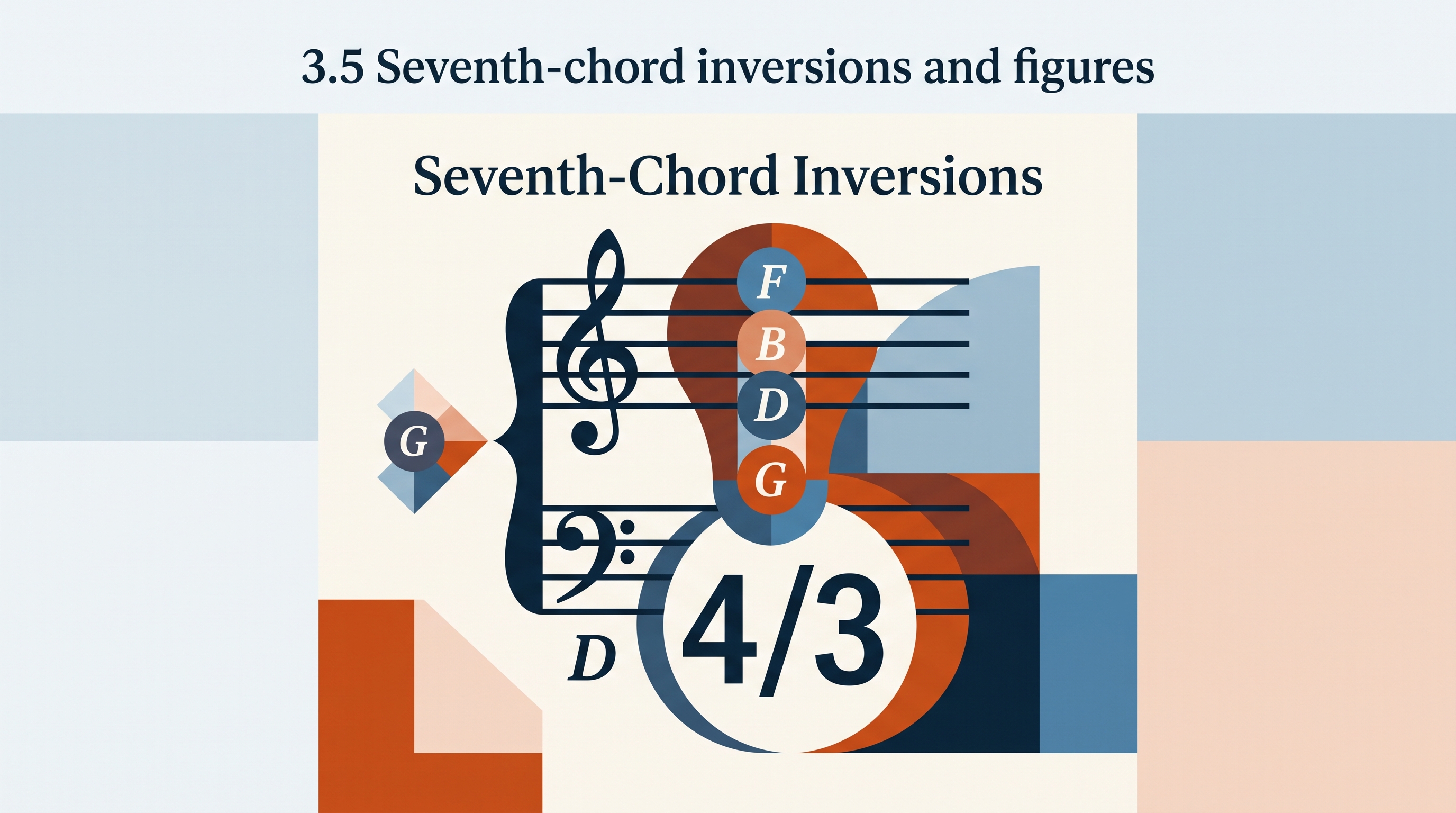
A seventh chord can keep exactly the same four pitches while its bass changes, so the ear may hear a new bass line without hearing a new harmony. Seventh-chord inversion identifies which chord member is in the bass; figured bass records the intervals above that bass note.
PIT-2.D.1: Seventh chords have the potential for a third inversion in which the chordal seventh appears in the bass.
The inversion map
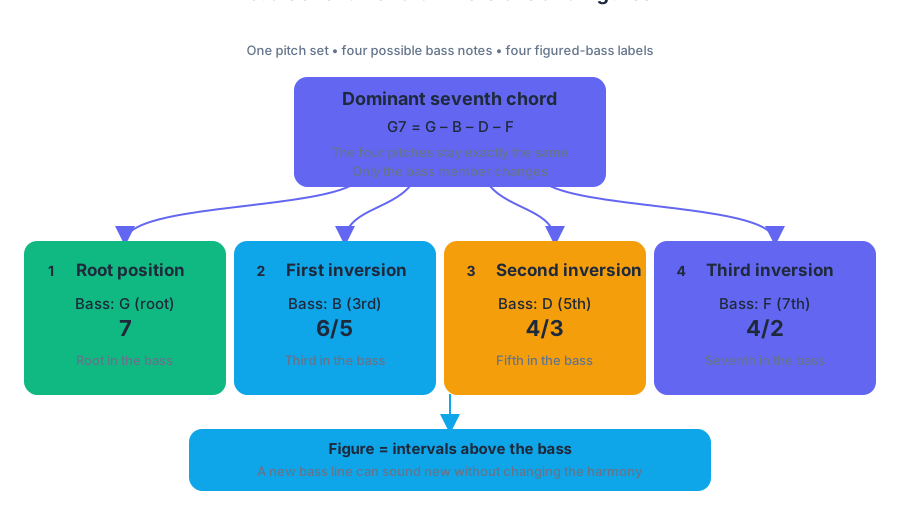
For a seventh chord, the figure names the intervals above the bass. The Roman numeral identifies the chord’s root and scale-degree function; the Arabic figures identify its inversion.
| Bass position | Chord member in bass | Standard figure | Example using $G^7 = G$–$B$–$D$–$F$ |
|---|---|---|---|
| Root position | Root | $7$ or omitted in some contexts | Bass $G$: $V^7$ |
| First inversion | Third | $6/5$ | Bass $B$: $V^{6/5}$ |
| Second inversion | Fifth | $4/3$ | Bass $D$: $V^{4/3}$ |
| Third inversion | Seventh | $4/2$ or $2$ | Bass $F$: $V^{4/2}$ |
Read the bass before reading the figure
The fastest reliable procedure is: identify the bass pitch, read the figure, build the chord above that bass, then determine the chord root and Roman numeral. Do not assume that the lowest note is the root.
Suppose the bass note is $F$ with the figure $4/2$ in the key of $C$ major. The intervals above $F$ must be a fourth, sixth, and second: $B$, $D$, and $G$. The complete sonority is $F$–$G$–$B$–$D$, which rearranges to $G$–$B$–$D$–$F$. Therefore the analysis is $V^{4/2}$: a dominant seventh chord in third inversion.
A bass note with figure $6$ is different. In the ordinary diatonic context, $6$ indicates a first-inversion triad, not a seventh chord. Thus, in a minor key, a bass $B\flat$ with figure $6$ can represent $i^6$: the tonic triad with its third in the bass. The missing $3$ is conventionally understood in a simple triadic figure.
Why $6/5$ means first inversion
For a seventh chord in first inversion, the bass is the chordal third. From that bass, the remaining chord members normally form the intervals $3$, $5$, and $6$, producing the compact figure $6/5$.
For example, if the chord is $A$–$C$–$E\flat$–$G$, then $A$ is the root. With $A$ in the bass, the chord is root position and should be represented by $7$. To create first inversion, place $C$ in the bass: $C$–$E\flat$–$G$–$A$. The resulting analysis is $A^{6/5}$, because $C$ is the third of the A seventh chord.
Misconception check: A figure $6/5$ does not mean “the bass note is the root.” It means the bass is the third of a seventh chord.
A complete Roman-numeral example
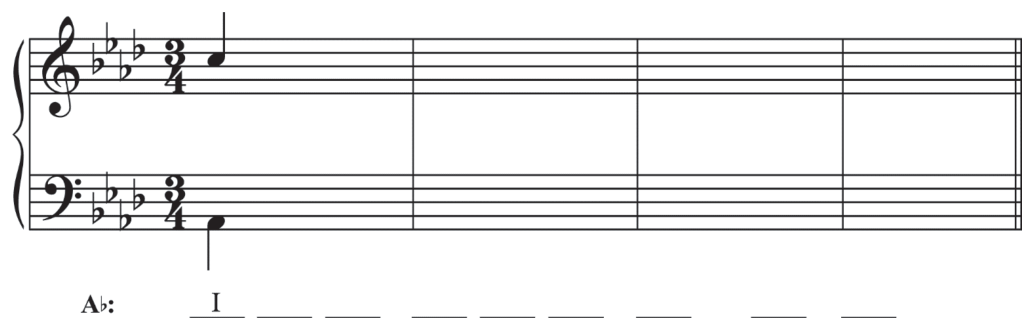
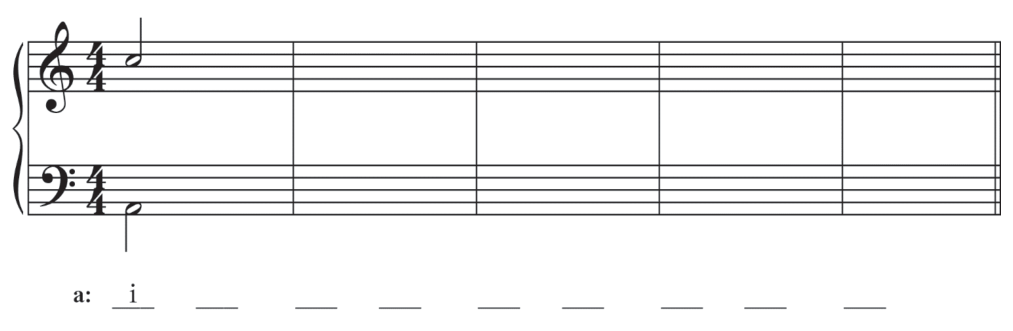
Consider this progression in $A$ minor:
$$I - I^6 - ii^7 - ii^{6/5} - V^7 - V^{4/2} - i$$
The first two sonorities may contain related tonic pitches but differ in bass placement. Likewise, $ii^7$ and $ii^{6/5}$ can contain the same four chord members while the bass changes from the root to the third. In harmonic dictation, listen for whether the harmony changes or whether only its inversion changes.
A useful listening question is: “Can I rearrange the notes of the second sonority into the same chord as the first?” If yes, the chord may be unchanged in a new inversion. If the pitch collection or function changes, the Roman numeral changes as well.
Sing the dominant seventh in every inversion
In $C$ major, the dominant seventh is $G$–$B$–$D$–$F$. Practice its arpeggio by rote in four bass arrangements:
$$G-B-D-F \quad (V^7)$$
$$B-D-F-G \quad (V^{6/5})$$
$$D-F-G-B \quad (V^{4/3})$$
$$F-G-B-D \quad (V^{4/2})$$
Singing these patterns makes inversion an audible event rather than a memorized symbol. It also supports melodic dictation: melodies may outline tonic and dominant triads, while compound meter changes how those arpeggiated pitches are grouped rhythmically.
Third-related dissonance
A seventh chord can contain a third-related dissonance: two chord members separated by a third may sound unstable when heard within the complete seventh-chord sonority. The added seventh changes the chord’s color and often creates a need for resolution, especially in dominant-function harmony.
This is why a seventh chord should not be treated as “just a triad with one extra note.” Its inversion changes the bass support, its figure changes, and its dissonant tendency may become more or less prominent depending on register and context.
Retrieval check
A bass note $D$ with figure $4/3$ appears in a $G$-dominant seventh chord. Name the inversion and the Roman numeral. Then answer: if the next sonority contains the same four pitches but puts $B$ in the bass, has the chord necessarily changed?
Answer: $D$ is the fifth of $G$–$B$–$D$–$F$, so the chord is $V^{4/3}$, a second-inversion dominant seventh. Moving the bass to $B$ produces $V^{6/5}$; the inversion changes, but the chord may remain the same.
Source Materials
- Learn More (.pdf)
- AP Music Theory Course and Exam Description
- AP Music Theory Course Overview
- AP Music Theory Course at a Glance
- AP Music Theory Course at a Glance Poster
- Adopt AP Music Theory
- AP Music Theory
- AP Music Theory
- The progression for Question 3 will now be played a third time.
- The progression for Question 4 will now be played a third time.