From the free course AP Music Theory on Lykke
7.2 Part writing of secondary dominant chords
Key concepts: Tonicization · Secondary dominant chords · Secondary leading-tone chords · Part writing · Voice leading · Accidentals and chromatic pitches · Harmonic function and key relationships · Chord inversions and seventh chords · Normative harmonic procedures of 18th-century music · Analysis and composition of secondary-function chords
Apply the dominant-chord voice-leading rules from 7.1 to secondary dominants: preserve normal doubling, spacing, and resolution practices while accounting for their chromatic pitches. The challenge is not to invent a new set of rules, but to hear the temporary target, spell the applied chord correctly, and connect…
7.2 Part Writing of Secondary Dominant Chords
Apply the dominant-chord voice-leading rules from 7.1 to secondary dominants: preserve normal doubling, spacing, and resolution practices while accounting for their chromatic pitches. The challenge is not to invent a new set of rules, but to hear the temporary target, spell the applied chord correctly, and connect each voice smoothly.
PIT-2.E: Compose a bass line added to a given soprano line, following the normative harmonic procedures of 18th-century music.
The part-writing principle
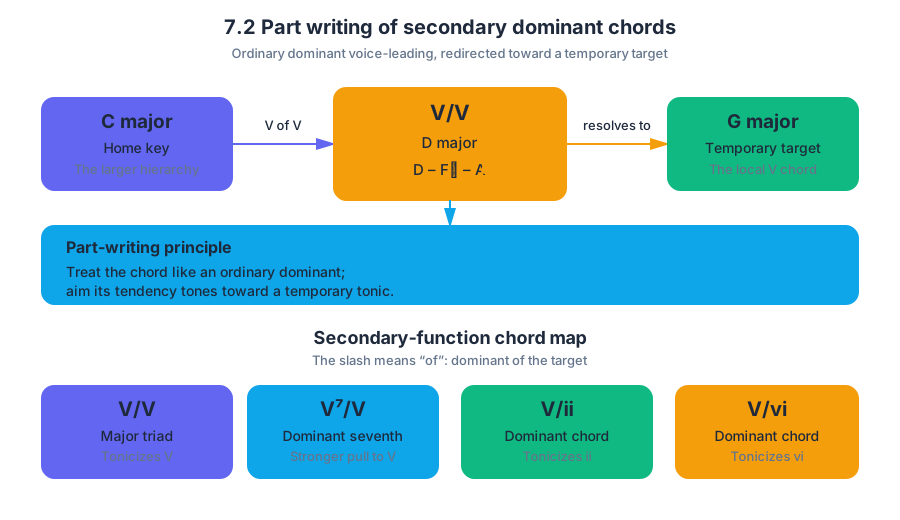
A secondary dominant uses the voice-leading behavior of an ordinary dominant chord—but toward a temporary target. In the key of C major, $V/V$ is the dominant of $V$: the chord $D$ major, spelled $D-F\sharp-A$, moves toward $G$ major. The $F\sharp$ is chromatic in C major, but it functions as the leading tone of the temporary key of G.
Secondary-function chords may be triads or seventh chords, and they may appear in root position or inversion. Their Roman-numeral labels identify both the chord quality and its target:
- $V/V$: a major dominant triad tonicizing $V$.
- $V^7/V$: a dominant seventh chord tonicizing $V$.
- $V/ii$: a dominant chord tonicizing $ii$.
- $V/vi$: a dominant chord tonicizing $vi$.
The slash means “of,” not division: $V/V$ means “the dominant of the dominant.”
Worked example: writing $V^7/V$ in four parts
Suppose a passage in C major moves from $V/V$ to $V$. The secondary dominant is $D^7$, whose pitches are $D-F\sharp-A-C$. A workable four-part voicing is:
| Voice | $V^7/V$ | Resolution to $V$ | Function |
|---|---|---|---|
| Bass | $D$ | $G$ | Root of applied chord moves to target root |
| Tenor | $A$ | $B$ | Chord tone moves by step |
| Alto | $C$ | $B$ | Chordal seventh resolves downward |
| Soprano | $F\sharp$ | $G$ | Temporary leading tone resolves upward |
The crucial resolutions are $F\sharp \rightarrow G$ and $C \rightarrow B$. The first is the leading tone of the temporary target, while the second is the chordal seventh of $D^7$ and therefore follows the normal dominant-seventh rule: it resolves downward by step. The resulting $G$-major chord contains the target harmony, not a new permanent key.
PIT-2.E.2: When part-writing secondary dominants, all doubling and voice-leading considerations of normal dominant chords should be maintained, including the downward resolution of chordal sevenths.
Doubling, spacing, and inversion
For a secondary-dominant triad, treat the chord as you would a normal dominant triad. In most situations, double the root rather than the temporary leading tone. Avoid doubling a chromatic leading-tone pitch because that pitch has a strong tendency toward the temporary tonic and can create parallel or awkward resolutions.
For a secondary dominant seventh chord, include all four chord members when possible. Keep the voices within conventional SATB ranges, avoid voice crossing, and resolve the chordal seventh downward by step. In an inversion, identify the chord members—not merely the bass note—before deciding which pitch is the seventh or temporary leading tone.
Misconception check: “Because $V/V$ is chromatic, it follows different voice-leading rules.”
Correction: Its spelling changes because of the chromatic pitch, but its dominant behavior does not. Apply the same doubling, spacing, tendency-tone, and seventh-resolution principles used for $V$.
Reading chromatic clues in a melody
When a soprano melody is given and a bass line must be composed, a chromatic pitch can imply an applied harmony. In C major, the pattern $F\sharp \rightarrow G$ is especially informative: raised scale degree $\sharp\hat{4}$ resolves to $\hat{5}$, suggesting that $G$—the dominant of C—is being briefly tonicized by $V/V$.
The reasoning chain is:
$$ \sharp\hat{4}=F\sharp \longrightarrow \hat{5}=G $$
$$ F\sharp \text{ is the leading tone of } G \Longrightarrow D-F\sharp-A \text{ or } D-F\sharp-A-C \Longrightarrow V/V \text{ or } V^7/V $$
This is not automatic: a chromatic note may have another melodic or harmonic explanation. Confirm the interpretation by checking the surrounding bass, the following chord, and whether the chromatic pitch behaves like a tendency tone.
Boundary: secondary leading-tone chords
The related secondary leading-tone chord, such as $vii^\circ/V$, also tonicizes a temporary target but is diminished rather than dominant. For example, in C major, $vii^\circ/V$ is $F\sharp-A-C$, whose root is the leading tone of G. Its specific part-writing treatment follows separately; here, the essential distinction is functional: $V/V$ is a dominant-quality chord, while $vii^\circ/V$ is a diminished leading-tone chord.
AP skill connection and retrieval check
Skill 4.A: “Apply knowledge of common-practice tonality to spell chords and to follow procedures of 18th-century voice leading to connect chords in harmonic progressions.” This appears when you spell $V^7/V$, resolve $F\sharp$ to $G$, and send the chordal seventh $C$ downward.
Skill 4.D: “Compose a bass line to harmonize a given melody, implying appropriate harmony, and identify the implied harmony using Roman and Arabic numerals.” This appears when a melodic $\sharp\hat{4}$–$\hat{5}$ pattern leads you to test $V/V$ as the supporting harmony.
Retrieval check: In E-flat major, a soprano line contains $D\flat \rightarrow E\flat$ while the harmony moves toward $A\flat$. Which secondary dominant is suggested? Spell the chord and name the two tendency tones in its seventh-chord form.
Answer: The suggested chord is $V/V$, because $A\flat$ is $V$ in E-flat major. Its dominant is $E\flat$ major, so $V/V$ is $E\flat-G-B\flat$; the seventh-chord form is $E\flat-G-B\flat-D\flat$. The $D\flat$ resolves downward to $C$, while $G$ resolves upward to $A\flat$.