From the free course AP Music Theory on Lykke
4.5 Voice leading with seventh chords
Key concepts: Voice leading as the coordinated motion and interaction of individual voices · 18th-century Western European voice-leading practices · Linear smoothness in voice leading · Independence of individual voices · Four types of voice motion: parallel, oblique, similar, and contrary · Voice leading in four voices · Voice leading with seventh chords · Seventh-chord inversions and figured-bass figures · Leading-tone resolution in voice leading · Avoidance of repeated perfect octaves or perfect unisons
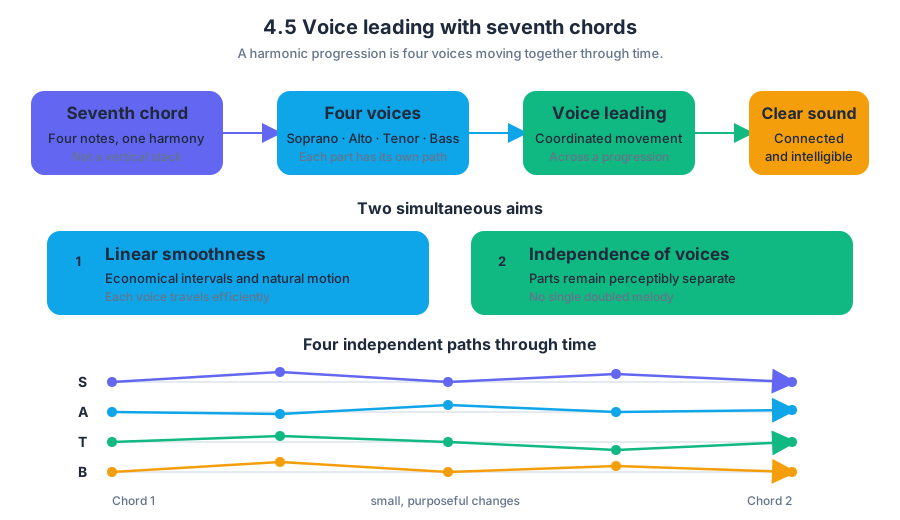
A seventh chord is not four unrelated notes stacked vertically: it is four individual voices moving through time. Voice leading is the coordinated movement of those voices as a harmonic progression advances, and good voice leading makes the progression sound both connected and intelligible.
4.5 Voice leading with seventh chords
A seventh chord is not four unrelated notes stacked vertically: it is four individual voices moving through time. Voice leading is the coordinated movement of those voices as a harmonic progression advances, and good voice leading makes the progression sound both connected and intelligible.
In the 18th-century Western European common-practice tradition, a four-voice texture aims for two simultaneous qualities: linear smoothness, meaning each part moves naturally with economical intervals, and independence of voices, meaning each part remains perceptibly separate rather than collapsing into one doubled melody.
The four types of voice motion
Compare the two voices in one chord with the same two voices in the next chord. Their relationship is classified by direction and interval size:
| Motion | What the two voices do | Example |
|---|---|---|
| Parallel motion | Move in the same direction by the same melodic interval | soprano rises by a step; alto rises by a step |
| Similar motion | Move in the same direction by different melodic intervals | soprano rises by a third; alto rises by a step |
| Oblique motion | One voice stays fixed while the other moves | soprano remains; alto descends |
| Contrary motion | Move in opposite directions | soprano rises while alto descends |
These categories describe motion, not whether the voices sound smooth. Parallel motion can be useful, especially when it preserves a common pattern, but it becomes dangerous when it produces forbidden perfect-interval repetitions or weakens independence.
Perfect intervals: state the restriction precisely
The central prohibition is parallel perfect unisons and parallel perfect octaves. If the same two voices begin with a unison or octave and both move in the same direction by the same interval, they must not arrive at another unison or octave.
For example, if the tenor and soprano move from $C$–$G$ to $D$–$A$, the voices move upward together by whole step and preserve a perfect fifth; that is not the specific repeated-unison-or-octave error. But if they move from $C$–$C$ to $D$–$D$, or from $C$–$C'$ to $D$–$D'$, they have created parallel perfect unisons or octaves and have lost vocal independence.
The same restriction must be checked across successive chord changes even when an intervening chord appears elsewhere in the progression. Conversely, contrary motion and oblique motion are not parallel motion: a perfect interval reached through either of those motions is not automatically the prohibited pattern. A separate related warning applies when the outer voices move by similar motion into a perfect fifth or octave: normally, the upper voice should move by step. These are often called direct or hidden fifths and octaves.
Key distinction: “A perfect interval occurs” is not enough to diagnose an error. Ask whether the same two voices moved in parallel into a repeated perfect unison or octave.
Realizing a seventh-chord progression
A reliable realization begins vertically and ends horizontally. First spell every chord correctly; then assign its four chord tones to soprano, alto, tenor, and bass; finally inspect how each individual part moves.
Worked example: $V^7$ resolving to $I$ in C major
Suppose the dominant seventh chord is $G$–$B$–$D$–$F$, followed by $C$–$E$–$G$.
- Place the bass: let the bass move from $G$ to $C$.
- Resolve the leading tone: $B$, scale degree $\hat{7}$, normally rises to $C$, scale degree $\hat{1}$.
- Resolve the chordal seventh: $F$ normally descends by step to $E$.
- Complete the tonic: the remaining voice can move from $D$ to $G$, producing the tonic chord with a doubled root if the spacing permits.
- Check the texture: keep adjacent upper voices no farther than an octave apart; the bass may be more than an octave below the tenor. Confirm that no voice crosses over or overlaps an adjacent voice.
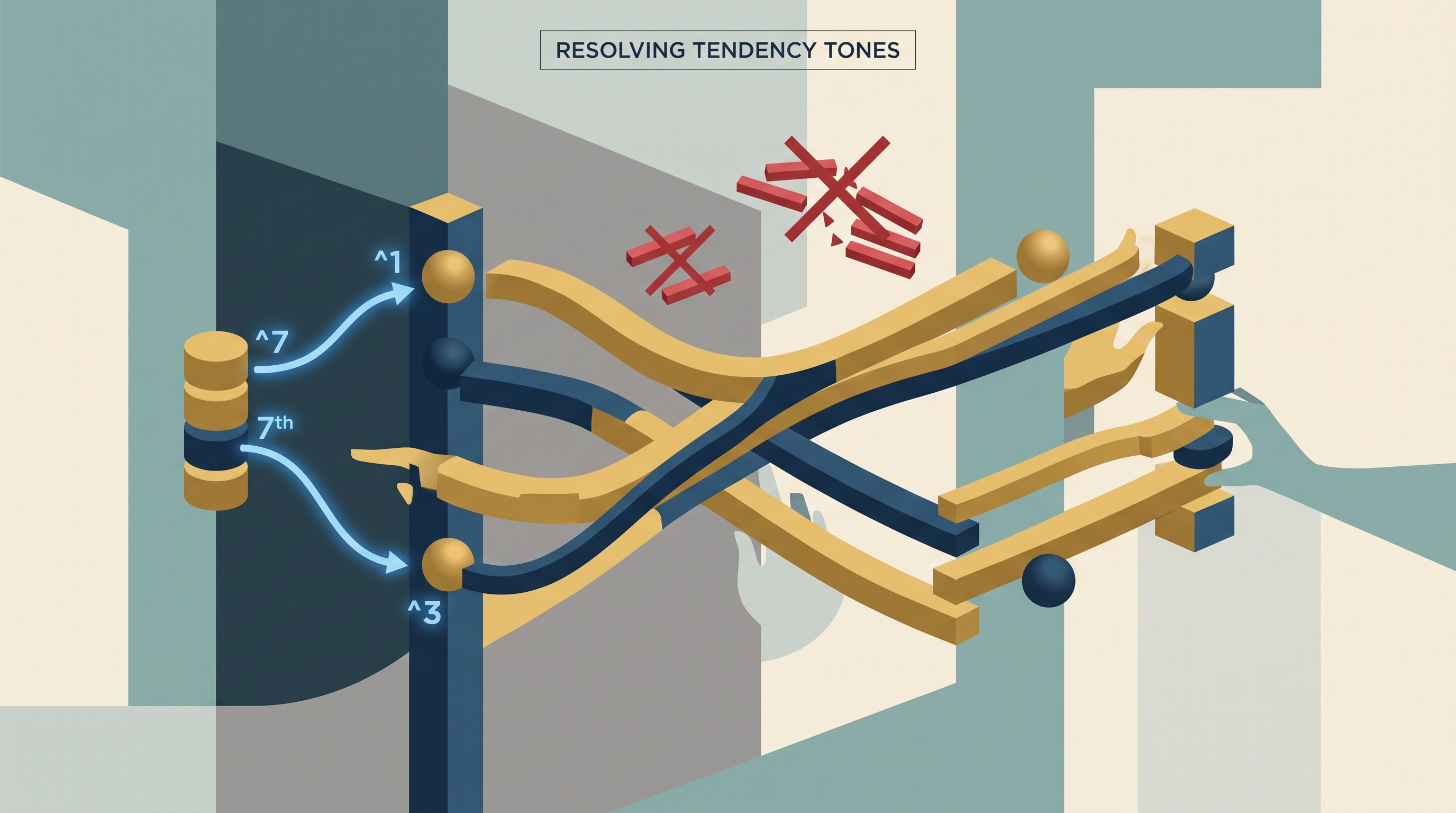
The seventh of a seventh chord is a tendency tone with a particularly strong conventional resolution: it generally moves downward by step. The leading tone generally resolves upward, but neither rule is an automatic visual reflex. A leading tone may be retained or redirected when the musical context requires it—for example, to avoid a prohibited interval, accommodate a chordal resolution, or maintain a complete and singable texture. The exception must be identifiable and musically explained.
A four-voice checking routine
Use this sequence whenever a seventh chord appears in root position or when any chord tone appears in the soprano:
- Chord spelling: Are all four pitches members of the intended seventh chord, with every accidental correct?
- Spacing: Are adjacent upper parts within an octave? Is the bass-to-tenor distance allowed to exceed an octave?
- Doubling and completeness: Is the chord complete when possible, and is any doubling justified by the voice leading?
- Tendency tones: Does the leading tone generally rise? Does the chordal seventh generally descend by step?
- Voice independence: Are voices free of crossing and overlap? Does each line remain singable?
- Motion audit: Between each pair of voices, label parallel, similar, oblique, or contrary motion.
- Perfect-interval audit: Are parallel perfect unisons or octaves absent? If outer voices approach a perfect fifth or octave by similar motion, does the upper voice move by step?
- Seventh-chord resolution: Does the seventh resolve appropriately, and is any exception supported by the surrounding progression?
Misconception check: A seventh chord is not “correct” merely because its four pitches are spelled correctly. A vertically accurate chord can still fail through voice crossing, excessive upper spacing, unresolved tendency tones, parallel perfect intervals, or lines that do not behave independently.
Retrieval check: In a $V^7$–$I$ progression, identify the usual destinations of the leading tone and the chordal seventh. Then ask: if two voices move in opposite directions into an octave, is that automatically parallel octaves? Explain why or why not.

Source Materials
- Learn More (.pdf)
- AP Music Theory Course and Exam Description
- AP Music Theory Course Overview
- AP Music Theory Course at a Glance
- AP Music Theory Course at a Glance Poster
- Adopt AP Music Theory
- AP Music Theory
- AP Music Theory
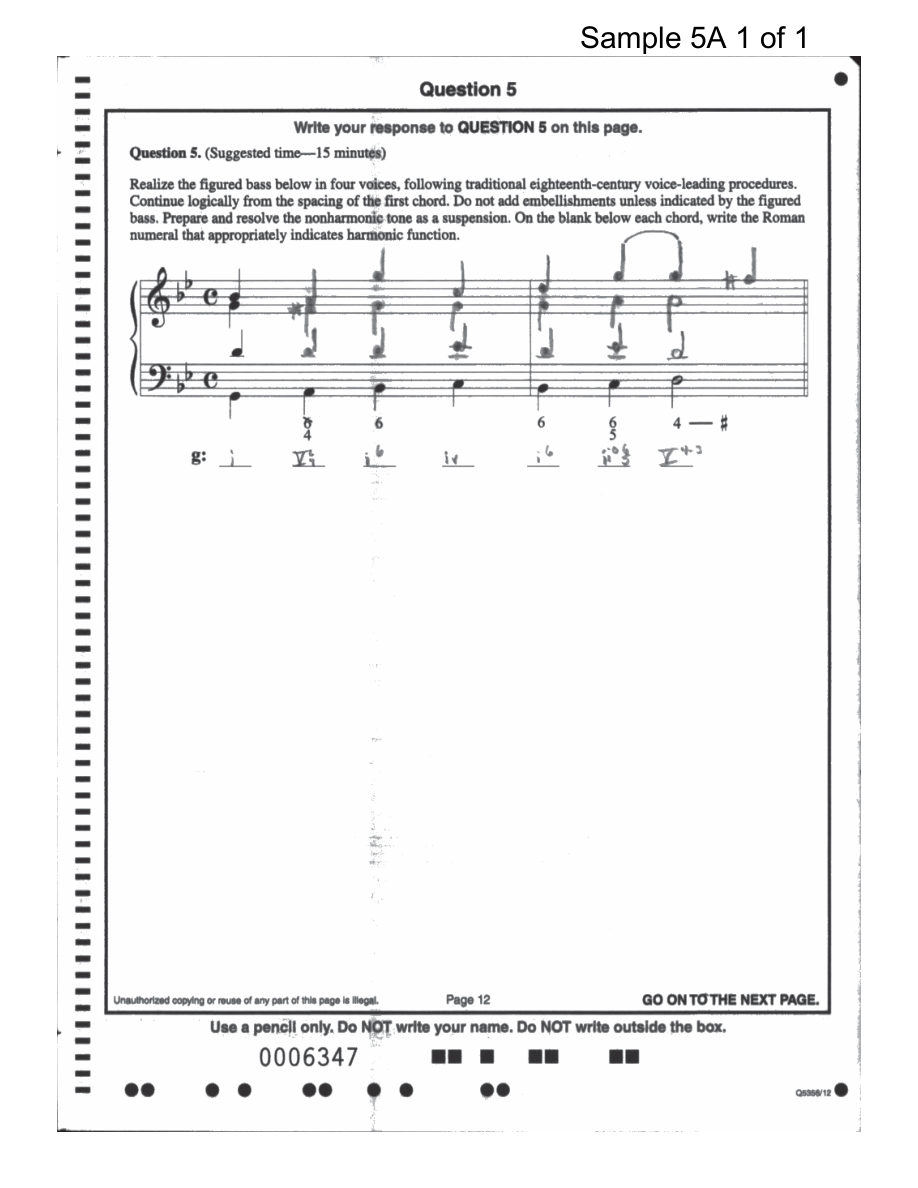
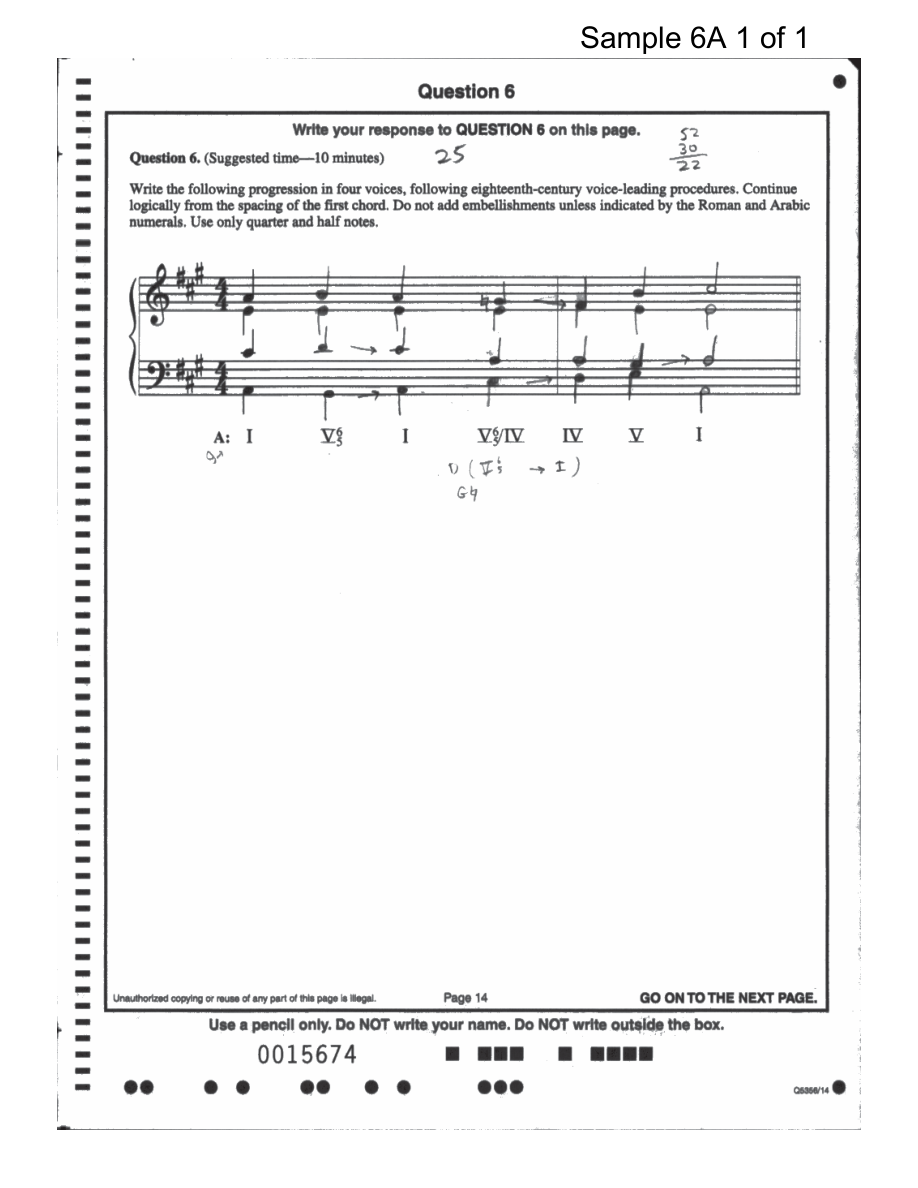
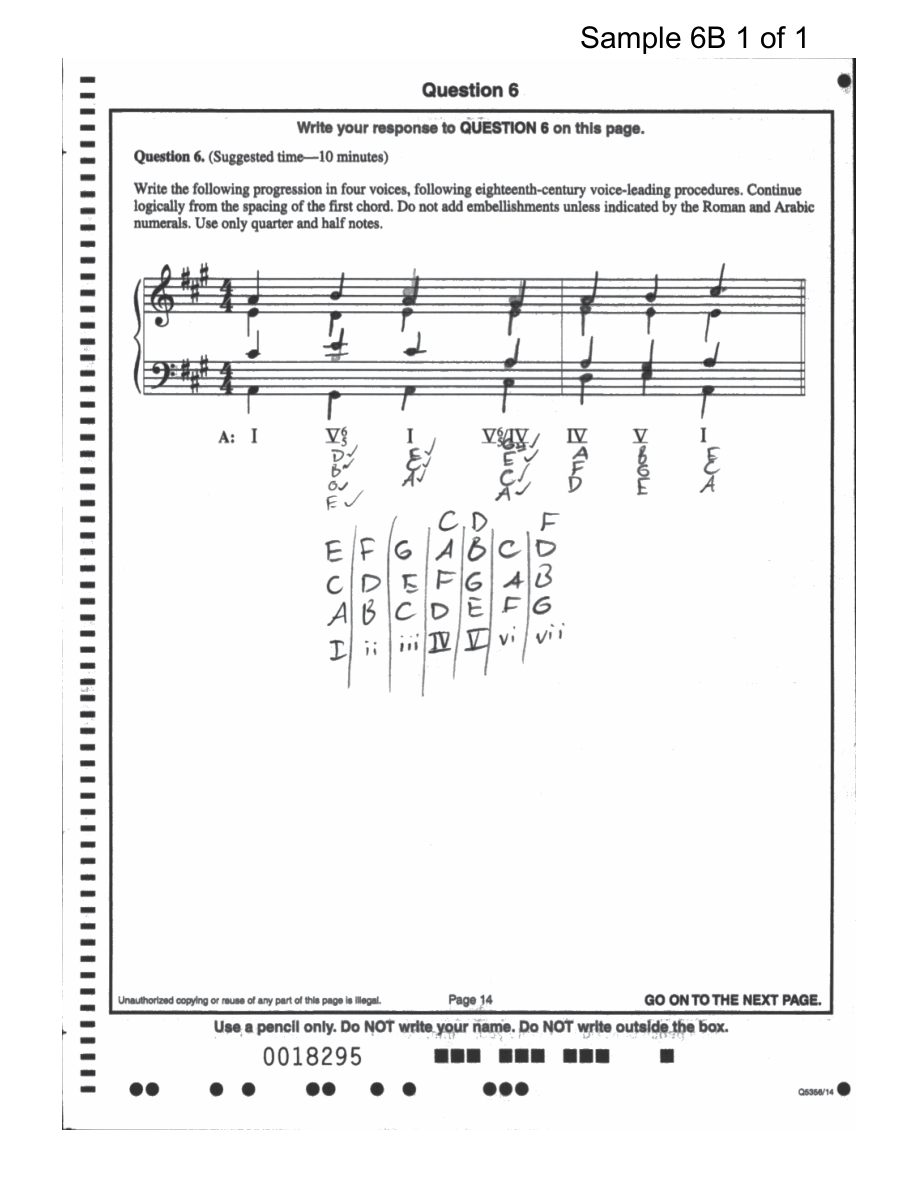
- Figure — Sample Responses Q5 (p. 6)
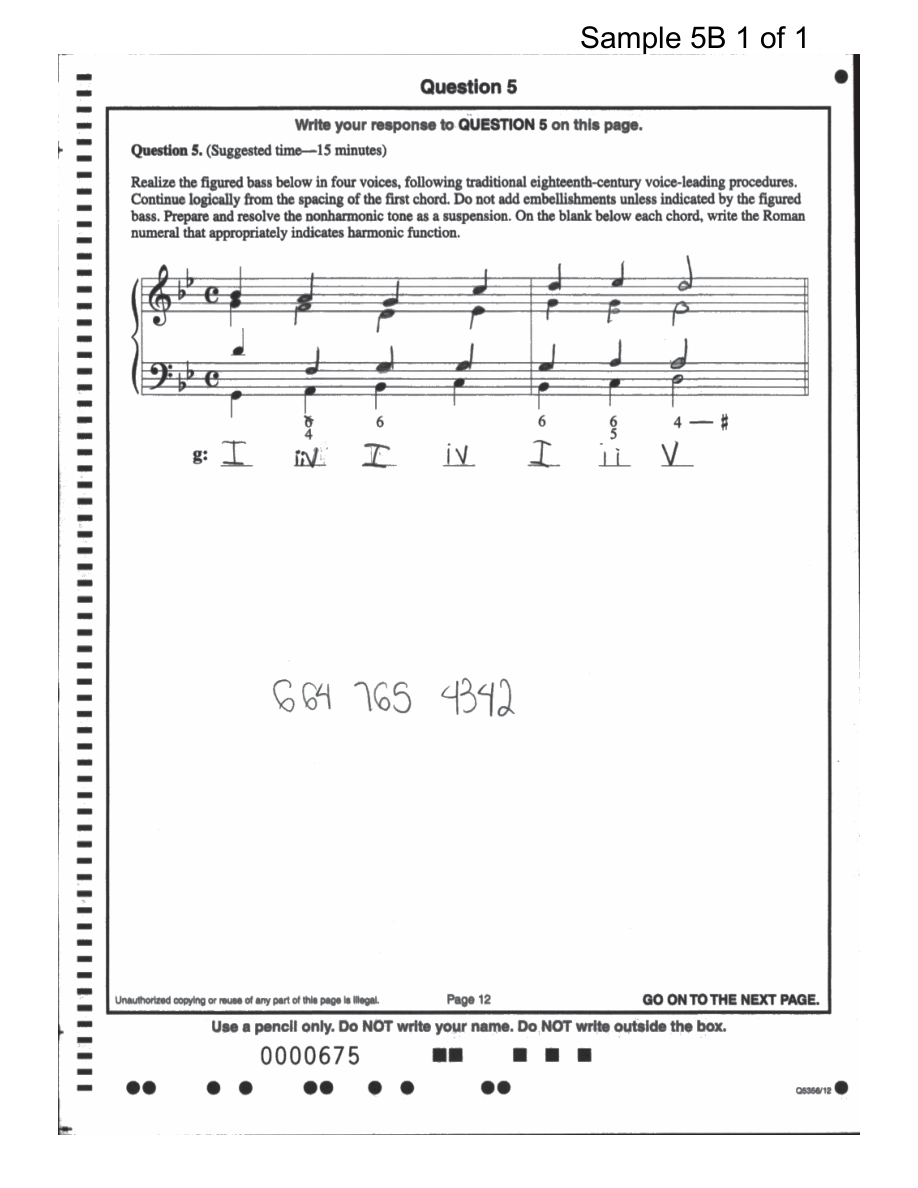
- Figure — Sample Responses Q5 (p. 7)
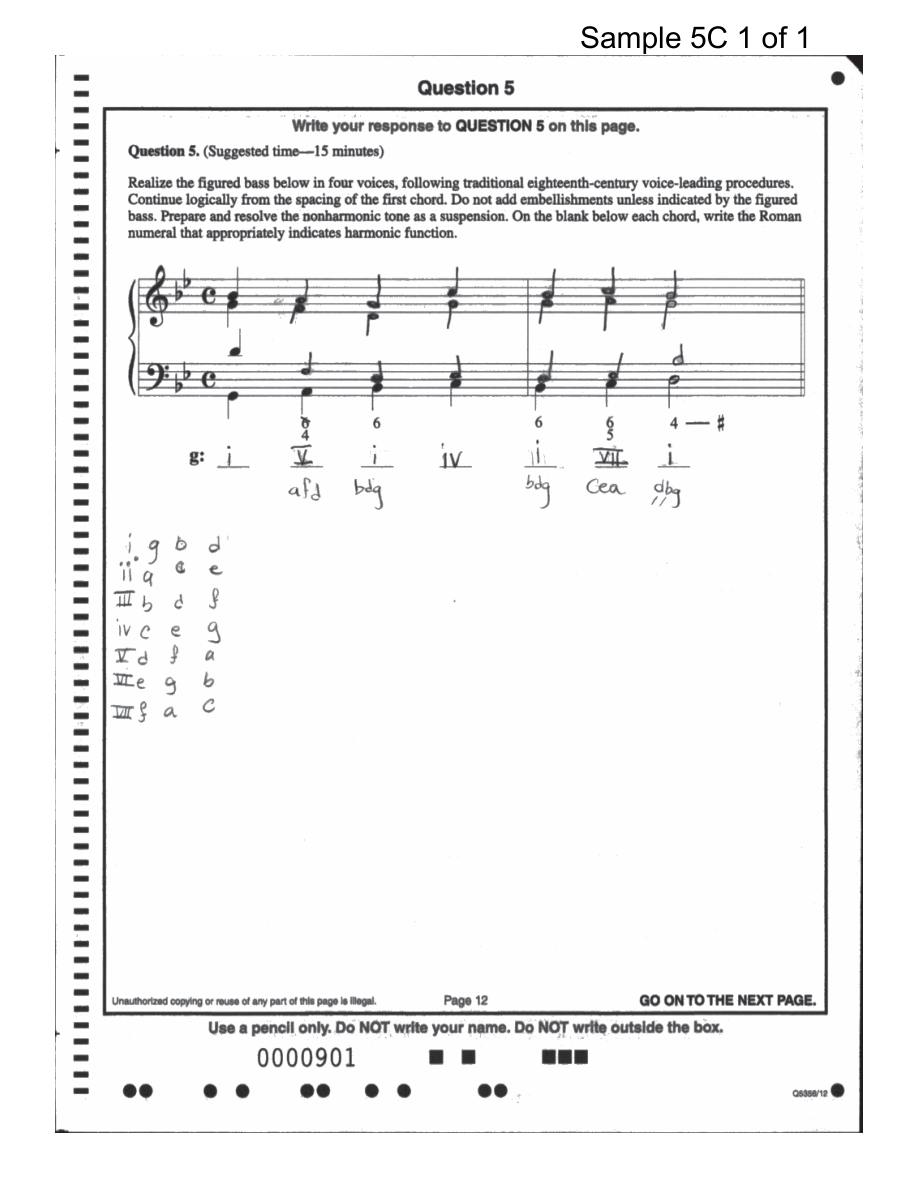
- Figure — Sample Responses Q5 (p. 8)
- Figure — Sample Responses Q6 (p. 4)