From the free course AP Music Theory on Lykke
2.7 Transposing instruments
Key concepts: Transposing instruments · Identifying transposing instruments · Transposing musical exercises · Specified levels of transposition · AP Music Theory Exam presentation of transposing-instrument exercises
A transposing instrument is an instrument whose written, or notated, pitch differs from the pitch that actually sounds. The notation tells the performer which fingering or key to use; the resulting sound may be higher or lower than the written note.
2.7 Transposing instruments
A transposing instrument is an instrument whose written, or notated, pitch differs from the pitch that actually sounds. The notation tells the performer which fingering or key to use; the resulting sound may be higher or lower than the written note.
Core idea: Always identify the requested direction and interval before changing any notes.
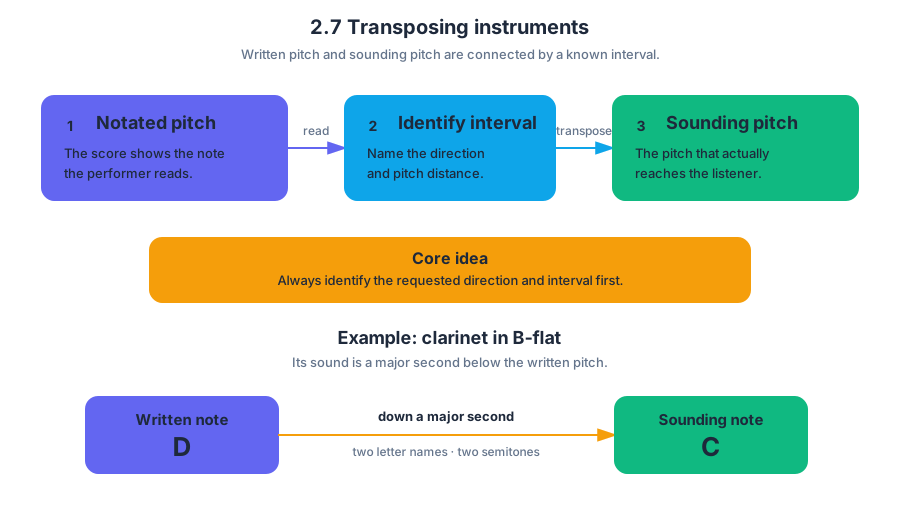
The distinction is easiest to see as a two-step path:
For example, if a score says that a clarinet in B-flat sounds a major second below the notated pitch, a written $D$ produces a sounding $C$. The interval is a major second because $D$ down to $C$ spans two letter names, and the pitch distance is two semitones.
Identifying a transposing instrument
In a musical exercise, first inspect the instrument label or the question directions. Do not assume that every part sounds exactly as written. The exercise may identify the instrument directly and may provide its transposition in words such as “sounding a major second below notated pitch.”
The AP Music Theory framework places this work under the big idea PIT: Pitch, especially PIT-1.N.1, which concerns the relationship between notated and sounding pitch. The relevant skill categories are Skill 2: Analyze notated music and Skill 3: Convert between performed and notated music. When the task asks you to complete or adapt a musical exercise based on the printed directions, it also draws on Skill 4: Complete based on cues.
A reliable identification routine
Use this visual scan before writing anything:
- Read the instrument name. Look for a part whose notation may not represent concert pitch.
- Find the stated interval. The score or directions should specify the level of transposition.
- Find the direction. Determine whether the sounding pitch is above or below the written pitch.
- Decide what the answer requires. Are you converting written notes into sounding notes, or sounding notes into notation?
Worked example: converting notation into sounding pitch
Suppose a short clarinet line is written as:
$$ D ;-; E ;-; F^\sharp ;-; G $$
The directions state: “Clarinet in B-flat sounding a major second below notated pitch.”
Transpose every note downward by a major second:
| Notated pitch | Direction | Sounding pitch |
|---|---|---|
| $D$ | down a major second | $C$ |
| $E$ | down a major second | $D$ |
| $F^\sharp$ | down a major second | $E$ |
| $G$ | down a major second | $F$ |
The sounding line is therefore:
$$ C ;-; D ;-; E ;-; F $$
The accidentals must move with the pitches. A written $F^\sharp$ becomes sounding $E$, not $E^\sharp$ or $F$, because the specified interval is applied to the pitch itself while preserving the correct letter-and-interval relationship.
Specified levels and directions of transposition
The AP Music Theory Exam supplies the information needed for the conversion. Students do not need to memorize the transpositions of specific instruments. The exercise indicates the specific level, and the question directions specify the direction.
This prevents a frequent error: using a familiar convention instead of the interval actually printed in the question. If a prompt says “sounding a perfect fourth above notated pitch,” move upward by a perfect fourth even if you associate that instrument with a different convention in ordinary performance practice.
Exam rule: The printed interval and direction outrank memory.
The octave exception
The stated boundary is instruments whose transposition is an octave, such as the double bass. These instruments are treated as an exception to the special AP presentation described for other transposing instruments. When an exercise involves a non-octave transposition, expect the score and directions to identify exactly how the conversion works.
Common misconception check
Misconception: “I must memorize which instruments transpose and by how much.”
Correction: For AP Music Theory transposing-instrument exercises, the necessary transposition level is indicated in the score, and the direction is specified in the question directions.
Misconception: “Transposing means changing only the key signature.”
Correction: Transposition changes every pitch in the exercise by the stated interval. A key signature may change as a consequence, but the central operation is pitch-by-pitch conversion.
Retrieval check
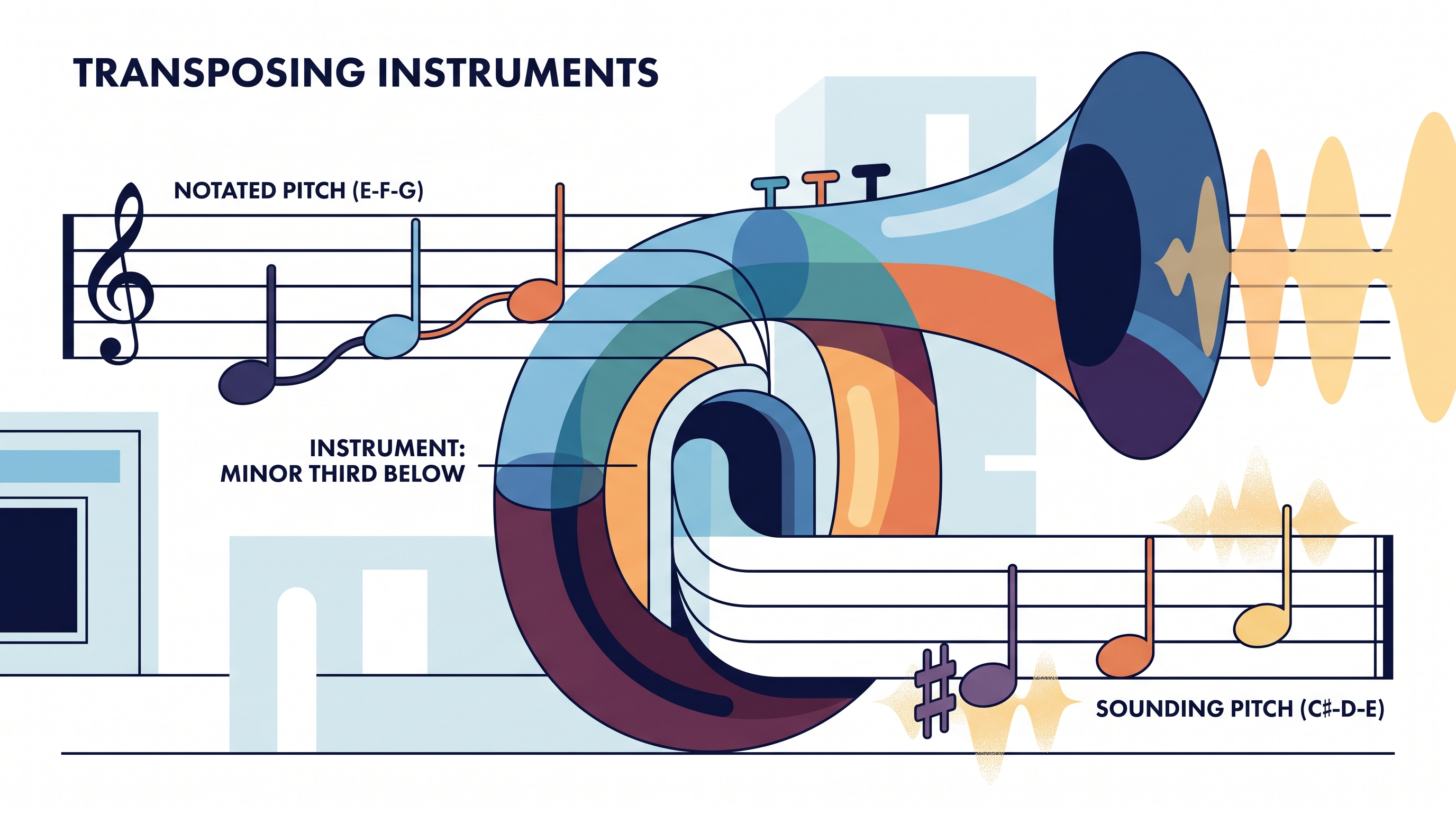
A part is labeled “instrument sounding a minor third below notated pitch.” If the written melody begins $E$–$F$–$G$, what are the sounding pitches?
Move each note down a minor third: $E$ becomes $C^\sharp$, $F$ becomes $D$, and $G$ becomes $E$. The sounding opening is therefore:
$$ C^\sharp ;-; D ;-; E $$