From the free course AP Music Theory on Lykke
4.2 SATB voice leading
Key concepts: SATB four-voice writing and spacing · Eighteenth-century voice-leading procedures · Harmonic intervals between voices · Similar and contrary motion · Direct (hidden) fifths and octaves · Stepwise motion in the upper voice · Leading-tone resolution · Note-against-note dissonance · Roman-numeral harmonic progressions · Score analysis and contextual listening
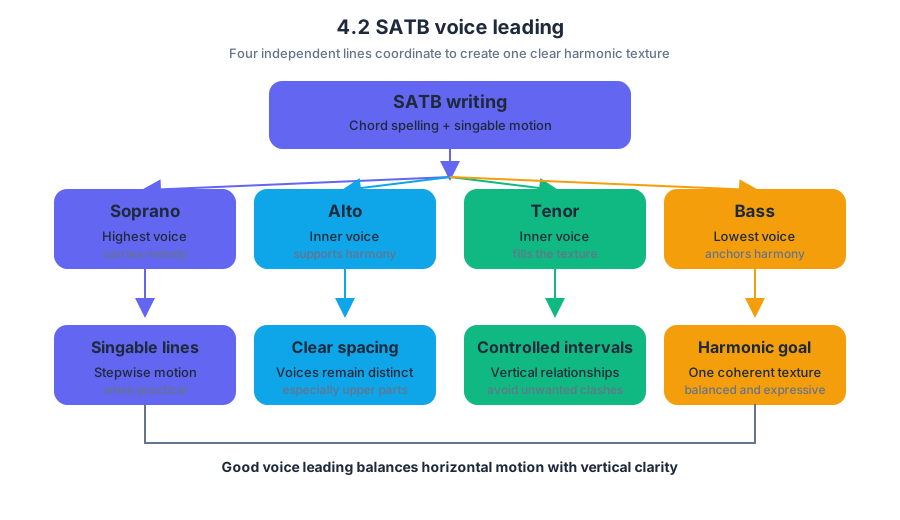
SATB writing arranges four voices from highest to lowest as soprano, alto, tenor, bass. The challenge is not merely to spell each chord correctly: every voice must form a singable line while the vertical intervals between voices remain clear and stylistically controlled.
4.2 SATB voice leading
SATB writing arranges four voices from highest to lowest as soprano, alto, tenor, bass. The challenge is not merely to spell each chord correctly: every voice must form a singable line while the vertical intervals between voices remain clear and stylistically controlled.
The SATB “grid”: horizontal lines, vertical chords
Read a four-part passage in two directions at once:
- Horizontally: Does each voice move logically from one note to the next?
- Vertically: Do the voices form the required chord, with acceptable spacing and intervals?
- Across time: Do successive chords create forbidden parallels, direct intervals, unresolved dissonances, or awkward overlaps?
Write the voices in this order:
$$ \text{soprano} ;>; \text{alto} ;>; \text{tenor} ;>; \text{bass} $$
The soprano and alto, and the alto and tenor, should normally remain within an octave. The tenor and bass may be farther apart. Preserve the basic spacing established by the first chord unless the musical texture gives you a clear reason to change it.
Worked example: a compact I–V$^6$–I progression
In C major, consider this original realization:
| Chord | Soprano | Alto | Tenor | Bass |
|---|---|---|---|---|
| I | E | C | G | C |
| V$^6$ | D | B | G | G |
| I | E | C | G | C |
The vertical check confirms that the notes belong to I, V$^6$, and I. The horizontal check is equally important: the alto moves $C$–$B$–$C$, so the leading tone $B$ resolves upward by step to tonic $C$. The soprano moves by step from $E$ to $D$ and back to $E$, while the tenor remains on $G$ and the bass outlines the harmonic motion $C$–$G$–$C$.
Now inspect the intervals between voices. The upper voices are comfortably spaced, no voice crosses another, and the soprano does not leap into a perfect fifth or octave by similar motion. This is the central SATB habit: check the chord and the path into it.
Motion and perfect intervals
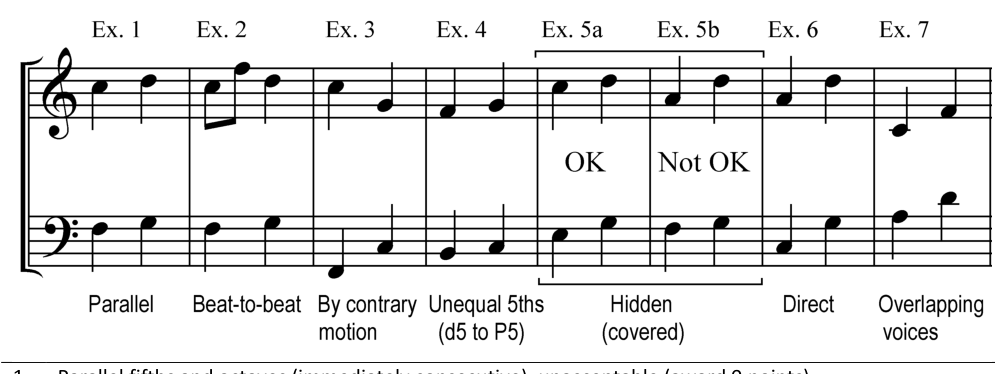
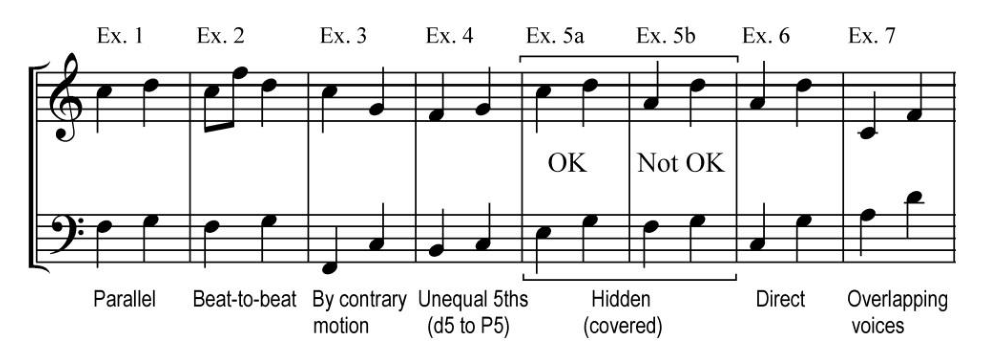
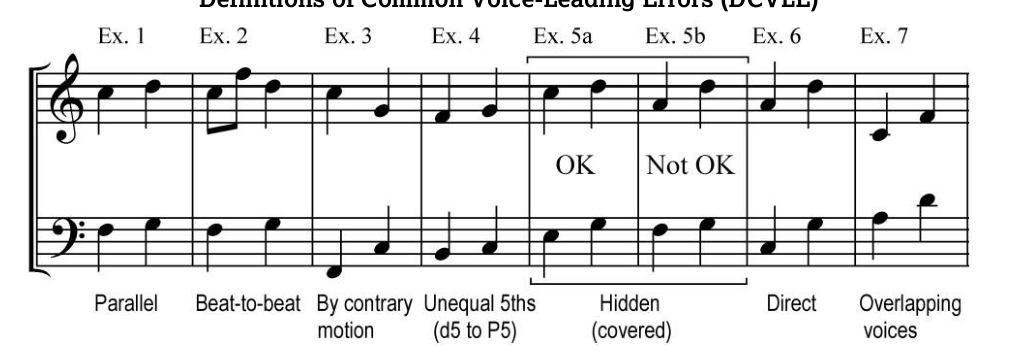
Similar motion occurs when two voices move in the same direction. Contrary motion occurs when one rises while the other falls. Oblique motion occurs when one voice moves and the other remains stationary. Contrary motion into a perfect fifth or octave is not automatically an error; the direction of motion alone does not make the interval forbidden.
The major danger is a succession of perfect intervals:
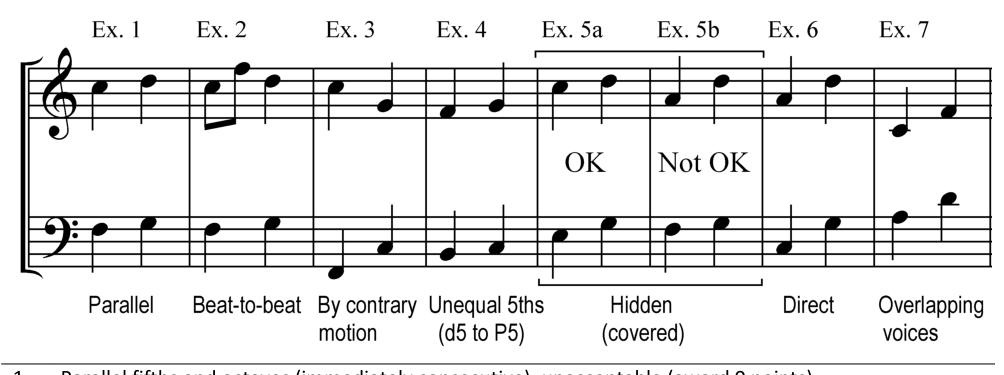
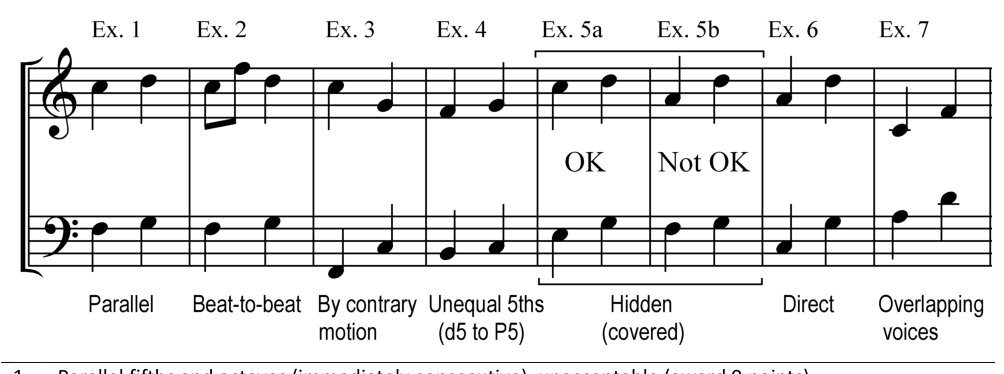
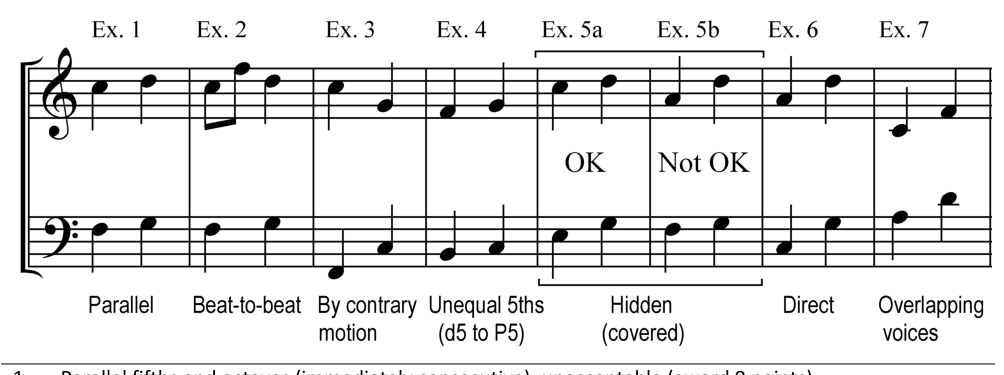
- Parallel fifths or octaves: the same two voices move in the same direction from one perfect interval to another. These are prohibited.
- Beat-to-beat fifths or octaves: equal perfect intervals recur between the same voices on successive beats, even if the passage is notated as separate chord changes.
- Direct, or hidden, fifths and octaves: two voices move by similar motion into a perfect interval. In the stricter outer-voice case, the error is especially serious when the soprano leaps.
- Contrary motion: do not classify every contrary-motion arrival at a perfect interval as forbidden. Instead, test whether the passage creates a prohibited succession or another voice-leading problem.
A practical distinction is:
$$ \text{similar motion} + \text{perfect interval} = \text{check for direct/hidden interval} $$
whereas
$$ \text{contrary motion} + \text{perfect interval} \neq \text{automatic error} $$
When similar motion brings the outer voices to a perfect fifth or octave, prefer stepwise motion in the upper voice. If the upper voice leaps into that perfect interval, revise the line if possible.
Other interval hazards
Avoid excessive consecutive thirds between the same pair of voices. A single third is normal, but a long chain of parallel or repeatedly similar thirds can make two voices behave like a locked pair rather than independent melodic lines. Vary the interval or redirect one voice while preserving the chord.
Watch for unequal fifths, especially a diminished fifth changing to a perfect fifth. An ascending diminished-fifth-to-perfect-fifth motion can be acceptable between upper voices in the specific motion from I to I$^6$ through V$^{4}_{3}$ or vii$^\circ_6$; other cases require caution, and the same motion between bass and an upper voice is unacceptable under the stated scoring conventions. A perfect fifth changing to a diminished fifth by step between upper voices is generally acceptable.
Voice overlap occurs when a voice moves into the former range of a neighboring voice—for example, the tenor rises above the alto’s previous note. Keep each part in a coherent register. Also identify note-against-note dissonances: a dissonant vertical interval must be justified by the surrounding motion and should not sound like an accidental clash.
Leading tones, dissonance, and final checking
A leading tone normally resolves upward by step to the tonic. Do not leave it stranded merely because the next chord offers a convenient note; first determine whether the leading tone can resolve without creating a larger error. Likewise, a dissonance between voices is not judged in isolation: examine whether it is approached and left smoothly.
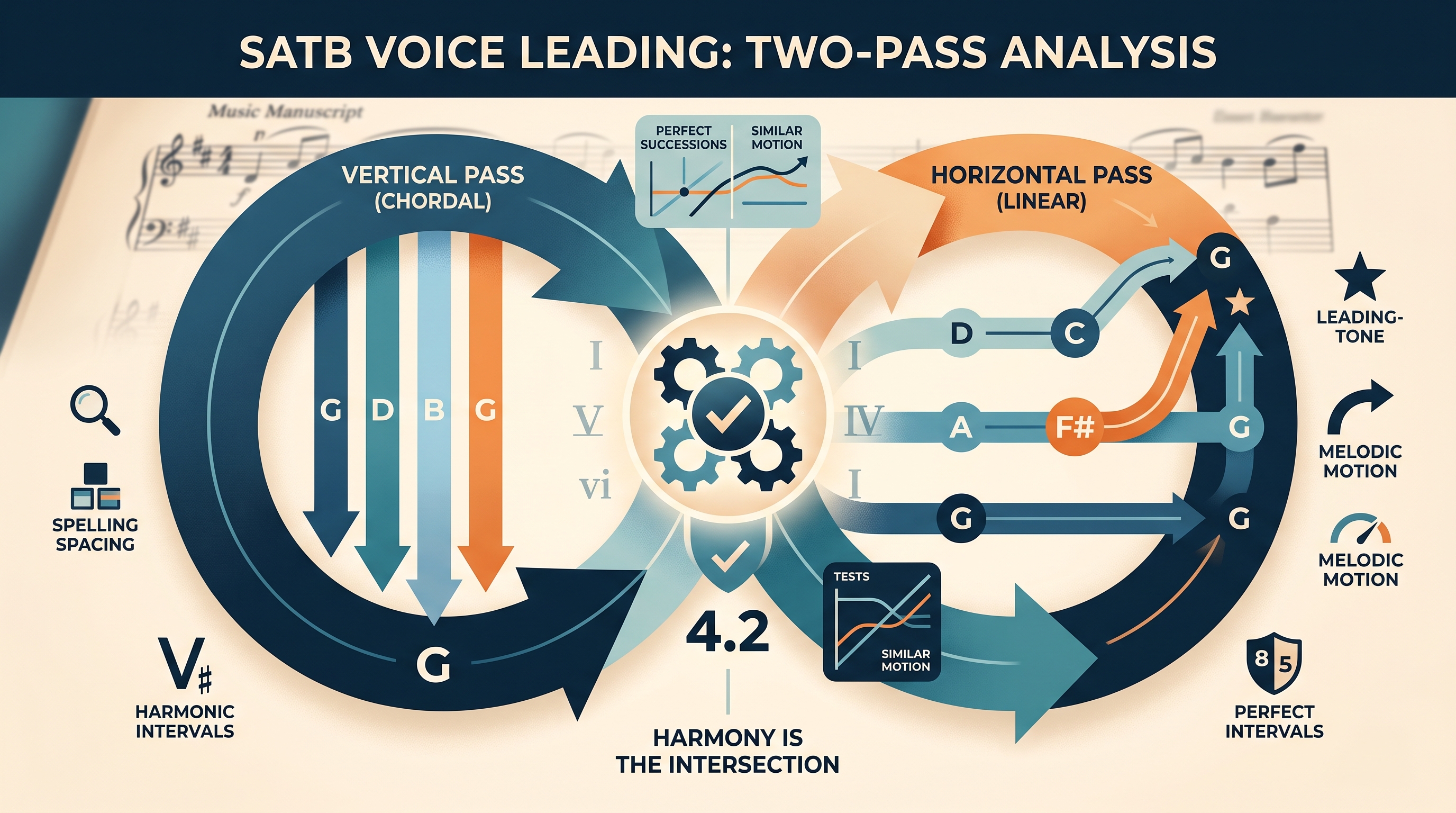
Use Roman numerals to label the harmonic progression, then perform two passes:
- Vertical pass: chord spelling, inversion, spacing, doubling, harmonic intervals, and dissonance.
- Horizontal pass: voice ranges, overlap, leaps, leading-tone resolution, similar motion, and perfect-interval successions.
Misconception check: “Any two voices moving in contrary motion to a fifth or octave is forbidden.” Correction: contrary motion is not itself the prohibition. The essential tests are whether perfect intervals occur consecutively, whether similar motion creates a direct or hidden fifth or octave, and whether the individual voices remain stylistically controlled.
Retrieval check: In the example I–V$^6$–I above, which voice contains the leading tone, and why is its motion preferred? Then identify whether the soprano’s motion into the final chord is stepwise or leaping, and explain why that matters when checking the outer voices.
Source Materials
- Learn More (.pdf)
- AP Music Theory Course and Exam Description
- AP Music Theory Course Overview
- AP Music Theory Course at a Glance
- AP Music Theory Course at a Glance Poster
- Adopt AP Music Theory
- AP Music Theory
- AP Music Theory
- 1. Parallel fifths and octaves (immediately consecutive): unacceptable (award 0 points).
- 1. Parallel fifths and octaves (immediately consecutive): unacceptable (award 0 points).
- 1. Parallel fifths and octaves (immediately consecutive): unacceptable (award 0 points).
- 1. Parallel fifths and octaves (immediately consecutive): unacceptable (award 0 points).