From the free course AP Music Theory on Lykke
7.1 Tonicization through secondary dominant chords
Key concepts: Tonicization · Secondary dominant (applied dominant) chords · Roman-numeral slash notation · Temporary tonicization of non-tonic major or minor triads · V/V (the dominant of the dominant) · V/ii and V/IV · Resolution of secondary dominants · Chromatic accidentals in secondary dominants · Dominant seventh (major-minor seventh) chords · Identifying tonicization in performed and notated music
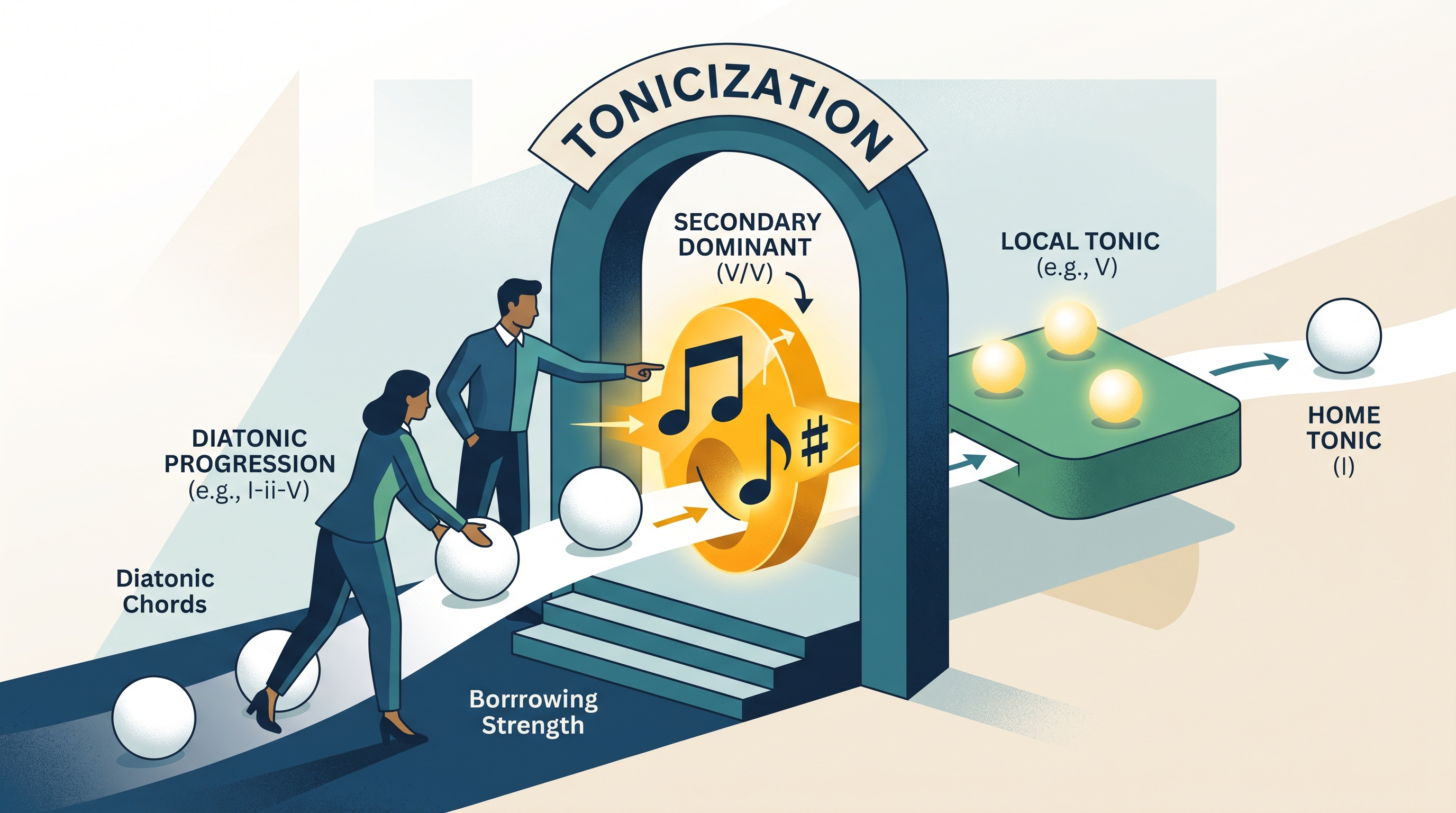
A tonicization makes a chord other than the home-key tonic sound temporarily like a tonic, usually by placing that chord after its own dominant. The effect is a brief musical spotlight: the overall key remains stable, but one local chord suddenly feels like “home.”
7.1 Tonicization through secondary dominant chords
A tonicization makes a chord other than the home-key tonic sound temporarily like a tonic, usually by placing that chord after its own dominant. The effect is a brief musical spotlight: the overall key remains stable, but one local chord suddenly feels like “home.”
Learning Objective PIT-2.Q: Identify and describe tonicization in performed music and notated music.
Essential Knowledge PIT-2.Q.1: Tonicization is a fleeting local event in which a scale degree or chord other than the primary tonic is made to sound like a temporary tonic. It does not necessarily change the composition’s overall key.
The dominant-of-the-target mechanism
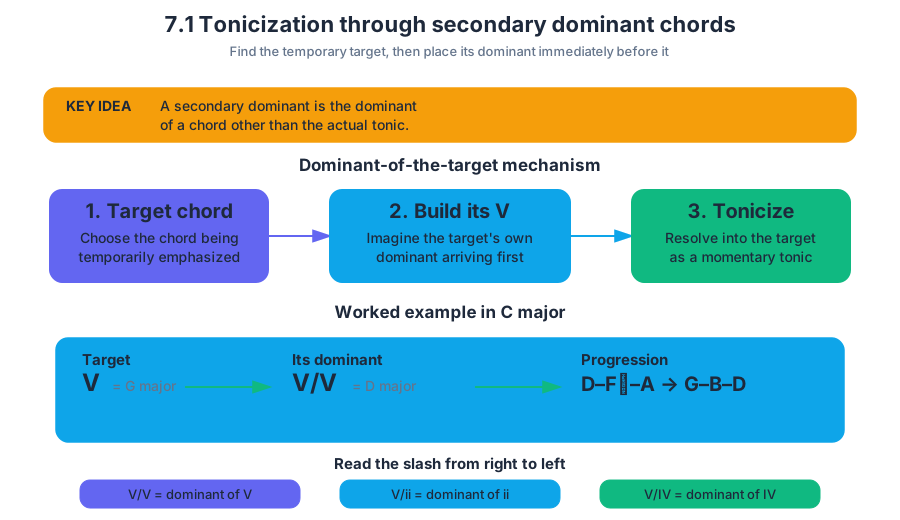
The most common way to create tonicization is with a secondary dominant, also called an applied dominant. A secondary dominant is the dominant chord of a major or minor triad other than the actual tonic.
Key idea: Find the chord being temporarily emphasized. Then imagine its own dominant arriving immediately before it.
In C major, the ordinary dominant is $\text{V}$, a G-major triad. The dominant of G is D major, so the progression
$$ \text{V}/\text{V} \rightarrow \text{V} $$
is spelled
$$ \text{D–F}\sharp\text{–A} \rightarrow \text{G–B–D}. $$
The D-major chord is labeled $\text{V}/\text{V}$, pronounced “five of five.” The first numeral identifies the function of the applied chord; the chord after the slash identifies the temporarily tonicized target:
- $\text{V}/\text{V}$ = the dominant of the dominant
- $\text{V}/\text{ii}$ = the dominant of the supertonic
- $\text{V}/\text{IV}$ = the dominant of the subdominant
The slash does not mean a fraction or an inversion. It describes a relationship between two chords. In $\text{V}/\text{ii}$, read from right to left: first identify $\text{ii}$ as the target, then construct its dominant.
Worked examples in C major
To construct $\text{V}/\text{ii}$ in C major, begin with the target: $\text{ii}$ is D minor, spelled D–F–A. Its dominant is A major, spelled A–C$\sharp$–E. Therefore,
$$ \text{V}/\text{ii} = \text{A–C}\sharp\text{–E} \rightarrow \text{D–F–A}. $$
The C$\sharp$ is not in the key signature of C major. That accidental is expected: the applied dominant borrows the leading tone of the temporarily tonicized chord. The arrival on D minor creates a brief sense that D is the local tonal center, even though the composition may continue in C major.
Similarly, $\text{V}/\text{IV}$ targets F major. The dominant of F is C major:
$$ \text{V}/\text{IV} = \text{C–E–G} \rightarrow \text{F–A–C}. $$
This example may require no new accidental in C major because C major is already the dominant of F. By contrast, $\text{V}/\text{V}$ requires F$\sharp$, and $\text{V}/\text{ii}$ requires C$\sharp$. Secondary dominants nearly always require accidentals, but the exact spelling depends on the target chord and the home key.
Triads, seventh chords, and inversions
A secondary dominant may appear as a triad or as a dominant seventh chord, also called a major-minor seventh ($\text{Mm7}$). In C major, the applied dominant of G can therefore be either
$$ \text{D–F}\sharp\text{–A} $$
or
$$ \text{D–F}\sharp\text{–A–C}. $$
It may also occur in any inversion appropriate to the harmonic context. The inversion changes the bass and the figured-bass description, but it does not change the secondary-function label: an inverted D-major chord still functions as $\text{V}/\text{V}$ if it resolves to G major.
How to identify tonicization by ear and by score
For notated music, look for three clues: a target triad that is not the home tonic, an applied dominant immediately before it, and an accidental that creates the target’s leading tone. Then label the applied chord with slash notation.
For performed music, listen for a short dominant-to-tonic-like gesture that does not establish a permanent new key. A sharpened note may sound like a sudden upward pull, followed by a chord that briefly feels settled. The strongest confirmation is the resolution: $\text{V}/\text{V}$ should resolve to $\text{V}$, $\text{V}/\text{ii}$ to $\text{ii}$, and $\text{V}/\text{IV}$ to $\text{IV}$.
Misconception check — “Every accidental means modulation.” An accidental can support tonicization without changing the overall key. Modulation requires a more sustained change of tonal center; tonicization is a temporary local emphasis.
Retrieval check: In G major, which chord is $\text{V}/\text{V}$, and what note must be altered to spell it? Answer: the target is D major, whose dominant is A major, A–C$\sharp$–E; C$\sharp$ is the accidental that creates the applied dominant.
Source Materials
- Learn More (.pdf)
- AP Music Theory Course and Exam Description
- AP Music Theory Course Overview
- AP Music Theory Course at a Glance
- AP Music Theory Course at a Glance Poster
- Adopt AP Music Theory
- AP Music Theory
- AP Music Theory
- AP Music Theory-AP Students-College Board
- AP Music Theory-Unit Study Guides
- AP Music Theory-Raidar Choir
- Everything you need to know to get a 5 on AP Music Theory