From the free course AP Music Theory on Lykke
6.2 Writing passing and neighbor tones
Key concepts: Writing unaccented passing tones · Writing unaccented neighbor tones · Stepwise melodic motion · Harmonic-context analysis of melodies · Part-writing passing 6/4 chords · Part-writing pedal (neighboring) 6/4 chords · Doubling the fifth in a passing 6/4 chord · Stationary bass in a pedal or neighboring 6/4 chord
A passing or neighbor tone earns its label not merely from its pitch, but from where it occurs in the meter, how it moves, and what harmony surrounds it.
6.2 Writing passing and neighbor tones
A passing or neighbor tone earns its label not merely from its pitch, but from where it occurs in the meter, how it moves, and what harmony surrounds it. In prescribed writing exercises, both types should normally be unaccented, meaning they occur on a weak beat or weak part of a beat.
Write the melody before naming the tone
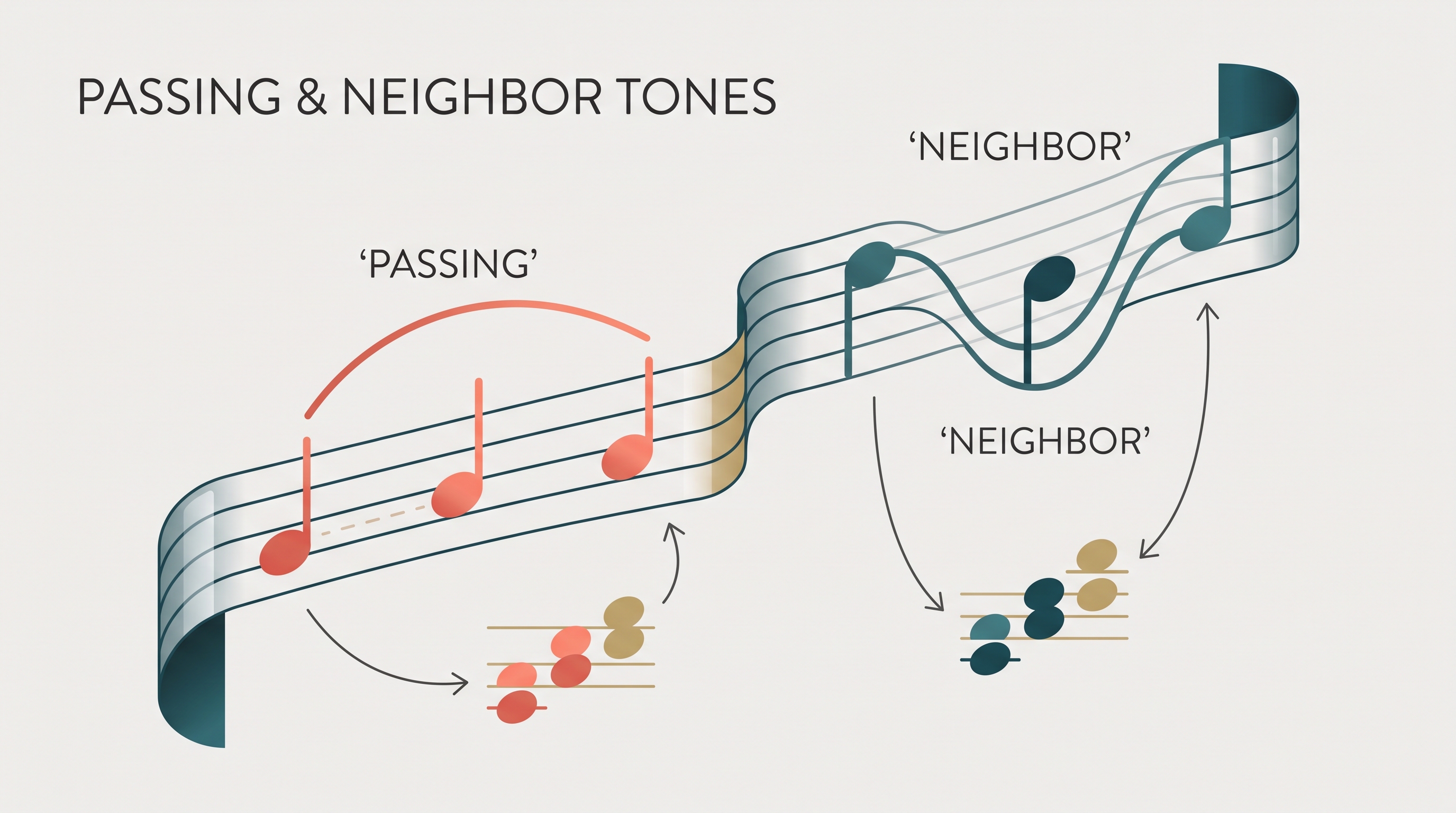
Use the surrounding chord tones as the stable points of the melody. A passing tone fills the step between two different chord tones; a neighbor tone leaves a chord tone and returns to that same tone. The writing pattern is therefore:
$$ \text{passing: } X \rightarrow Y \rightarrow Z $$
where $Y$ lies between $X$ and $Z$ by step, while
$$ \text{neighbor: } X \rightarrow Y \rightarrow X $$
returns to the starting pitch.
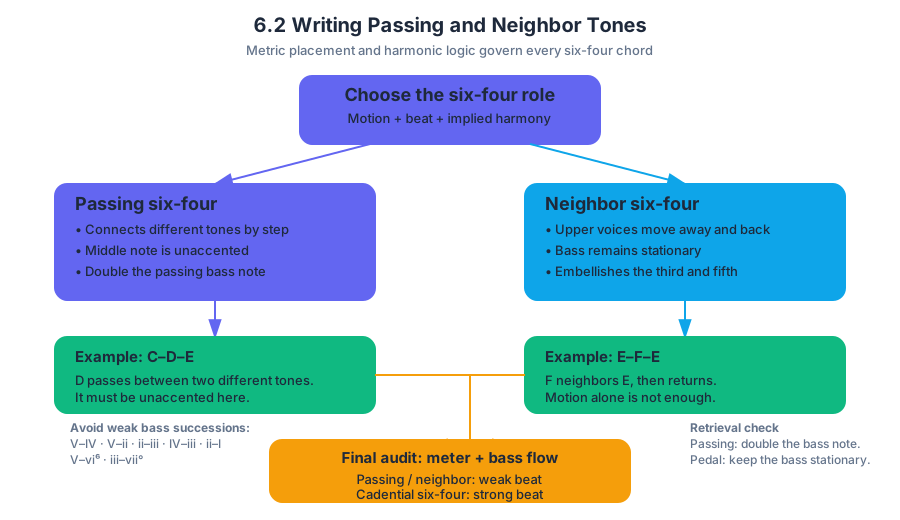
For example, in a melody whose stable notes are $C$ and $E$, the sequence $C-D-E$ may use $D$ as an unaccented passing tone. If the melody instead moves $E-F-E$, the $F$ is an unaccented upper neighbor. The distinction becomes reliable only after the rhythm and harmony are inspected together.
A writing checklist
- Locate the likely chord tones before and after the embellishing tone.
- Check whether the middle tone moves by step.
- Check the meter: the passing or neighbor tone should be unaccented.
- Decide whether the tone connects two different pitches or returns to its point of departure.
- Test the result against the implied harmonic progression.
Worked example: harmonic-context analysis
Suppose a soprano line in $C$ major moves as follows:
$$ \text{beat 1: } C \qquad \text{weak part of beat 2: } D \qquad \text{beat 3: } E $$
If the surrounding harmony supports $C$ before the motion and $E$ afterward, then $D$ is a passing tone: it connects $C$ and $E$ by step and is placed weakly. If the line instead reads
$$ E ;-; F ;-; E, $$
with $E$ supported before and after the motion, $F$ is a neighbor tone.
The same pitch can receive a different interpretation in another harmonic setting. A note that looks like a passing tone in isolation may be a chord member of the current harmony, or it may create an implausible chord succession. Always analyze the melody within its harmonic context rather than labeling notes from contour alone.
Diagnostic questions: Is the tone unaccented? Does it move by step? Does it connect two different chord tones or return to the same one? Does the implied harmony make musical sense?
Part-writing a passing ${}^{6}_{4}$ chord
A passing ${}^{6}{4}$ chord is a harmonic event created by stepwise motion in all four voices. The bass moves through the second-inversion chord while the upper voices also travel by step toward their next positions. Under PIT-4.F.1, the fifth of the ${}^{6}{4}$ chord should be doubled.
| Feature | Passing ${}^{6}_{4}$ requirement |
|---|---|
| Melodic motion | All voices move by step |
| Chord position | Second inversion |
| Doubling | Double the fifth of the ${}^{6}_{4}$ chord |
| Metric placement | Normally weak or unaccented |
| Function | Connects neighboring harmonic areas |
The doubling rule is not optional decoration. It helps the passing sonority arise naturally from the surrounding lines and prevents the chord from behaving like an isolated, incorrectly emphasized harmony.
Part-writing a pedal or neighboring ${}^{6}_{4}$ chord
A pedal, or neighboring, ${}^{6}_{4}$ chord is recognized by a different motion pattern: the bass remains stationary while upper voices move away from and return toward tones belonging to the root-position triad. Under PIT-4.F.2, the third and fifth of that root-position triad are embellished by their respective upper neighbor tones.
Imagine a sustained bass supporting a root-position triad. One upper voice rises by step and returns, while another upper voice performs the same kind of neighboring motion. The temporary upper-voice sonority forms the neighboring ${}^{6}_{4}$; because the bass does not move, it is pedal rather than passing.
| Chord type | Bass | Upper voices | Main motion |
|---|---|---|---|
| Passing ${}^{6}_{4}$ | Moves by step | Move by step | All voices move |
| Pedal or neighboring ${}^{6}_{4}$ | Remains stationary | Embellish by upper neighbors | Upper voices move around a fixed bass |
Metric and harmonic control
PIT-4.F.4 requires the six-four chord to fit both its tonal and rhythmic setting. Passing and neighboring ${}^{6}{4}$ chords normally occur on weak beats, whereas a cadential ${}^{6}{4}$ belongs on a strong beat. A plausible bass line must also avoid poor successions such as $V-IV$, $V-ii$, $ii-iii$, $IV-iii$, $ii-I$, $V-vi^{6}$, and $iii-vii^\circ$.
Misconception check: “Any stepwise note is automatically passing.” Not necessarily. A passing tone must connect two different tones by step, be unaccented in these exercises, and work with the implied harmony. A stationary bass also does not prove that every upper motion is a neighbor tone; the upper voices must embellish the third and fifth of the root-position triad as specified by PIT-4.F.2.
Retrieval check: In one sentence each, explain why the middle note in $C-D-E$ can be passing, why the middle note in $E-F-E$ can be a neighbor, what must be doubled in a passing ${}^{6}{4}$ chord, and what must remain stationary in a pedal ${}^{6}{4}$ chord.