From the free course AP Music Theory on Lykke
7.3 Tonicization through secondary leading-tone chords
Key concepts: Tonicization as a temporary local emphasis of a chord other than the primary tonic · Secondary dominant (applied dominant) chords · Secondary leading-tone chords, also called applied leading-tone or applied diminished seventh chords · Chromatic alteration and accidentals used to tonicize a target chord · Roman-numeral and Arabic-numeral analysis of applied chords · Inversion and notation of secondary leading-tone triads and seventh chords · Resolution of chromatically altered tones · Common-practice voice leading in secondary-function harmony
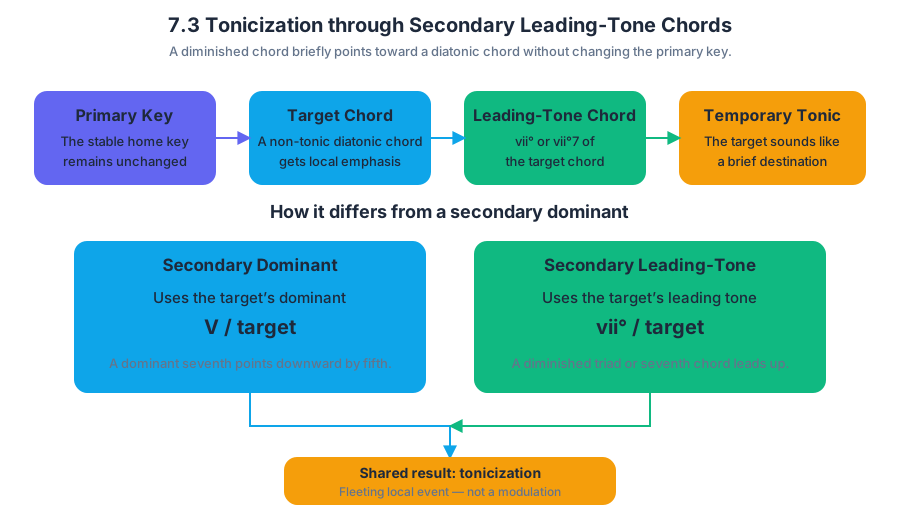
A chord can briefly behave like a destination without becoming the permanent home key: tonicization is the local emphasis of a diatonic chord other than the primary tonic, making that chord sound like a temporary tonic.
7.3 Tonicization through Secondary Leading-Tone Chords
A chord can briefly behave like a destination without becoming the permanent home key: tonicization is the local emphasis of a diatonic chord other than the primary tonic, making that chord sound like a temporary tonic. The primary key remains unchanged, but chromatically altered pitches usually signal the temporary harmonic spotlight.
PIT-2.Q.2: Tonicization is a fleeting local event, not a modulation.
Like the secondary dominants analyzed in 7.2, secondary leading-tone chords tonicize a non-tonic chord. They differ in the chord used to approach the target: a secondary dominant uses the target’s dominant, while a secondary leading-tone chord uses the target’s leading-tone diminished triad or diminished-seventh chord.
The target-and-approach model
To analyze an applied chord, identify two things:
- Target: the non-tonic diatonic chord being temporarily emphasized.
- Approach chord: the diminished chord built on the leading tone of that target.
For example, in C major, the target $V$ chord is G major. Its temporary leading tone is $\sharp\hat{4}$, or F-sharp, because F-sharp lies a half step below G. Building a diminished seventh chord above F-sharp produces F-sharp–A–C–E, which resolves naturally to G:
$$ \mathrm{vii}^{\circ 7}/V \longrightarrow V $$
The slash means “of.” Thus, $\mathrm{vii}^{\circ 7}/V$ means “the diminished-seventh chord built on the leading tone of V,” not “the ordinary vii chord in the main key.” In C major, the spelling is:
$$ \mathrm{F\sharp-A-C-E} \longrightarrow \mathrm{G-B-D} $$
The F-sharp rises to G, while the other chord members resolve according to the surrounding harmonic context.
Building and identifying applied leading-tone chords
PIT-2.Q.3 defines secondary leading-tone chords as diminished triads or diminished seventh chords—fully diminished or half diminished—whose root is the leading tone of the chord being tonicized. They may tonicize any accurately notated diatonic major or minor triad other than the primary tonic.
Consider the target $ii$ in C major: D minor. Its leading tone is C-sharp, so the applied diminished-seventh chord is:
$$ \mathrm{vii}^{\circ 7}/ii
\mathrm{C\sharp-E-G-B\flat} \longrightarrow \mathrm{D-F-A} $$
The accidental is not optional decoration. C-sharp is required because it is the leading tone of D, the temporary target. A spelling such as D-sharp–F-sharp–A–C would point toward E, not D, and therefore describes a different harmonic function.
The diminished-triad version normally appears only in first inversion. In C major, the applied leading-tone triad of V is F-sharp–A–C, but its standard notation is:
$$ \mathrm{vii}^{\circ 6}/V $$
The Arabic $6$ indicates first inversion: A, the chord’s third, appears in the bass. Applied diminished-seventh chords may appear in any inversion appropriate to the harmonic context, using figures such as $7$, $6/5$, $4/3$, or $4/2$.
A half-diminished secondary leading-tone chord has an important restriction: it is used only when the target is a major triad. Therefore, a half-diminished applied leading-tone chord can tonicize $V$ or $IV$ in a major key, but it does not normally tonicize a minor target such as $ii$.
Roman-numeral analysis in context
When a passage contains a chromatic pitch, do not immediately rename the entire key. First ask whether the altered pitch creates a leading tone aimed at a nearby non-tonic chord. A sequence such as
$$ \mathrm{I - vii}^{\circ 7}/V - V - I $$
remains in C major: the applied chord intensifies G major locally, and the final C-major chord confirms the primary tonic.
Misconception check — “Every chromatic diminished chord is vii° of the main key.” Not so. The slash notation identifies the temporary target. In C major, F-sharp–A–C–E is not simply the diatonic vii°7 of C; it is $\mathrm{vii}^{\circ 7}/V$ because F-sharp leads to G.
Skill connection: this topic most directly uses Skill 1: Analyze performed music, Skill 2: Analyze notated music, and Skill 3: Convert between performed and notated music. In listening, hear the sudden emphasis of a non-tonic chord and its chromatic leading tone. In notation, identify the target, spell the applied chord, label its Roman numeral and Arabic figure, and account for the accidental. Skill 4: Complete based on cues applies when a required target or bass line determines the correct inversion and spelling.
Voice-leading guardrail
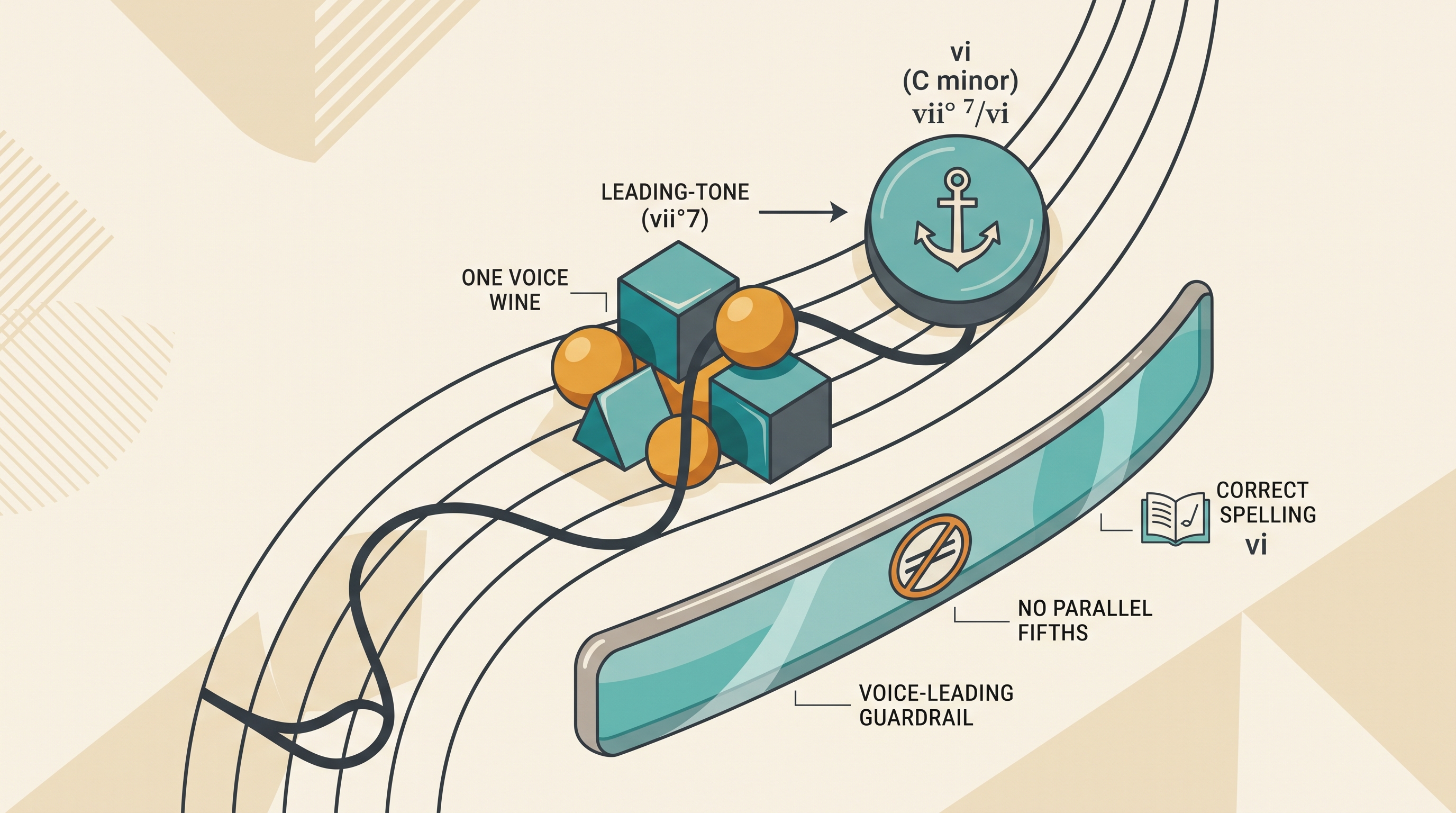
Analysis and notation are inseparable from eighteenth-century voice-leading conventions. Chromatically altered tones must resolve appropriately, voices should remain within practical ranges, and part writing should avoid forbidden parallels—especially parallel fifths. A correct Roman numeral attached to an incorrectly spelled or poorly connected chord is not a complete solution.
Retrieval check: In E-flat major, which applied leading-tone seventh chord tonicizes the diatonic $vi$ chord, C minor? Identify its root, spell the chord, and write its analysis. The target is C, so its leading tone is B natural; the chord is B–D–F–A-flat, analyzed as $\mathrm{vii}^{\circ 7}/vi$.
Source Materials
- Learn More (.pdf)
- AP Music Theory Course and Exam Description
- AP Music Theory Course Overview
- AP Music Theory Course at a Glance
- AP Music Theory Course at a Glance Poster
- Adopt AP Music Theory
- AP Music Theory
- AP Music Theory
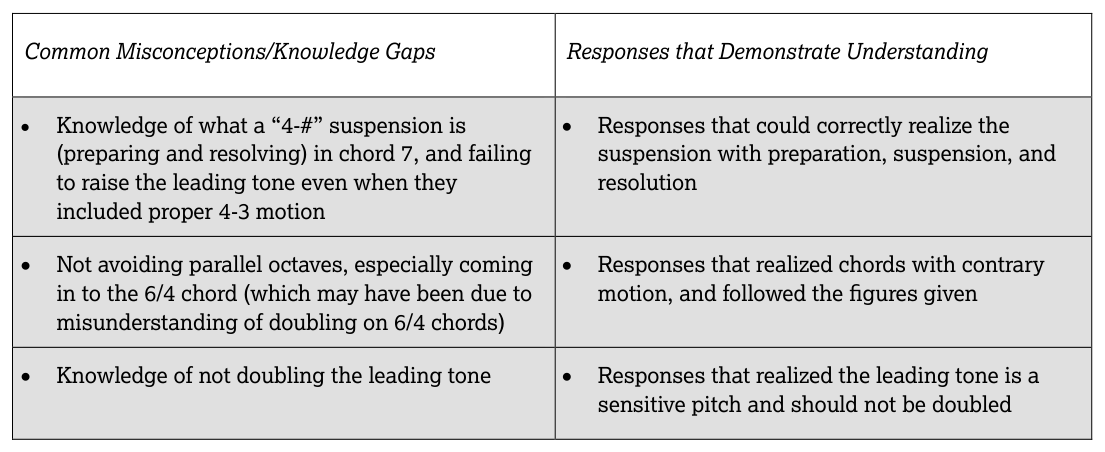
- Other frequent (though less common) student misconceptions/gaps in knowledge observed in the responses included: