From the free course AP Music Theory on Lykke
4.1 Soprano-bass counterpoint
Key concepts: Soprano-bass counterpoint · SATB voice leading · Parallel perfect intervals · Beat-to-beat parallels · Hidden (covered) perfect intervals · Direct perfect intervals · Overlapping voices · Phrase structure and phrase relationships · Roman-numeral harmonic analysis · Common-practice period part-writing
A convincing bass line does more than supply low notes: it forms a second melody that must cooperate with the soprano at every moment. Soprano-bass counterpoint is the practice of completing a bass beneath a given soprano while controlling harmonic function, melodic direction, phrase shape, and the intervals formed…
4.1 Soprano-bass counterpoint
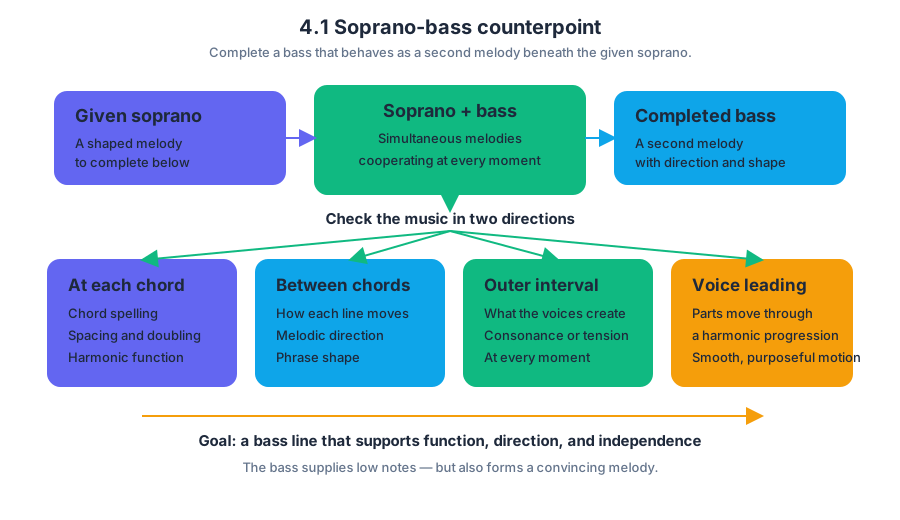
A convincing bass line does more than supply low notes: it forms a second melody that must cooperate with the soprano at every moment. Soprano-bass counterpoint is the practice of completing a bass beneath a given soprano while controlling harmonic function, melodic direction, phrase shape, and the intervals formed between the outer voices.
Voice leading describes how individual voices or parts move as a harmonic progression advances from one chord to the next.
In a two-voice exercise, inspect the soprano and bass as simultaneous melodies. At each chord, check chord spelling, spacing, doubling, and harmonic progression; from one chord to the next, check how each line moves and what interval the two voices create.
The outer voices as a musical conversation
The soprano often supplies a given melodic contour, while the bass must create a complementary line beneath it. A useful first pass is to identify likely harmonic goals from the soprano’s notes, then use Roman-numeral analysis to choose a bass that supports those goals without producing forbidden motion.
For example, suppose a phrase in C major begins with a soprano moving $E_4$–$F_4$–$G_4$ and ends with a soprano $D_4$–$C_4$. A plausible bass might move $C_3$–$F_3$–$G_3$–$C_3$, supporting a progression such as
$$ I \rightarrow IV \rightarrow V \rightarrow I. $$
The bass rises toward the dominant, then returns to tonic at the cadence. The exact notes depend on the complete harmony, but the underlying reasoning is consistent: identify the phrase’s destination, plan the harmonic progression, and make the bass line singable rather than merely functional.
Perfect intervals: the motion test
A perfect interval is a perfect fifth or perfect octave in this context. The central error is not simply “two perfect intervals”; it is parallel motion into consecutive perfect intervals: the same two voices move in the same direction and preserve a perfect fifth or octave.
| Motion between the same two voices | Example pattern | Parallel-perfect-interval error? |
|---|---|---|
| Same direction, $P8 \rightarrow P8$ | Bass $G_2 \rightarrow A_2$; soprano $G_4 \rightarrow A_4$ | Yes |
| Same direction, $P5 \rightarrow P5$ | Tenor $C_4 \rightarrow D_4$; alto $G_4 \rightarrow A_4$ | Yes |
| Same direction on successive beats | Perfect interval on beat $1$, another on beat $2$ | Yes |
| Opposite directions into a perfect interval | One voice rises while the other falls | No, not by the parallel rule |
| Similar motion into a perfect interval | Both voices move toward a new $P5$ or $P8$ | Possible hidden/direct error |
Beat-to-beat parallels require special attention. Compare the interval between the same two voices on successive beats, even when notes intervene between the attacks. If the first strong beat forms a perfect octave and the next strong beat forms another perfect octave, the result is treated as a parallel error.
Contrary motion is different: if the bass moves up while the soprano moves down, the voices are not moving in parallel. Thus, a $P5$ or $P8$ approached by contrary motion is not a parallel-perfect-interval error. Do not confuse “successive perfect intervals” with “parallel perfect intervals”; direction determines the classification.
Hidden and direct perfect intervals
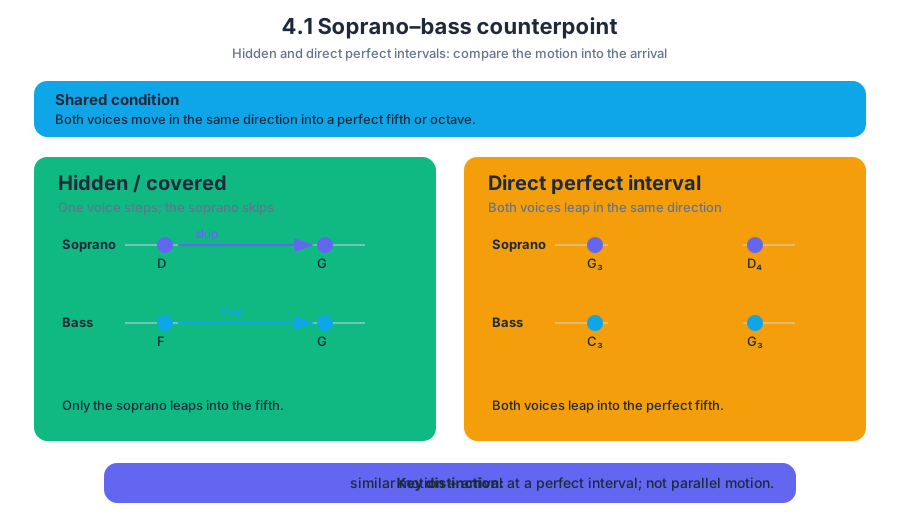
A hidden, or covered, perfect interval occurs when two voices move in the same direction into a perfect fifth or octave. In outer-voice writing, the soprano’s motion matters especially: a soprano skip into the perfect interval makes the arrival sound more exposed.
The source examples distinguish two cases. A bass moving by step from $F$ to $G$ while the soprano skips from $D$ to $G$ may be acceptable because only the soprano leaps. By contrast, if both voices leap in the same direction into the perfect interval, the result is unacceptable.
A direct perfect interval is the especially conspicuous case in which both voices move in the same direction—often by skip—into a perfect fifth or octave. For example:
$$ \text{Bass: } C_3 \rightarrow G_3 \qquad \text{Soprano: } G_3 \rightarrow D_4 $$
The voices move upward by leap and arrive at a perfect fifth. This is not a parallel interval, because the starting interval is not another perfect fifth; it is a direct-perfect-interval problem caused by similar motion and simultaneous leaps.
Spacing, overlap, and independence
Voices must remain distinct in register. Voice overlap occurs when a lower voice moves above the previous pitch of a higher voice, or when a higher voice moves below the previous pitch of a lower voice. If the bass moves from $G_3$ to $D_4$ while the soprano moves from $C_4$ to $B_3$, the new bass note $D_4$ is higher than the soprano’s previous $C_4$—an overlap error.
Do not confuse overlap with ordinary spacing. A bass and soprano may be separated by a wide interval, but neither should cross the prior position of the other. The voices should sound like independent lines, not like two parts exchanging registers.
Phrase structure determines the solution
A soprano-bass solution must also follow the phrase. Phrases are often marked by cadences and fermatas, and a phrase may function as an antecedent—a question-like opening that ends with a half cadence—or a consequent—a reply that more strongly closes with an authentic cadence.
This distinction guides bass contour and harmonic choice:
- An antecedent phrase may move toward $V$ and finish with a half cadence, leaving the music open.
- A consequent phrase may repeat or vary the opening, then direct the bass toward $V \rightarrow I$ for an authentic cadence.
- Parallel phrases begin with similar or identical melodic material; their bass openings may echo the same contour while changing the cadence.
- Contrasting phrases begin differently, so the bass may answer with a new register, direction, or harmonic route while still supporting the larger period.
For instance, two phrases might share the same soprano opening, but the first ends on $V$ and the second ends on $I$. Reusing a related bass opening preserves the parallel relationship; changing the final bass motion from a dominant arrival to a tonic arrival creates the phrase-level contrast between an open antecedent and a closed consequent.
AP skill connection and retrieval check
This topic develops 2.E: Use symbols and terms to describe and apply harmonic, melodic, and rhythmic procedures of 18th-century voice leading (up to 4 voices) in notated music. It also uses 2.F: Use terms and symbols to describe formal features and relationships in notated music, including motives, phrases, and phrase relationships. In performed music, the corresponding interpretive work connects with 1.E and 1.F: recognizing voice-leading procedures and phrase relationships by ear.
Retrieval check: If the bass and soprano move in opposite directions into a perfect octave, is that automatically parallel motion? If both move upward by leap into a perfect fifth, what problem should you investigate? Finally, which cadence better completes a consequent phrase: a half cadence or an authentic cadence?
Answers: opposite-direction motion is not parallel motion; both voices leaping into the perfect fifth suggests a direct perfect interval; and an authentic cadence normally provides the stronger consequent ending.
Source Materials
- Learn More (.pdf)
- AP Music Theory Course and Exam Description
- AP Music Theory Course Overview
- AP Music Theory Course at a Glance
- AP Music Theory Course at a Glance Poster
- Adopt AP Music Theory
- AP Music Theory
- AP Music Theory
- AP Music Theory-AP Students-College Board
- AP Music Theory-Unit Study Guides
- AP Music Theory-Raidar Choir
- Everything you need to know to get a 5 on AP Music Theory