From the free course AP Music Theory on Lykke
1.5 Major keys and key signatures
Key concepts: Major keys · Major scales · Key signatures · Tonic or central pitch · D major · Identifying keys in notated music · Representing scale pitches with a key signature · Major and minor scales · Clefs and notated music
A key signature tells you which pitches belong to a scale, but it does not by itself tell you whether the music is major or minor.
1.5 Major keys and key signatures
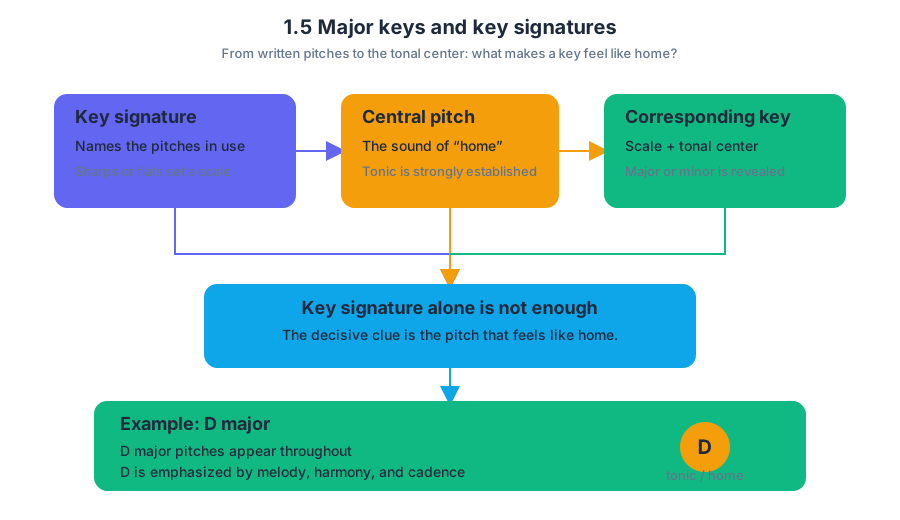
A key signature tells you which pitches belong to a scale, but it does not by itself tell you whether the music is major or minor. The decisive clue is the central pitch—the pitch that sounds like “home.”
PIT-1.F.1: When a particular major or minor scale is used prominently and its tonic is established as the central pitch, the music is said to be in the corresponding key.
For example, a passage may use the pitches of the D major scale and repeatedly emphasize $D$ through melody, harmony, or cadence. Because $D$ functions as the tonal center, the passage is in the key of D major.
Key, scale, and key signature
A scale is an ordered collection of pitches. A key is the tonal organization created when one pitch—the tonic, or central pitch—acts as the point of rest. A key signature is the grouping of sharps or flats placed after the clef that represents the pitch collection associated with a major or minor key.
In D major, the scale is:
$$D\ E\ F\sharp\ G\ A\ B\ C\sharp\ D$$
The key signature contains two sharps, $F\sharp$ and $C\sharp$. Once those sharps appear in the signature, every $F$ and $C$ is normally performed as sharp unless an accidental temporarily changes it.
Pitches belonging to the prevailing scale are diatonic. A pitch outside that scale is chromatic. Thus, $F\sharp$ is diatonic in D major, while $F\natural$ is chromatic unless the music changes its tonal context.
Major and minor can share a key signature
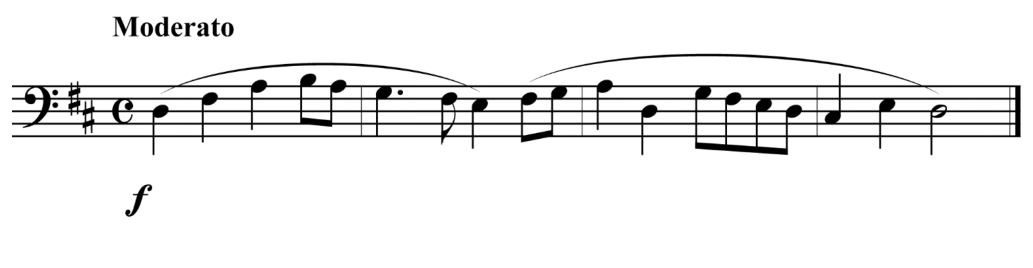
A major key and a minor key may use the same key signature. D major and B minor are a crucial example:
| Tonal collection | Pitches | Key signature |
|---|---|---|
| D major | $D\ E\ F\sharp\ G\ A\ B\ C\sharp$ | $F\sharp$, $C\sharp$ |
| B natural minor | $B\ C\sharp\ D\ E\ F\sharp\ G\ A$ | $F\sharp$, $C\sharp$ |
The shared signature represents the natural-minor collection for B minor. Minor music may then alter pitches with accidentals. In B harmonic minor, the seventh scale degree $A$ is raised to $A\sharp$:
$$B\ C\sharp\ D\ E\ F\sharp\ G\ A\sharp\ B$$
In ascending B melodic minor, the sixth and seventh degrees are raised:
$$B\ C\sharp\ D\ E\ F\sharp\ G\sharp\ A\sharp\ B$$
The raised $G\sharp$ and $A\sharp$ are written as accidentals in the music; they are not added to the ordinary B-minor key signature. This distinction matters: the key signature identifies the underlying collection, while accidentals show temporary alterations such as harmonic- or melodic-minor inflections.
Identifying a key signature in notation
Read a key signature in two stages:
- Identify the sharps or flats and their order.
- Decide which pitch acts as tonic.
For sharp signatures, the last sharp is usually one half step below the major tonic. If the signature contains $F\sharp$ and $C\sharp$, the last sharp is $C\sharp$; one half step above it is $D$. The major key is therefore D major.
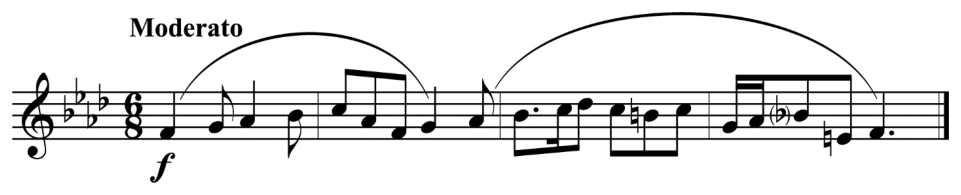
For flat signatures, the major tonic is generally the second-to-last flat. For example, a signature containing $B\flat$, $E\flat$, and $A\flat$ points to E-flat major, because $E\flat$ is the second-to-last flat. The one-flat signature is the exception: it identifies F major.
The clef changes where the symbols appear on the staff, but not what they mean. In treble clef, a key signature containing $F\sharp$ and $C\sharp$ still means those pitch classes are sharp; in bass clef, the symbols are positioned differently but identify the same signature.
Major or relative minor?
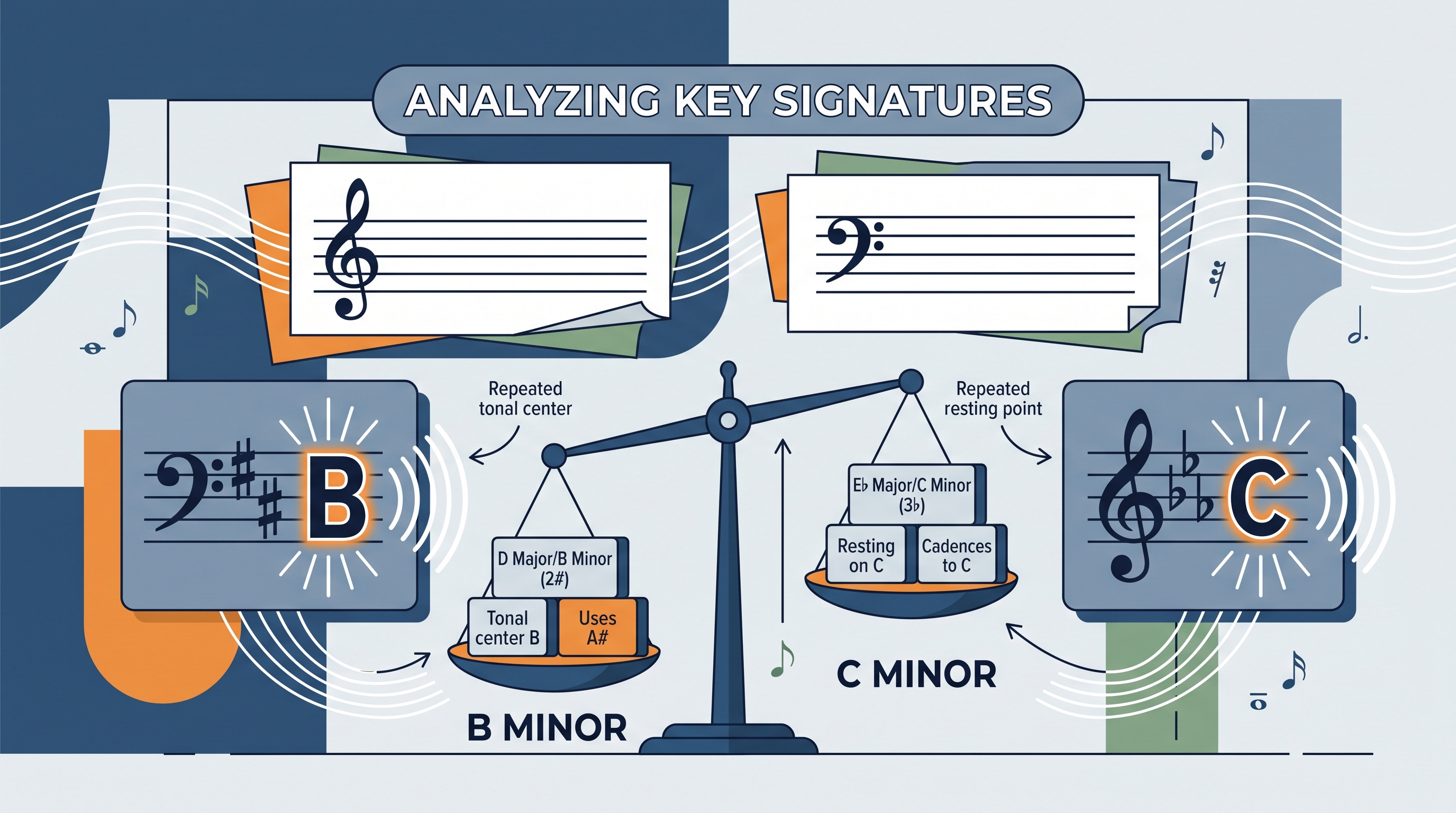
When a key signature could represent either a major or minor key, inspect the musical evidence. Look for the final or longest-held pitch, repeated emphasis, melodic arrival points, and harmonic cadences. A signature of two sharps may indicate D major if $D$ feels like home, or B minor if $B$ is the tonal center.
Common misconception: “The key signature tells me the key automatically.”
A key signature tells you the available default pitches, not necessarily the tonic. The same two-sharp signature can belong to D major or B minor; tonal center determines the answer.
Common misconception: “A raised seventh changes the key signature.”
In minor music, a raised seventh such as $A\sharp$ in B harmonic minor is normally written as an accidental. It changes the pitch used at that moment, not the underlying key signature.
Worked identification
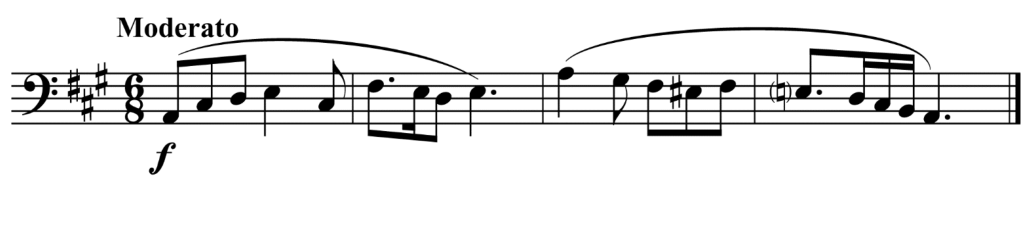
Suppose a bass-clef melody has two sharps in its key signature, repeatedly ends on $B$, and uses $A\sharp$ before the final $B$. The reasoning is:
- Two sharps establish the shared D-major/B-minor pitch collection.
- The repeated arrival on $B$ identifies $B$ as the tonal center.
- The $A\sharp$ is a raised seventh, supporting harmonic minor.
- Therefore, the passage is in B minor, not D major.
Retrieval check: A treble-clef passage has three flats, repeatedly rests on $C$, and cadences to $C$. Is it C minor or E-flat major? What evidence would confirm your answer, and which pitch alterations might appear in C harmonic or melodic minor?
Source Materials
- Learn More (.pdf)
- AP Music Theory Course and Exam Description
- AP Music Theory Course Overview
- AP Music Theory Course at a Glance
- AP Music Theory Course at a Glance Poster
- Adopt AP Music Theory
- AP Music Theory
- AP Music Theory
- Figure — Sight Singing Questions (p. 3)
- Figure — Sight Singing Questions (p. 4)
- Figure — Music, Sight Singing Question 2 Transcript (p. 1)