AP Environmental Science
113 study materials · 59 sections
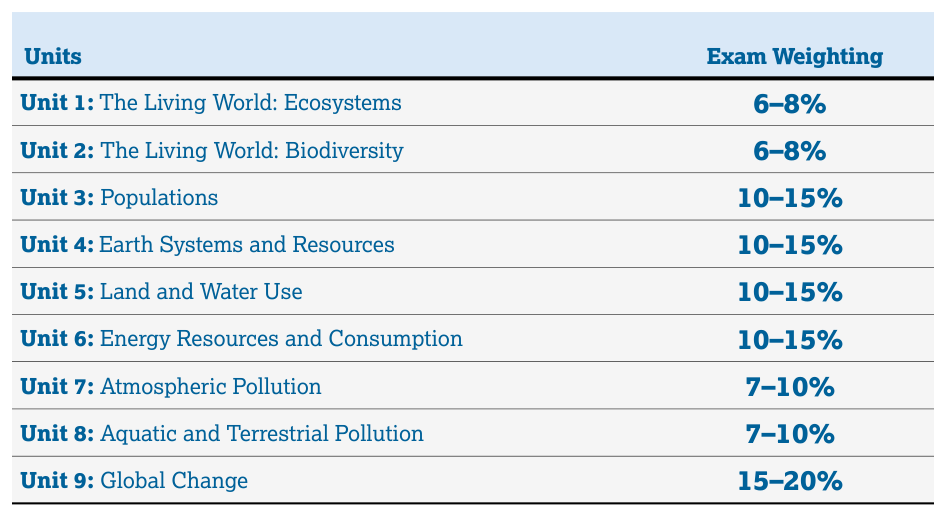
AP Environmental Science students working the current College Board Course and Exam Description, including first-time students with no prior background, plus teachers reviewing the page for CED alignment.; Teach every official CED unit and every numbered topic at topic granularity.; Develop every AP skill / science-practice code explicitly and by name.; Replace description with teaching: worked contextual examples, named misconceptions, and in-flow retrieval checks.; Build an exam-practice unit covering every task type on the current exam.
Course Sections
Course Framework, Skills and Reasoning Processes
Key concepts: AP Environmental Science course framework · Big ideas as cross-cutting concepts · Concept explanation · Visual representation and interpretation · Text analysis · Scientific investigation and reasoning · Energy flow through systems · Interactions between Earth systems · Ecosystems · Biodiversity and terrestrial biomes
Environmental systems are best understood as connected systems: energy moves through them, matter cycles within them, organisms interact with one another and their surroundings, and human decisions can either strengthen or destabilize those relationships.
1.1 Introduction to Ecosystems · 1.2 Terrestrial Biomes
Key concepts: Ecosystems · Terrestrial biomes · Biotic and abiotic factors · Climate · Global distribution of biomes · Species interactions · Resource distribution · Energy transformations · Temperate seasonal forests · Savannas
An ecosystem is a community of organisms interacting with one another and with the nonliving environment around them. A forest, for example, is not merely a collection of trees: sunlight, soil minerals, temperature, water, fungi, insects, birds, and decomposers continuously affect one another.
1.3 Aquatic Biomes · 1.4 The Carbon Cycle
Key concepts: Freshwater biomes · Marine biomes · Algae and aquatic primary productivity · Carbon reservoirs · Carbon cycle · Photosynthesis · Cellular respiration · Fossil fuel combustion · Carbon dioxide in the atmosphere · Aquatic photosynthesis in low-light environments
Water is not one ecosystem: a fast, oxygen-rich stream, a nutrient-loaded estuary, and a dark deep-ocean zone impose very different conditions on life. At the same time, these aquatic systems participate in the global carbon cycle, the movement of carbon among living organisms, the atmosphere, oceans, soils, and…
1.5 The Nitrogen Cycle · 1.6 The Phosphorus Cycle
Key concepts: Nitrogen cycle · Nitrogen fixation · Nitrogen compounds as limiting nutrients · Human impacts on the nitrogen cycle · Strategies to reduce human impact on the nitrogen cycle · Phosphorus cycle · Phosphorus-bearing minerals and sediments · Phosphorus as a limiting nutrient · Absence of a significant atmospheric reservoir in the phosphorus cycle · Synthetic nitrogen fertilizer and compost application calculations
Nitrogen and phosphorus are both essential nutrients, but ecosystems often receive them through very different pathways: nitrogen enters through biological conversion of atmospheric $N_2$, while phosphorus is released mainly when rocks and sediments weather.
1.7 The Hydrologic (Water) Cycle · 1.8 Primary Productivity
Key concepts: The hydrologic (water) cycle · Primary productivity · Gross primary productivity (GPP) · Photosynthesis · Net primary production (NPP) · Solar energy conversion · Energy flow in ecosystems · Productivity comparisons among common ecosystems · Productivity measured per unit area · Productivity measured as total energy
A forest can grow only where water arrives, remains available, and can be moved through living tissue; an ocean can contain abundant water yet support very different photosynthetic activity at different depths.
1.9 Trophic Levels · 1.10 Energy Flow and the 10% Rule
Key concepts: Trophic levels · Energy flow through ecosystems · The 10% rule · Producers · Primary, secondary, and tertiary consumers · Food chains and food webs · Omnivores and carnivores · Detritivores and decomposers · Nutrient cycling · Energy and matter in ecosystems
Only about $10\%$ of the energy available at one trophic level reaches the next, so ecosystems contain progressively less usable energy as energy moves upward from producers to consumers.
1.11 Food Chains and Food Webs
Key concepts: Food chains · Food webs · Visual representations and models · Biogeochemical cycles · Effects of changes within a cycle · Phosphorus cycle and nutrient limitation · Invasive species and ecosystem impacts · Habitat fragmentation, disturbance, and species richness · Ecosystem services · Environmental characteristics and processes
A food chain is a single pathway showing who eats whom; a food web is the more realistic network of interconnected feeding pathways in an ecosystem.
2.1 Ecosystem Services · 2.2 Island Biogeography
Key concepts: Ecosystem services · Provisioning services · Regulating services · Cultural services · Supporting services · Human disruptions to ecosystem services · Island biogeography theory · Calculating average number of species across islands · Invasive species range expansion · Spatial-temporal interpretation of species distributions
A forest can be valuable even when no timber is harvested: it may filter drinking water, store carbon, support pollinators, provide recreation, and sustain food webs.
2.3 Ecological Tolerance · 2.4 Natural Disruptions to Ecosystems
Key concepts: Ecological tolerance · Temperature, salinity, flow rate, and sunlight as environmental conditions · Individual and species tolerance ranges · Natural disruptions to ecosystems · Short-term and long-term ecosystem impacts · Environmental consequences of natural disruptions · Major environmental change and upheaval over geological time · Ecosystem structure and diversity changing over time · Analyzing and interpreting tables, charts, and graphs
A trout cannot survive in every stream: temperature, salinity, flow rate, and sunlight each impose limits on where it can live, grow, and reproduce. Ecological tolerance is the range of environmental conditions an organism can endure before injury or death results.
2.5 Adaptations · 2.6 Ecological Succession
Key concepts: Ecological succession · Primary succession · Secondary succession · Pioneer species · Successional stages and soil development · Adaptations of pioneer species · Plant diversity and ecosystem resilience · Recovery after disturbance · Succession in different biomes · Relationships among variables in ecological data
A community does not return after disturbance all at once: organisms arrive in a sequence shaped by soil, sunlight, nutrients, climate, and biological interactions. Ecological succession is the predictable change in species composition and community structure over time.
3.1 Generalist and Specialist Species · 3.2 K-Selected and r-Selected Species
Key concepts: Generalist species · Specialist species · Habitat stability and species advantage · Changing habitats and species advantage · Invasive species · Generalist or r-selected characteristics of invasive species · K-selected species · r-selected species · Biodiversity and ecosystem recovery · Habitat loss and species loss
A habitat that changes slowly rewards precision; a habitat that changes often rewards flexibility. These two pressures help explain why some organisms are specialist species, adapted to a narrow range of conditions, while others are generalist species, able to use many resources and tolerate varied conditions.
3.3 Survivorship Curves · 3.4 Carrying Capacity
Key concepts: Survivorship curves · Cohorts and cohort survival · The three main survivorship-curve shapes · Survival patterns across different life stages · K-selected and r-selected reproductive strategies · The relationship between reproductive strategy and survivorship-curve shape · Carrying capacity · Resource availability and sustainable population size · Habitat loss and reduced carrying capacity · Analyzing and explaining patterns and trends in survivorship data
A population can lose most of its members either early in life, steadily across life, or mainly near old age. A survivorship curve shows how the proportion of a birth group remains alive as the group ages; carrying capacity, in contrast, describes how many individuals an environment can sustain.
3.5 Population Growth and Resource Availability · 3.6 Age Structure Diagrams
Key concepts: Population growth · Resource availability · Carrying capacity · Finite resource base · Population growth rates · Age structure diagrams · Population age distribution · Stable and declining populations · Social and cultural factors · Population fluctuations
A population can expand rapidly when food, water, space, and other necessities are abundant—but no population can draw indefinitely from an unlimited supply. Resource availability connects the short-term rate of population growth to the longer-term limits imposed by a finite environment.
3.7 Total Fertility Rate · 3.8 Human Population Dynamics
Key concepts: Total fertility rate (TFR) · Human population dynamics · Birth rates and death rates · Immigration and emigration · Rate of natural increase (RNI) · Replacement-level fertility · Infant mortality rates · Population pyramids · Factors affecting fertility, including age at first child and education · Data analysis of population patterns and trends
A population can continue growing even after its total fertility rate has fallen because today’s large number of young people may still enter childbearing ages.
3.9 Demographic Transition
The demographic transition is the long-term shift from high birth and death rates to low birth and death rates as a society industrializes and gains access to improved sanitation, medicine, education, and economic opportunities.
4.1 Plate Tectonics · 4.2 Soil Formation and Erosion
Key concepts: Plate tectonics · Global distribution of plate boundaries · Convergent, divergent, and transform plate boundaries · Using figures and maps to identify plate boundaries · Environmental issues related to plate boundaries · Soil formation during primary succession · Soil erosion · Effects of forested versus clear-cut areas · Land-use change and grazing · Cultural ecosystem services provided by mature forests
Plate tectonics describes the movement of rigid pieces of Earth’s lithosphere over the softer asthenosphere beneath them. That slow motion reshapes landscapes, creates hazards, and can even influence where ecosystems develop: the Serengeti National Park, for example, lies above a divergent plate boundary, where…
4.3 Soil Composition and Properties · 4.4 Earth’s Atmosphere
Key concepts: Soil horizons · Soil porosity, permeability, and fertility · Soil texture and composition · Clay, silt, and sand percentages · Loam · Chemical, physical, and biological soil testing methods · Atmospheric layers and temperature gradients · Thermal inversions · Scientific research methods and experimental variables · Interactions among Earth’s systems and balance over time
A handful of soil is a miniature water-management system: its particles determine how much water enters, how much remains available to plants, and how easily nutrients move.
4.5 Global Wind Patterns · 4.6 Watersheds
Key concepts: Global wind patterns · Atmospheric circulation · Solar radiation · Density differences · Coriolis effect · Earth system interactions · Environmental factors · Rainfall patterns · Wind patterns · Earth system balance
Global wind patterns begin with an unevenly heated planet: the equator receives the most intense solar radiation, so air there warms, expands, and becomes less dense than surrounding air.
4.7 Solar Radiation and Earth’s Seasons · 4.8 Earth’s Geography and Climate
Key concepts: Incoming solar radiation (insolation) · Relationship between solar radiation, season, and latitude · Solar-ray angle and radiation intensity · Earth’s axial tilt and seasons · Earth’s geography · Weather and climate · Geologic factors affecting weather and climate · Geographic factors affecting weather and climate · Atmospheric circulation · Global wind patterns and equatorial solar radiation
Earth’s surface is heated unevenly because sunlight arrives at different angles, for different lengths of time, at different latitudes and seasons. That uneven heating drives temperature differences, while Earth’s landforms and geographic position reshape the resulting weather and climate.
4.9 El Niño and La Niña
Every few years, the tropical Pacific Ocean changes the way it stores and releases heat, rearranging rainfall, fisheries, storms, and drought risk across much of the planet.
5.1 The Tragedy of the Commons · 5.2 Clearcutting
Key concepts: Tragedy of the commons · Shared/common resources · Individual self-interest and resource depletion · Overfishing · Clearcutting · Human impacts on natural systems · Sustainability · Case studies and solution evaluation · Quantitative data analysis · Aquatic food-chain effects of invasive species
A fishery can collapse even when every fisher is making a decision that seems economically reasonable: catch one more fish before someone else does. This conflict between individual self-interest and the common good is the tragedy of the commons.
5.3 The Green Revolution · 5.4 Impacts of Agricultural Practices
Key concepts: Green Revolution agricultural strategies · Mechanization · Genetically modified organisms (GMOs) · Fertilization and soil fertility management · Irrigation and aquifer use · Pesticide use · Overgrazing and livestock management · Salinization and soil degradation · Free-range livestock systems
A single field can produce far more food than it once did—but only by redirecting energy, water, nutrients, and technology into the agricultural system. The Green Revolution was this broad shift toward agricultural strategies designed to increase food production, including mechanization, genetically modified…
5.5 Irrigation Methods · 5.6 Pest Control Methods
Key concepts: Irrigation-method evaluation · Pest-control methods · Physical pest control through trapping · Genetically modified pest-resistant crops · Advantages, disadvantages, and unintended consequences of solutions · Nutrient cycling through decomposition · Community resilience and biodiversity · Ecological succession after disturbance · Population and community changes after introduction of a new species · Nutrient and sediment runoff comparisons between crop plots
How can a farm increase crop production without simply transferring its problems into the soil, water, or surrounding ecosystem? Irrigation and pest control are environmental solutions because they address immediate agricultural limits—but every solution can create new effects elsewhere.
5.7 Meat Production Methods · 5.8 Impacts of Overfishing
Key concepts: Concentrated animal feeding operations (CAFOs) and feedlots · Pasture-based meat production · Rotational grazing · Free-range grazing · Economic efficiency and consumer costs of CAFOs · Environmental benefits and drawbacks of different meat-production methods · Effects of reducing ruminant meat consumption · Greenhouse-gas emissions from livestock, including CO2, CH4, and N2O · Freshwater conservation and reduced reliance on antibiotics and growth hormones · Feed-quality improvements and precision-farming technologies
A kilogram of protein does not have the same environmental cost in every food system: meat production generally requires more land, water, and energy than plant-based protein, but the method used to raise animals strongly changes the outcome.
5.9 Impacts of Mining · 5.10 Impacts of Urbanization
Key concepts: Trophic levels · Demographic transition · Climate · Urbanization · Geothermal energy
Mining and urbanization reshape landscapes by moving enormous amounts of rock, soil, water, and energy through human systems. The environmental question is not simply whether these activities are “good” or “bad,” but how their benefits, risks, and long-term costs are distributed across ecosystems and communities.
5.11 Ecological Footprints · 5.12 Introduction to Sustainability
Key concepts: Ecological footprints · Human use of natural resources · Natural-system alteration · Resource demands and waste production · Individual and societal environmental impacts · Land and water use · Climate impacts · Introduction to sustainability · Impacts of urbanization
Every meal, building, trip, and manufactured object depends on natural resources—and using those resources alters natural systems. An ecological footprint estimates the resource demands and waste production associated with an individual or society, including demands on land and water.
5.13 Methods to Reduce Urban Runoff · 5.14 Integrated Pest Management
Key concepts: Methods to reduce urban runoff · Permeable pavement · Planting trees · Increased use of public transportation · Integrated pest management (IPM) · Combining methods to control pest species · Minimizing disruption to human health and the environment · Advantages and drawbacks of IPM
Urban runoff increases when rain falls on hard, impervious surfaces and cannot soak into the ground. Two powerful environmental solutions address this problem from different directions: redesigning human infrastructure to manage water, and combining pest-control methods to reduce harm to people and ecosystems.
5.15 Sustainable Agriculture · 5.16 Aquaculture
Key concepts: Sustainable agriculture · Aquaculture · Sustainable farming techniques · Soil integrity · Land degradation · Plant agriculture · Livestock agriculture · Interactions
Agriculture is sustainable when it produces food while maintaining the soil, water, and ecological systems that future production depends on. The central question is practical: How can farming supply food without exhausting the land that grows it?
5.17 Sustainable Forestry
Key concepts: Sustainable forestry · Sustainability
A forest can produce timber indefinitely only when harvesting does not permanently reduce the forest’s ability to regenerate, support biodiversity, protect soil, and regulate water.
6.1 Renewable and Nonrenewable Resources · 6.2 Global Energy Consumption
Key concepts: Renewable energy resources · Nonrenewable energy resources · Regional distribution of natural energy resources · Global energy consumption · Nuclear power · Biomass energy · Wind energy · Hydroelectric power and dams · Hydrogen fuel cells · Environmental consequences of energy use
Every energy source transforms stored or moving energy into forms humans can use, but the crucial distinction is whether nature replaces the resource on a human timescale.
6.3 Fuel Types and Uses · 6.4 Distribution of Natural Energy Resources
Key concepts: Energy resources and consumption · Fuel types and their uses · Coal formation and quality · Natural gas · Crude oil and tar sands · Fossil-fuel refining · Nuclear fission · Distribution and availability of natural energy resources · Environmental consequences of energy use
A fuel’s usefulness depends on more than how much energy it contains: its physical form, chemical composition, location, accessibility, and environmental cost determine whether people can realistically use it for heating, transportation, or electricity.
6.5 Fossil Fuels · 6.6 Nuclear Power
Key concepts: Fossil-fuel combustion for electricity generation · Environmental impacts of fossil-fuel extraction and use · Surface mining and land-use changes · Fracking-related groundwater contamination and volatile organic compounds · Thermal pollution from power plants · Nuclear power and uranium-235 fuel · Electricity-generation calculations using percentages · Environmental impacts of burning fossil fuels · Ocean acidification · Coal and U.S. energy-consumption trends
Fossil-fuel power plants convert the chemical energy of coal, oil, or natural gas into electricity by burning the fuel, while nuclear plants release energy by splitting atomic nuclei.
6.7 Energy from Biomass · 6.8 Solar Energy
Key concepts: Biomass energy · Environmental consequences of overharvesting trees for fuel · Ethanol as a biomass-based gasoline fuel · Carbon emissions from burning biomass fuels · Solar energy · Photovoltaic systems · Active solar energy systems · Availability of sunlight as a limitation · Environmental benefits and impacts of solar energy · Energy use producing positive and negative consequences
A forest can become a fuel tank—but if people remove trees faster than the ecosystem replaces them, the “renewable” fuel source can produce lasting damage.
6.9 Hydroelectric Power · 6.10 Geothermal Energy
Key concepts: Hydroelectric power generation · Dams and reservoirs · River turbines · Tidal energy · Environmental effects of hydroelectricity · Geothermal energy generation · Geothermal energy accessibility and cost · Hydrogen sulfide release · Thermal energy from Earth · Turbines and electricity generation
Both hydroelectric and geothermal systems generate electricity by turning a turbine—a rotating machine connected to an electric generator—but they draw energy from different natural flows: hydroelectricity uses moving water, while geothermal energy uses heat stored inside Earth.
6.11 Hydrogen Fuel Cell · 6.12 Wind Energy
Key concepts: Hydrogen fuel cells · Hydrogen and oxygen reaction · Renewable fuel sources · Hydrogen fuel cells in power generation · Environmental impacts of hydrogen fuel cells · Hydrogen fuel-cell automobiles · Energy-intensive hydrogen production · Economic cost of hydrogen vehicles · Safety risks of hydrogen fuel cells · Wind energy
A hydrogen fuel cell generates electricity by combining hydrogen gas with oxygen from the air; a wind turbine generates electricity by capturing the kinetic energy of moving air.
6.13 Energy Conservation
Energy conservation means reducing the amount of energy consumed while still providing the same useful service—such as lighting a room, heating a building, or transporting a person.
7.1 Introduction to Air Pollution · 7.2 Photochemical Smog
Key concepts: Air pollution from fossil-fuel combustion · Pollutants released by coal combustion · Nitrogen oxides from fossil-fuel combustion · Photochemical smog formation · Role of heat and sunlight in smog formation · Volatile organic hydrocarbons · Primary and secondary air pollutants · Sulfur dioxide and air quality · Lead pollution and Clean Air Act regulation · Catalytic converters as pollution-control devices
A vehicle can release pollutants that were not present in its fuel as separate substances: combustion transforms fuel and oxygen into new gases, particles, and reactive chemicals.
7.3 Thermal Inversion · 7.4 Atmospheric CO₂ and Particulates
Key concepts: Thermal inversion · Normal atmospheric temperature gradient · Air pollution trapping near Earth’s surface · Photochemical smog · Particulates · Nitrogen oxides (NOx) · Volatile organic compounds (VOCs) · Natural gas versus coal power generation · Air-quality improvement through pollutant reduction · Visual interpretation of environmental processes
A thermal inversion occurs when the usual atmospheric temperature pattern reverses: air near Earth’s surface becomes cooler than air above it. The result is like placing a lid over a shallow bowl of smoke—the pollutants cannot mix upward easily, so concentrations increase where people live and breathe.
7.5 Indoor Air Pollutants · 7.6 Reduction of Air Pollutants
Key concepts: Indoor air pollution · Carbon monoxide as an asphyxiant · Particulate indoor air pollutants · Volatile organic compounds (VOCs) · Formaldehyde as an indoor air pollutant · Radon gas and radioactive decay · Health effects of indoor air pollutants · Sources and pathways of indoor pollutants · Reduction of air pollutants · Data analysis of air-pollution patterns and trends
Indoor air pollution can build inside a home even when outdoor air appears clean. The key question is not merely what pollutant is present, but also where it comes from, how it affects people, and which intervention removes or reduces the exposure.
7.7 Acid Rain · 7.8 Noise Pollution
Key concepts: Acid rain formation and environmental effects · Sulfur dioxide and nitrogen oxide air pollution · Soil and limestone buffering of acid rain · Coal-burning power plants as sources of sulfur dioxide · Methods for reducing air pollution from power plants · Particulate matter sources · Vapor recovery nozzles and volatile organic compounds · Reducing vehicle commuting to lower emissions · Noise pollution and environmental consequences · Environmental technology and pollution mitigation
Coal-burning power plants can affect ecosystems hundreds of kilometers away: sulfur-containing fuel releases sulfur dioxide, atmospheric reactions produce sulfuric acid, and prevailing winds carry the resulting acid deposition downwind.
8.1 Sources of Pollution · 8.2 Human Impacts on Ecosystems
Key concepts: Sources of pollution · Primary and secondary air pollutants · Physical, chemical, and biological consequences of human activities · Point sources of pollution · Human impacts on aquatic ecosystems · Economic impacts of oil pollution · Mercury contamination and methylmercury · Anthropogenic eutrophication · Environmental evidence and data analysis · Environmental problem-solving
A pollutant is a substance or form of energy introduced into the environment at a rate that can harm organisms, ecosystems, or human systems. Its effects depend not only on toxicity, but also on where it enters, how it moves, and how organisms respond.
8.3 Endocrine Disruptors · 8.4 Human Impacts on Wetlands and Mangroves
Key concepts: Endocrine disruptors · Interference with the endocrine system in animals · Birth defects and developmental disorders caused by endocrine disruptors · Gender imbalances in fish and other species · Wetlands as providers of regulating ecosystem services · Human impacts of urbanization and development on wetlands · Mangrove and wetland environmental problems · Nutrient and sediment pollution in estuaries · Environmental solutions for aquatic pollution · Water-quality improvement through filtration
A chemical does not need to kill an animal immediately to damage an ecosystem: if it interferes with hormones during development, it can alter reproduction, growth, or sexual development across an entire population.
8.5 Eutrophication · 8.6 Thermal Pollution
Key concepts: Deforestation · Clear-cutting · Water temperature · Shade from trees · Sunlight reaching water · Sedimentation
A forest can influence the temperature and oxygen content of a stream even when the trees never touch the water. Removing the forest changes the stream’s physical conditions first; those changes can then affect dissolved oxygen, algae, and aquatic organisms.
8.7 Persistent Organic Pollutants (POPs) · 8.8 Bioaccumulation and Biomagnification
Key concepts: Persistent organic pollutants (POPs) · Synthetic carbon-based molecules · Environmental persistence · Fat solubility · Toxicity to organisms · Bioaccumulation · Selective absorption into organisms’ fatty tissues · Biomagnification · Trophic levels · DDT and PCBs as examples of POPs
Persistent organic pollutants (POPs) are synthetic, carbon-based molecules that resist environmental breakdown and can become increasingly concentrated in organisms and food webs. Two important examples are DDT and PCBs.
8.9 Solid Waste Disposal · 8.10 Waste Reduction Methods
Key concepts: Solid waste · Solid waste disposal methods · Landfills · Landfill decomposition · Methane emissions · Incineration · Illegal dumping · Organic waste · Waste reduction methods · Electronic waste
A discarded cell phone, a banana peel, a worn tire, and a broken television all become part of the waste stream—but they do not behave alike after disposal.
8.11 Sewage Treatment · 8.12 Lethal Dose 50% (LD50)
Key concepts: Sewage treatment · Disinfection of treated sewage · Chlorine, ozone, and ultraviolet (UV) light as disinfectants · Lethal Dose 50% (LD50) · Interpreting an LD50 curve · Calculating LD50 · Dose-response relationships · Using experimental data to estimate LD50
Sewage treatment uses physical, biological, and chemical steps to reduce pollutants and pathogens before wastewater returns to the environment. The final safety question is simple but consequential: How can treated sewage be disinfected, and how can the toxicity of a chemical be measured quantitatively?
8.13 Dose Response Curve · 8.14 Pollution and Human Health
Key concepts: Dose-response curves · Evaluating dose-response curves · Dose of a toxin or drug · Organism effects from pollutants · Population mortality rate · Lethal dose 50% (LD₅₀) · Pollutants’ direct impacts on organism health · Pollutants’ indirect impacts on organism health · Pollution and human health · Aquatic and terrestrial pollution
A dose-response curve shows how an organism, or a population’s mortality rate, changes as exposure to a particular toxin or drug increases. The curve turns “more pollution” into a measurable question: How much exposure produces which biological effect?
8.15 Pathogens and Infectious Diseases
Key concepts: Human pathogens · Infectious diseases · Pathogen cycling through the environment · Environmental transmission pathways · Direct and indirect health impacts of pollutants · Sanitary waste disposal and drinking-water quality · Disease emergence in new areas · Respiratory and direct-contact transmission · Vector-borne transmission · Plague
A human pathogen is a disease-causing organism or infectious agent that can move among hosts, survive in environmental reservoirs, and exploit opportunities created by climate, pollution, or inadequate sanitation.
9.1 Stratospheric Ozone Depletion · 9.2 Reducing Ozone Depletion
Key concepts: Stratospheric ozone depletion · Anthropogenic causes of ozone depletion · Chlorofluorocarbons (CFCs) · Natural factors contributing to ozone depletion · Melting ice crystals in the atmosphere · Antarctic spring ozone depletion · Ultraviolet (UV) radiation · Human health effects of increased UV exposure · Skin cancer · Cataracts
A thin layer of ozone high above Earth acts like a planetary sunscreen: when it becomes thinner, more ultraviolet radiation reaches the surface, increasing risks such as skin cancer and cataracts.
9.3 The Greenhouse Effect · 9.4 Increases in Greenhouse Gases
Key concepts: The greenhouse effect · Greenhouse gases · Increases in greenhouse-gas concentrations · Global climate change · Global warming potential (GWP) · Atmospheric residence time · Antarctic ice-core proxy data · Relationship between atmospheric carbon dioxide and global temperature · Climate-change feedbacks · Melting sea ice and thawing tundra
Earth’s atmosphere stays warm because certain gases absorb and re-emit outgoing infrared radiation, creating the greenhouse effect. Without this natural process, Earth’s surface would be too cold for life as we know it; the problem arises when human activities increase the concentration of greenhouse gases and…
9.5 Global Climate Change · 9.6 Ocean Warming
Key concepts: Global climate change · Effects of climate change · Greenhouse gases and ocean acidification · Ocean warming · Coral bleaching · Oceanic currents and the ocean conveyor belt · Coastal and global climate impacts · Human activities affecting global systems · Climate-change impacts on habitats and species · Arctic versus global temperature change
Earth’s climate has changed throughout its history, but current warming is producing linked changes across ice, soil, oceans, ecosystems, and human communities. The key question is not merely whether temperature rises, but how one change propagates through connected Earth systems.
9.7 Ocean Acidification · 9.8 Invasive Species
Key concepts: Ocean acidification · Calcium carbonate shell formation · Coral reef damage · Invasive species · Non-native species · Competition with native species · Threats to native populations · Biological control · Preventing invasive-species spread
Ocean acidification makes seawater less chemically favorable for organisms that build calcium carbonate shells or skeletons, while invasive species can disrupt native populations after entering environments where they did not originally occur.
9.9 Endangered Species · 9.10 Human Impacts on Biodiversity
Key concepts: Endangered species · Human impacts on biodiversity · Strategies to combat biodiversity loss · Species health and ecosystem health · Effects of environmental change on species · Poaching as a threat to animal populations · Protecting animal populations · Species richness · Species diversity · Using experimental data to analyze biodiversity
A species can decline toward extinction because its habitat, food supply, breeding conditions, or ecological relationships have been altered—even when the change seems small. The central idea of 9.9 Endangered Species · 9.10 Human Impacts on Biodiversity is that species health is inseparable from ecosystem health.
AP Practice 1
Key concepts: Evidence-based reasoning and the scientific method in AP courses · Intellectual freedom and analyzing perspectives in AP · AP Classroom practice tests and feedback · Digital activation and AP class-section registration · AP IDs and streamlined exam registration · Applying environmental science to real-world social and environmental problems · Proposing and evaluating solutions to environmental problems · Interpreting experimental data · Population growth curves and population change calculations · Effects of climate factors on population growth and environmental change
Environmental science turns evidence into decisions: an observation becomes useful only when a student can test an explanation, interpret the results, and justify a solution to a real environmental or social problem.
AP Practice 2
Key concepts: Biogeochemical cycles · Energy acquisition and transfer into usable forms · Human impacts on Earth-system cycles · Environmental science terminology · Patterns and trends in environmental data · Ecological services and ecological functions · Biodiversity and genetic diversity · Reproductive strategies of species · Invasive and endangered species · Evaluating environmental solutions and legislation
A wetland can be both a living machine and a public health safeguard: its plants capture energy, its soils store nutrients, and its standing water can either support biodiversity or create mosquito-breeding habitat when drainage and water movement are disrupted.
AP Practice 3
A nitrate-rich runoff pulse can transform a clear stream into an oxygen-starved system because nutrient enrichment increases algal production, and decomposition of that algal biomass consumes dissolved oxygen.
AP Practice 4
A strong AP Environmental Science data response does more than identify a trend: it uses evidence from a graph or table, performs the required calculation, and connects the result to an environmental mechanism.
AP Practice 5
A lake receiving excess fertilizer can become biologically productive at first and biologically stressed soon afterward because algal growth and decomposition alter dissolved oxygen.
AP Practice 6
A strong environmental solution does more than name a desirable action: it identifies a specific problem, explains the environmental mechanism causing it, evaluates trade-offs, and predicts how the proposal could be measured.
Source Materials
- AP Environmental Science Course and Exam Description
- Review the Clarifications (.pdf)
- AP Environmental Science Course Overview
- AP Environmental Science Course at a Glance
- AP Environmental Science Course at a Glance Poster
- AP Environmental Science
- AP Environmental Science
- AP Environmental Science Sample Syllabus 1
- Figure — AP Environmental Science Course and Exam Description (p. 1)
- Figure — AP Environmental Science Course and Exam Description (p. 17)
- Figure — AP Environmental Science Course and Exam Description (p. 25)
- AP Environmental Science Course and Exam Description Course Framework V.1 | 19



Study AP Environmental Science on Lykke
This course page is free to open: signed out, you can read its first two sections, and signing in, on any plan, opens the rest. The free Lykke Chrome extension syncs your own Canvas courses, so ChatGPT, Claude and Muse can answer from your classes and deadlines. It only reads Canvas.
Add the free extensionSign in to open every section