From the free course AP Environmental Science on Lykke
AP Practice 6
A strong environmental solution does more than name a desirable action: it identifies a specific problem, explains the environmental mechanism causing it, evaluates trade-offs, and predicts how the proposal could be measured.
AP Practice 6
A strong environmental solution does more than name a desirable action: it identifies a specific problem, explains the environmental mechanism causing it, evaluates trade-offs, and predicts how the proposal could be measured. This practice targets the free-response task type that asks you to propose an environmental solution using evidence and scientific reasoning.
Targeted science practices
This task most directly develops Science Practice 7: Environmental Solutions, while also requiring Science Practice 1: Concept Application, Science Practice 2: Visual Representations, Science Practice 5: Data Analysis, and Science Practice 6: Mathematical Routines.
| Science Practice | How it appears in this task |
|---|---|
| Science Practice 1: Concept Application | Apply eutrophication, nutrient cycling, and dissolved-oxygen concepts to a watershed problem. |
| Science Practice 2: Visual Representations | Interpret a runoff diagram or convert a proposed intervention into a causal flow. |
| Science Practice 5: Data Analysis | Use monitoring data to identify the most serious pollution source and support a proposal. |
| Science Practice 6: Mathematical Routines | Calculate a percentage change or nutrient-load reduction. |
| Science Practice 7: Environmental Solutions | Propose a feasible action, explain its mechanism, and evaluate environmental and social trade-offs. |
The solution-building chain
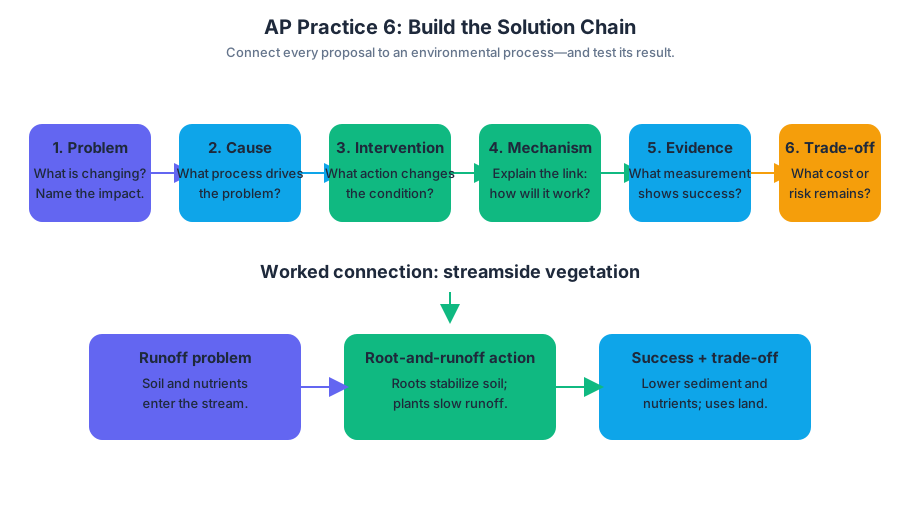
A reliable response follows the chain:
$$ \text{problem} \rightarrow \text{cause} \rightarrow \text{intervention} \rightarrow \text{mechanism} \rightarrow \text{evidence of success} \rightarrow \text{trade-off} $$
Do not jump directly from “pollution is bad” to “use more regulation.” The examiner rewards the connection between the proposal and the environmental process. For example, planting vegetation beside a stream is useful only if you explain that the roots stabilize soil and the vegetation slows runoff, allowing suspended sediment and dissolved nutrients to be retained before reaching the waterway.
Original practice task
A lake receives water from an agricultural watershed. During summer, the lake develops dense algal growth followed by fish deaths. Monitoring results are shown below.
| Sampling location | Nitrate concentration ($mg/L$) | Dissolved oxygen at dawn ($mg/L$) |
|---|---|---|
| Forested upstream area | $0.8$ | $8.4$ |
| Agricultural drainage ditch | $7.2$ | $6.1$ |
| Lake inlet | $5.9$ | $5.4$ |
| Open lake water | $3.1$ | $3.0$ |
(a) Identify the likely cause of the fish deaths.
(b) Propose one environmental solution that would reduce the problem.
(c) Explain the mechanism by which the proposed solution would improve lake conditions.
(d) The proposed solution is expected to reduce nitrate entering the lake from $5.9\ mg/L$ to $3.8\ mg/L$. Calculate the percentage decrease.
(e) Identify one limitation or trade-off associated with the solution and explain how it could be addressed.
Worked response
(a) Cause. The fish deaths are most likely caused by low dissolved oxygen resulting from eutrophication. Excess nitrate from agricultural drainage stimulates algal growth; when algae die, decomposers consume oxygen while breaking down the organic matter. The dawn dissolved-oxygen value of $3.0\ mg/L$ in the open lake indicates hypoxic conditions that can stress or kill fish.
(b) Solution. Establish a vegetated riparian buffer between agricultural fields and the drainage ditch. The buffer should contain dense perennial vegetation and be maintained along the portions of the watershed where runoff enters the ditch.
(c) Mechanism. Vegetation would slow surface runoff, increase infiltration, and absorb some nitrate through plant uptake. The buffer would therefore reduce the nitrate load reaching the lake. Less nitrate would limit algal production; less dead algal biomass would be decomposed, reducing oxygen consumption and increasing dissolved-oxygen concentration.
(d) Calculation.
$$ \text{Percentage decrease}
\frac{\text{initial concentration} - \text{final concentration}} {\text{initial concentration}} \times 100 $$
$$
\frac{5.9 - 3.8}{5.9}\times 100
35.6% $$
The nitrate concentration would decrease by approximately $36%$. A common scoring error is dividing by the final value, $3.8$, rather than the original value, $5.9$.
(e) Limitation and response. A riparian buffer removes land from agricultural production and may reduce short-term farm income. This limitation could be addressed through conservation payments, tax incentives, or assistance for farmers who install and maintain buffers. Monitoring nitrate and dawn dissolved oxygen before and after installation would test whether the intervention works.
What earns credit
An examiner-rewarded answer should contain these elements:
- a specific environmental problem, such as hypoxia caused by eutrophication;
- a feasible proposal rather than a vague command;
- a scientifically correct causal mechanism;
- a calculation with the correct setup, substitution, and units or percentage;
- one realistic limitation, stakeholder concern, or unintended effect;
- a method for measuring whether the solution succeeded.
Misconception check — “The algae directly use all the oxygen.” Algae generally produce oxygen during daylight photosynthesis. The major oxygen loss in this scenario occurs when decomposers respire while breaking down dead algal matter, especially when photosynthesis stops at night. That is why dawn measurements are especially informative.
Timing and error review
For a multi-part environmental-solutions free-response question, reserve roughly $20$–$25$ minutes. Spend the first $2$ minutes identifying the pollutant and process, then answer each lettered part directly; do not write a long introduction.
Afterward, label every missed point as one of four errors: content, evidence, calculation, or feasibility. Rewrite only the weakest sentence—for example, change “buffers stop pollution” to “buffers slow runoff and retain nutrients, reducing nitrate delivery to the lake.” That revision makes the mechanism observable, specific, and scientifically defensible.
Retrieval check
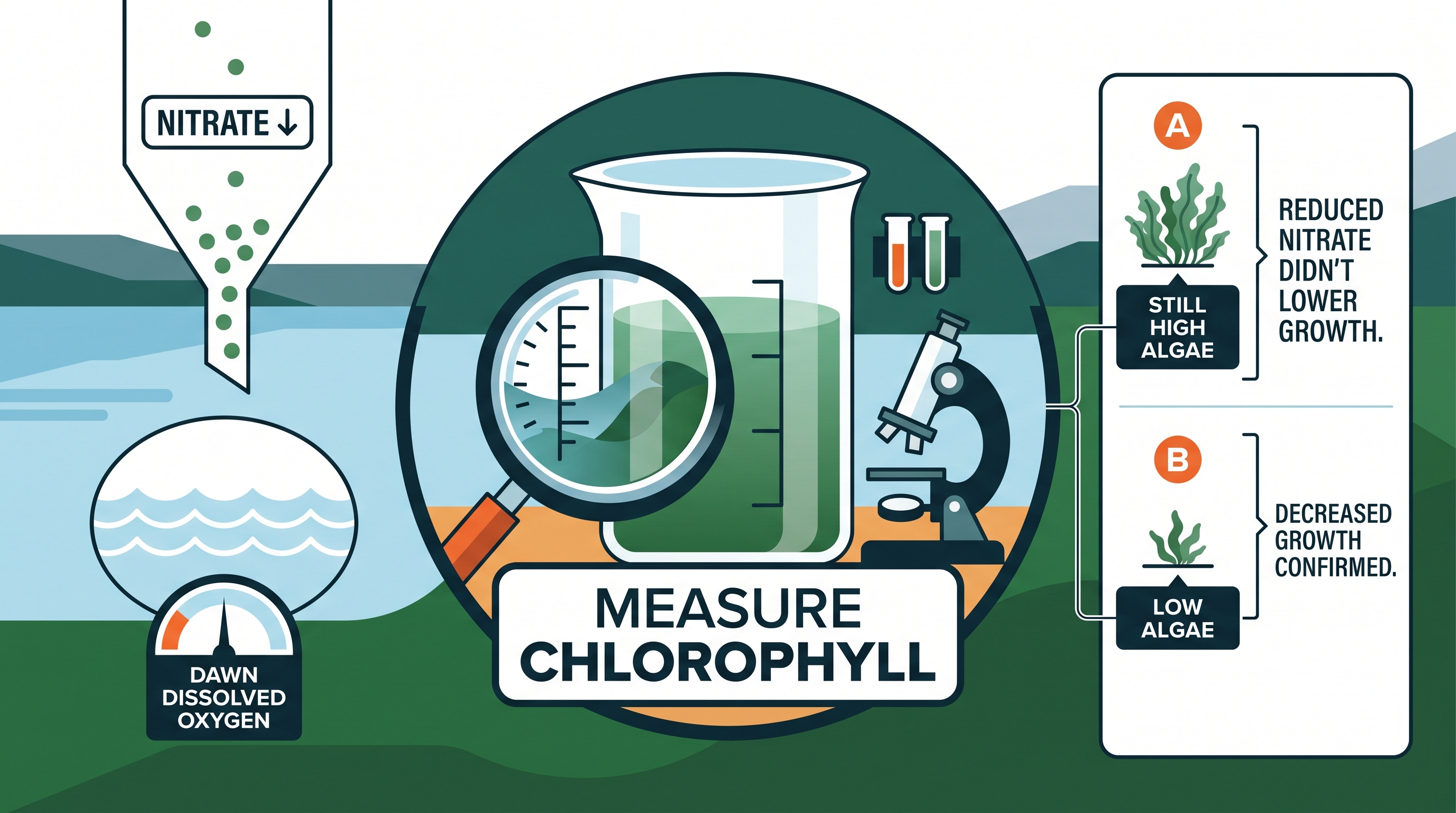
If nitrate entering a lake decreases but dawn dissolved oxygen does not increase, name one additional measurement you would collect and explain what it would reveal. A strong answer could identify chlorophyll concentration or algal biomass, because those data would show whether reduced nitrate actually decreased algal growth.
Source Materials
- AP Environmental Science Course and Exam Description
- Review the Clarifications (.pdf)
- AP Environmental Science Course Overview
- AP Environmental Science Course at a Glance
- AP Environmental Science Course at a Glance Poster
- AP Environmental Science
- AP Environmental Science
- AP Environmental Science Sample Syllabus 1
- AP/College Environmental Science-Khan Academy
- AP Environmental Science Exam-College Board
- AP Environmental Science Units-Save my Exams
- AP Environmental Science-Bozeman Science