From the free course AP Environmental Science on Lykke
5.9 Impacts of Mining · 5.10 Impacts of Urbanization
Key concepts: Trophic levels · Demographic transition · Climate · Urbanization · Geothermal energy
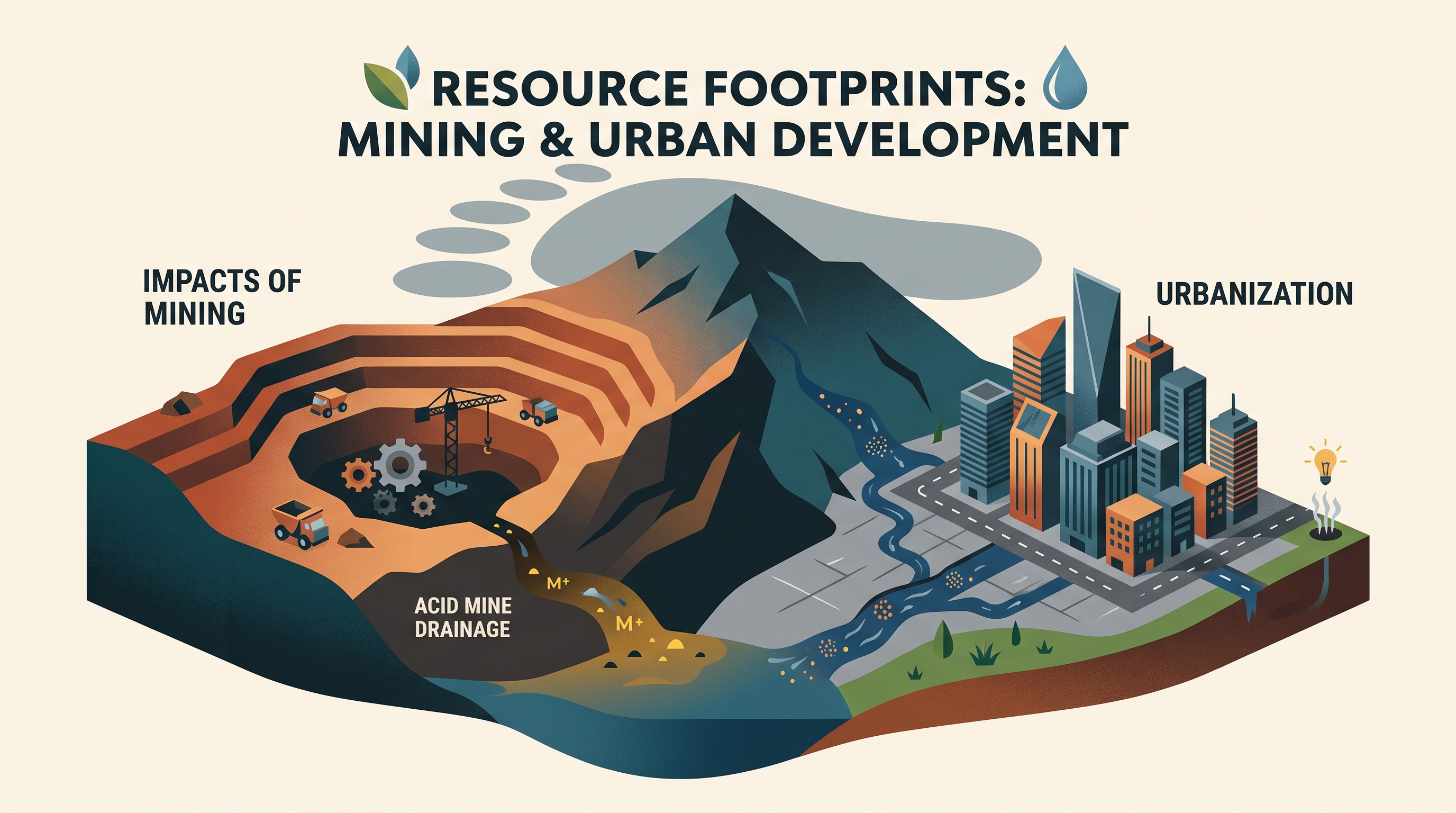
Mining and urbanization reshape landscapes by moving enormous amounts of rock, soil, water, and energy through human systems. The environmental question is not simply whether these activities are “good” or “bad,” but how their benefits, risks, and long-term costs are distributed across ecosystems and communities.
5.9 Impacts of Mining · 5.10 Impacts of Urbanization
Mining and urbanization reshape landscapes by moving enormous amounts of rock, soil, water, and energy through human systems. The environmental question is not simply whether these activities are “good” or “bad,” but how their benefits, risks, and long-term costs are distributed across ecosystems and communities.
5.9 Impacts of Mining
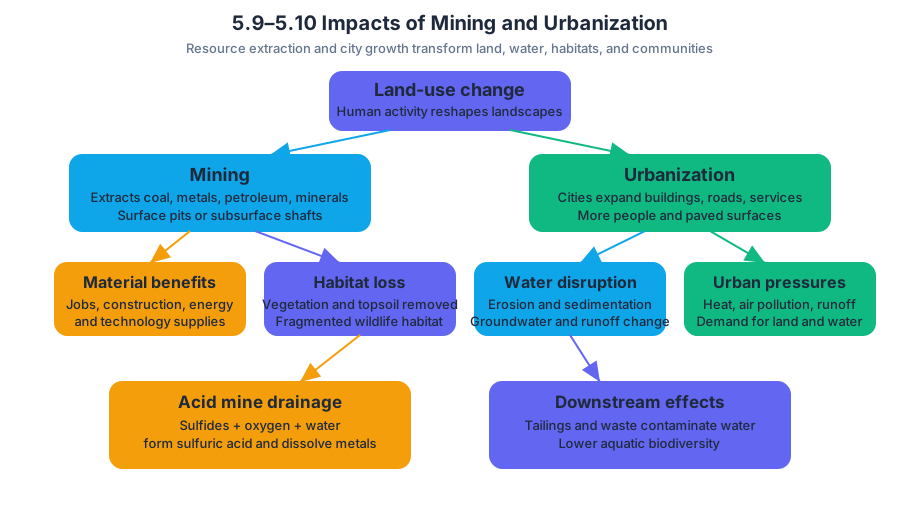
Mining extracts concentrated deposits of useful geological resources such as coal, metals, petroleum, and minerals. Surface mining removes vegetation, topsoil, and overburden—the rock and soil above a deposit—while subsurface mining reaches deposits through shafts and tunnels.
Mining can produce employment and materials for construction, transportation, electricity generation, and technology. However, the same process can cause habitat loss, soil erosion, sedimentation, groundwater disruption, and contamination from waste rock and tailings, the crushed material left after valuable minerals are separated from ore.
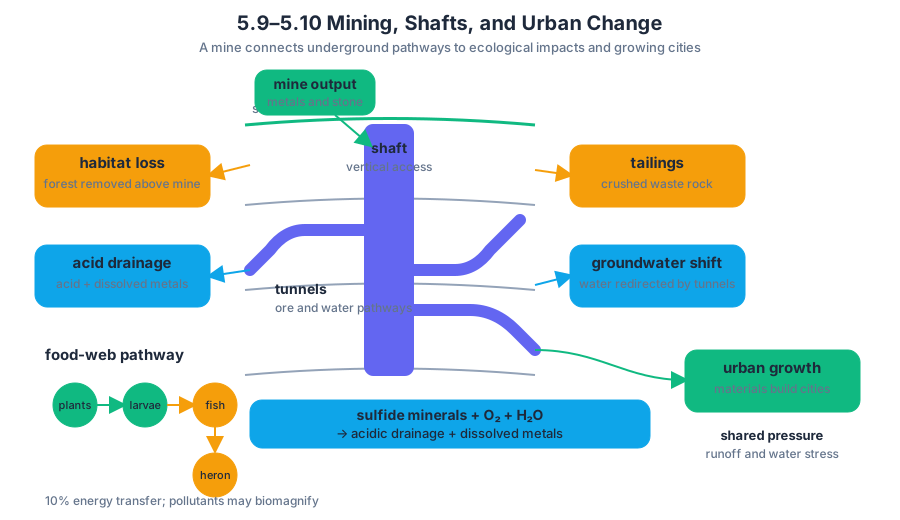
A particularly important pathway is acid mine drainage. When sulfide-containing minerals are exposed to oxygen and water, sulfuric acid can form. The acidic water may dissolve toxic metals, carrying substances such as iron, lead, or mercury into streams. The result can be lower aquatic biodiversity, reduced water quality, and long-term pollution even after a mine closes.
$$ \text{sulfide minerals} + O_2 + H_2O \rightarrow \text{acidic drainage} + \text{dissolved metals} $$
Worked example — a mine-stream food web: Suppose a surface mine removes forest above a stream. Sediment covers aquatic plants and insect habitat, while metal-contaminated runoff enters the water. Aquatic plants occupy a lower trophic level, meaning a feeding position in an ecosystem; insect larvae that eat the plants occupy the next level; fish that eat the larvae occupy a higher level; and a heron that eats the fish occupies an even higher level.
Only a fraction of the energy stored at one trophic level becomes biomass at the next, often approximated by the 10% rule. Thus, habitat loss at the producer level can reduce energy available to every higher consumer. If a persistent metal is also transferred through the food web, its concentration may increase at higher trophic levels through biomagnification, exposing fish-eating birds and mammals to the greatest risk.
Misconception check — “higher trophic levels contain more energy.” They do not. Higher levels generally contain less available energy and biomass, although persistent pollutants can become more concentrated in organisms at those levels. Mining therefore affects food webs both by removing habitat and by altering the movement of matter through the ecosystem.
5.10 Impacts of Urbanization
Urbanization is the growth of cities as people and infrastructure become concentrated in urban areas. It often replaces permeable soil and vegetation with roads, rooftops, parking lots, and buildings. These impervious surfaces increase stormwater runoff, carrying oil, metals, nutrients, sediment, and pathogens into waterways.
Urban areas also modify local climate. Concrete and asphalt absorb solar energy and release it slowly, producing the urban heat-island effect: cities are often warmer than surrounding rural areas. Tall buildings can reduce wind movement, while energy use and vehicle emissions add heat and air pollutants. Vegetation, shade trees, reflective roofs, green roofs, and public transportation can reduce these effects.
The connection between population change and urban growth becomes clearer through the demographic transition—the shift from high birth and death rates to low birth and death rates as a society develops.
| Stage | Birth rate | Death rate | Population and urban pattern |
|---|---|---|---|
| Preindustrial | High | High and variable | Slow growth; mostly rural |
| Transitional | Remains high, then declines | Declines rapidly | Rapid population growth; migration toward cities accelerates |
| Industrial | Declines | Low | Growth slows; urban population expands |
| Postindustrial | Low | Low | Stable or declining population; highly urbanized |
During the transitional stage, improved sanitation, medicine, and food supply can lower death rates before families reduce birth rates. Population growth therefore accelerates, and rural-to-urban migration increases demand for housing, water, electricity, transportation, and waste treatment. If infrastructure cannot keep pace, informal settlements, contaminated water, traffic pollution, and flood risk may increase.
Worked example — urban flooding: A city replaces a wetland and nearby fields with a housing development. Rainwater that once infiltrated the soil now runs rapidly across pavement into a stream. The lost wetland no longer stores floodwater or traps sediment, so downstream flooding and turbidity increase. Restoring wetlands, installing permeable pavement, planting urban trees, and constructing rain gardens can reduce runoff while improving local climate conditions.
Geothermal Energy in Urban and Mining Regions
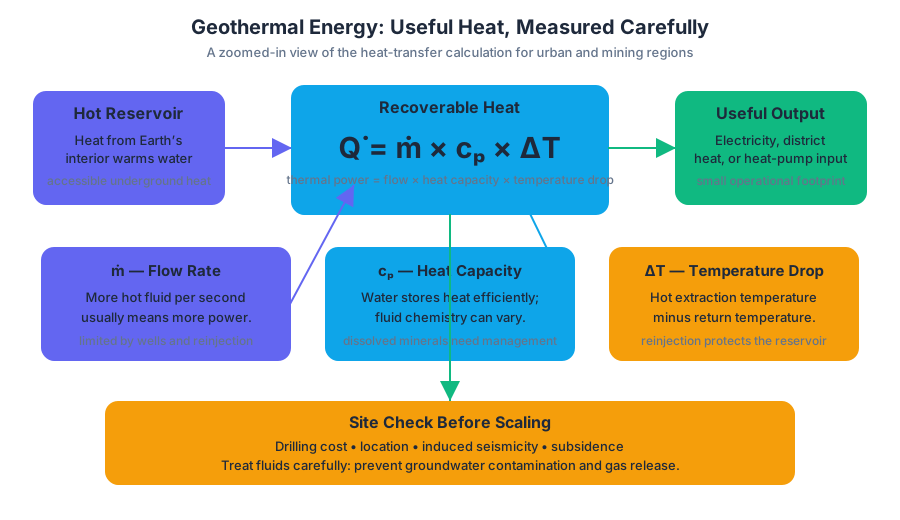
Geothermal energy uses heat from Earth’s interior. Wells can bring hot water or steam to the surface to drive a turbine and generate electricity; lower-temperature geothermal systems can directly heat buildings or use heat pumps to move heat between buildings and the ground.
Geothermal power provides a relatively reliable renewable energy source with low operational greenhouse-gas emissions and a small land footprint compared with some large energy facilities. It can support urban electricity or district heating, especially where hot groundwater or accessible underground heat is available.
Its limitations are location, drilling cost, induced seismic activity, subsidence, and the possible release of dissolved gases or minerals in geothermal fluids. Poorly managed fluids can also contaminate groundwater. In a mining region, geothermal development may reuse energy infrastructure or provide an alternative to fossil-fuel electricity, but it does not automatically repair mining damage or eliminate the need for careful environmental assessment.
Science-practice connection: These topics use Science Practice 1: Concept Explanation when linking mining to acid drainage or urbanization to runoff; Science Practice 2: Visual Representations when interpreting food webs, demographic-transition graphs, or land-use diagrams; Science Practice 5: Data Analysis when evaluating pollution or population trends; Science Practice 6: Mathematical Routines when calculating percent change or energy transfer; and Science Practice 7: Environmental Solutions when comparing reclamation, green infrastructure, public transit, or geothermal energy.
Retrieval check: A city’s population is growing rapidly, pavement is expanding, and a nearby mine releases metal-contaminated runoff. Name one demographic process, one urban-climate or runoff effect, one trophic-level consequence, and one limitation of geothermal energy that planners should evaluate.
Source Materials
- AP Environmental Science Course and Exam Description
- Review the Clarifications (.pdf)
- AP Environmental Science Course Overview
- AP Environmental Science Course at a Glance
- AP Environmental Science Course at a Glance Poster
- AP Environmental Science
- AP Environmental Science
- AP Environmental Science Sample Syllabus 1