From the free course AP Environmental Science on Lykke
1.5 The Nitrogen Cycle · 1.6 The Phosphorus Cycle
Key concepts: Nitrogen cycle · Nitrogen fixation · Nitrogen compounds as limiting nutrients · Human impacts on the nitrogen cycle · Strategies to reduce human impact on the nitrogen cycle · Phosphorus cycle · Phosphorus-bearing minerals and sediments · Phosphorus as a limiting nutrient · Absence of a significant atmospheric reservoir in the phosphorus cycle · Synthetic nitrogen fertilizer and compost application calculations
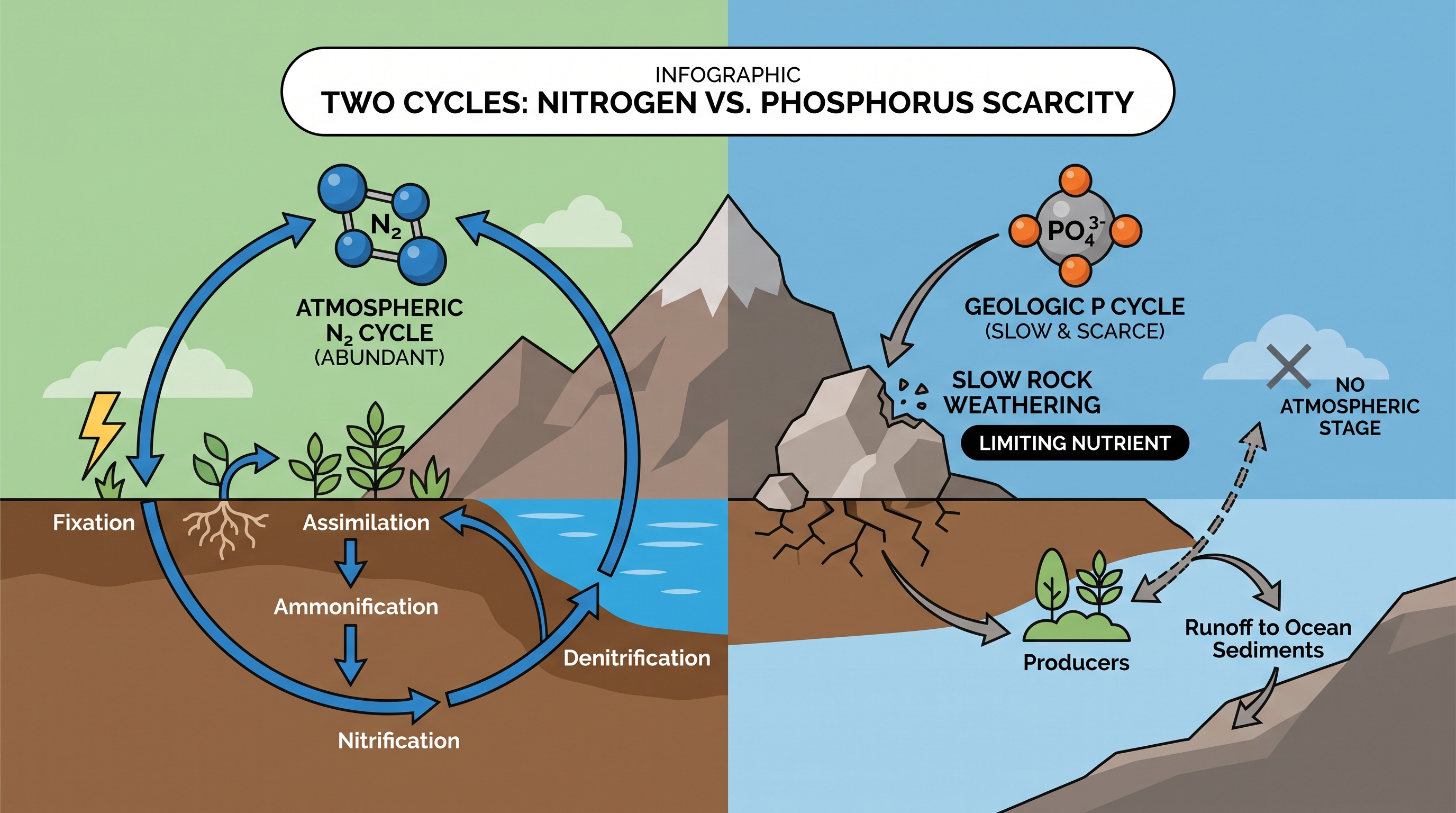
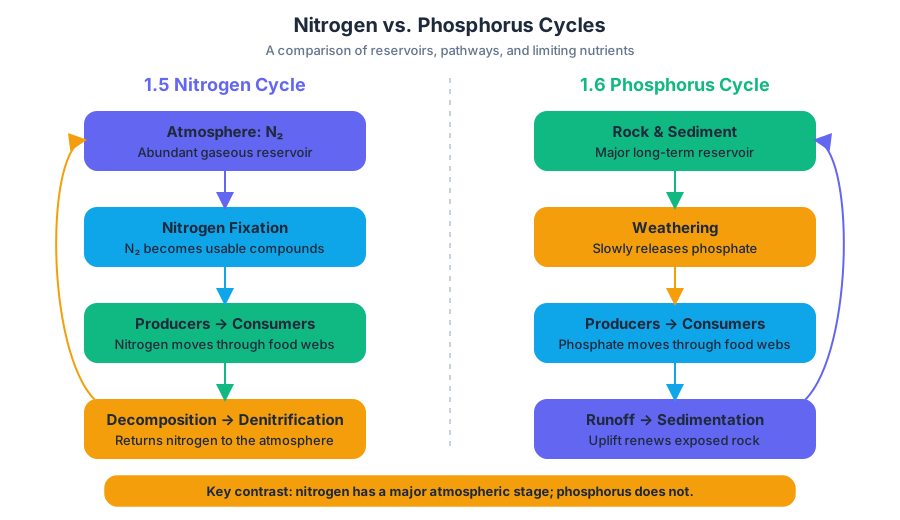
Nitrogen and phosphorus are both essential nutrients, but ecosystems often receive them through very different pathways: nitrogen enters through biological conversion of atmospheric $N_2$, while phosphorus is released mainly when rocks and sediments weather.
1.5 The Nitrogen Cycle · 1.6 The Phosphorus Cycle
Nitrogen and phosphorus are both essential nutrients, but ecosystems often receive them through very different pathways: nitrogen enters through biological conversion of atmospheric $N_2$, while phosphorus is released mainly when rocks and sediments weather. That difference determines which nutrient limits producer growth and how human activities disrupt each cycle.
The nitrogen cycle: making atmospheric nitrogen usable
The atmosphere is the largest reservoir of nitrogen, but most organisms cannot use atmospheric nitrogen gas, $N_2$, directly. Nitrogen fixation is the conversion of $N_2$ into ammonia, $NH_3$, and then ammonium, $NH_4^+$, forms that can enter biological processes. Soil microorganisms perform much of this conversion, so the availability of usable nitrogen compounds is limited by the rate of nitrogen fixation.
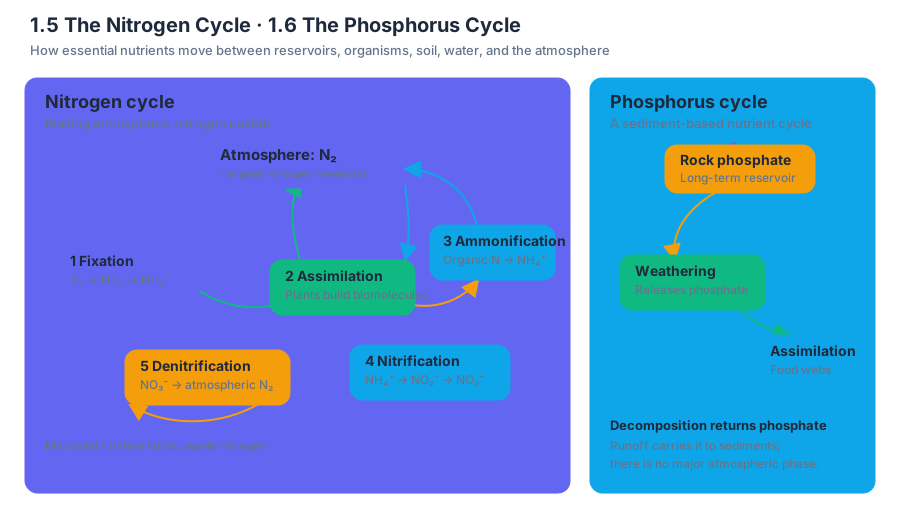
Under ERT-1.E.1, the nitrogen cycle is the movement of nitrogen between sources and sinks through five important processes:
- Fixation: Atmospheric $N_2$ becomes $NH_3$ and $NH_4^+$.
- Assimilation: Plants and other producers absorb inorganic nitrogen, especially ammonium or nitrate, and incorporate it into proteins and nucleic acids.
- Ammonification: Decomposers convert organic nitrogen in wastes and dead organisms into $NH_4^+$.
- Nitrification: Soil bacteria convert $NH_4^+$ first into nitrite, $NO_2^-$, and then into nitrate, $NO_3^-$.
- Denitrification: Other bacteria convert $NO_3^-$ back into atmospheric $N_2$, returning nitrogen to the atmosphere.
A reservoir is a place where matter is stored; a sink is a reservoir that receives and holds matter, at least temporarily. The atmosphere is the largest nitrogen reservoir, while soil, living biomass, wastes, and water contain nitrogen compounds in reservoirs that generally hold them for relatively short periods of time. This is a key distinction: nitrogen may be abundant globally but unavailable to plants locally.
Nitrogen as a limiting nutrient
A limiting nutrient is a nutrient whose scarcity restricts producer growth and therefore limits primary production. In many ecosystems, plants have adequate light, water, and carbon dioxide but cannot increase growth because usable nitrogen compounds are insufficient. Adding nitrogen can increase plant growth at first, but excess nitrogen may then wash into aquatic ecosystems and stimulate harmful algal growth.
Worked example — fertilizer and nitrogen loading. A garden receives nitrogen at a rate of $1\ \mathrm{kg}$ per $70.0\ \mathrm{m^2}$. For a $140\ \mathrm{m^2}$ garden:
$$ \text{nitrogen required}
140\ \mathrm{m^2} \left( \frac{1\ \mathrm{kg\ N}}{70.0\ \mathrm{m^2}} \right)
2.00\ \mathrm{kg\ N} $$
If compost contains $2.5%$ nitrogen by mass, the compost required is:
$$ \text{compost mass}
\frac{2.00\ \mathrm{kg\ N}}{0.025}
80.0\ \mathrm{kg\ compost} $$
If a synthetic fertilizer were labeled $10%$ nitrogen, the equivalent fertilizer mass would be:
$$ \frac{2.00\ \mathrm{kg\ N}}{0.10}
20.0\ \mathrm{kg\ fertilizer} $$
The nitrogen percentage must be written as a decimal before dividing.
Human impacts and defensible solutions
Human activities accelerate nitrogen movement. Applying more fertilizer or manure than crops can absorb increases nitrate runoff and groundwater contamination. Burning fossil fuels produces nitrogen oxides, which contribute to atmospheric pollution and can return to ecosystems through deposition. Excess irrigation can waterlog soil, filling soil pores with water and reducing oxygen availability; this can alter microbial transformations, including denitrification.
A viable reduction strategy must identify both the action and the mechanism. For example, farmers can use precision fertilizer application: apply nitrogen at the crop’s actual rate and near the time of greatest uptake. This reduces the amount available for runoff or leaching while maintaining crop production. Vegetated buffer strips provide a second defense by slowing runoff and allowing plants and soil microbes to retain or transform nitrogen before it reaches a stream.
Misconception check: “More nitrogen always means more plant growth.”
Nitrogen increases production only when nitrogen is limiting and other conditions remain suitable. Beyond the required amount, additional nitrogen becomes pollution rather than a growth benefit.
For this topic, Suggested Skill: Visual Representations means tracing each arrow between nitrogen reservoirs and labeling the process responsible for the transfer. Concept Application requires linking a changed process—such as excess fertilizer application—to a consequence such as nitrate pollution or eutrophication. Environmental Solutions requires justifying why a proposed intervention reduces a specific human impact.
The phosphorus cycle: a sediment-dominated cycle
Under ERT-1.F.1, the phosphorus cycle is the movement of atoms and molecules containing phosphorus between sources and sinks. Its major reservoirs are phosphorus-bearing minerals in rock and ocean sediments, not the atmosphere.
Weathering slowly releases phosphate from rock into soil and water. Producers absorb phosphate, consumers obtain it by feeding, and decomposition returns phosphorus to soil or water. Some phosphorus is carried by runoff into lakes and oceans, where it becomes part of sediments; over geologic time, uplift can expose these sediments and rocks to renewed weathering.
ERT-1.F.2 emphasizes that the phosphorus cycle lacks a significant atmospheric component. ERT-1.F.3 explains why phosphorus is relatively scarce: rocks weather slowly. Consequently, phosphorus is often a limiting nutrient for plants and other producers, particularly in freshwater and some terrestrial ecosystems.
Misconception check: “All nutrient cycles have major atmospheric stages.”
Nitrogen does, because the atmosphere stores abundant $N_2$. Phosphorus does not; its long-term storage is concentrated in rocks and sediments.
Retrieval check: Name the five nitrogen-cycle processes in order from atmospheric nitrogen entering biological availability to its return to the atmosphere. Then explain why phosphorus limitation is especially likely when rock weathering is slow. A complete response should include fixation, assimilation, ammonification, nitrification, denitrification, and the absence of a significant atmospheric phosphorus reservoir.
Source Materials
- AP Environmental Science Course and Exam Description
- Review the Clarifications (.pdf)
- AP Environmental Science Course Overview
- AP Environmental Science Course at a Glance
- AP Environmental Science Course at a Glance Poster
- AP Environmental Science
- AP Environmental Science
- AP Environmental Science Sample Syllabus 1