From the free course AP Environmental Science on Lykke
6.1 Renewable and Nonrenewable Resources · 6.2 Global Energy Consumption
Key concepts: Renewable energy resources · Nonrenewable energy resources · Regional distribution of natural energy resources · Global energy consumption · Nuclear power · Biomass energy · Wind energy · Hydroelectric power and dams · Hydrogen fuel cells · Environmental consequences of energy use
Every energy source transforms stored or moving energy into forms humans can use, but the crucial distinction is whether nature replaces the resource on a human timescale.
6.1 Renewable and Nonrenewable Resources · 6.2 Global Energy Consumption
Every energy source transforms stored or moving energy into forms humans can use, but the crucial distinction is whether nature replaces the resource on a human timescale.
Renewable versus nonrenewable resources
A renewable energy resource is replenished naturally quickly enough to be used repeatedly, such as sunlight, wind, flowing water, geothermal heat, and biomass. A nonrenewable energy resource exists in a fixed amount—or is replaced so slowly that its supply is effectively fixed for human societies—including coal, petroleum, natural gas, and uranium used for nuclear power.
The distinction describes the resource stock, not whether using the resource has environmental impacts. A renewable resource can still be depleted locally or used faster than it is replenished. For example, a forest can provide renewable biomass, but harvesting trees faster than they regrow converts a renewable supply into a declining one.
Key distinction: “Renewable” means replenished naturally; it does not mean unlimited, pollution-free, or automatically sustainable.
Energy resources are also unevenly distributed. A region’s supply depends partly on its geologic history: the processes that formed and buried organic matter, concentrated minerals, shaped groundwater systems, or created favorable conditions for geothermal heat. Sunlight, wind, and flowing water likewise vary with climate, topography, and geography. Therefore, a resource may be abundant globally but unavailable or expensive in a particular region.
Humans use a mixture of energy sources
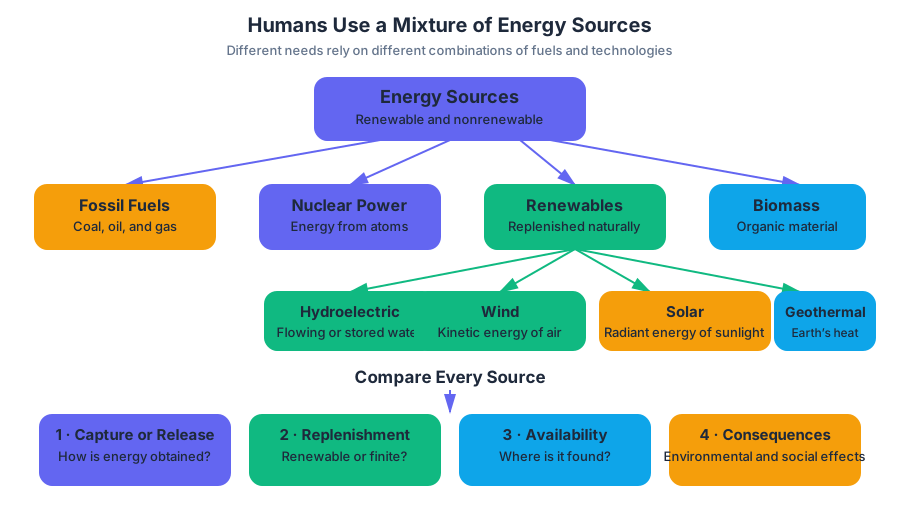
Modern societies obtain energy from many sources rather than one universal fuel. Electricity, transportation, heating, and industrial processes may rely on different combinations of fossil fuels, nuclear power, biomass, hydroelectricity, wind, solar energy, and geothermal energy.
A useful way to compare sources is to ask four questions:
- How is the energy captured or released?
- Can the resource be replenished?
- Where is it available?
- What environmental and social consequences accompany its use?
For example, a wind turbine uses the kinetic energy—the energy of motion—of moving air. A hydroelectric dam converts water stored at elevation into moving water and then electricity. The dam can provide reliable electricity and flood control, but it can also inundate land, disrupt river habitats, alter sediment movement, and displace human communities.
Global energy consumption
Global energy consumption is the amount of energy used by people worldwide over a specified time. Consumption is not the same as energy production: energy may be produced in one location, transported, and consumed elsewhere. Total consumption can rise because of population growth, increased industrial activity, transportation demand, or greater energy use per person.
When comparing countries, total energy use and per-capita energy use answer different questions. A large population may have high total consumption but relatively low consumption per person, while a smaller, wealthier population may use more energy per person.
Worked calculation: Suppose Region A uses $900$ petajoules of energy annually and has a population of $30$ million people. Its per-capita consumption is
$$ \frac{900\ \text{petajoules}}{30\ \text{million people}}
30\ \text{gigajoules per person} $$
because $1$ petajoule equals $1{,}000$ gigajoules. Always convert units before comparing regions.
Energy sources produce trade-offs
No energy source has only positive or only negative consequences. Nuclear power generation is nonrenewable because uranium is finite. Nuclear plants produce large amounts of electricity without directly burning fossil fuels, but they can cause thermal pollution when heated cooling water enters an aquatic system and can generate hazardous solid radioactive waste that requires secure long-term management.
Biomass energy comes from recently living organic material, such as wood or crop residues. Burning biomass produces heat that can be used directly or converted into electricity. Its consequences depend on how the biomass is obtained: managed regrowth may support a renewable supply, whereas unsustainable harvesting can cause habitat loss, soil degradation, and increased atmospheric pollution.
Energy-resource processes may also release hydrogen sulfide, a toxic gas with a rotten-egg odor. This is especially associated with some underground and geothermal processes. The example illustrates why evaluating an energy source requires examining its entire process—not merely the electricity produced at the end.
Misconception check and retrieval
Misconception: “Renewable energy has no environmental cost.”
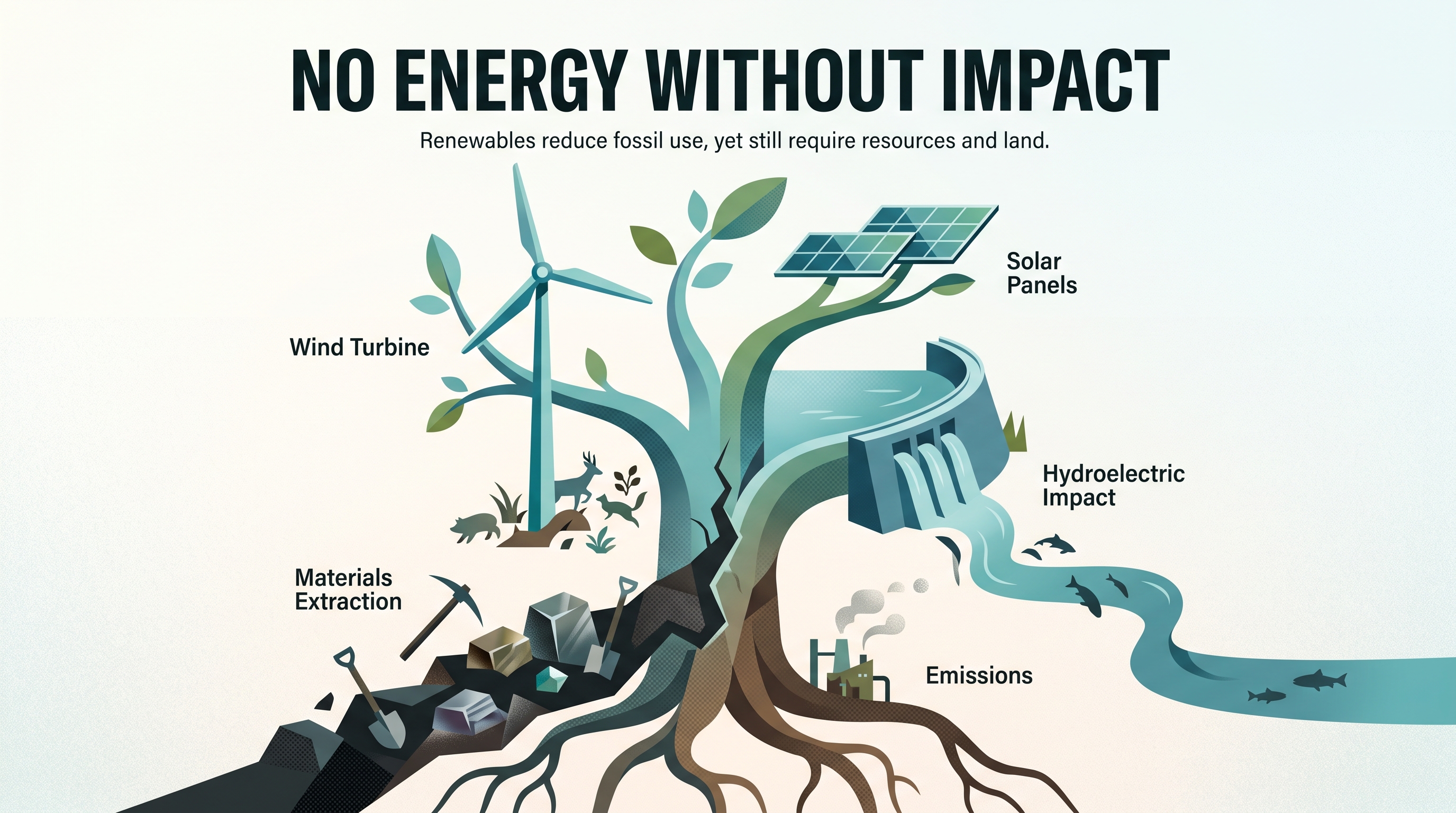
Correction: Renewable sources reduce dependence on finite fuels, but dams alter rivers, biomass combustion releases pollutants, wind facilities occupy land, and every energy system requires materials and infrastructure.
Retrieval check: Why is nuclear power classified as nonrenewable even though a nuclear plant does not burn coal or natural gas? Name one environmental benefit and two possible drawbacks of a hydroelectric dam.

Source Materials
- AP Environmental Science Course and Exam Description
- Review the Clarifications (.pdf)
- AP Environmental Science Course Overview
- AP Environmental Science Course at a Glance
- AP Environmental Science Course at a Glance Poster
- AP Environmental Science
- AP Environmental Science
- AP Environmental Science Sample Syllabus 1
- (a) Identify a fuel used in a nuclear power plant. 1 point
- AP/College Environmental Science-Khan Academy
- AP Environmental Science Exam-College Board
- AP Environmental Science Units-Save my Exams