From the free course AP Environmental Science on Lykke
6.13 Energy Conservation
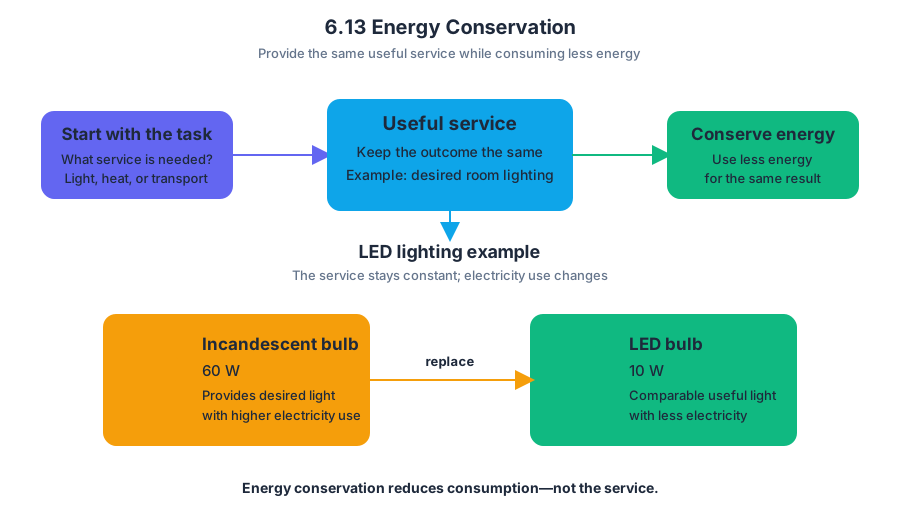
Energy conservation means reducing the amount of energy consumed while still providing the same useful service—such as lighting a room, heating a building, or transporting a person.
6.13 Energy Conservation
Energy conservation means reducing the amount of energy consumed while still providing the same useful service—such as lighting a room, heating a building, or transporting a person. The key question is not simply “Which energy source is better?” but “How can society accomplish the same task with less energy?”
A light-emitting diode (LED) illustrates the idea. If an incandescent bulb uses $60\ \text{W}$ to provide a desired amount of light but an LED provides comparable light using $10\ \text{W}$, replacing the bulb does not eliminate the need for lighting; it reduces the electricity required for that service.
Conservation versus efficiency
Energy conservation is the broad practice of using less energy. Energy efficiency is the use of technology or design that provides the same output with less energy input. Turning off an unnecessary light is conservation through behavior; replacing an incandescent bulb with an LED is conservation through improved efficiency.
The distinction matters because energy production often creates environmental impacts. Burning fossil fuels can release carbon dioxide, sulfur dioxide, nitrogen oxides, particulate matter, and other pollutants. If a household reduces electricity demand, the power plant may need to generate less electricity, decreasing fuel consumption and associated emissions.
Major methods of energy conservation
| Method | How it reduces energy consumption | Example |
|---|---|---|
| Improved efficiency | Produces the same service with less energy input | LED bulbs, efficient appliances |
| Reduced heat loss | Prevents energy from escaping unnecessarily | Insulation, sealed windows |
| Behavioral changes | Avoids unnecessary energy use | Turning off lights, adjusting thermostats |
| Transportation changes | Reduces energy used per passenger or distance | Public transit, walking, carpooling |
| Building and community design | Decreases heating, cooling, and travel demand | Passive solar design, compact development |
| Energy management | Matches energy use to actual demand | Smart thermostats and efficient scheduling |
Conservation can also reduce peak demand—the highest rate of electricity use during a period. For example, using efficient air-conditioning systems and improving building insulation can reduce the electricity required on very hot afternoons, when many buildings are cooling simultaneously.
Worked example: calculating electricity savings
A school replaces $100$ incandescent bulbs rated at $60\ \text{W}$ with $100$ LED bulbs rated at $10\ \text{W}$. Each bulb operates for $2{,}000$ hours per year. Determine the annual electricity savings.
First calculate the power reduction per bulb:
$$60\ \text{W} - 10\ \text{W} = 50\ \text{W}$$
For $100$ bulbs, the total reduction is:
$$50\ \text{W} \times 100 = 5{,}000\ \text{W} = 5\ \text{kW}$$
Annual electricity savings are:
$$5\ \text{kW} \times 2{,}000\ \text{h} = 10{,}000\ \text{kWh}$$
If electricity costs $$0.15$ per kilowatt-hour, the school saves:
$$10{,}000\ \text{kWh} \times $0.15\ \text{kWh}^{-1} = $1{,}500$$
The environmental benefit depends on how the electricity was generated. The reduction is greatest when the avoided electricity would otherwise come from a highly polluting or carbon-intensive source.
Energy conservation as an environmental solution
Energy conservation can reduce several impacts at once: extraction of coal, oil, natural gas, or uranium; land disturbance from mining and drilling; air pollution from combustion; greenhouse-gas emissions; water use for energy production; and waste from power generation. It is therefore often described as a demand-side strategy: instead of increasing energy supply, society lowers the amount of energy demanded.
However, conservation is not automatically cost-free or equally accessible. Efficient appliances may require an initial investment, building upgrades may be difficult for renters, and public transportation may be unavailable in rural areas. A strong environmental solution considers effectiveness, cost, feasibility, and who receives the benefits.
Common misconception check
Misconception: Energy conservation means abandoning modern technology or using no energy.
Conservation does not mean eliminating useful energy services. It means reducing waste and using energy more effectively. Also, replacing one appliance with a more efficient model does not guarantee lower total consumption if people respond by using it more often—a possibility called the rebound effect.
AP Science Practices in Topic 6.13
Topic 6.13 Energy Conservation is especially suited to the following official science practices:
- Science Practice 1: Concept Application — connect efficiency improvements to reduced fuel use, emissions, and resource extraction.
- Science Practice 2: Visual Representations — interpret an energy-flow diagram or compare energy inputs and useful outputs.
- Science Practice 5: Data Analysis — identify trends in electricity use before and after an efficiency intervention.
- Science Practice 6: Mathematical Routines — calculate energy consumption using $E = Pt$, convert watts to kilowatts, and determine cost or percent change.
- Science Practice 7: Environmental Solutions — evaluate conservation strategies using environmental, economic, and social criteria.
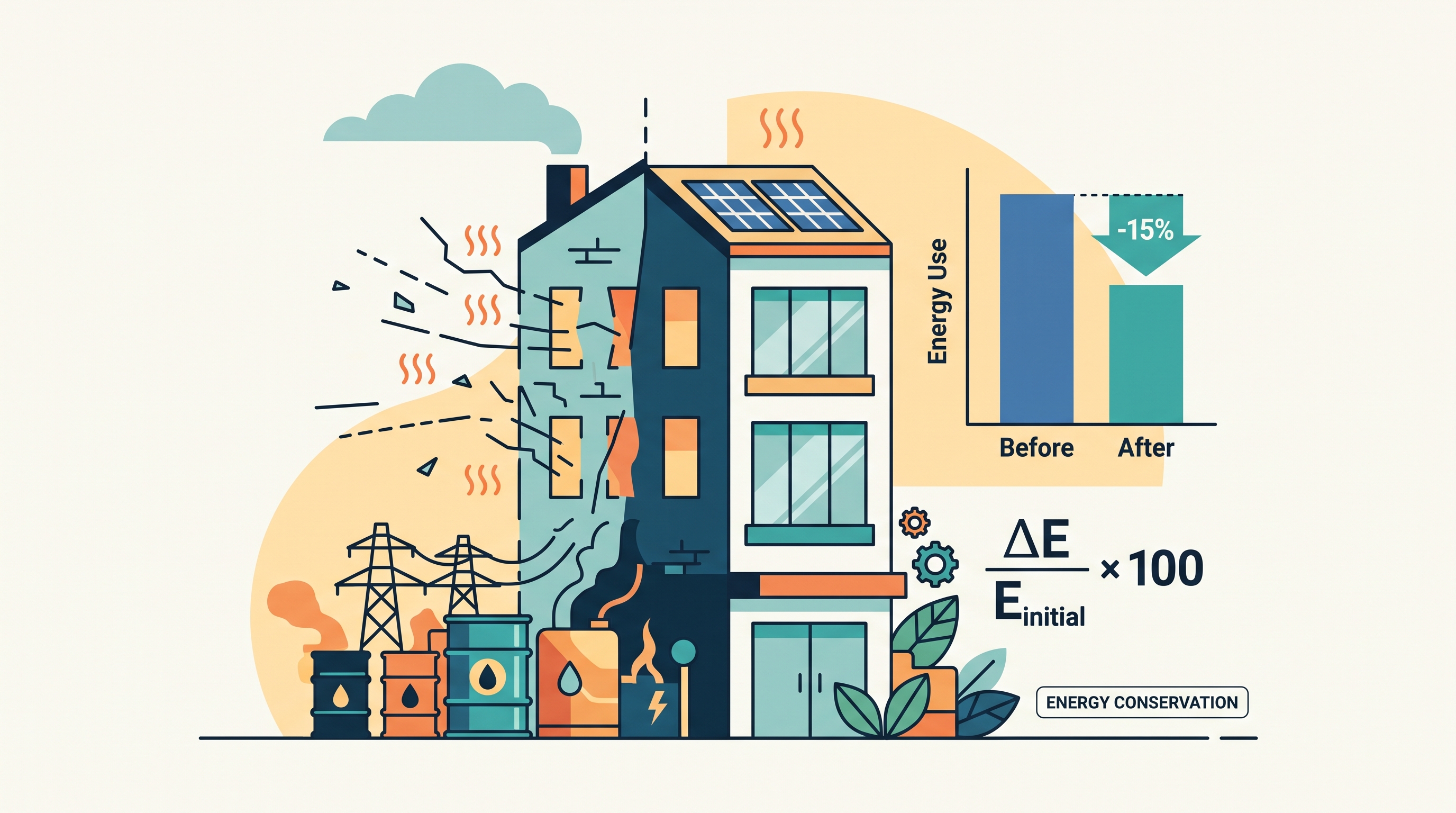
Retrieval check: A building reduces annual electricity use from $50{,}000\ \text{kWh}$ to $42{,}500\ \text{kWh}$. The reduction is $7{,}500\ \text{kWh}$, or:
$$\frac{50{,}000-42{,}500}{50{,}000}\times100 = 15%$$
The building conserved $15%$ of its electricity consumption. It did not necessarily produce $15%$ more electricity; it lowered the demand for electricity.
Source Materials
- AP Environmental Science Course and Exam Description
- Review the Clarifications (.pdf)
- AP Environmental Science Course Overview
- AP Environmental Science Course at a Glance
- AP Environmental Science Course at a Glance Poster
- AP Environmental Science
- AP Environmental Science
- AP Environmental Science Sample Syllabus 1