From the free course AP Environmental Science on Lykke
9.9 Endangered Species · 9.10 Human Impacts on Biodiversity
Key concepts: Endangered species · Human impacts on biodiversity · Strategies to combat biodiversity loss · Species health and ecosystem health · Effects of environmental change on species · Poaching as a threat to animal populations · Protecting animal populations · Species richness · Species diversity · Using experimental data to analyze biodiversity
A species can decline toward extinction because its habitat, food supply, breeding conditions, or ecological relationships have been altered—even when the change seems small. The central idea of 9.9 Endangered Species · 9.10 Human Impacts on Biodiversity is that species health is inseparable from ecosystem health.
9.9 Endangered Species · 9.10 Human Impacts on Biodiversity
A species can decline toward extinction because its habitat, food supply, breeding conditions, or ecological relationships have been altered—even when the change seems small. The central idea of 9.9 Endangered Species · 9.10 Human Impacts on Biodiversity is that species health is inseparable from ecosystem health.
Enduring Understanding EIN-4: The health of a species is closely tied to its ecosystem, and minor environmental changes can have a large impact.
Human activities and biodiversity loss
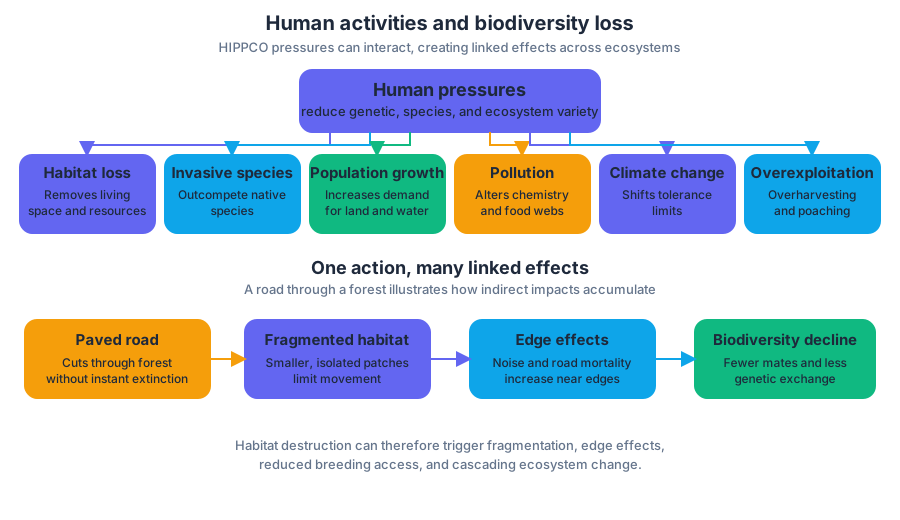
Biodiversity is the variety of life at genetic, species, and ecosystem levels. Human activities reduce biodiversity through the HIPPCO pressures identified in Essential Knowledge EIN-4.C.1:
- Habitat destruction and fragmentation
- Invasive species
- Population growth
- Pollution
- Climate change
- Overexploitation, including poaching
Habitat destruction removes the physical conditions a species needs. Fragmentation divides remaining habitat into smaller, isolated patches, which can reduce movement, limit access to mates and food, and decrease genetic exchange. Pollution can alter water chemistry, reproductive success, or food-web relationships, while climate change can shift temperature and precipitation beyond a species’ tolerance range.
The connection is often indirect. For example, a paved road through a forest may not kill every animal immediately, but it can divide habitat, increase road mortality, create noisy edges, and prevent individuals from reaching breeding areas. A small environmental change can therefore trigger several linked effects across the ecosystem.
Endangered species and conservation strategies
An endangered species is a species at serious risk of extinction throughout all or a significant portion of its range. Protecting the species itself is important, but protecting the ecosystem that supplies its food, shelter, nesting sites, and partners is usually more effective than treating the species as an isolated object.
The Learning Objective EIN-4.C is to explain how human activities affect biodiversity and strategies to combat the problem. Essential Knowledge EIN-4.C.6 identifies several mitigation strategies:
| Strategy | How it reduces biodiversity loss |
|---|---|
| Protected areas | Limit damaging development, hunting, or extraction in important habitat |
| Habitat corridors | Connect isolated habitat patches so organisms can migrate and exchange genes |
| Sustainable land use | Meet human needs while reducing long-term ecosystem damage |
| Habitat restoration | Rebuild degraded or lost habitat |
| Legislation | Establish enforceable protections for species and habitats |
| Criminalizing poaching | Makes illegal killing or capture punishable and can reduce overexploitation |
Poaching is the illegal hunting, capture, or collection of wildlife. Criminalizing poaching can protect animal populations by increasing the cost and legal risk of overexploitation, but enforcement, habitat protection, and reduction of illegal-market demand are also necessary. A law that exists only on paper may not stop population decline if poaching remains profitable and enforcement is weak.
Shell-in-a-bag investigation: richness versus diversity
A shell-in-a-bag investigation models an ecosystem containing multiple species. Without looking inside, a group records the different shell types, counts how many individuals belong to each type, and uses those data to compare biodiversity.
Species richness is simply the number of different species present:
$$ \text{Species richness} = S $$
If Bag A contains shells from five species and Bag B contains shells from three species, Bag A has greater species richness, regardless of how many shells belong to each species.
Species diversity includes both richness and relative abundance—how evenly individuals are distributed among the species. One common index is the Shannon diversity index:
$$ H'=-\sum_{i=1}^{S}p_i\ln(p_i) $$
where $S$ is the number of species and $p_i$ is the proportion of individuals belonging to species $i$. Higher $H'$ generally indicates greater diversity.
Worked example. Bag A contains four species with counts $4,4,4,4$. Bag B also contains four species, but its counts are $13,2,1,0$ only if the fourth species is absent, so Bag B actually has richness $3$. If the counts are instead $12,2,1,1$, both bags have richness $4$, but Bag A has greater species diversity because its individuals are more evenly distributed.
Misconception check: Species richness and species diversity are not interchangeable. Richness counts categories; diversity considers categories and abundance.
Interpreting an investigation
A strong interpretation connects evidence to a hypothesis rather than merely reporting which bag has more shells. Under Science Practice 5.D, Interpret experimental data and results in relation to a given hypothesis, a complete conclusion states the pattern, identifies the relevant measurement, and explains whether the evidence supports or refutes the hypothesis.
For example: “If the hypothesis predicts that disturbed habitat lowers biodiversity, and the disturbed bag has fewer species and a lower diversity index than the undisturbed bag, the results support the hypothesis.” The conclusion should not claim that the investigation proves the hypothesis; a small model may support a pattern without representing every ecosystem process.
AP reasoning and solution evaluation
This topic also uses Science Practice 1.C, Explain environmental concepts, processes, or models in applied contexts, when linking habitat change to population decline; Science Practice 7.A, Describe environmental problems, when identifying biodiversity loss; Science Practice 7.D, Use data and evidence to support a potential solution, when using richness or diversity data to justify conservation; Science Practice 7.E, Make a claim that proposes a solution to an environmental problem in an applied context; and Science Practice 7.C, Describe disadvantages, advantages, or unintended consequences for potential solutions.
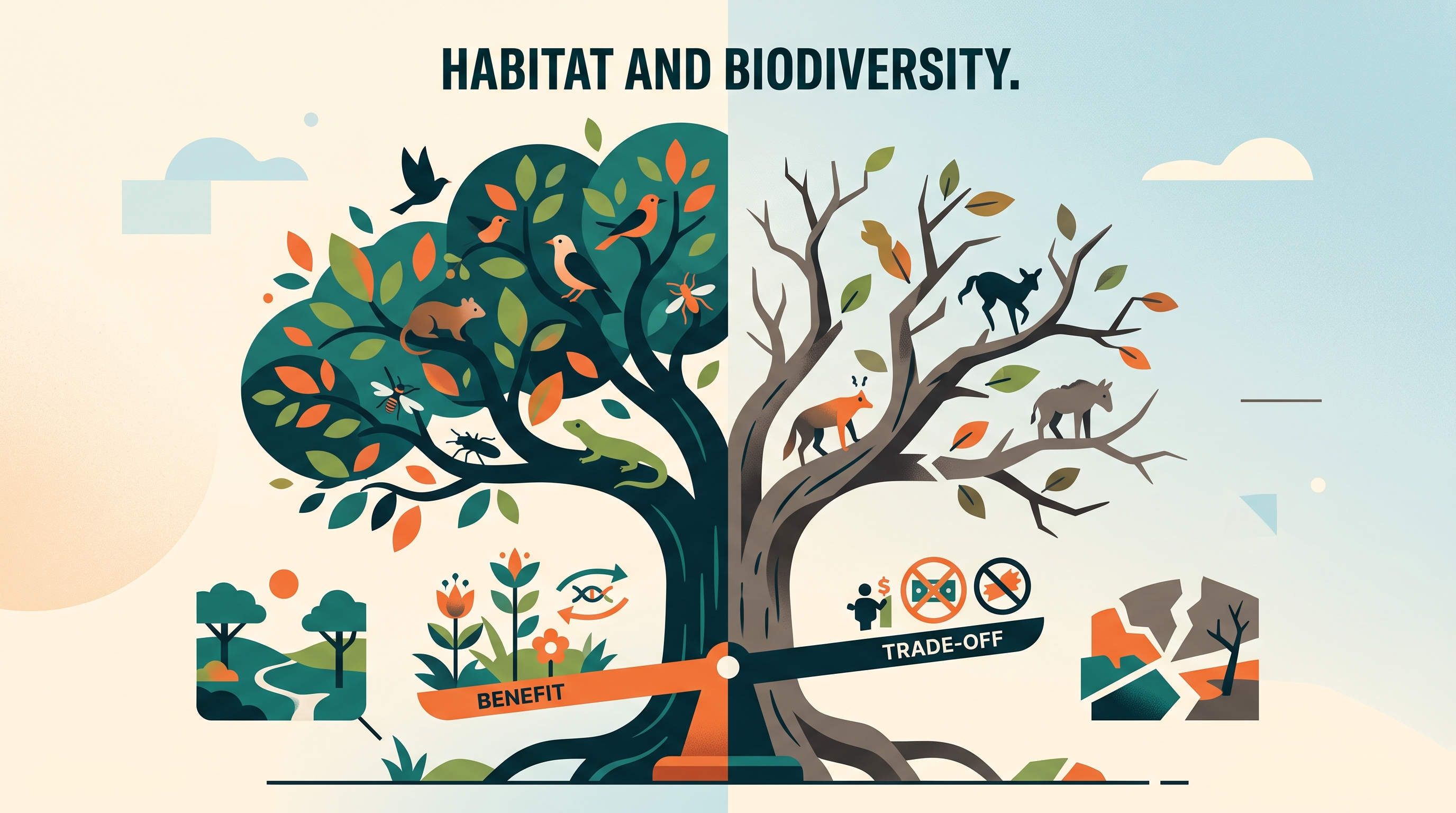
A protected area may conserve habitat but restrict local economic activity. A corridor may improve gene flow but also allow disease transmission or increase human–wildlife conflict. The strongest environmental solution recognizes both its benefit and a plausible trade-off.
Retrieval check: A forest contains six species, but one species accounts for nearly every individual. Does it necessarily have high species diversity? Explain the difference between its species richness and its evenness, then name one strategy—such as a protected area, habitat corridor, sustainable land use, restoration, or stronger anti-poaching enforcement—that could address a likely biodiversity threat.
Source Materials
- AP Environmental Science Course and Exam Description
- Review the Clarifications (.pdf)
- AP Environmental Science Course Overview
- AP Environmental Science Course at a Glance
- AP Environmental Science Course at a Glance Poster
- AP Environmental Science
- AP Environmental Science
- AP Environmental Science Sample Syllabus 1