From the free course AP Environmental Science on Lykke
1.11 Food Chains and Food Webs
Key concepts: Food chains · Food webs · Visual representations and models · Biogeochemical cycles · Effects of changes within a cycle · Phosphorus cycle and nutrient limitation · Invasive species and ecosystem impacts · Habitat fragmentation, disturbance, and species richness · Ecosystem services · Environmental characteristics and processes
A food chain is a single pathway showing who eats whom; a food web is the more realistic network of interconnected feeding pathways in an ecosystem.
1.11 Food Chains and Food Webs
A food chain is a single pathway showing who eats whom; a food web is the more realistic network of interconnected feeding pathways in an ecosystem. These models do more than name organisms: they help predict how a change in one population, nutrient reservoir, or habitat can spread through the entire system.
Reading ecological models
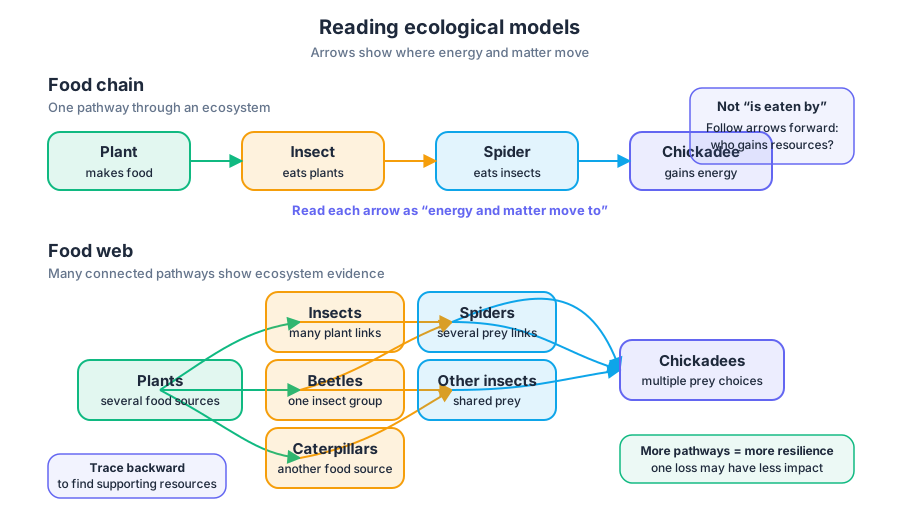
In a food chain, arrows point from the organism being eaten toward the organism that obtains the energy and matter. For example:
$$ \text{plant} \rightarrow \text{insect} \rightarrow \text{spider} \rightarrow \text{chickadee} $$
The arrow does not mean “is eaten by” in a grammatical sense; it means “energy and matter move to.” A food web combines many such pathways. Chickadees may eat insects and spiders, spiders may eat several kinds of insects, and insects may consume several plant species.
Visual models should be read as evidence, not decoration. Trace arrows forward to predict which consumers may gain or lose food, and trace them backward to identify the resources supporting a population. A food web also reveals that most species have more than one food source and more than one predator, so an ecosystem may respond less dramatically to the loss of one pathway than a simple food chain suggests.
Cycles connect food webs to the wider ecosystem
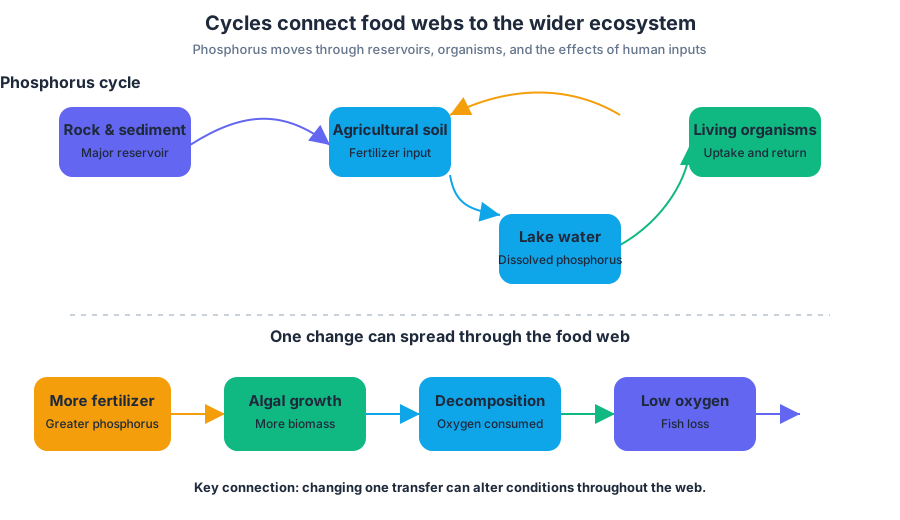
Biogeochemical cycles describe how matter moves among organisms and nonliving reservoirs. In a visual cycle, the reservoir is the major storage location for a substance, while arrows represent processes that move it elsewhere. For phosphorus, the major reservoir is rock and sediment rather than the atmosphere.
A change at one point in a cycle can produce effects elsewhere in the system. If phosphorus-containing fertilizer enters a lake, phosphorus may move from agricultural soil into the water. Algal growth can increase, and when algae die, decomposers consume dissolved oxygen while breaking down the organic matter. The original change—greater phosphorus input—can therefore contribute to oxygen depletion and fish loss.
Key connection: A cycle is not a set of isolated arrows. It is a linked system in which changing one transfer or reservoir can alter conditions throughout the food web.
Why phosphorus can limit productivity
A limiting nutrient is a nutrient whose scarcity restricts biological growth. Phosphorus is often limiting because rocks weather slowly, releasing phosphate into soil and water gradually. Unlike carbon and nitrogen, phosphorus has no major, rapid atmospheric pathway in the cycle.
Phosphorus limitation is especially important in freshwater ecosystems and in some terrestrial ecosystems. In a phosphorus-limited lake, even a small increase in phosphate can stimulate excessive algal growth. In a terrestrial ecosystem, slow release from rock may restrict plant growth despite adequate sunlight, water, and carbon dioxide.
Invasive species and ecosystem services
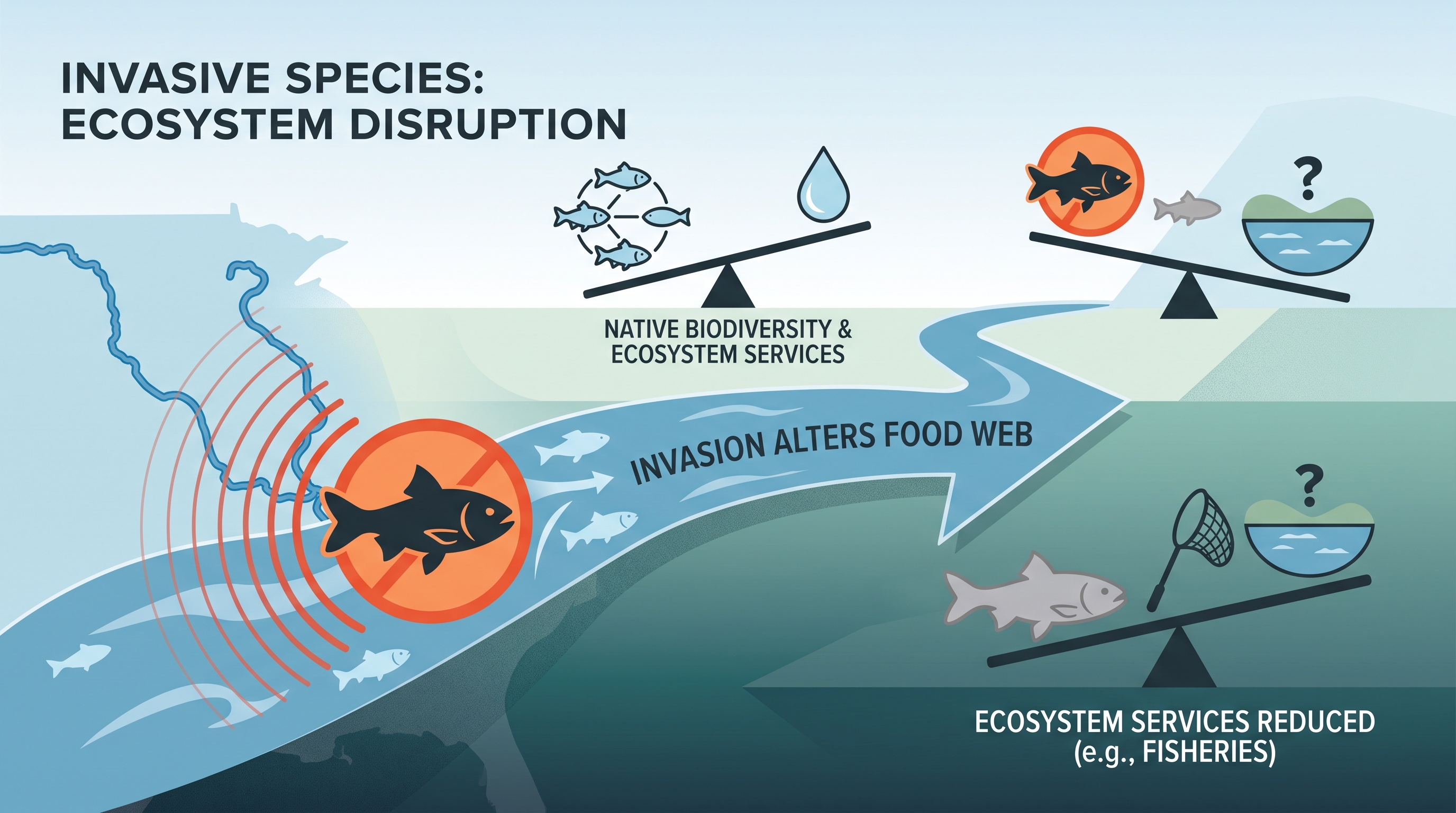
An invasive species is a nonnative species that spreads and causes ecological, economic, or human-health harm. It can alter food webs by consuming native organisms, competing for resources, changing habitat, or introducing new interactions. Those ecological effects can reduce ecosystem services, including provisioning services such as fisheries, regulating services such as water purification, and cultural services such as recreation.
A map-based question may ask you to identify a water body invaded by Asian carp and then interpret the invasion’s spread. The Mississippi River is an appropriate example of an invaded body of water. A strong visual interpretation would describe the distribution as having expanded substantially along the river system, rather than merely stating that the species is “present.”
The reasoning should then connect distribution to consequences. If Asian carp compete with native fish for food, native fish populations may decline; that can reduce fishery yields and affect the provisioning ecosystem services of connected waters such as the Great Lakes region.
Disturbance, roads, and species richness
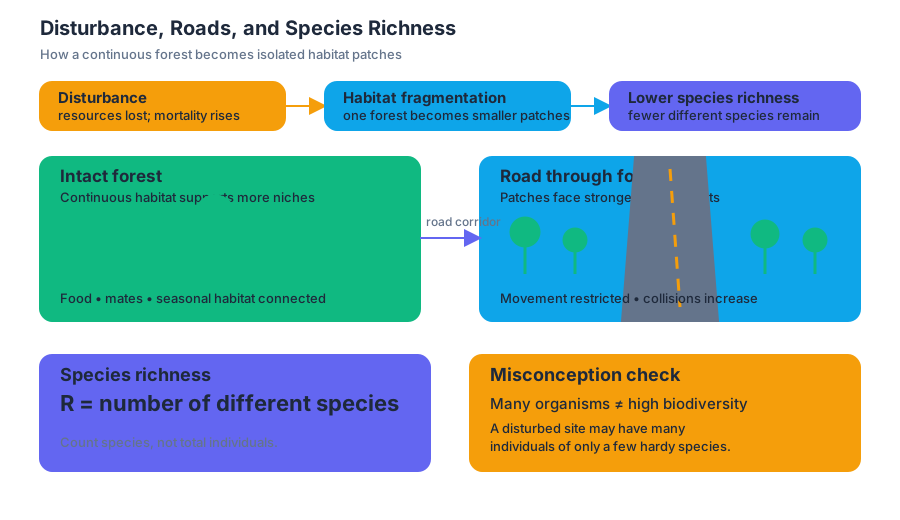
Species richness is the number of different species in an area. Habitat disturbance can reduce richness when it destroys resources, increases mortality, or makes conditions unsuitable for sensitive species. Roads add habitat fragmentation by dividing one continuous forest into smaller patches separated by a disturbed corridor.
A road through a forest may restrict movement by species such as deer or bears, increase collisions with vehicles, and separate individuals from food, mates, or seasonal habitat. Smaller, isolated patches generally support fewer species than an intact forest because they contain less habitat and experience stronger edge effects.
Misconception check: More organisms does not necessarily mean more biodiversity. A disturbed site may contain many individuals of a few hardy species while having lower species richness.
In-flow retrieval check
A lake receives a large phosphorus input after heavy rain. Predict one food-web change and one water-quality change. Then explain why building a road through a forest could reduce species richness even if the total forest area lost is small.
Answer: Extra phosphorus can increase algal growth, followed by greater decomposition and lower dissolved oxygen. The road can fragment habitat, isolate populations, increase edge effects and wildlife mortality, and leave patches too small for some species to survive.
Source Materials
- AP Environmental Science Course and Exam Description
- Review the Clarifications (.pdf)
- AP Environmental Science Course Overview
- AP Environmental Science Course at a Glance
- AP Environmental Science Course at a Glance Poster
- AP Environmental Science
- AP Environmental Science
- AP Environmental Science Sample Syllabus 1