From the free course AP Environmental Science on Lykke
1.1 Introduction to Ecosystems · 1.2 Terrestrial Biomes
Key concepts: Ecosystems · Terrestrial biomes · Biotic and abiotic factors · Climate · Global distribution of biomes · Species interactions · Resource distribution · Energy transformations · Temperate seasonal forests · Savannas
An ecosystem is a community of organisms interacting with one another and with the nonliving environment around them. A forest, for example, is not merely a collection of trees: sunlight, soil minerals, temperature, water, fungi, insects, birds, and decomposers continuously affect one another.
1.1 Introduction to Ecosystems · 1.2 Terrestrial Biomes
An ecosystem is a community of organisms interacting with one another and with the nonliving environment around them. A forest, for example, is not merely a collection of trees: sunlight, soil minerals, temperature, water, fungi, insects, birds, and decomposers continuously affect one another.
ERT-1 — Ecosystems are the result of biotic and abiotic interactions.
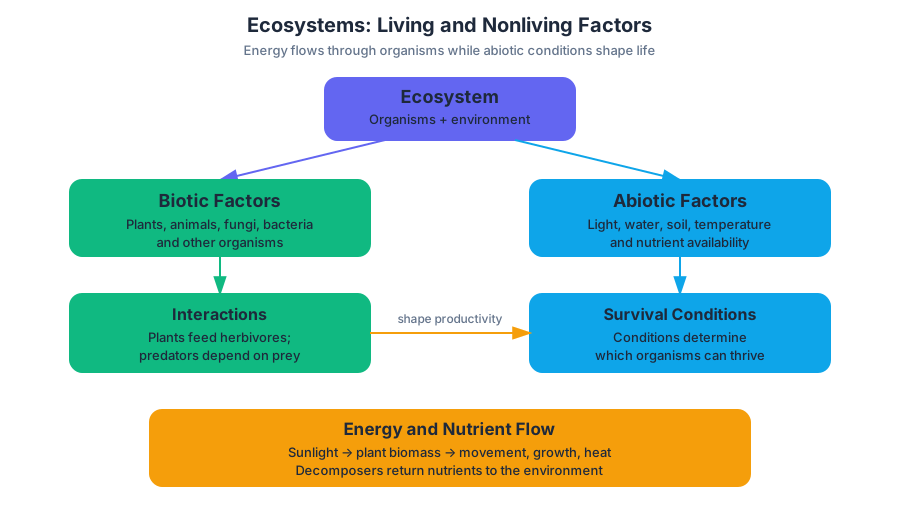
Ecosystems: living and nonliving factors
Biotic factors are living components, including plants, animals, fungi, bacteria, and other organisms. Abiotic factors are nonliving components, such as temperature, precipitation, sunlight, soil, salinity, wind, and nutrient availability. An ecosystem emerges from the interaction of both: plants require light, water, carbon dioxide, and nutrients; herbivores depend on plants; predators depend on prey; and decomposers return nutrients to the environment.
Energy also changes forms within ecosystems. Light energy can become chemical energy stored in plant biomass through photosynthesis; that chemical energy can then become movement, growth, heat, or chemical energy in another organism. Energy transfer is therefore linked to interactions among organisms, while abiotic conditions determine which organisms can survive and how productive the ecosystem can be.
Resources shape species interactions
Resources are not always distributed evenly. Resource distribution means the way necessities such as water, light, nutrients, food, or shelter vary across space and time. A shaded forest floor may receive little light but retain moisture, while a canopy receives intense light but may be exposed to drying winds. These differences create distinct opportunities and limits for different species.
Consider two plant species growing in the same forest. One has broad leaves and thrives in dim understory light; the other grows rapidly in bright canopy openings. If a fallen tree creates a sunny gap, the second species may outcompete the first there, while the shade-tolerant species remains successful beneath closed canopy. The resource pattern—light changing from place to place—helps determine species distributions and reduces or intensifies competition.
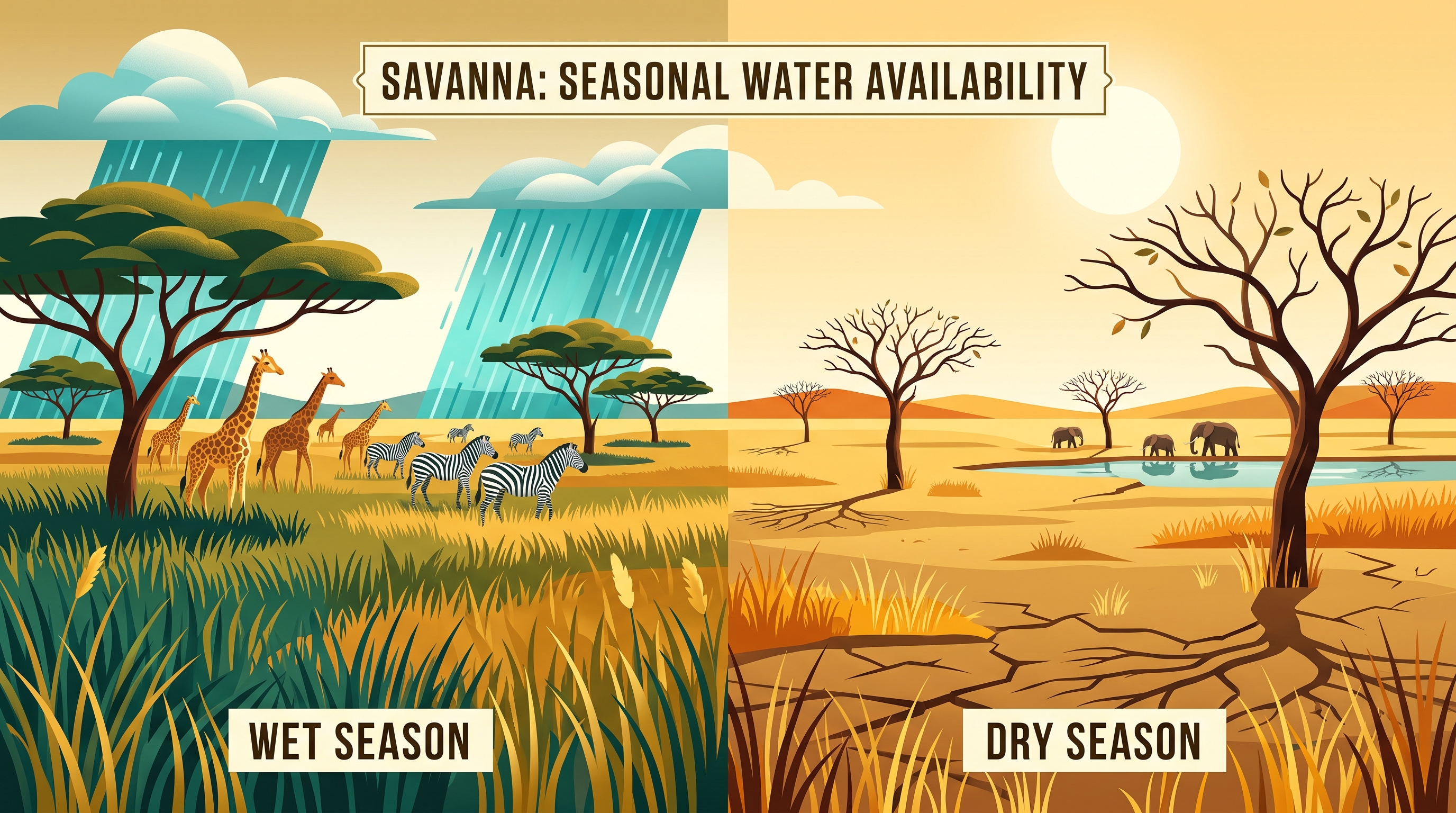
Resource availability can also change seasonally. In a savanna, water is abundant during the rainy season but scarce during the dry season. Organisms may compete more intensely for water, migrate, become dormant, or use different feeding times. Thus, species interactions depend not only on what resources exist, but also on where and when those resources are available.
Misconception check: “If two species use the same ecosystem, they must compete equally.”
Competition depends on overlap in resource use. Species that use different foods, spaces, seasons, or light levels may reduce competition through resource partitioning, even when they live in the same ecosystem.
Terrestrial biomes and climate
A biome is a large regional ecosystem identified by characteristic climate, vegetation, and organisms. Biomes occur across the globe in both terrestrial and aquatic environments, but terrestrial biomes are especially strongly shaped by temperature and precipitation. Latitude, elevation, seasonal patterns, and local conditions help explain why vegetation changes across Earth’s surface.
ERT-1.B — Describe the global distribution and principal environmental aspects of terrestrial biomes.
Major terrestrial biomes include tropical rain forests, tropical seasonal forests, savannas, deserts, temperate seasonal forests, temperate rain forests, temperate grasslands, chaparral, and taiga. Their boundaries are not rigid lines: climate can shift gradually across a landscape, and the worldwide distribution of biomes is dynamic. Past climate change has altered biome locations, and future climate change may shift them again.
The following comparison shows why similar-looking grasslands and forests cannot be identified from temperature alone.
| Biome | Seasonal pattern | Annual precipitation | Vegetation pattern |
|---|---|---|---|
| Temperate seasonal forest | Four distinct seasons | More precipitation than a savanna; precipitation occurs throughout the year | Deciduous and evergreen trees |
| Savanna | Warm conditions with distinct rainy and dry seasons | Less annual precipitation than a temperate seasonal forest | Grasses with scattered trees |
A temperate seasonal forest experiences four distinct seasons and receives precipitation throughout the year. A savanna has distinct rainy and dry seasons and receives less annual precipitation. Even if a savanna supports scattered trees, its seasonal drought and frequent water limitation favor grasses and drought-adapted organisms rather than a closed forest canopy.
Worked interpretation: identifying a biome
Suppose a climate record describes a region with four seasons, moderate temperatures, and precipitation in every month. The best interpretation is temperate seasonal forest, not savanna. The decisive evidence is the combination of four-season temperature patterns and year-round precipitation; a savanna would show a pronounced rainy season followed by a distinct dry season.
This reasoning demonstrates 1.B Concept Explanation: connect evidence about climate to the environmental characteristics and global distribution of a biome. On a map or climate graph, do not identify a biome from one variable alone. Match temperature, precipitation amount, and precipitation timing to the biome’s characteristic vegetation and organisms.
Retrieval check
A landscape receives heavy rain for six months and very little rain for six months, with warm temperatures year-round. Is it more consistent with a temperate seasonal forest or a savanna? Explain using both precipitation timing and ecosystem structure.
Answer: It is more consistent with a savanna because precipitation is concentrated in a rainy season followed by a distinct dry season. Seasonal water scarcity favors grasses and scattered trees rather than the continuous, year-round moisture associated with a temperate seasonal forest.
Source Materials
- AP Environmental Science Course and Exam Description
- Review the Clarifications (.pdf)
- AP Environmental Science Course Overview
- AP Environmental Science Course at a Glance
- AP Environmental Science Course at a Glance Poster
- AP Environmental Science
- AP Environmental Science
- AP Environmental Science Sample Syllabus 1
- AP/College Environmental Science-Khan Academy
- AP Environmental Science Exam-College Board
- AP Environmental Science Units-Save my Exams
- AP Environmental Science-Bozeman Science