From the free course AP Environmental Science on Lykke
2.5 Adaptations · 2.6 Ecological Succession
Key concepts: Ecological succession · Primary succession · Secondary succession · Pioneer species · Successional stages and soil development · Adaptations of pioneer species · Plant diversity and ecosystem resilience · Recovery after disturbance · Succession in different biomes · Relationships among variables in ecological data
A community does not return after disturbance all at once: organisms arrive in a sequence shaped by soil, sunlight, nutrients, climate, and biological interactions. Ecological succession is the predictable change in species composition and community structure over time.
2.5 Adaptations · 2.6 Ecological Succession
A community does not return after disturbance all at once: organisms arrive in a sequence shaped by soil, sunlight, nutrients, climate, and biological interactions. Ecological succession is the predictable change in species composition and community structure over time.
Adaptations determine who arrives first
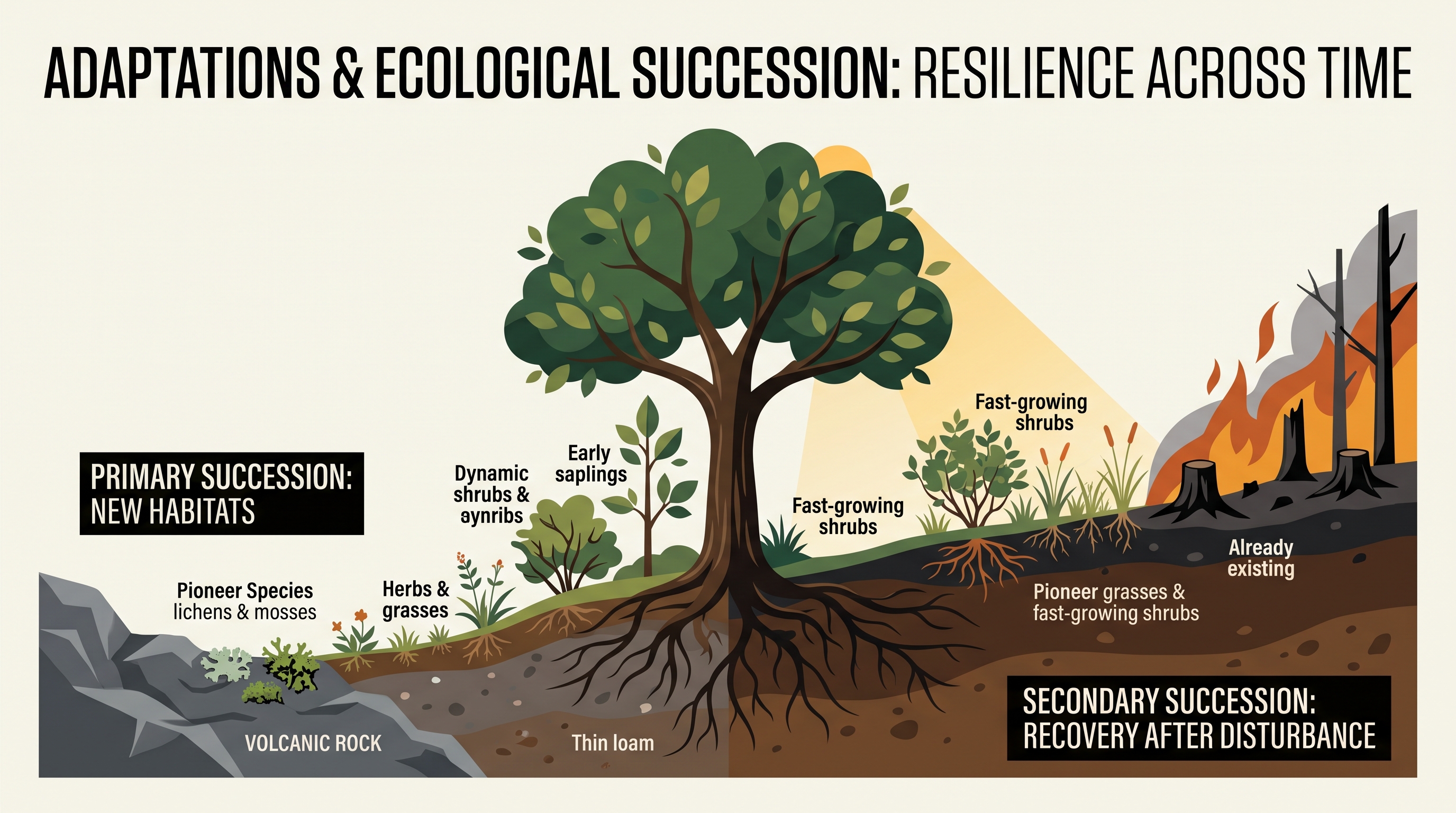
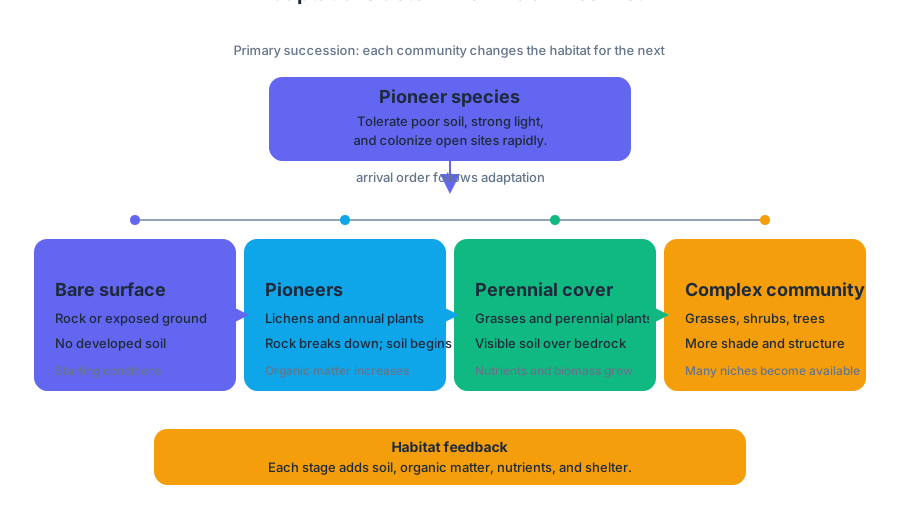
A pioneer species is an organism adapted to colonize a newly exposed or disturbed habitat. Pioneer species can tolerate little or poor soil, low organic matter, low nutrient availability, intense sunlight, and a wide range of habitats. They also tend to colonize rapidly, allowing them to reach open sites before slower-growing species.
Typical pioneers include lichens and small annual plants. Lichens help break down bare rock, while their dead organic matter contributes material that can mix with mineral particles. Small plants add additional organic matter when they die and decompose, gradually improving conditions for later vegetation.
The sequence is not simply “small plants become large plants.” Each stage changes the physical environment, making it more suitable for different species:
| Successional stage | Typical vegetation | Environmental change |
|---|---|---|
| Stage I | Bare rock or exposed surface | No developed soil |
| Stage II/2 | Lichens and small annual plants | Early soil formation begins |
| Stage III | Grasses and perennial plants | A visible soil layer forms over bedrock |
| Later stages | Grasses, shrubs, and shade-intolerant or shade-tolerant vegetation | More organic matter, nutrients, biomass, and structural complexity |
Adaptations are not intentional improvements made by individual organisms. An organism already possessing traits that fit the conditions is more likely to survive and reproduce. Over generations, natural selection can make those traits common in the population. For pioneers, useful traits include rapid growth, rapid reproduction, tolerance of full sunlight, efficient use of scarce nutrients, and the ability to establish across many habitat types.
Primary versus secondary succession
Primary succession begins on bare rock or another surface without soil. Because soil must first develop, primary succession is generally slow. A newly exposed rock surface is an example: lichens and small annual plants appear in Stage II/2, contribute organic matter, and help initiate the formation of soil; by Stage III, a visible soil layer has formed over the bedrock.
Secondary succession occurs after a disturbance when soil remains. Burning crops leaves soil, so the field undergoes secondary rather than primary succession. Fast-growing, early-successional organisms can recolonize the existing soil, usually much sooner than vegetation can establish on bare rock.
Misconception check — “fire always causes primary succession.” The disturbance itself does not determine the type of succession. The deciding question is: Did soil remain? Fire that removes vegetation but leaves soil causes secondary succession; a disturbance that removes the soil layer and exposes bare substrate can initiate primary succession.
Biodiversity and recovery
Communities with greater plant diversity generally recover more quickly from disturbances such as flooding. Higher species richness, meaning more species in the community, makes it less likely that one event will eliminate a large proportion of the community. Different species also have different tolerances and functions, so some may survive and repopulate after others are damaged.
A diverse community may also contain greater genetic diversity and more complex ecological connections. By contrast, a dominant species or monoculture can be severely affected when a disturbance targets its particular traits—for example, when nearly all plants lack flood tolerance. Diversity therefore increases the likelihood that resistant or resilient organisms remain.
Applying succession to ecological data
Suppose plant species richness is measured on mine-waste piles of different ages. If older piles generally contain more plant species, the data support a relationship of increasing species richness with site age. A strong response describes the pattern and connects it to succession: soil development and accumulating organic matter allow grasses, perennials, shrubs, and additional vegetation to establish.
Recovery rate also depends on biome conditions. Plant recovery after mining would generally be slower in a tundra than in a temperate forest because tundra has colder conditions and a shorter growing season. The recovering plants would be tundra-native, and the site would generally reflect the lower species diversity typical of that biome.
AP Science Practices in action
This topic is assessed especially through Science Practice 1: Concept Explanation, when distinguishing primary from secondary succession or explaining why diversity increases resilience; Science Practice 2: Visual Representations, when interpreting succession diagrams; Science Practice 4: Scientific Experiments, when comparing spontaneous and human-assisted restoration; Science Practice 5: Data Analysis, when describing species-richness trends across sites of different ages; and Science Practice 7: Environmental Solutions, when evaluating restoration strategies after mining or fire.
Retrieval check: A crop field is burned, but its soil remains. Identify the type of succession, name the likely early colonizers, and explain why a diverse plant community would usually recover from flooding more quickly than a monoculture.
Source Materials
- AP Environmental Science Course and Exam Description
- Review the Clarifications (.pdf)
- AP Environmental Science Course Overview
- AP Environmental Science Course at a Glance
- AP Environmental Science Course at a Glance Poster
- AP Environmental Science
- AP Environmental Science
- AP Environmental Science Sample Syllabus 1