From the free course AP Environmental Science on Lykke
9.5 Global Climate Change · 9.6 Ocean Warming
Key concepts: Global climate change · Effects of climate change · Greenhouse gases and ocean acidification · Ocean warming · Coral bleaching · Oceanic currents and the ocean conveyor belt · Coastal and global climate impacts · Human activities affecting global systems · Climate-change impacts on habitats and species · Arctic versus global temperature change
Earth’s climate has changed throughout its history, but current warming is producing linked changes across ice, soil, oceans, ecosystems, and human communities. The key question is not merely whether temperature rises, but how one change propagates through connected Earth systems.
9.5 Global Climate Change · 9.6 Ocean Warming
Earth’s climate has changed throughout its history, but current warming is producing linked changes across ice, soil, oceans, ecosystems, and human communities. The key question is not merely whether temperature rises, but how one change propagates through connected Earth systems.
Climate change is a connected-system problem
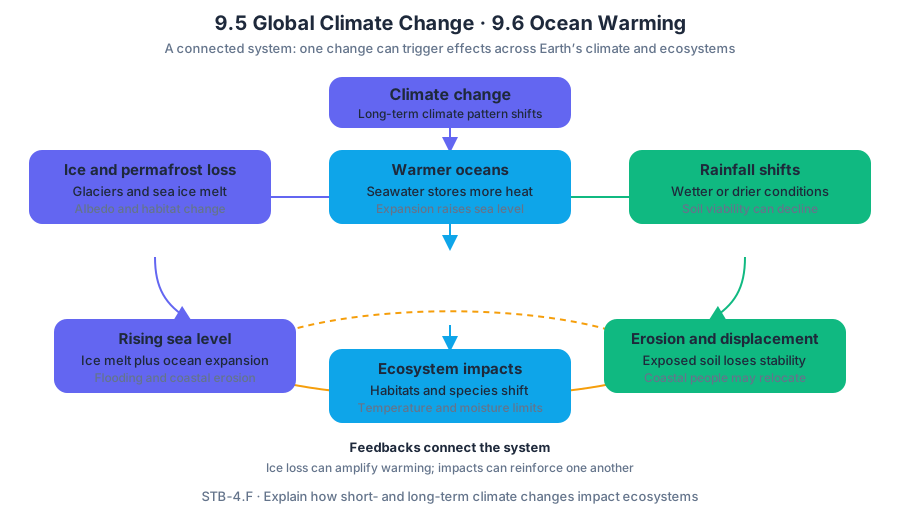
Global climate change is a long-term change in Earth’s climate patterns, including temperature, precipitation, ice cover, sea level, and circulation.
A warmer climate can produce several observable effects at once:
- rising average temperatures;
- melting permafrost and sea ice;
- melting glaciers and land-based ice sheets;
- rising sea levels;
- changes in rainfall and soil viability;
- increased erosion;
- displacement of coastal inhabitants; and
- habitat loss or other changes for species that depend on particular temperature, moisture, or ice conditions.
These effects interact. For example, melting land-based ice raises sea level, while warming seawater expands. Higher sea levels can flood coastal wetlands, reduce nesting habitat, and force people to relocate. In a different system, altered temperature and rainfall can reduce soil viability and leave exposed soil more vulnerable to erosion. This cause-and-effect chain develops STB-4.F: Explain how changes in climate, both short- and long-term, impact ecosystems.
Oceanic currents move climate around the planet
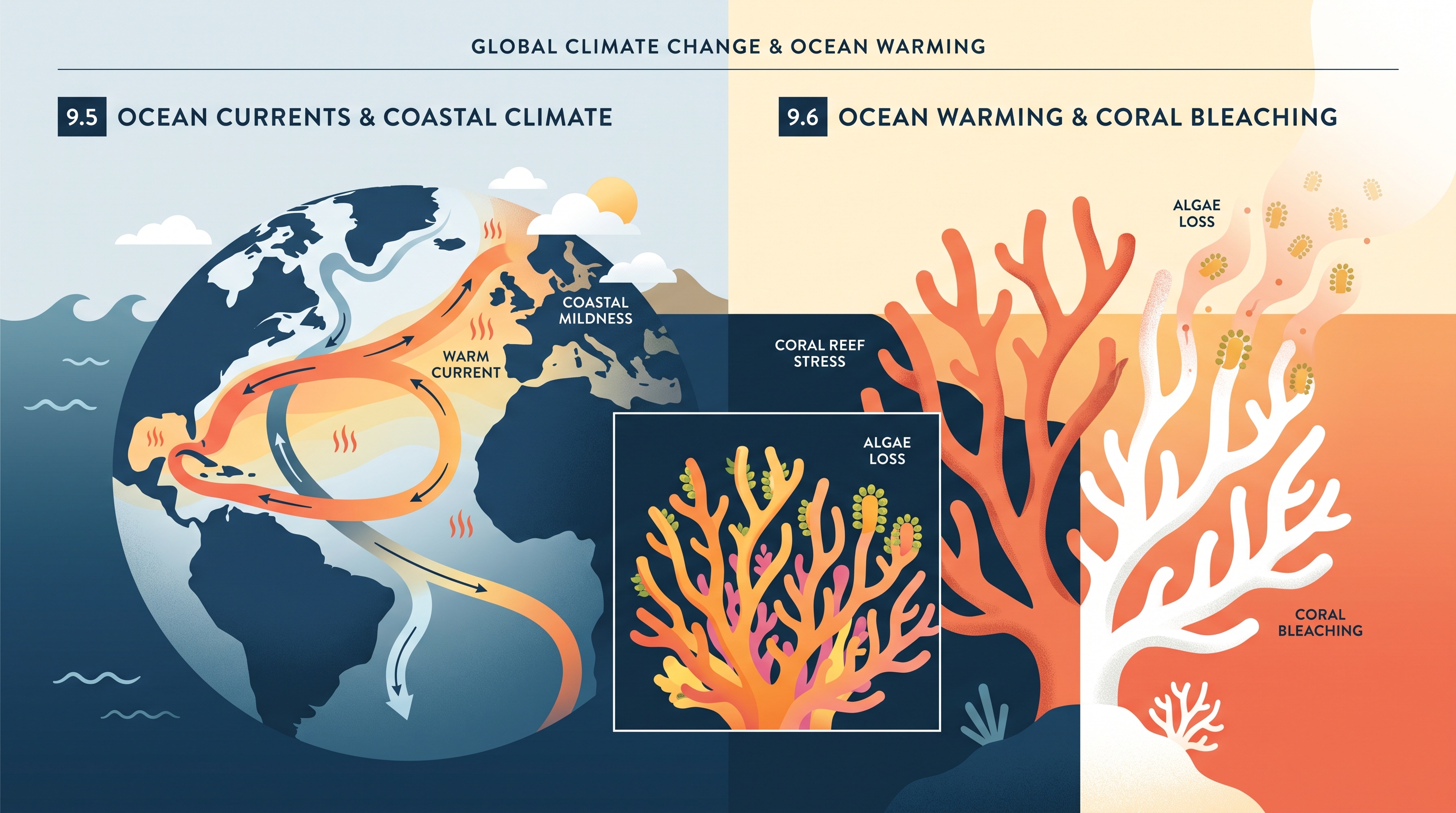
Oceanic currents, sometimes called the ocean conveyor belt, are large-scale movements of seawater that redistribute heat throughout the world. Warm water transports energy away from the tropics; colder, denser water sinks and helps drive deep-water circulation.
A simplified circulation pattern looks like this:
$$ \text{Warm surface water} \rightarrow \text{higher latitudes} \rightarrow \text{cooling and sinking} \rightarrow \text{deep return flow} $$
This movement matters especially in coastal regions. If a current changes in speed, direction, or temperature, the climate of nearby land can change as well. Coastal communities may experience altered temperatures, precipitation patterns, storm conditions, fisheries, and growing seasons even when the change began far away in the ocean.
Essential knowledge — STB-4.F.5: Oceanic currents, or the ocean conveyor belt, carry heat throughout the world. When these currents change, they can strongly affect global climate, especially in coastal regions.
Misconception check — “The ocean only responds to climate.”
The ocean responds to atmospheric change, but it also helps control climate by storing and transporting heat. A current shift can therefore become a climate driver for regions along its path.
Positive feedback accelerates polar change
Albedo is the fraction of incoming solar energy reflected by a surface. Bright snow and ice have high albedo; darker ocean water and exposed ground absorb more energy.
The polar feedback can be represented as:
$$ \text{warming} \rightarrow \text{ice and snow melt} \rightarrow \text{lower albedo} \rightarrow \text{more energy absorbed} \rightarrow \text{additional warming} $$
This is a positive feedback loop because the initial change—warming—is amplified rather than reduced. In the Arctic, melting sea ice and thawing tundra can also release greenhouse gases such as methane, adding another reinforcing pathway. Species that rely on sea ice for habitat or food are consequently exposed to both habitat loss and food-web disruption.
Essential knowledge — STB-4.F.7, STB-4.F.8, and STB-4.F.9: Polar regions respond rapidly because ice and snow reflect substantial energy back to space. As they melt, Earth absorbs more energy, and Arctic feedback loops involving sea ice and thawing tundra can intensify warming.
A positive feedback is not the same as a positive outcome. “Positive” describes the direction of the response: the effect reinforces the original change.
Ocean warming and marine species
STB-4.G.1: Ocean warming is caused by the increase in greenhouse gases in the atmosphere.
The ocean absorbs much of the additional heat associated with atmospheric greenhouse-gas increases. Warmer seawater can affect marine species through loss of habitat and through changes in metabolism, growth, migration, and reproduction.
Ocean warming is also linked to changes in ocean pH. The chemical details of acidification belong with the following topic, but the connection is important: increasing greenhouse gases in the atmosphere can alter both ocean temperature and ocean chemistry. A single global-scale driver can therefore create multiple stresses for marine organisms.
Coral bleaching: a visible warning signal
Coral bleaching occurs when corals lose the algae living within their tissues and turn white. These algae normally contribute energy to the coral; without them, the coral is stressed and may have insufficient energy for growth, reproduction, and repair.
The sequence is:
$$ \text{ocean warming} \rightarrow \text{algal loss} \rightarrow \text{white coral tissue} \rightarrow \begin{cases} \text{recovery if stress ends} \ \text{death if stress persists} \end{cases} $$
STB-4.G.3: Ocean warming is causing coral bleaching; bleaching occurs when corals lose their algae and become white. Some bleached corals recover, while others die. Therefore, bleaching is not automatically proof that every coral is dead—but it is evidence of severe stress.
Worked example: linking local activity to global effects
Suppose a coastal region clears mangroves and increases fossil-fuel use. Locally, mangrove removal eliminates nursery habitat and reduces coastal protection. Regionally, more exposed shoreline is vulnerable to flooding and erosion. Globally, added greenhouse gases contribute to ocean warming; warmer water increases stress on nearby coral reefs, while rising sea level threatens low-lying communities.
The reasoning is:
- Identify the activity: land clearing and fuel combustion.
- Trace the physical change: habitat removal, increased greenhouse gases, warming ocean, and rising sea level.
- Connect each change to an ecosystem or human consequence: reduced nursery habitat, coral bleaching, erosion, flooding, and displacement.
- State the scale: a local or regional activity can contribute to impacts that operate globally.
This directly applies the skill 7.A.9 — Describe environmental problems: name the problem, identify its cause, and connect it to a specific environmental consequence.
Retrieval check
Why can a change in oceanic currents affect a coastal climate, and why can ocean warming cause coral bleaching? A strong answer should mention heat transport by currents, the loss of coral-associated algae, and the possibility of coral recovery or death depending on how long the stress lasts.
Source Materials
- AP Environmental Science Course and Exam Description
- Review the Clarifications (.pdf)
- AP Environmental Science Course Overview
- AP Environmental Science Course at a Glance
- AP Environmental Science Course at a Glance Poster
- AP Environmental Science
- AP Environmental Science
- AP Environmental Science Sample Syllabus 1