From the free course AP Environmental Science on Lykke
7.7 Acid Rain · 7.8 Noise Pollution
Key concepts: Acid rain formation and environmental effects · Sulfur dioxide and nitrogen oxide air pollution · Soil and limestone buffering of acid rain · Coal-burning power plants as sources of sulfur dioxide · Methods for reducing air pollution from power plants · Particulate matter sources · Vapor recovery nozzles and volatile organic compounds · Reducing vehicle commuting to lower emissions · Noise pollution and environmental consequences · Environmental technology and pollution mitigation
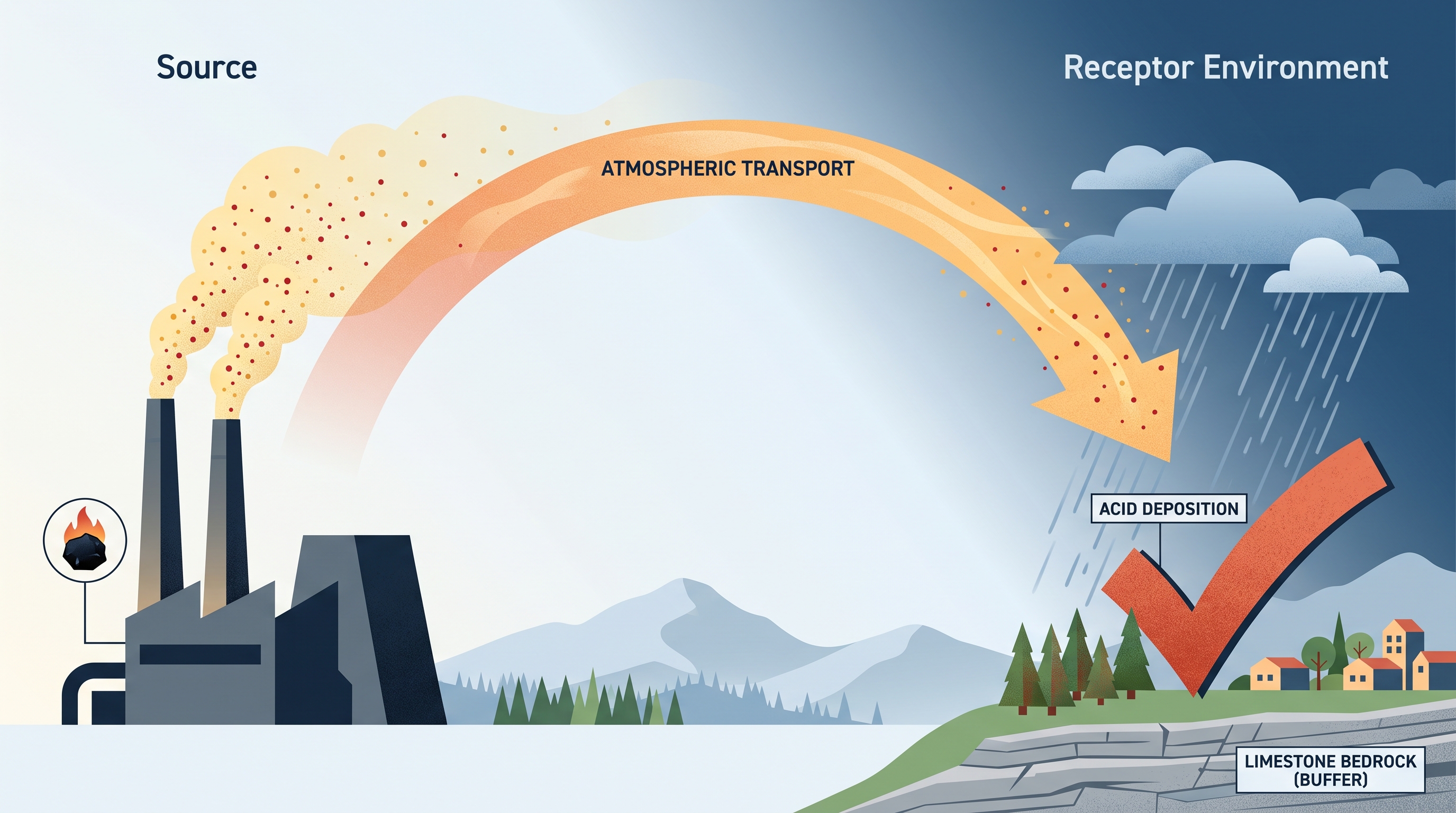
Coal-burning power plants can affect ecosystems hundreds of kilometers away: sulfur-containing fuel releases sulfur dioxide, atmospheric reactions produce sulfuric acid, and prevailing winds carry the resulting acid deposition downwind.
7.7 Acid Rain · 7.8 Noise Pollution
Coal-burning power plants can affect ecosystems hundreds of kilometers away: sulfur-containing fuel releases sulfur dioxide, atmospheric reactions produce sulfuric acid, and prevailing winds carry the resulting acid deposition downwind.
Acid rain: from emission to ecosystem damage
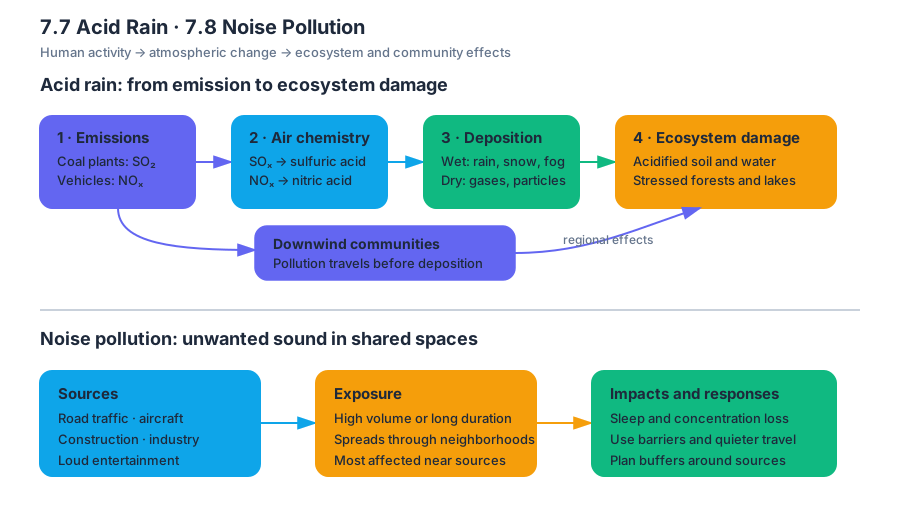
Acid deposition is the return of acidic substances from the atmosphere to Earth’s surface. It includes wet deposition, such as acid rain, snow, or fog, and dry deposition, in which acidic particles and gases settle without precipitation. The central chemical pathway begins when sulfur oxides and nitrogen oxides react in the atmosphere to form sulfuric acid and nitric acid.
Coal-burning power plants are a major source of the sulfur dioxide associated with acid deposition. Vehicles and combustion sources also release nitrogen oxides; therefore, reducing vehicle travel through public transportation or carpooling can reduce emissions of nitrogen oxides and sulfur oxides, decrease atmospheric acidity, and reduce the formation of nitric and sulfuric acids.
The geographic pattern matters. Acid deposition mainly affects communities downwind from coal-burning power plants, because emitted pollutants can be transported before they are converted into acids and deposited. This is why a local power plant can create regional environmental effects rather than only affecting the land immediately surrounding its smokestack. STB-2.I.1
What acid rain changes in soils and water
Acid rain increases environmental acidity, lowering the pH of soils, lakes, and ponds. Aquatic organisms may be harmed when water chemistry changes beyond their tolerance ranges, while acidic soils can alter nutrient availability and make toxic metals more soluble. The result is not simply “rain that burns”; it is a chemical shift that changes the conditions organisms depend on. STB-2.I.2
Some environments resist this change through buffering, the ability of a substance or system to neutralize added acid and limit a rapid pH decrease. Limestone bedrock, composed largely of calcium carbonate, can neutralize acidic water. In simplified form, carbonate consumes hydrogen ions:
$$ CO_3^{2-} + 2H^+ \rightarrow H_2CO_3 $$
Soils also differ in buffering strength. A useful investigation would add equal volumes of acidic rainwater to equal masses of different soil types, then measure the change in pH. The soil showing the smallest pH decrease provides the strongest buffer, provided the experiment controls soil mass, acid volume, acid concentration, and measurement method.
Misconception check — “All lakes respond identically to acid rain.” They do not. A lake over limestone or carbonate-rich material may be strongly buffered, whereas a lake in thin, nutrient-poor soil over noncarbonate bedrock may experience a much larger pH decline.
Reducing acid-forming pollution at the source
Source control prevents pollutants from entering the atmosphere rather than attempting to repair damage afterward. Methods for reducing air pollution from coal-burning power plants include scrubbers, which remove sulfur dioxide from exhaust gases, and electrostatic precipitators, which use electrical charges to remove particulate matter from smokestack emissions. This directly applies the suggested skill STB-2.G.5: Explain how air pollutants can be reduced at the source.
A vapor recovery nozzle addresses a different source: vehicle refueling. It captures gasoline vapors, including volatile organic compounds, and prevents those fumes from escaping into the atmosphere. This device does not remove sulfuric acid from a lake; it reduces pollution at the moment the vapor would otherwise be released.
Particulate matter: pollution that travels as particles
Particulate matter consists of tiny solid particles or liquid droplets suspended in air. Sources include industry, construction and demolition, agriculture, mining, waste incineration, biomass burning, human-caused wildfires, and unpaved roads. Identifying a source requires naming an activity—not merely writing “pollution.”
For example, “construction” identifies an anthropogenic source because excavation and demolition can release dust particles. “Wildfires” is incomplete if the question asks for a human-caused source; “human-caused wildfires” is more precise.
Noise pollution
Noise pollution is unwanted or harmful sound produced at levels, frequencies, or durations that interfere with human activity or wildlife behavior. Transportation, construction, industrial machinery, aircraft, and urban activity can create persistent noise. Unlike acid rain, noise pollution is not a chemical pollutant that forms an acid in the atmosphere; its effects are transmitted as sound energy.
Mitigation reduces either the source, the transmission pathway, or the receiver’s exposure. Examples include quieter machinery, limits on operating hours, sound barriers, increased distance from the source, and vegetation or structural barriers where appropriate. A strong environmental solution links the intervention to the impact: reducing traffic noise near a nesting area can reduce disturbance to wildlife.
Retrieval check
- Why are communities downwind from coal-burning power plants especially vulnerable to acid deposition?
- Which environmental material can buffer acid rain: limestone bedrock or unpaved-road dust? Explain.
- Complete the causal chain: fewer personal-vehicle commutes $\rightarrow$ lower ______ emissions $\rightarrow$ less formation of ______ and ______ acids.
- Name one particulate-matter source other than motor vehicles and one function of a vapor recovery nozzle.
Answers: pollutants are transported downwind before deposition; limestone bedrock because carbonate neutralizes acid; nitrogen oxides or sulfur oxides, followed by nitric and sulfuric acids; acceptable sources include construction, mining, agriculture, waste incineration, biomass burning, human-caused wildfires, or unpaved roads, and the nozzle prevents gasoline vapors from escaping during refueling.
Source Materials
- AP Environmental Science Course and Exam Description
- Review the Clarifications (.pdf)
- AP Environmental Science Course Overview
- AP Environmental Science Course at a Glance
- AP Environmental Science Course at a Glance Poster
- AP Environmental Science
- AP Environmental Science
- AP Environmental Science Sample Syllabus 1