From the free course AP Environmental Science on Lykke
AP Practice 5
A lake receiving excess fertilizer can become biologically productive at first and biologically stressed soon afterward because algal growth and decomposition alter dissolved oxygen.
AP Practice 5
A lake receiving excess fertilizer can become biologically productive at first and biologically stressed soon afterward because algal growth and decomposition alter dissolved oxygen.
Task type: Quantitative data interpretation
This practice targets the free-response task type that asks you to interpret environmental data, perform calculations, and connect a numerical pattern to an ecological mechanism. The scenario combines Science Practice 5: Data Analysis, Science Practice 6: Mathematical Routines, Science Practice 1: Concept Application, and Science Practice 7: Environmental Solutions.
Suggested timing: Work for approximately $20$–$23$ minutes without looking at the solution. Reserve the last $2$ minutes to check units, arithmetic, and whether every explanation includes a mechanism rather than merely repeating the data.
Original practice scenario
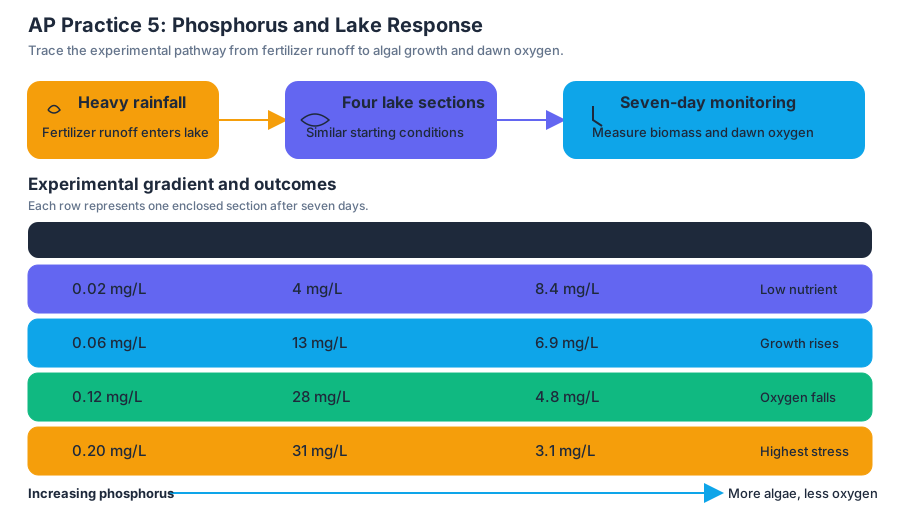
A shallow freshwater lake lies downstream from agricultural fields. After heavy rainfall, dissolved phosphorus from fertilizer enters the lake. Researchers establish four enclosed experimental sections with similar initial conditions. Each section receives a different phosphorus concentration and is monitored for seven days.
| Phosphorus concentration in water ($mg/L$) | Algal biomass after seven days ($mg/L$) | Dissolved oxygen at dawn after seven days ($mg/L$) |
|---|---|---|
| $0.02$ | $4$ | $8.4$ |
| $0.06$ | $13$ | $6.9$ |
| $0.12$ | $28$ | $4.8$ |
| $0.20$ | $31$ | $3.1$ |
Questions
(a) Identify the relationship between phosphorus concentration and algal biomass shown in the data.
(b) Calculate the percentage decrease in dissolved oxygen between the section receiving $0.02\ mg/L$ phosphorus and the section receiving $0.20\ mg/L$ phosphorus. Show your setup.
(c) Use the data and an ecological mechanism to explain why the section with the greatest algal biomass has the lowest dissolved oxygen concentration at dawn.
(d) Describe one limitation of using these enclosed sections to predict conditions in the entire lake.
(e) Propose one management practice that could reduce the likelihood of oxygen depletion in the lake. Explain how the practice addresses the phosphorus source.
Worked solution
(a) Interpret the relationship
As phosphorus concentration increases from $0.02\ mg/L$ to $0.12\ mg/L$, algal biomass increases from $4\ mg/L$ to $28\ mg/L$. Biomass then increases only slightly, from $28\ mg/L$ to $31\ mg/L$, when phosphorus rises to $0.20\ mg/L.
A complete response identifies a positive relationship with a leveling-off pattern. Phosphorus appears to limit algal growth at lower concentrations, but another factor may become limiting at higher concentrations. The response should not claim that algal biomass increases indefinitely.
Scoring target — data interpretation: State the direction of the relationship and describe the important pattern in the data, including the reduced increase at the highest phosphorus concentration.
(b) Calculate percentage decrease
Use the initial dissolved oxygen concentration as the denominator:
$$ \text{Percentage decrease}
\frac{\text{initial value} - \text{final value}}{\text{initial value}} \times 100 $$
Substitute the values:
$$ \text{Percentage decrease}
\frac{8.4\ mg/L - 3.1\ mg/L}{8.4\ mg/L} \times 100 $$
$$
\frac{5.3}{8.4}\times 100 \approx 63.1% $$
The dissolved oxygen concentration decreased by approximately $63%$. A response that gives the correct number but omits the setup may lose the calculation point if the scoring criterion requires supporting work.
Scoring target — mathematical routine: Use the correct initial-value denominator, show the calculation, and report a reasonable rounded result with units or a clear percentage label.
(c) Explain the mechanism
Phosphorus stimulates algal growth, producing a large algal population. When algae die, bacteria decompose the organic matter; bacterial cellular respiration consumes dissolved oxygen. At night, algae and other organisms also respire without photosynthetic oxygen production, so oxygen concentration is especially low at dawn.
This is an example of eutrophication, the enrichment of a body of water with nutrients that can produce excessive biological growth and oxygen depletion. The data support the mechanism: the highest algal biomass, $31\ mg/L$, occurs with the lowest dawn dissolved oxygen, $3.1\ mg/L$.
Scoring target — concept application: Connect nutrient enrichment to algal growth, decomposition or respiration, and oxygen consumption. Merely stating “more algae means less oxygen” is incomplete because it does not identify the process causing the decrease.
(d) Identify a limitation
The enclosed sections may not reproduce the lake’s mixing, water flow, depth, temperature variation, species composition, or nutrient inputs. Therefore, the measured response may not represent the response of the entire lake.
A strong limitation names both the experimental difference and its consequence. For example, “The sections restrict water movement, so oxygen may decline more rapidly inside them than in the open lake” is stronger than “The experiment is not realistic.”
Scoring target — experimental interpretation: Identify a specific limitation that could affect the generalizability of the results.
(e) Propose a solution
Farmers could establish vegetated buffer strips between cropland and the lake. Plant roots and soil can retain or absorb phosphorus before runoff enters surface water, reducing nutrient delivery and the resulting algal growth.
Other defensible answers include applying fertilizer according to soil-test results, reducing fertilizer application before heavy rainfall, or improving erosion-control practices. The response must explain the pathway from the practice to reduced phosphorus input; naming a solution without that connection is not enough.
Scoring target — environmental solution: Propose a feasible practice and explain how it reduces the environmental cause or prevents the harmful effect.
Misconception check: “High algal biomass always means high oxygen”
Algae produce oxygen through photosynthesis during daylight, but the entire community consumes oxygen through cellular respiration. After algal cells die, decomposition can consume enough oxygen to create hypoxic conditions. Thus, a lake can show abundant algae at the surface while organisms below the surface experience oxygen stress.
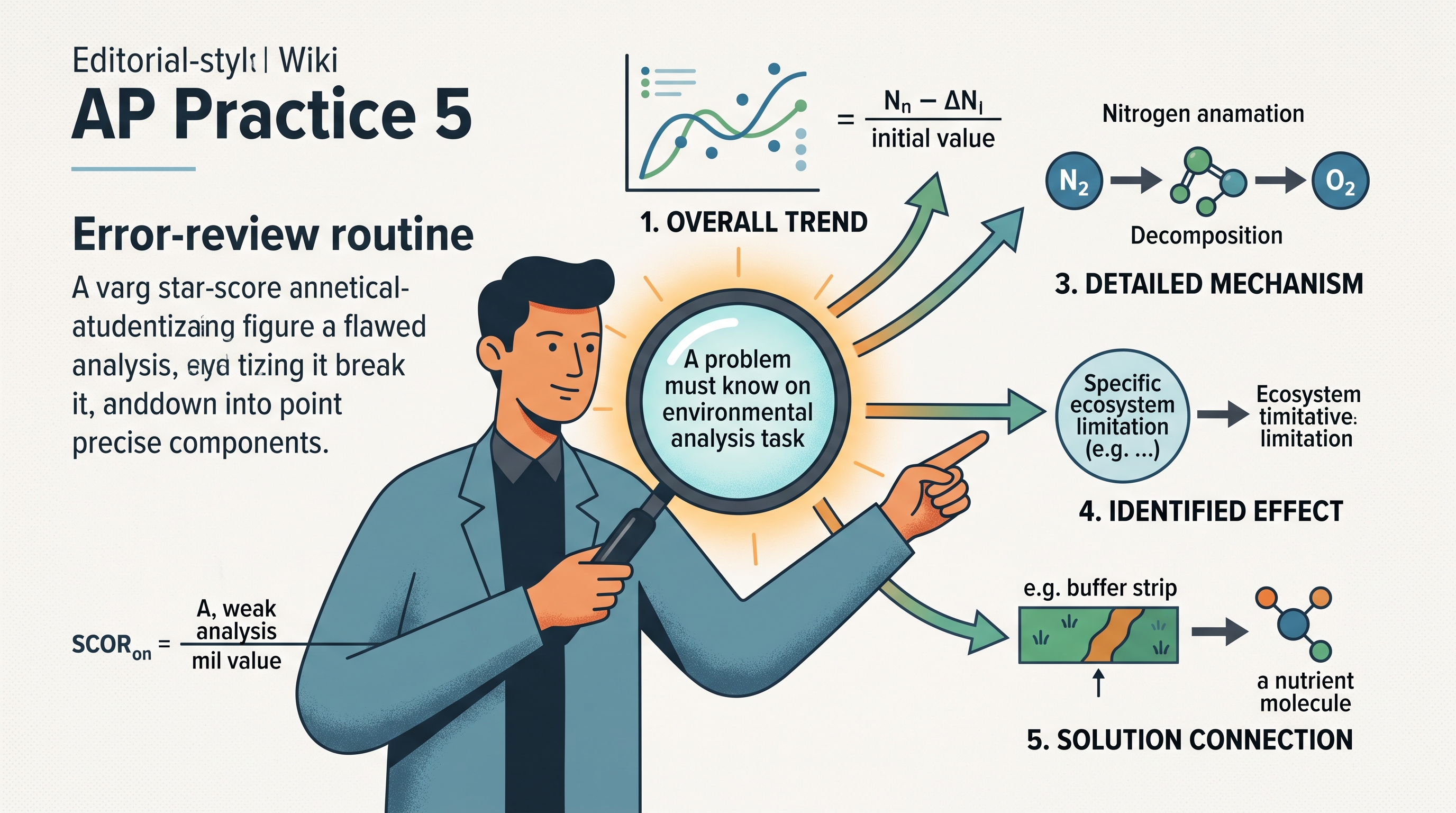
Error-review routine
After completing the task, classify each missed or weak response:
- Pattern error: You described only one data point instead of the overall trend.
- Denominator error: You divided by the final value rather than the initial value.
- Mechanism error: You named eutrophication but did not explain decomposition or respiration.
- Generalization error: You gave a vague limitation without identifying its effect.
- Solution-link error: You proposed an action but did not connect it to phosphorus reduction.
For a second attempt, cover the solution, rewrite each response using a specific datum, a process, and—where relevant—a unit. The goal is not merely to obtain $63%$; it is to show how evidence, mathematics, ecological reasoning, and an intervention form one defensible environmental argument.
Source Materials
- AP Environmental Science Course and Exam Description
- Review the Clarifications (.pdf)
- AP Environmental Science Course Overview
- AP Environmental Science Course at a Glance
- AP Environmental Science Course at a Glance Poster
- AP Environmental Science
- AP Environmental Science
- AP Environmental Science Sample Syllabus 1
- AP/College Environmental Science-Khan Academy
- AP Environmental Science Exam-College Board
- AP Environmental Science Units-Save my Exams
- AP Environmental Science-Bozeman Science