From the free course AP Environmental Science on Lykke
AP Practice 1
Key concepts: Evidence-based reasoning and the scientific method in AP courses · Intellectual freedom and analyzing perspectives in AP · AP Classroom practice tests and feedback · Digital activation and AP class-section registration · AP IDs and streamlined exam registration · Applying environmental science to real-world social and environmental problems · Proposing and evaluating solutions to environmental problems · Interpreting experimental data · Population growth curves and population change calculations · Effects of climate factors on population growth and environmental change
Environmental science turns evidence into decisions: an observation becomes useful only when a student can test an explanation, interpret the results, and justify a solution to a real environmental or social problem.
AP Practice 1
Environmental science turns evidence into decisions: an observation becomes useful only when a student can test an explanation, interpret the results, and justify a solution to a real environmental or social problem.
The evidence-to-solution chain
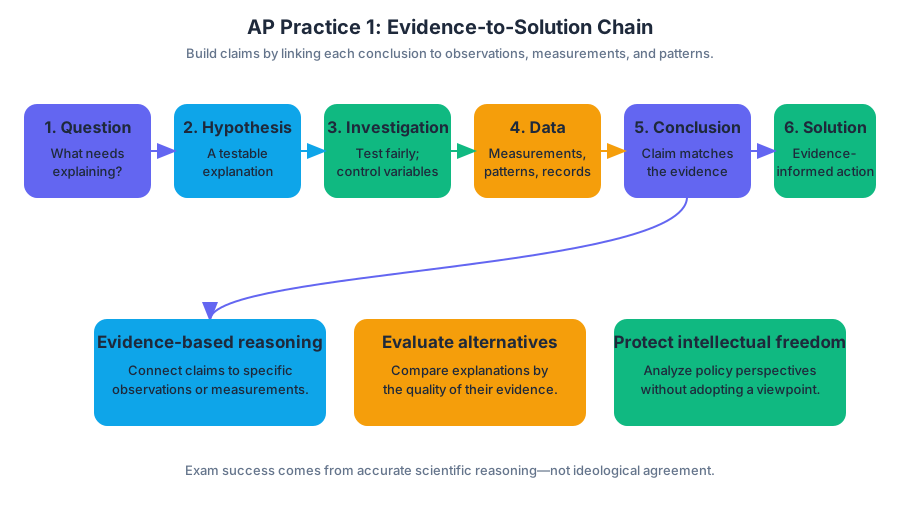
A strong environmental-science response follows a recognizable chain:
$$ \text{Question} \rightarrow \text{Hypothesis} \rightarrow \text{Investigation} \rightarrow \text{Data} \rightarrow \text{Conclusion} \rightarrow \text{Solution} $$
Evidence-based reasoning means connecting a claim to specific observations, measurements, or patterns. The scientific method does not require students to reach a predetermined political or cultural conclusion. Instead, it requires them to evaluate competing explanations according to the quality of their evidence.
AP courses also protect intellectual freedom. Students may analyze perspectives different from their own—including perspectives involving environmental policy, resource use, conservation, or development—without being required to adopt a prescribed cultural or political viewpoint. The exam rewards accurate scientific reasoning, not agreement with a particular ideology.
Practice 1 task: design an investigation
On the current AP Environmental Science exam, Free-Response Question 1 presents an authentic environmental scenario with a model or visual representation. The student must apply the scientific method, identify an environmental problem, and propose a solution. This task primarily assesses Practice 2: Visual Representations and commonly connects with Practice 1: Concept Application, Practice 4: Scientific Experiments, and Practice 7: Environmental Solutions.
A reliable response identifies:
- the environmental question being investigated;
- a testable hypothesis;
- the independent variable, which the investigator changes or compares;
- the dependent variable, which the investigator measures;
- a control or comparison condition;
- repeated trials or multiple sampling sites;
- a method for collecting comparable data;
- a conclusion tied directly to the evidence; and
- a realistic solution supported by the investigation.
Worked example: shoreline vegetation and bird habitat
A coastal town observes that sites with more shoreline development contain fewer nesting birds. A student proposes this investigation:
Question: How does the percentage of developed shoreline affect the number of nesting bird pairs?
Hypothesis: If the percentage of developed shoreline increases, then the number of nesting bird pairs will decrease because development reduces available nesting habitat.
The independent variable is percentage of developed shoreline. The dependent variable is the number of nesting bird pairs. The student should compare several shoreline sites, keep the survey area and observation period consistent, and repeat bird counts across multiple days or seasons. A suitable control is a minimally developed shoreline site, although the investigator should recognize that natural differences among sites—such as vegetation, predators, and tidal exposure—could also affect bird abundance.
If the data show that bird numbers decline as development increases, the evidence supports the hypothesis. A justified solution might combine development setbacks with protection or restoration of nesting vegetation. This solution is stronger than simply saying “stop development” because it addresses the mechanism shown by the investigation while recognizing that communities must evaluate alternative solutions.
Common misconception — correlation proves causation. A negative relationship between development and bird abundance does not automatically prove that development caused the decline. The response earns stronger scientific reasoning by identifying possible confounding variables and explaining how randomization, matched sites, repeated trials, or controls could reduce their influence.
The other practices that support this task
| Science practice | How it appears in environmental problem solving |
|---|---|
| Practice 1: Concept Application | Applies ecological, population, climate, or pollution concepts to a new scenario. |
| Practice 2: Visual Representations | Interprets maps, models, diagrams, graphs, or other representations. |
| Practice 3: Text Analysis | Uses information from text-based environmental sources. |
| Practice 4: Scientific Experiments | Identifies variables, controls, hypotheses, and limitations. |
| Practice 5: Data Analysis | Describes trends, compares groups, and evaluates evidence. |
| Practice 6: Mathematical Routines | Performs environmental calculations and shows work. |
| Practice 7: Environmental Solutions | Proposes and supports solutions to environmental problems. |
Population problems often require both data interpretation and calculation. For example, a population changing from $12{,}000$ to $13{,}200$ individuals has an absolute increase of $1{,}200$ individuals and a percent increase of
$$\frac{13{,}200-12{,}000}{12{,}000}\times 100=10%.$$
A response should then interpret the result biologically: the population increased by $10%$ during the measured interval. A growth curve can reveal whether that change is part of exponential growth, logistic growth approaching carrying capacity, or a temporary fluctuation caused by climate, food availability, disease, or another environmental factor.
Practice, feedback, and digital access
AP Classroom allows teachers to locate questions by topic and skill, assemble customized tests, and assign them online or on paper. Feedback is most useful when it identifies the failed reasoning step—not merely the incorrect answer. After practice, label each error as content misunderstanding, graph-reading error, calculation error, experimental-design error, or unsupported justification.
Students join an AP Classroom class section with a join code supplied by the teacher or AP Coordinator. Digital activation collects registration information and reduces extensive answer-sheet bubbling on exam day. Personalized AP ID registration labels connect exam materials with the student’s digital registration information, helping streamline exam registration and processing.
Timed practice and retrieval check
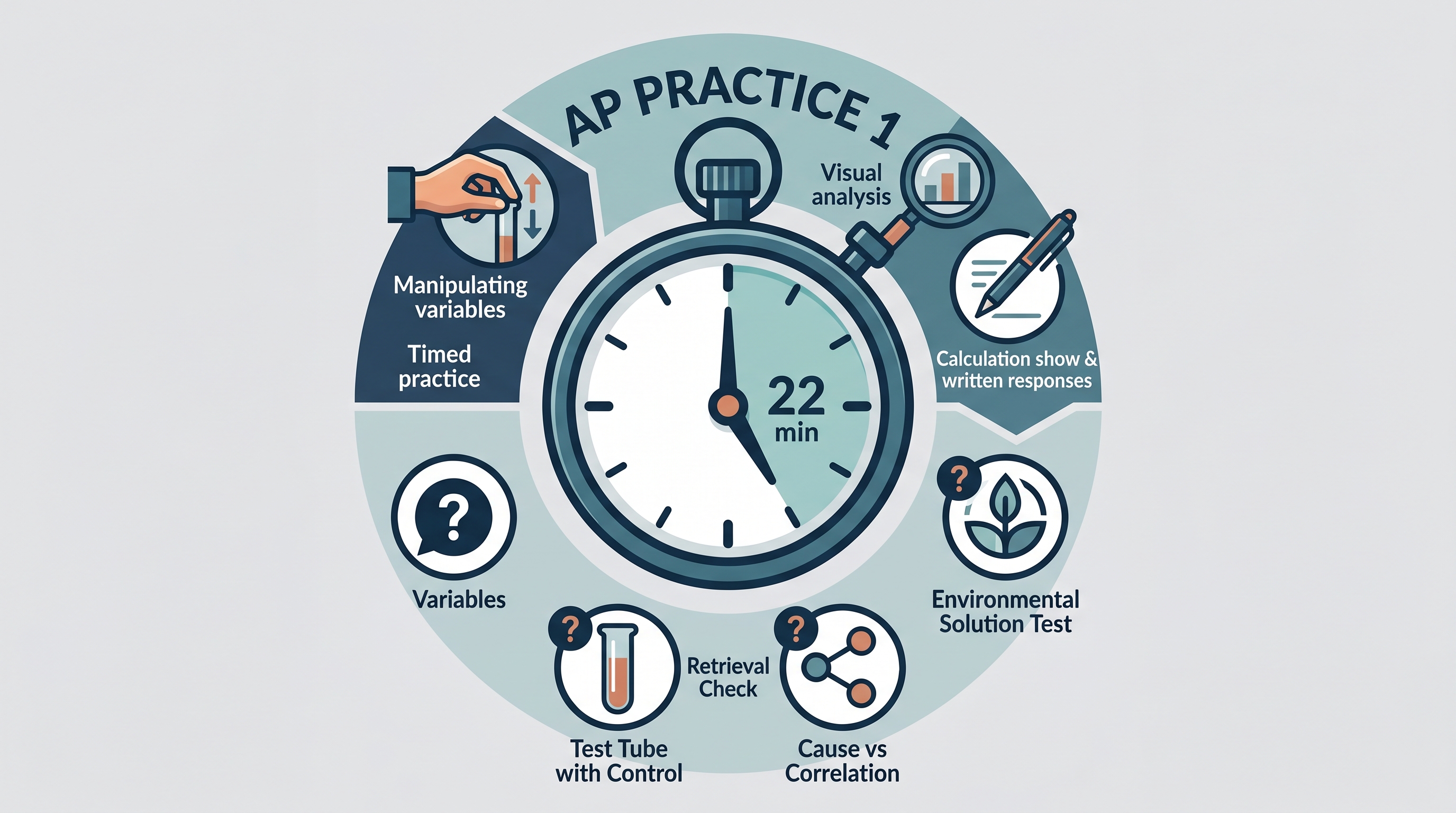
For this investigation-design task, reserve approximately $22$ minutes when practicing the three-question, $70$-minute free-response section. Spend the first few minutes identifying the variables and reading the visual, then write concise answers in complete sentences and show every required calculation.
Before moving on, answer without looking back: What is the difference between an independent and dependent variable? Why is a control useful? What evidence would distinguish a causal relationship from a mere correlation? Finally, name one environmental solution whose effectiveness could be tested with a follow-up investigation.
Source Materials
- AP Environmental Science Course and Exam Description
- Review the Clarifications (.pdf)
- AP Environmental Science Course Overview
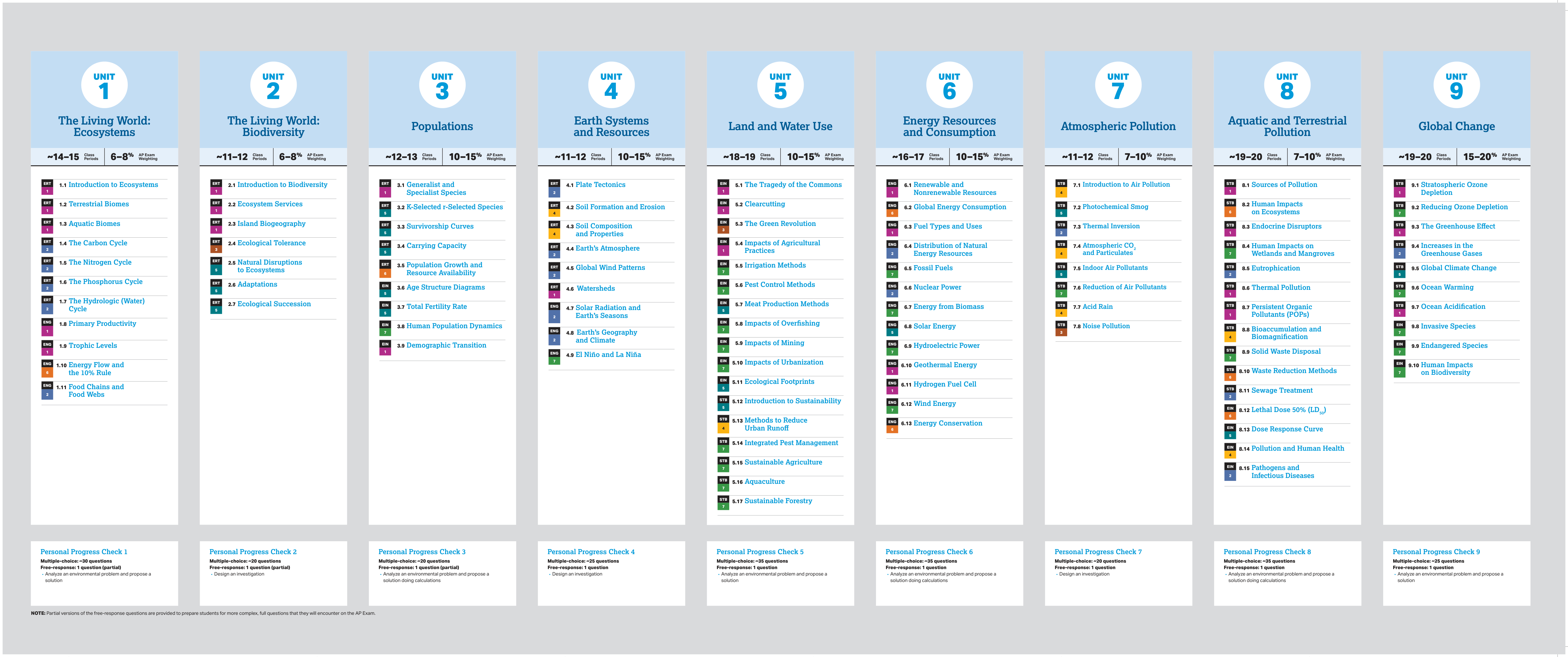
- AP Environmental Science Course at a Glance
- AP Environmental Science Course at a Glance Poster
- AP Environmental Science
- AP Environmental Science
- AP Environmental Science Sample Syllabus 1
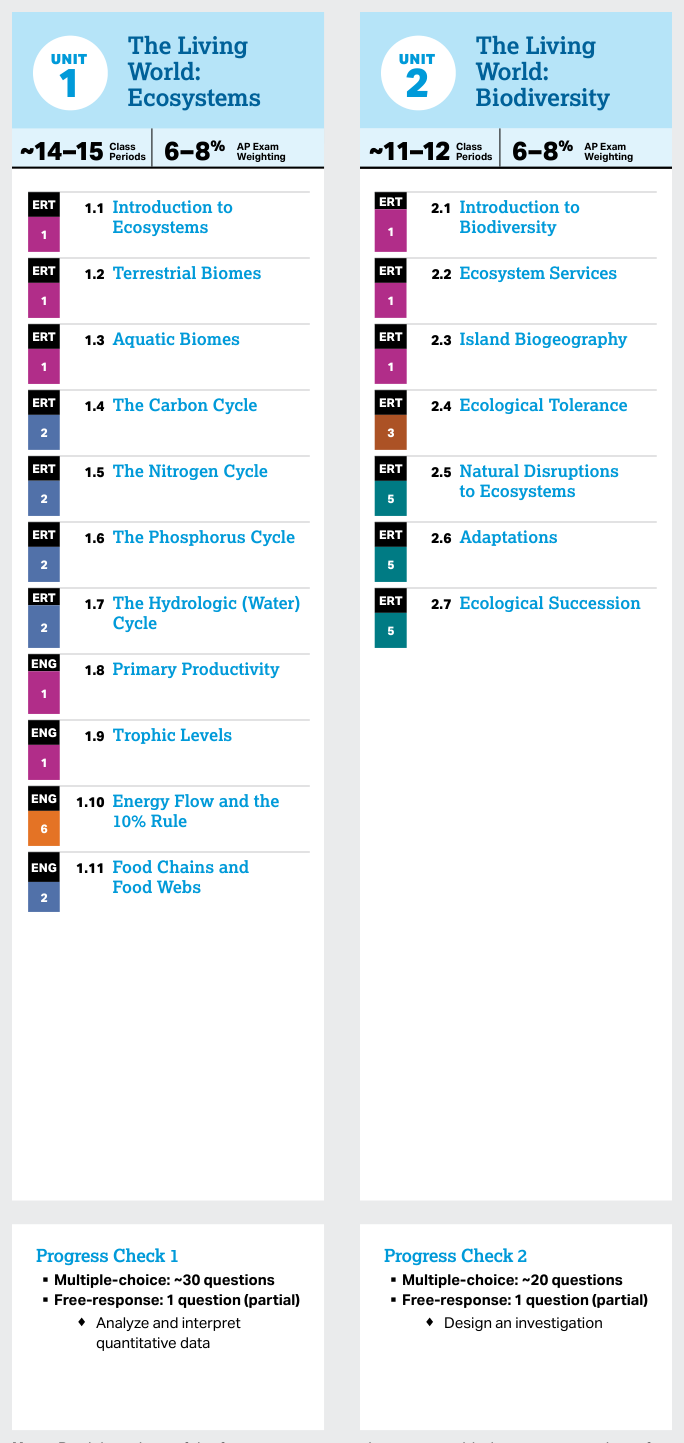
- Note: Partial versions of the free-response questions are provided to prepare students for more complex, full questions that they will encounter on the AP Exam.
- Figure — AP Environmental Science Course at a Glance Poster (p. 1)
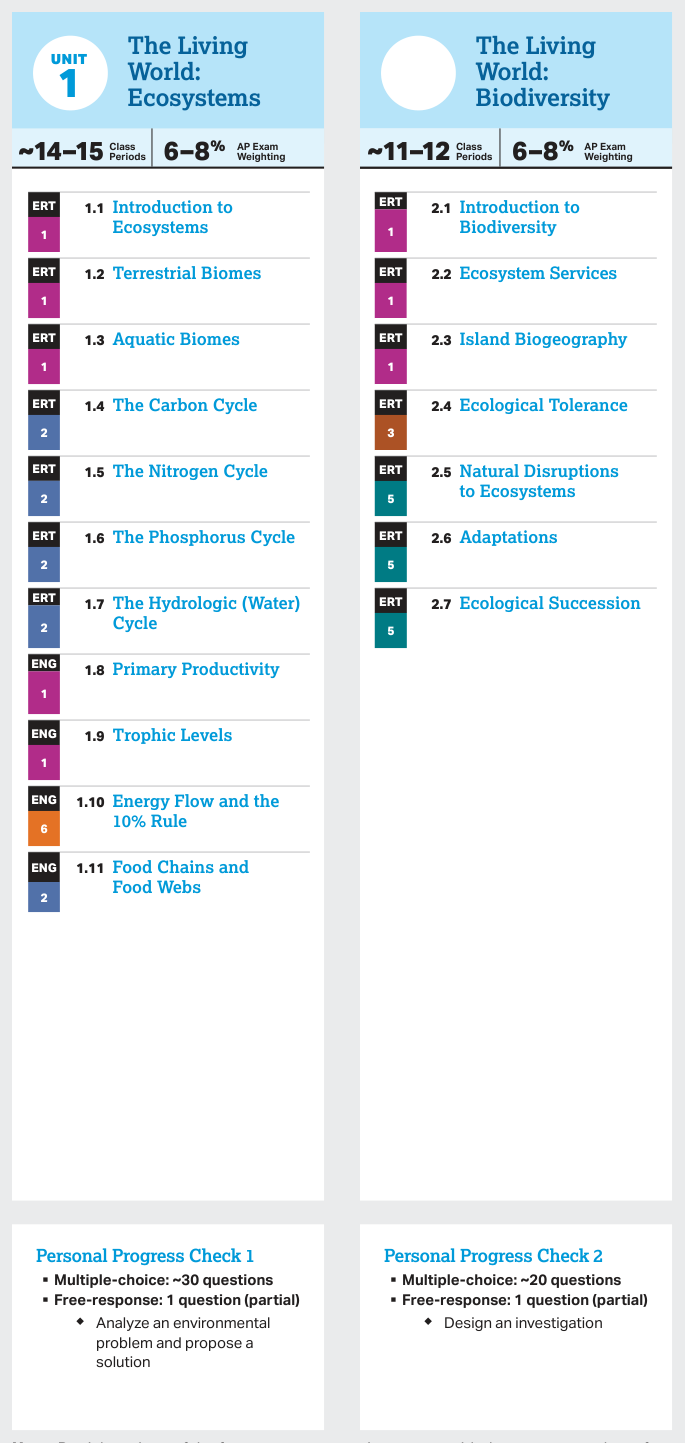
- Note: Partial versions of the free-response questions are provided to prepare students for more complex, full questions that they will encounter on the AP Exam.
- Figure — Chief Reader Report – Set 1 (p. 1)