From the free course AP Environmental Science on Lykke
5.7 Meat Production Methods · 5.8 Impacts of Overfishing
Key concepts: Concentrated animal feeding operations (CAFOs) and feedlots · Pasture-based meat production · Rotational grazing · Free-range grazing · Economic efficiency and consumer costs of CAFOs · Environmental benefits and drawbacks of different meat-production methods · Effects of reducing ruminant meat consumption · Greenhouse-gas emissions from livestock, including CO2, CH4, and N2O · Freshwater conservation and reduced reliance on antibiotics and growth hormones · Feed-quality improvements and precision-farming technologies
A kilogram of protein does not have the same environmental cost in every food system: meat production generally requires more land, water, and energy than plant-based protein, but the method used to raise animals strongly changes the outcome.
5.7 Meat Production Methods · 5.8 Impacts of Overfishing
A kilogram of protein does not have the same environmental cost in every food system: meat production generally requires more land, water, and energy than plant-based protein, but the method used to raise animals strongly changes the outcome.
Two production pathways
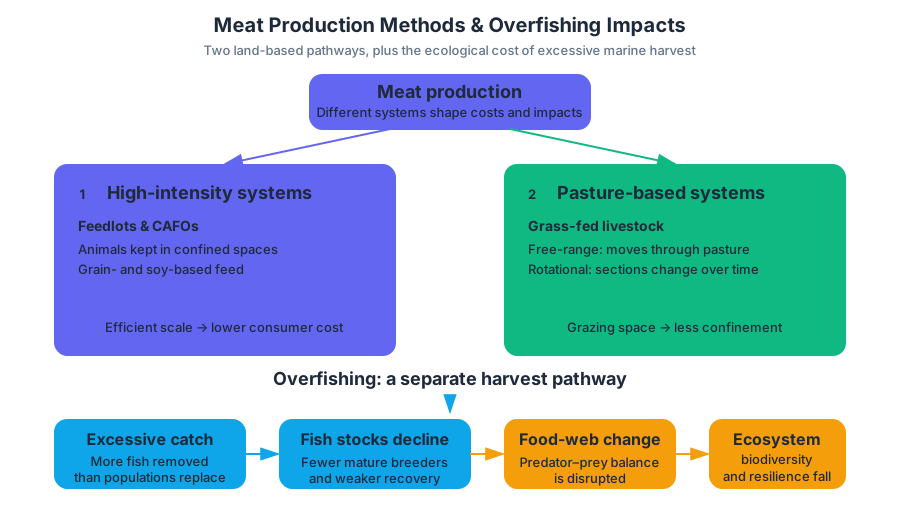
EIN-2.H — Identify different methods of meat production. The two broad approaches are high-intensity systems, such as feedlots and concentrated animal feeding operations (CAFOs), and pasture-based systems, including rotational grazing and free-range grazing.
CAFOs and feedlots concentrate animals in confined spaces and commonly provide grain- and soy-based feed. Because many animals can be raised near one another, these systems can be economically efficient: large-scale production can lower the cost paid by consumers. The tradeoff is a high concentration of manure, which can contaminate nearby waterways if it is not properly managed.
Pasture-based systems allow animals to feed on grass. In free-range grazing, animals move through available pasture without being kept continuously in a confined feeding area. In rotational grazing, livestock are moved among pasture sections so that one area can recover while another is being used.
Comparing environmental benefits and drawbacks
EIN-2.I — Describe the benefits and drawbacks of different methods of meat production. Meat production is resource-intensive and increases nutrient pollution and greenhouse-gas emissions, including methane. However, environmental impacts vary with the livestock species and the production practices used.
| Method | Potential benefits | Potential drawbacks |
|---|---|---|
| CAFOs/feedlots | Economically efficient; lower consumer costs; concentrated production | Manure concentration can contaminate waterways; grain and soy feed require land, water, and energy |
| Pasture-based grazing | Manure can return nutrients to soil; animals feed on grass | Requires more land; can cost consumers more; dense herds can cause runoff, erosion, and compaction |
| Rotational grazing | Recovery periods can reduce pressure on vegetation and help mitigate overgrazing | Still requires careful management; excessive stocking can exceed the land’s capacity |
| Free-range grazing | Uses pasture rather than continuous confinement | High animal density can degrade soil and vegetation; poorly managed grazing can increase runoff and erosion |
A useful way to compare systems is to follow the movement of nutrients. In a well-managed pasture, manure adds nutrients to soil where plants can use them. In a CAFO, the same waste is concentrated in a smaller area; if storage or application is inadequate, rainfall can carry nutrients into waterways, producing nutrient pollution.
Overgrazing and desertification
Overgrazing occurs when the livestock population exceeds the land’s carrying capacity—the largest population the area can support without long-term damage. Vegetation declines, soil becomes compacted and eroded, soil fertility decreases, biodiversity is reduced, and carbon storage can fall.
In arid and semi-arid regions, persistent overgrazing can contribute to desertification, the degradation of productive land toward desert-like conditions. Restoration, soil conservation, and improved grazing practices—including rotational grazing—can help reverse or limit these effects.
Key distinction: Rotational grazing is not automatically sustainable. It is a management strategy that can reduce damage only when herd size, recovery time, and pasture conditions remain within the land’s carrying capacity.
Worked example: choosing a lower-impact strategy
A ranch is experiencing bare soil and declining grass cover. The owner divides the pasture into four sections and moves cattle between them, allowing unused sections to recover. This is rotational grazing. The environmental reasoning is: lower continuous grazing pressure allows vegetation to regrow; stronger vegetation protects soil from erosion; healthier soil can retain nutrients and store more carbon.
If the owner instead increases the herd until all four sections remain heavily grazed, the system can still produce overgrazing. The label “rotational” does not remove the limiting factor: the livestock population must remain at or below the pasture’s carrying capacity.
Reducing ruminant-meat consumption
EIN-2.I.6 identifies several possible benefits of consuming less meat, especially meat from ruminants such as cattle and sheep. Reduced consumption can lower emissions of carbon dioxide, methane, and nitrous oxide; conserve freshwater resources; and reduce reliance on antibiotics and growth hormones.
The climate connection is not a single-gas problem. A change in production or consumption can affect several gases simultaneously: livestock systems are associated with carbon dioxide, methane, and nitrous oxide emissions, represented as $CO_2$, $CH_4$, and $N_2O$.
Technology—and an important caveat
Improved feed quality can reduce environmental impacts by helping animals obtain more usable nutrition from their feed. Precision-farming technologies can also improve the targeting and efficiency of resource use, reducing waste in production systems.
The benefit of eating less meat is not identical everywhere. It depends on the production method being replaced and on what happens to land no longer used for livestock. Land that is restored to natural vegetation may provide different environmental benefits from land converted to another intensive use.
Misconception check: “Pasture-based meat is always environmentally harmless” and “CAFOs are always environmentally worse” are both oversimplifications. Each system has benefits and drawbacks; management, livestock type, resource use, waste handling, and later land management determine the magnitude of the impact.
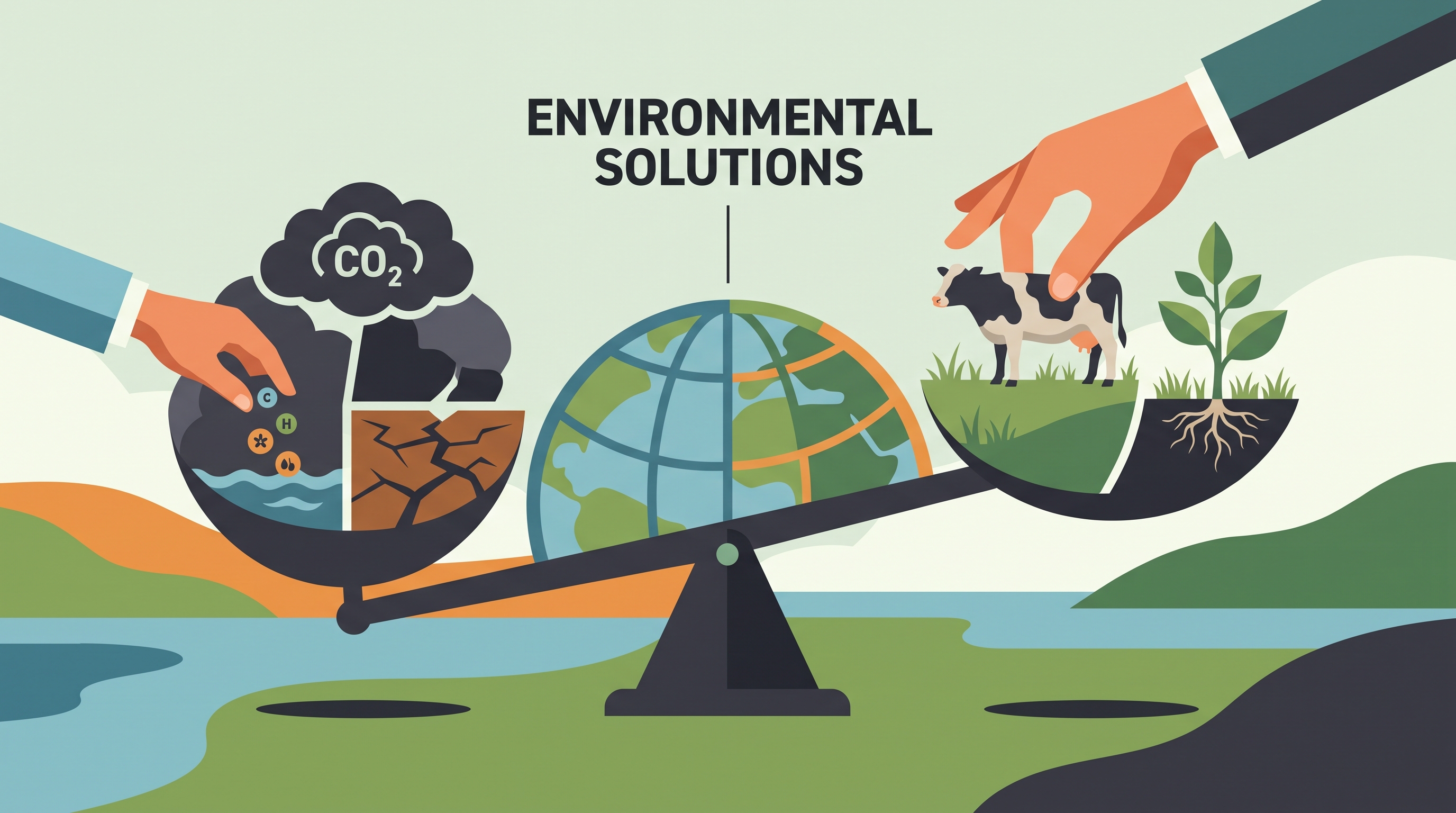
AP skill connection: Environmental Solutions
The suggested skill is Environmental Solutions (Science Practice 7). A strong response does more than name a preferred meat-production method: it identifies the environmental problem, explains the mechanism, proposes a strategy such as rotational grazing or improved feed quality, and evaluates tradeoffs such as land requirements, consumer cost, nutrient pollution, and greenhouse-gas emissions.
Retrieval check: Why can rotational grazing reduce environmental damage, and why might it fail? A complete answer should mention pasture recovery and reduced continuous pressure, then explain that excessive herd size can still exceed carrying capacity and cause erosion, compaction, reduced fertility, biodiversity loss, and desertification.
Source Materials
- AP Environmental Science Course and Exam Description
- Review the Clarifications (.pdf)
- AP Environmental Science Course Overview
- AP Environmental Science Course at a Glance
- AP Environmental Science Course at a Glance Poster
- AP Environmental Science
- AP Environmental Science
- AP Environmental Science Sample Syllabus 1