From the free course AP Environmental Science on Lykke
8.9 Solid Waste Disposal · 8.10 Waste Reduction Methods
Key concepts: Solid waste · Solid waste disposal methods · Landfills · Landfill decomposition · Methane emissions · Incineration · Illegal dumping · Organic waste · Waste reduction methods · Electronic waste
A discarded cell phone, a banana peel, a worn tire, and a broken television all become part of the waste stream—but they do not behave alike after disposal.
8.9 Solid Waste Disposal · 8.10 Waste Reduction Methods
A discarded cell phone, a banana peel, a worn tire, and a broken television all become part of the waste stream—but they do not behave alike after disposal. Solid waste is any discarded material that is neither a liquid nor a gas. Human activities generate it in domestic, industrial, business, and agricultural sectors, including large quantities of organic waste and electronic waste, or e-waste, such as televisions, cell phones, and computers.
Essential Knowledge STB-3.K.1: Solid waste is any discarded material that is not a liquid or gas. It is generated in domestic, industrial, business, and agricultural sectors.
Essential Knowledge STB-3.K.3: Electronic waste, or e-waste, is composed of discarded electronic devices including televisions, cell phones, and computers.
Landfills: containment, not disappearance
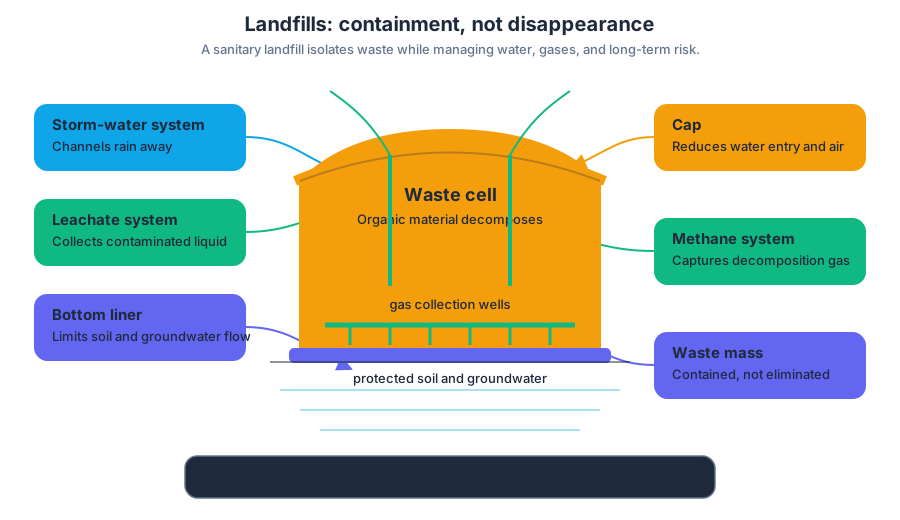
Solid waste is most often disposed of in landfills. A modern sanitary municipal landfill is engineered to isolate waste from surrounding ecosystems, but it does not make the waste vanish or eliminate every environmental risk.
A sanitary landfill typically includes five protective systems:
- Bottom liner: plastic or clay that limits movement of contaminated liquid into soil and groundwater.
- Storm-water collection system: channels precipitation away from the waste to reduce infiltration.
- Leachate collection system: gathers contaminated liquid produced when water moves through the waste.
- Cap: covers filled waste, reducing water entry and limiting contact with air.
- Methane collection system: captures methane produced as organic material decomposes.
Essential Knowledge STB-3.K.4: A sanitary municipal landfill consists of a bottom liner, a storm-water collection system, a leachate collection system, a cap, and a methane collection system.
The central trade-off is straightforward: landfill engineering reduces exposure, but the waste remains chemically and biologically active. Landfills can still contaminate groundwater if leachate escapes and can release harmful gases if gas collection is incomplete.
Essential Knowledge STB-3.K.2: Solid waste is most often disposed of in landfills. Landfills can contaminate groundwater and release harmful gases.
What controls landfill decomposition?
Decomposition is the breakdown of organic material by microorganisms. In a landfill, its rate and products depend on two major variables: the composition of the trash and the conditions available for microbial decomposition.
A load containing food scraps, paper, and yard waste contains substantial biodegradable material. A load dominated by glass, metals, plastics, and other non-degradable materials will change much more slowly. Oxygen concentration also matters: buried organic waste may undergo low-oxygen or anaerobic decomposition, producing methane, $CH_4$, as a by-product.
Essential Knowledge STB-3.L.1: Factors in landfill decomposition include the composition of the trash and conditions needed for microbial decomposition of the waste.
Worked example: predicting landfill gas
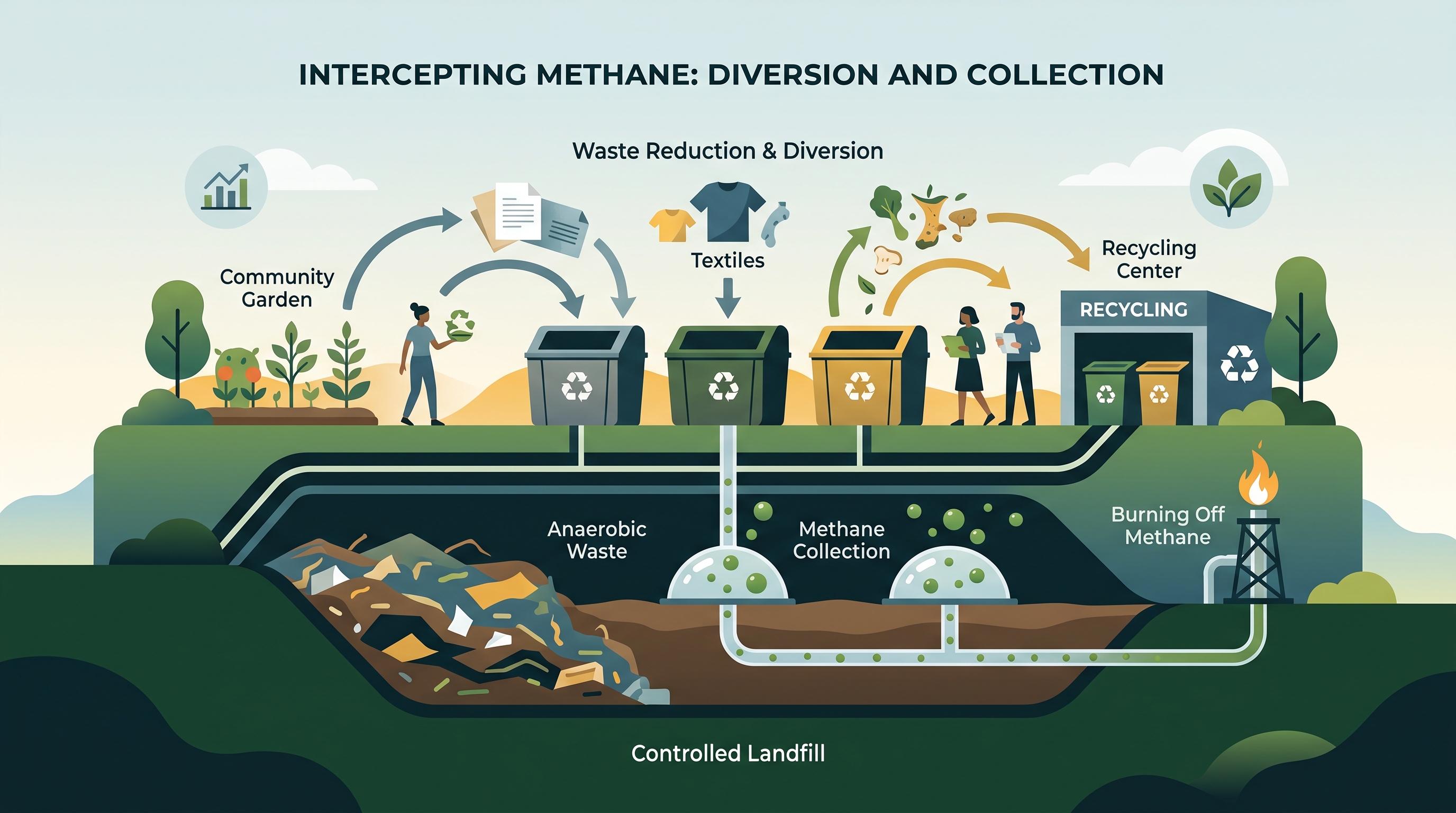
Suppose two landfill sections receive equal masses of trash. Section A contains mostly food scraps and paper, while Section B contains mostly glass and metal. If both sections have limited oxygen, Section A is expected to generate more methane because it contains more biodegradable organic material available for anaerobic microbial decomposition. A methane-collection system can capture this gas; the methane may then be used as an energy source or burned off to reduce its release into the atmosphere.
Misconception check — “All buried trash decomposes at the same rate.” It does not. Decomposition depends on both what the trash contains and whether microorganisms have suitable conditions, including an appropriate oxygen environment. Non-degradable materials may remain while organic material changes around them.
Incineration and improper disposal
Incineration burns solid waste at high temperatures. Its major advantage is volume reduction: much less solid material requires final disposal. Its major disadvantage is that combustion can create air pollution, so incineration does not automatically transform waste into an environmentally harmless product.
Illegal dumping is another improper disposal method. For example, discarded rubber tires can collect water and create breeding sites for mosquitoes, while unmanaged waste can spread into soil and water. The disposal method therefore changes the pathway by which pollution reaches organisms and ecosystems.
Waste reduction and methane mitigation
The strongest waste strategy is to prevent material from entering disposal systems in the first place. Acceptable reduction or mitigation methods include:
| Method | Environmental mechanism |
|---|---|
| Reusing materials | Extends product life and avoids replacement waste |
| Recycling | Recovers materials for use in new products |
| Composting non-synthetic organic waste | Diverts biodegradable material from landfills |
| Incineration | Reduces the volume requiring disposal, while requiring air-pollution controls |
| Methane collection | Captures landfill methane before it escapes |
| Burning off methane | Converts captured methane into less climate-forcing combustion products |
Reusing or recycling paper and textiles, and composting suitable organic material, reduce the amount of biodegradable waste available for methane production. When organic waste is already in a landfill, methane collection or controlled burning can reduce atmospheric emissions.
Suggested skill — “Use data and evidence to support a potential solution.” A strong environmental solution must connect evidence to a mechanism. For example, if waste audits show that a landfill receives a high percentage of compostable food waste, composting is supported because it removes biodegradable material before anaerobic landfill decomposition can generate methane.
Retrieval check: A landfill receives more organic waste but has the same oxygen concentration and collection infrastructure. Predict the likely change in methane production and explain your reasoning using STB-3.L.1. Why would composting that organic fraction address the cause rather than merely the symptom?
Source Materials
- AP Environmental Science Course and Exam Description
- Review the Clarifications (.pdf)
- AP Environmental Science Course Overview
- AP Environmental Science Course at a Glance
- AP Environmental Science Course at a Glance Poster
- AP Environmental Science
- AP Environmental Science
- AP Environmental Science Sample Syllabus 1