From the free course AP Environmental Science on Lykke
9.3 The Greenhouse Effect · 9.4 Increases in Greenhouse Gases
Key concepts: The greenhouse effect · Greenhouse gases · Increases in greenhouse-gas concentrations · Global climate change · Global warming potential (GWP) · Atmospheric residence time · Antarctic ice-core proxy data · Relationship between atmospheric carbon dioxide and global temperature · Climate-change feedbacks · Melting sea ice and thawing tundra
Earth’s atmosphere stays warm because certain gases absorb and re-emit outgoing infrared radiation, creating the greenhouse effect. Without this natural process, Earth’s surface would be too cold for life as we know it; the problem arises when human activities increase the concentration of greenhouse gases and…
9.3 The Greenhouse Effect · 9.4 Increases in Greenhouse Gases
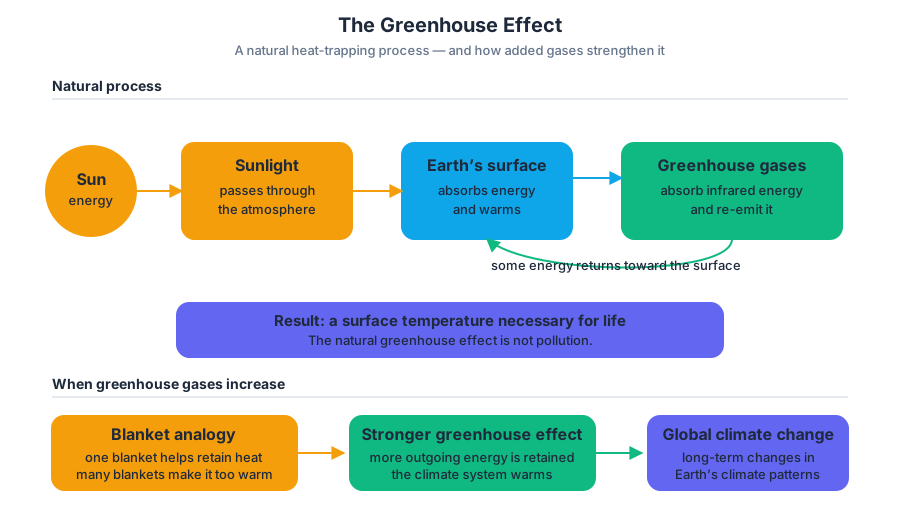
Earth’s atmosphere stays warm because certain gases absorb and re-emit outgoing infrared radiation, creating the greenhouse effect. Without this natural process, Earth’s surface would be too cold for life as we know it; the problem arises when human activities increase the concentration of greenhouse gases and disturb the atmosphere’s energy balance.
The natural greenhouse effect
Sunlight passes through the atmosphere and warms Earth’s surface. The surface then releases energy as infrared radiation. Greenhouse gases absorb some of that outgoing energy and re-emit it in different directions, including back toward the surface.
STB-4.C.3: The greenhouse effect results in the surface temperature necessary for life on Earth to exist.
The greenhouse effect is therefore not itself pollution. A useful analogy is a blanket: a blanket is necessary to prevent excessive heat loss, but adding many more blankets makes the body too warm. Similarly, excess greenhouse gases strengthen the natural greenhouse effect and contribute to global climate change, meaning long-term changes in Earth’s climate patterns.
Principal greenhouse gases
STB-4.C requires identification of the greenhouse gases. The principal gases are carbon dioxide, methane, water vapor, nitrous oxide, and chlorofluorocarbons, or CFCs.
| Greenhouse gas | Important human sources | Key climate concept |
|---|---|---|
| Carbon dioxide, $CO_2$ | Fossil-fuel combustion, deforestation, cement production | Reference gas with GWP $=1$ |
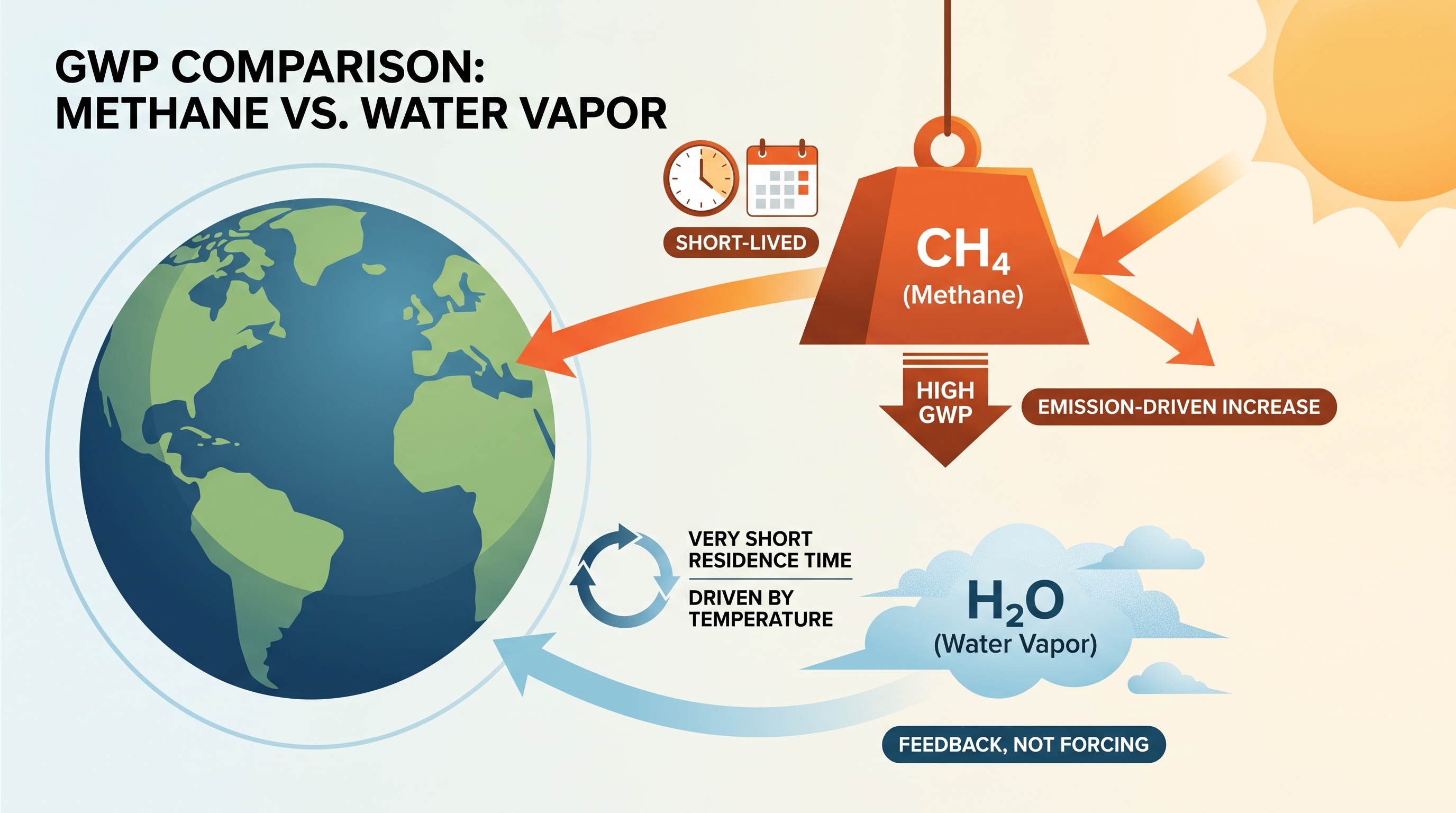
| Methane, $CH_4$ | Livestock, landfills, rice cultivation, fossil-fuel extraction | High potency but short atmospheric residence time |
| Nitrous oxide, $N_2O$ | Agricultural soils and nitrogen fertilizers | Higher GWP than methane |
| CFCs | Older refrigerants and industrial compounds | Highest GWP among the gases listed |
| Water vapor, $H_2O$ | Evaporation and transpiration; mainly natural sources | Greenhouse gas with a short residence time |
STB-4.C.1 identifies the principal greenhouse gases, including carbon dioxide, methane, water vapor, nitrous oxide, and CFCs. Water vapor is a greenhouse gas, but STB-4.C.2 emphasizes that its short atmospheric residence time means it does not contribute significantly to long-term global climate change compared with longer-lived increases in gases such as carbon dioxide.
Global warming potential and residence time
Global warming potential (GWP) compares how strongly a greenhouse gas contributes to warming relative to carbon dioxide over a specified time period. Carbon dioxide is assigned a GWP of $1$, making it the reference point.
STB-4.D.1 establishes the required potency ranking: CFCs have the highest GWP, followed by nitrous oxide, then methane, with carbon dioxide as the reference gas.
A gas’s atmospheric residence time is how long it remains in the atmosphere before chemical reactions, biological uptake, or other processes remove it. GWP and residence time are related but not identical: a gas can be extremely potent while present in relatively small quantities, whereas a less potent gas can have a major long-term effect if it accumulates and remains for a long time.
Misconception check — “The most powerful gas must cause the most total warming.” Not necessarily. Climate impact depends on potency, atmospheric concentration, residence time, and the amount released. Methane has a shorter residence time than carbon dioxide, but large methane emissions can still produce substantial warming.
Ice cores as evidence of past climate
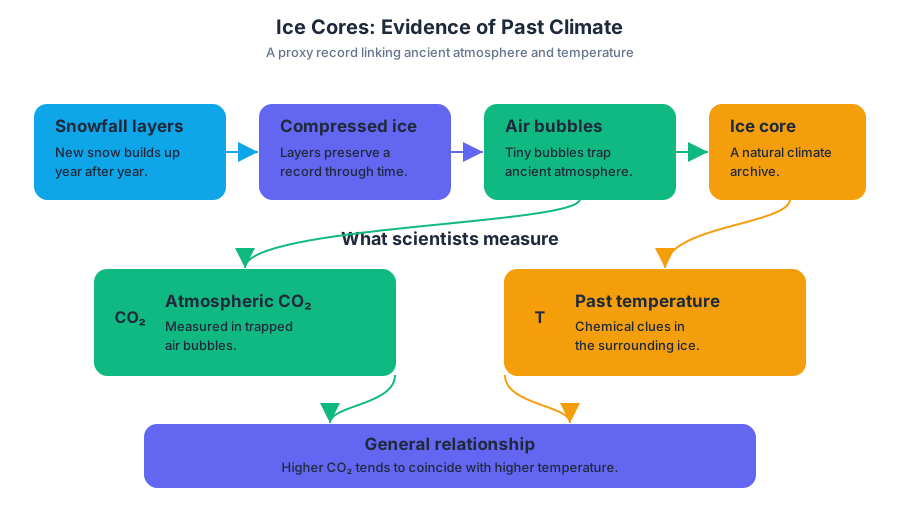
Antarctic ice cores provide proxy evidence—indirect evidence used to reconstruct past conditions. As snow accumulates and becomes compressed into ice, tiny bubbles of ancient atmosphere remain trapped inside. Scientists can measure past carbon dioxide concentrations in those bubbles, while chemical properties of the surrounding ice provide information about past temperature conditions.
Across the historical record preserved in Antarctic ice, atmospheric carbon dioxide levels and global temperature show a general relationship: periods with higher atmospheric carbon dioxide tend to correspond to higher temperatures, while periods with lower carbon dioxide tend to correspond to lower temperatures. The correlation does not mean that carbon dioxide is the only climate influence, but it is important evidence that atmospheric composition and temperature are connected.
Feedback from thawing landscapes
Warming can trigger processes that add still more greenhouse gases to the atmosphere. Melting sea ice changes Earth’s reflective surface, while thawing tundra can expose previously frozen organic matter to decomposition. That decomposition can release carbon dioxide and methane, creating a reinforcing feedback: warming promotes greenhouse-gas release, which can promote additional warming.
A local activity can therefore produce a global consequence. For example, methane released from a regional landfill or fossil-fuel operation mixes through the atmosphere and contributes to climate change beyond the location where it was emitted. This is the meaning of the required connection that local and regional human activities can have impacts at the global level.
Worked reasoning: an evidence chain
Scenario: A region expands natural-gas extraction, and monitoring shows increased methane emissions. Explain why the activity can affect global climate.
- The extraction activity increases atmospheric $CH_4$ concentration.
- Methane is a greenhouse gas, so it absorbs outgoing infrared radiation.
- Methane has a higher GWP than carbon dioxide, although its atmospheric residence time is relatively short.
- The enhanced greenhouse effect contributes to global climate change.
- Because methane mixes through the atmosphere, a regional emission can produce a global impact.
AP Science Practice 1.B — Concept Explanation: A strong explanation connects each cause to its mechanism and consequence. Do not merely write “methane causes warming”; identify methane as a greenhouse gas, explain its role in absorbing infrared radiation, and connect increased concentration to an enhanced greenhouse effect.
Retrieval check
Why can methane contribute strongly to climate change even though it has a short atmospheric residence time, and why is water vapor treated differently in this context? A complete answer should mention methane’s relatively high GWP, its emission-driven increase, and water vapor’s short residence time.
Source Materials
- AP Environmental Science Course and Exam Description
- Review the Clarifications (.pdf)
- AP Environmental Science Course Overview
- AP Environmental Science Course at a Glance
- AP Environmental Science Course at a Glance Poster
- AP Environmental Science
- AP Environmental Science
- AP Environmental Science Sample Syllabus 1