From the free course AP Environmental Science on Lykke
4.5 Global Wind Patterns · 4.6 Watersheds
Key concepts: Global wind patterns · Atmospheric circulation · Solar radiation · Density differences · Coriolis effect · Earth system interactions · Environmental factors · Rainfall patterns · Wind patterns · Earth system balance
Global wind patterns begin with an unevenly heated planet: the equator receives the most intense solar radiation, so air there warms, expands, and becomes less dense than surrounding air.
4.5 Global Wind Patterns · 4.6 Watersheds
Global wind patterns begin with an unevenly heated planet: the equator receives the most intense solar radiation, so air there warms, expands, and becomes less dense than surrounding air. That density contrast drives atmospheric circulation, while Earth’s rotation bends moving air through the Coriolis effect.
4.5 Global Wind Patterns
Atmospheric circulation is the large-scale movement of air caused primarily by unequal heating. Warm, less-dense air rises; cooler, denser air sinks. As air moves from regions of higher pressure toward regions of lower pressure, it produces wind.
ERT-4.E.1: Global wind patterns primarily result from the most intense solar radiation arriving at the equator, resulting in density differences and the Coriolis effect.
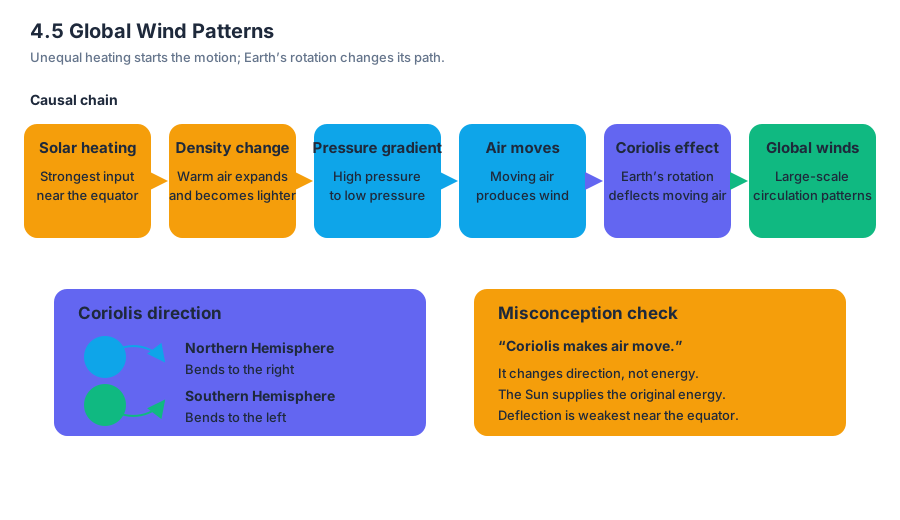
The causal chain is more important than memorizing isolated wind names:
The Coriolis effect is the apparent deflection of moving air caused by Earth’s rotation. Moving air bends to the right in the Northern Hemisphere and to the left in the Southern Hemisphere. The effect changes the direction of winds, but it does not provide the original energy that moves the air; solar radiation supplies that energy.
Misconception check — “The Coriolis effect makes air move.” It does not. Unequal solar heating creates density and pressure differences; the Coriolis effect then modifies the path of moving air. Winds near the equator are affected less strongly because rotational deflection is weakest there.
A worked atmospheric example
Imagine a broad equatorial region receiving stronger solar heating than nearby regions. The heated air expands and rises, leaving relatively lower pressure near the surface. Cooler, denser air from surrounding areas moves toward that low-pressure region; Earth’s rotation deflects the moving air, producing a curved global wind pattern rather than a perfectly straight flow.
If an environmental change alters heating, ocean temperature, or atmospheric pressure, the circulation pattern can shift. Because air movement influences the transport of moisture, environmental factors can produce global changes in rainfall and wind, with one region becoming wetter while another becomes drier.
ERT-4.E: Explain how environmental factors can result in atmospheric circulation.
Suggested Skill 2.B — Visual Representations: Explain relationships between different characteristics of environmental concepts, processes, or models represented visually, in theoretical and applied contexts.
On an exam, a strong visual explanation should identify the direction of movement, connect that movement to density or pressure differences, and then explain how the Coriolis effect changes the path. Naming a circulation cell or wind belt without explaining those relationships is incomplete.
4.6 Watersheds
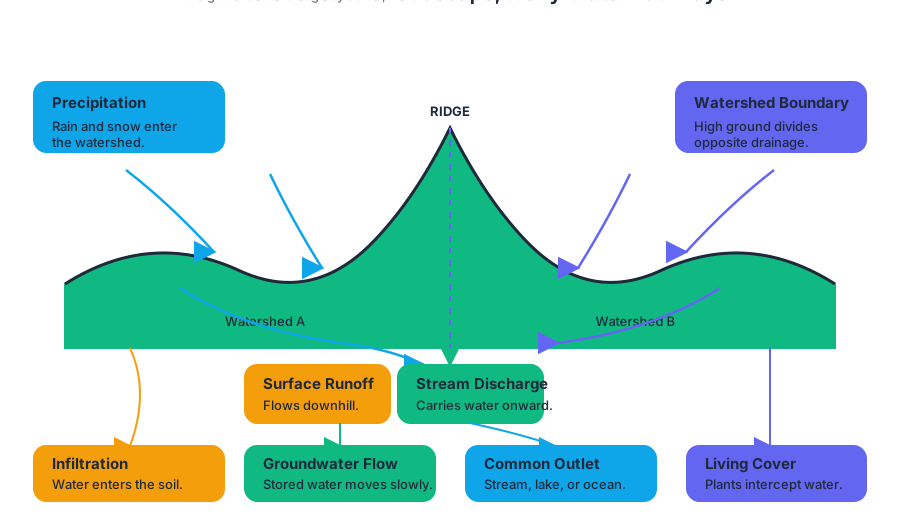
A watershed is an area of land that drains water to a common outlet, such as a stream, lake, estuary, or ocean. Ridges and other high points form watershed boundaries; rainfall on opposite sides of a ridge may enter entirely different drainage systems.
ERT-4.F.1: A watershed is an area of land that drains to a common body of water.
Water moves through a watershed as precipitation, surface runoff, infiltration into soil, groundwater flow, and stream discharge. These pathways connect the atmosphere, geosphere, hydrosphere, and biosphere: rainfall becomes runoff, soil stores and filters some water, plants intercept and use water, and streams transport dissolved materials and sediments.
Worked watershed example
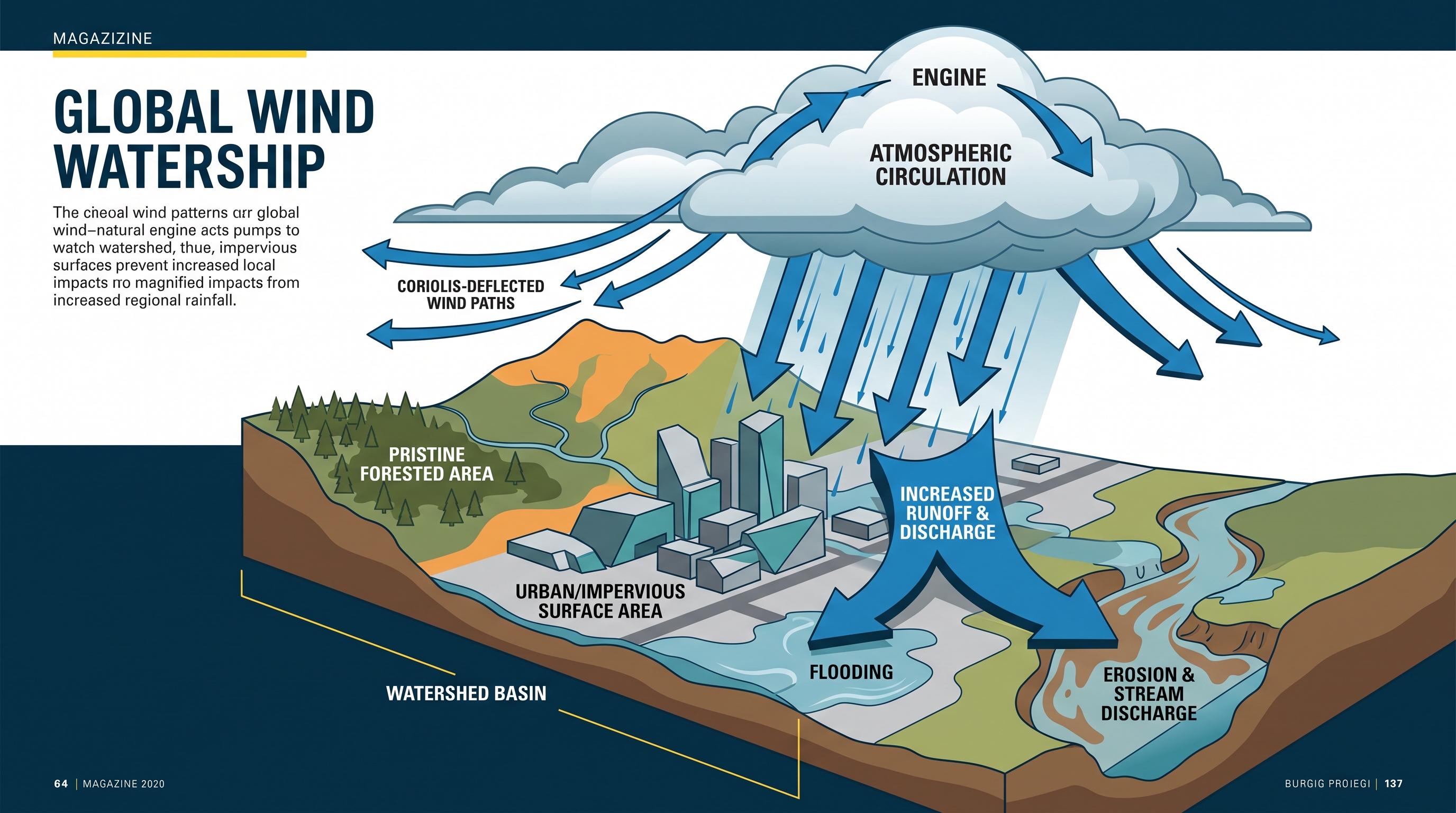
A town replaces a forested slope with roads, parking lots, and rooftops. During a storm, less water infiltrates into the ground and more water reaches the stream rapidly as surface runoff. The likely results are a higher peak stream discharge, increased erosion, greater transport of pollutants, and a higher risk of downstream flooding.
The watershed-scale solution is not merely to remove water faster. Vegetated areas, riparian buffers, wetlands, and permeable surfaces can slow runoff, encourage infiltration, trap sediment, and reduce the amount of polluted water entering the stream.
Misconception check — “A watershed is only the visible river.” The river is the channel receiving water; the watershed includes the entire surrounding land that supplies that water. A pollutant applied far uphill can affect a downstream water body because all connected drainage pathways belong to the same system.
Systems in balance
These topics show why Earth’s systems cannot be studied as isolated compartments. Solar energy drives atmospheric motion; atmospheric motion redistributes heat and moisture; rainfall enters watersheds; and watershed conditions influence ecosystems and human communities.
ERT-4 — Earth’s systems interact, resulting in a state of balance over time.
“Balance” does not mean that conditions remain perfectly constant. It means that interacting processes tend toward dynamic equilibrium: increased runoff may be followed by stream discharge, infiltration, evaporation, or storage, while altered heating can reorganize wind and rainfall patterns. A disturbance can therefore produce effects far from its original location.
Retrieval check
A diagram shows warmer, rising air over one region and cooler, sinking air over another. Identify the immediate driver of circulation, state the role of the Coriolis effect, and predict one watershed consequence if the resulting circulation increases rainfall over an urban basin.
Answer: Unequal heating creates density and pressure differences that drive air movement; the Coriolis effect deflects the moving air; increased rainfall over the urban basin can increase runoff, stream discharge, erosion, and flooding, especially where impervious surfaces limit infiltration.
Source Materials
- AP Environmental Science Course and Exam Description
- Review the Clarifications (.pdf)
- AP Environmental Science Course Overview
- AP Environmental Science Course at a Glance
- AP Environmental Science Course at a Glance Poster
- AP Environmental Science
- AP Environmental Science
- AP Environmental Science Sample Syllabus 1