From the free course AP Environmental Science on Lykke
9.7 Ocean Acidification · 9.8 Invasive Species
Key concepts: Ocean acidification · Calcium carbonate shell formation · Coral reef damage · Invasive species · Non-native species · Competition with native species · Threats to native populations · Biological control · Preventing invasive-species spread
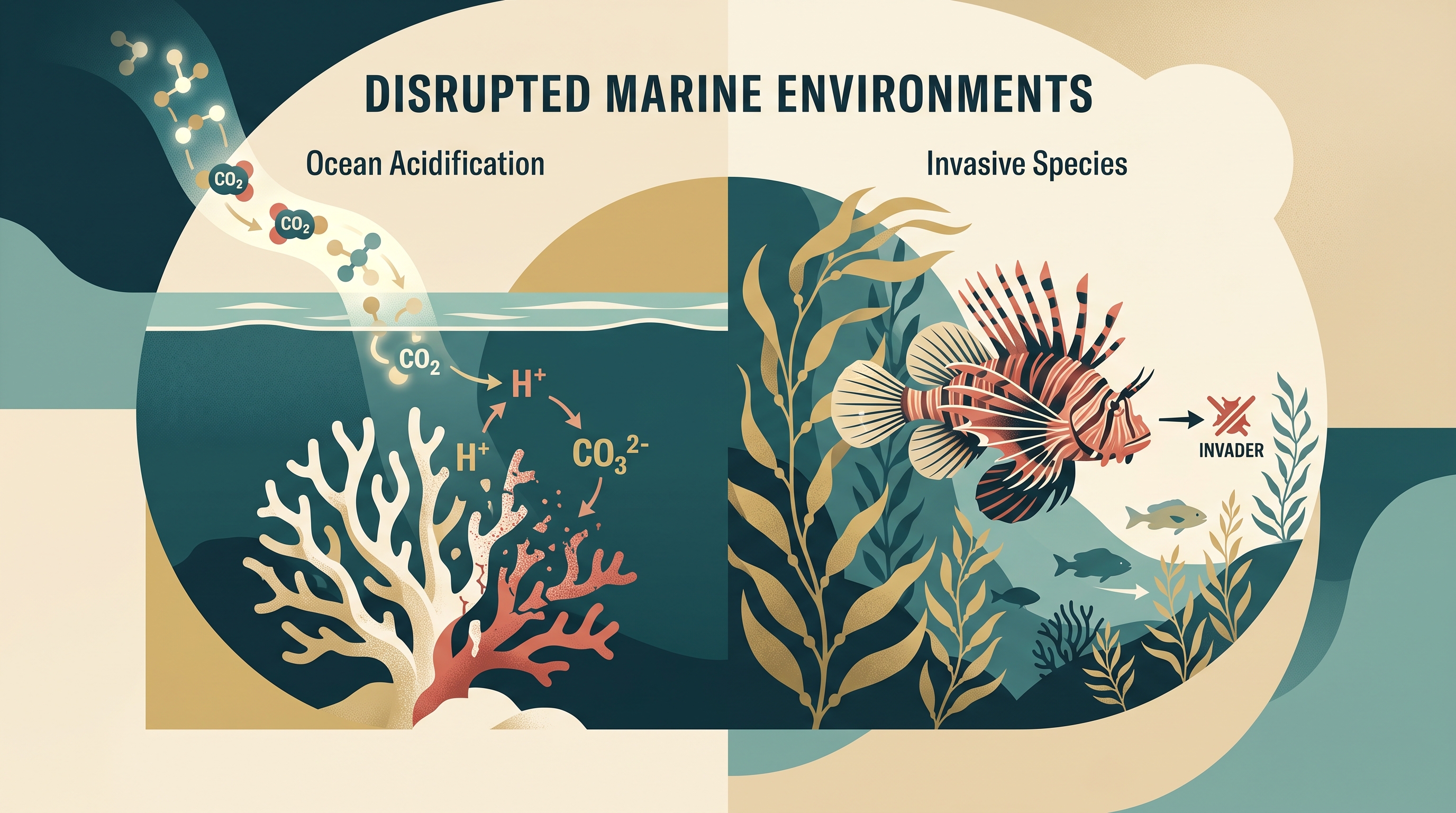
Ocean acidification makes seawater less chemically favorable for organisms that build calcium carbonate shells or skeletons, while invasive species can disrupt native populations after entering environments where they did not originally occur.
9.7 Ocean Acidification · 9.8 Invasive Species
Ocean acidification makes seawater less chemically favorable for organisms that build calcium carbonate shells or skeletons, while invasive species can disrupt native populations after entering environments where they did not originally occur. Both problems begin with a change in environmental conditions, but their mechanisms differ: acidification alters ocean chemistry globally; invasion changes biological interactions locally or regionally.
Ocean acidification: changing the carbonate building supply
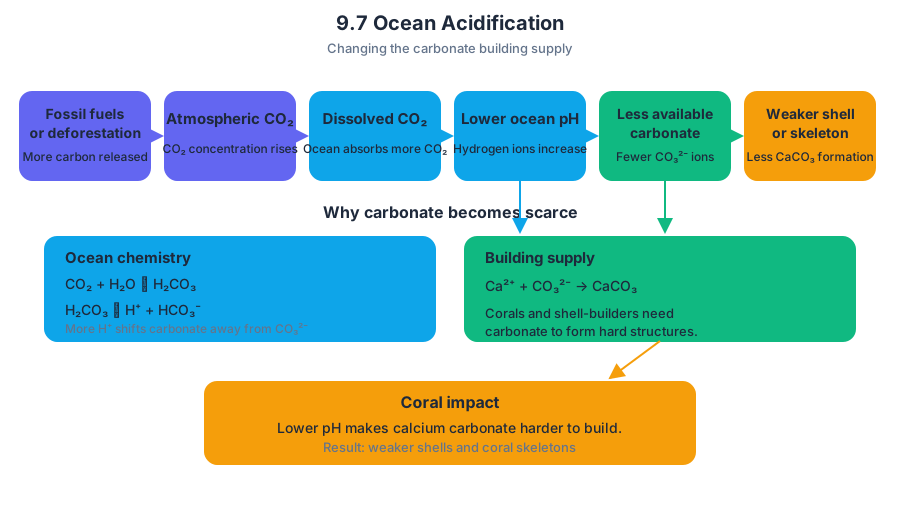
Human activities that increase atmospheric carbon dioxide, including fossil-fuel combustion, vehicle emissions, and deforestation, also increase the amount of carbon dioxide absorbed by the ocean. Once dissolved, carbon dioxide participates in reactions that increase hydrogen-ion concentration and lower pH:
CO_2 + H_2O \rightleftharpoons H_2CO_3
H_2CO_3 \rightleftharpoons H^+ + HCO_3^-
As hydrogen-ion concentration rises, carbonate ions become less available. Because many marine organisms require carbonate ions to combine with calcium ions, the concentration of available calcium carbonate can decline.
STB-4.H.4: Ocean acidification damages coral because acidification makes it difficult for them to form shells, due to the loss of calcium carbonate.
The important chain is not simply “more carbon dioxide equals dead coral.” The exam-relevant reasoning is:
$$ \text{fossil fuels or deforestation} \rightarrow \text{more atmospheric } CO_2 \rightarrow \text{more dissolved } CO_2 \rightarrow \text{lower ocean pH} \rightarrow \text{less available } CaCO_3 \rightarrow \text{weaker shell or skeleton formation} $$
Why calcium carbonate matters
Calcium carbonate, written as $CaCO_3$, is a structural material used by organisms such as corals and many shell-forming marine animals. When seawater contains less available calcium carbonate, these organisms must spend more energy forming and maintaining shells or skeletons; existing calcium-carbonate structures may also become more vulnerable to dissolution.
Worked contextual example. A coastal region clears forest and expands gasoline-powered transportation. Atmospheric $CO_2$ rises, and the ocean absorbs more of that gas. The resulting increase in $H^+$ lowers seawater pH and reduces carbonate-ion availability. Coral polyps then have greater difficulty depositing $CaCO_3$ to build their skeletons. As coral growth slows, reef structure can weaken, reducing habitat complexity for organisms that depend on the reef.
Misconception check — “acidification means the ocean becomes a strong acid.” Ocean acidification means a decrease in pH relative to earlier conditions; seawater remains mildly basic in the ordinary chemical sense. The ecological danger comes from a shift in carbonate chemistry that interferes with shell and skeleton formation, not necessarily from seawater becoming chemically similar to vinegar.
Invasive species: when non-native becomes harmful
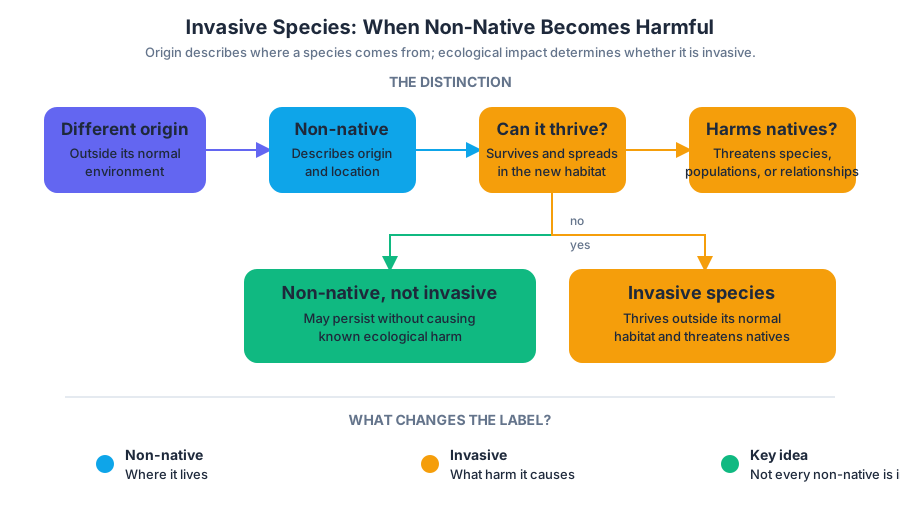
A non-native species is a species living outside the environment in which it normally occurs. An invasive species is a non-native species that can live, and sometimes thrive, outside its normal habitat and threatens native species.
EIN-4.A.1: Invasive species are species that can live, and sometimes thrive, outside of their normal habitat. Invasive species can sometimes be beneficial, but they are considered invasive when they threaten native species.
The distinction matters: non-native describes origin and location; invasive adds an ecological consequence. A non-native organism is not automatically invasive. It becomes invasive when its spread or abundance harms native species, populations, or ecosystem relationships.
Competition with native species
Invasive species may negatively affect native populations through competition, the interaction that occurs when organisms require the same limited resource. The resource might be food, light, nesting space, water, or territory. If the invasive species uses that resource more effectively, the native population may experience reduced growth, survival, or reproduction.
For example, suppose a non-native beetle enters an experimental plot and consumes the same plant material required by a native beetle. If both populations begin with similar access to food but the native beetle declines as the non-native beetle increases, competition is a plausible explanation. A strong environmental explanation identifies the shared limiting resource and connects resource reduction to a native-population effect.
Misconception check — “every introduced species is invasive.” Introduction alone does not establish invasiveness. The evidence must show that the species can persist outside its normal range and threaten native species, such as by competing for a limiting resource.
Controlling and preventing an invasion
Once an invasive population is established, biological control uses a living organism—such as a predator, parasite, or pathogen—to reduce the invasive species. Biological control can be effective because it targets the population directly, but the control organism must be selected carefully: introducing another non-native organism can create a second ecological problem if it attacks native species or spreads beyond the intended area.
Worked contextual example. Researchers discover a non-native beetle in an experimental plot. To prevent it from spreading beyond the current range, they could trap and physically remove beetles, apply an appropriate pesticide, or introduce a predator, parasite, or pathogen that harms the beetles. Each proposal is stronger when it specifies how the method reduces beetle abundance or blocks dispersal.
A prevention strategy should match the question. If the task asks how to stop spread beyond a plot, “protect native biodiversity” is too vague. A realistic answer names an action and its mechanism: remove beetles before reproduction, restrict movement of infested soil or plant material, establish barriers or quarantine zones, or use carefully evaluated biological control.
Apply the reasoning
The relevant AP science practice is Explain environmental concepts, processes, or models in applied contexts. For ocean acidification, explain a linked causal sequence from anthropogenic carbon dioxide emissions to reduced calcium-carbonate availability and coral damage. For invasive species, identify the non-native organism, explain how it persists outside its normal environment, and connect competition or another interaction to a decline in native populations.
Retrieval check. A graph shows atmospheric $CO_2$ increasing while coral growth decreases. What intermediate chemical change should appear in the explanation? Answer: More dissolved $CO_2$ increases hydrogen-ion concentration, lowers seawater pH, and reduces carbonate availability, making $CaCO_3$ formation more difficult. A separate prompt describes a beetle outside its normal range but provides no evidence of harm. Is “invasive” automatically justified? No: the threat to native species must also be established.
Source Materials
- AP Environmental Science Course and Exam Description
- Review the Clarifications (.pdf)
- AP Environmental Science Course Overview
- AP Environmental Science Course at a Glance
- AP Environmental Science Course at a Glance Poster
- AP Environmental Science
- AP Environmental Science
- AP Environmental Science Sample Syllabus 1