From the free course AP Environmental Science on Lykke
Course Framework, Skills and Reasoning Processes
Key concepts: AP Environmental Science course framework · Big ideas as cross-cutting concepts · Concept explanation · Visual representation and interpretation · Text analysis · Scientific investigation and reasoning · Energy flow through systems · Interactions between Earth systems · Ecosystems · Biodiversity and terrestrial biomes
Environmental systems are best understood as connected systems: energy moves through them, matter cycles within them, organisms interact with one another and their surroundings, and human decisions can either strengthen or destabilize those relationships.
Course Framework, Skills and Reasoning Processes
Environmental systems are best understood as connected systems: energy moves through them, matter cycles within them, organisms interact with one another and their surroundings, and human decisions can either strengthen or destabilize those relationships.
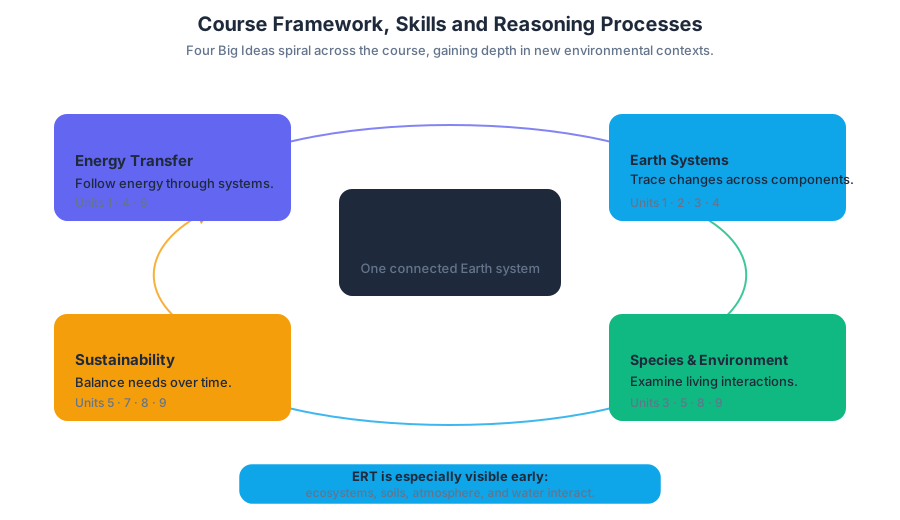
Four Big Ideas that spiral across the course
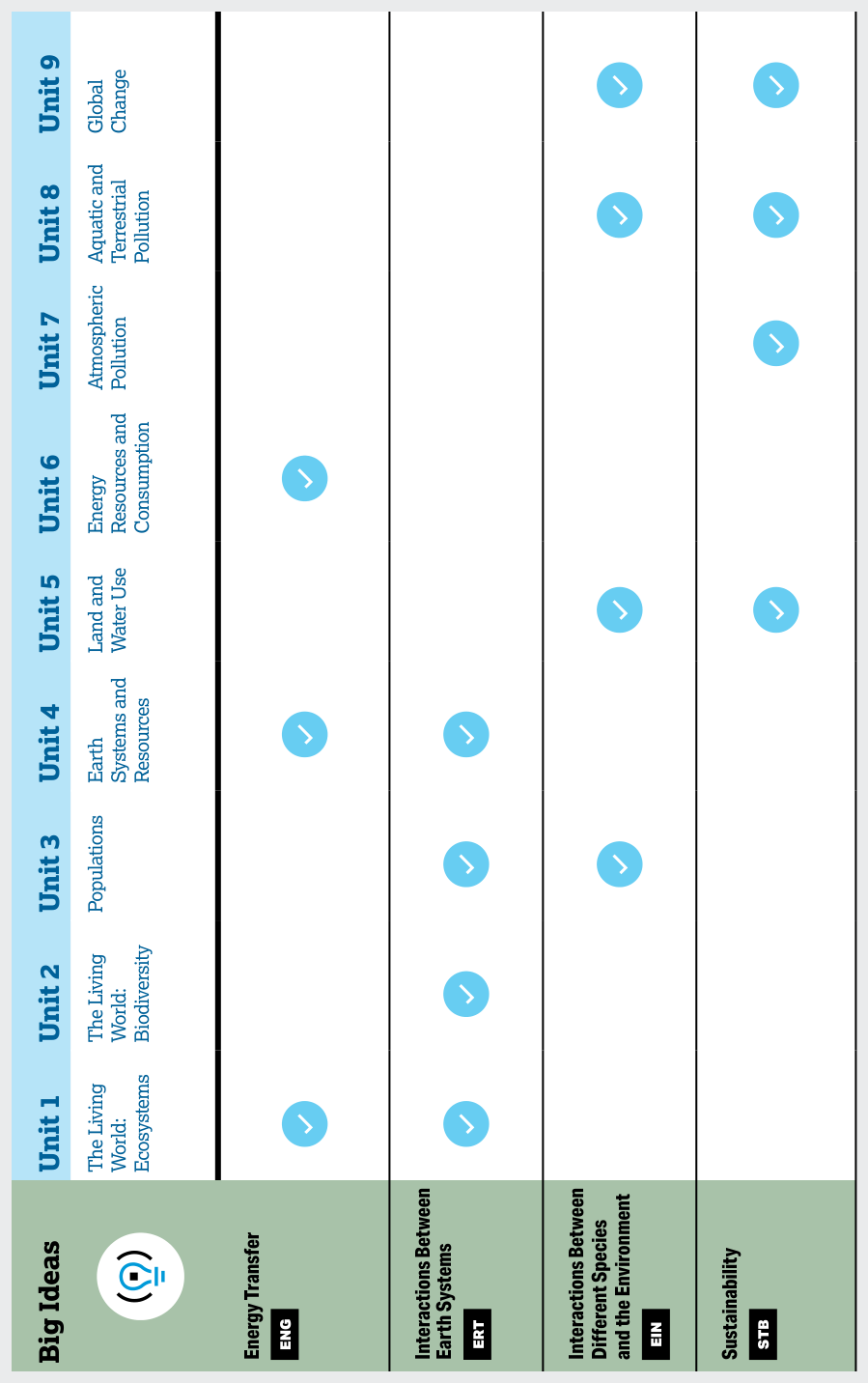
The course framework is organized around four Big Ideas rather than isolated chapters. These ideas spiral: students encounter the same underlying concept repeatedly, but apply it to increasingly varied environmental contexts.
| Code | Big Idea | Where it is emphasized |
|---|---|---|
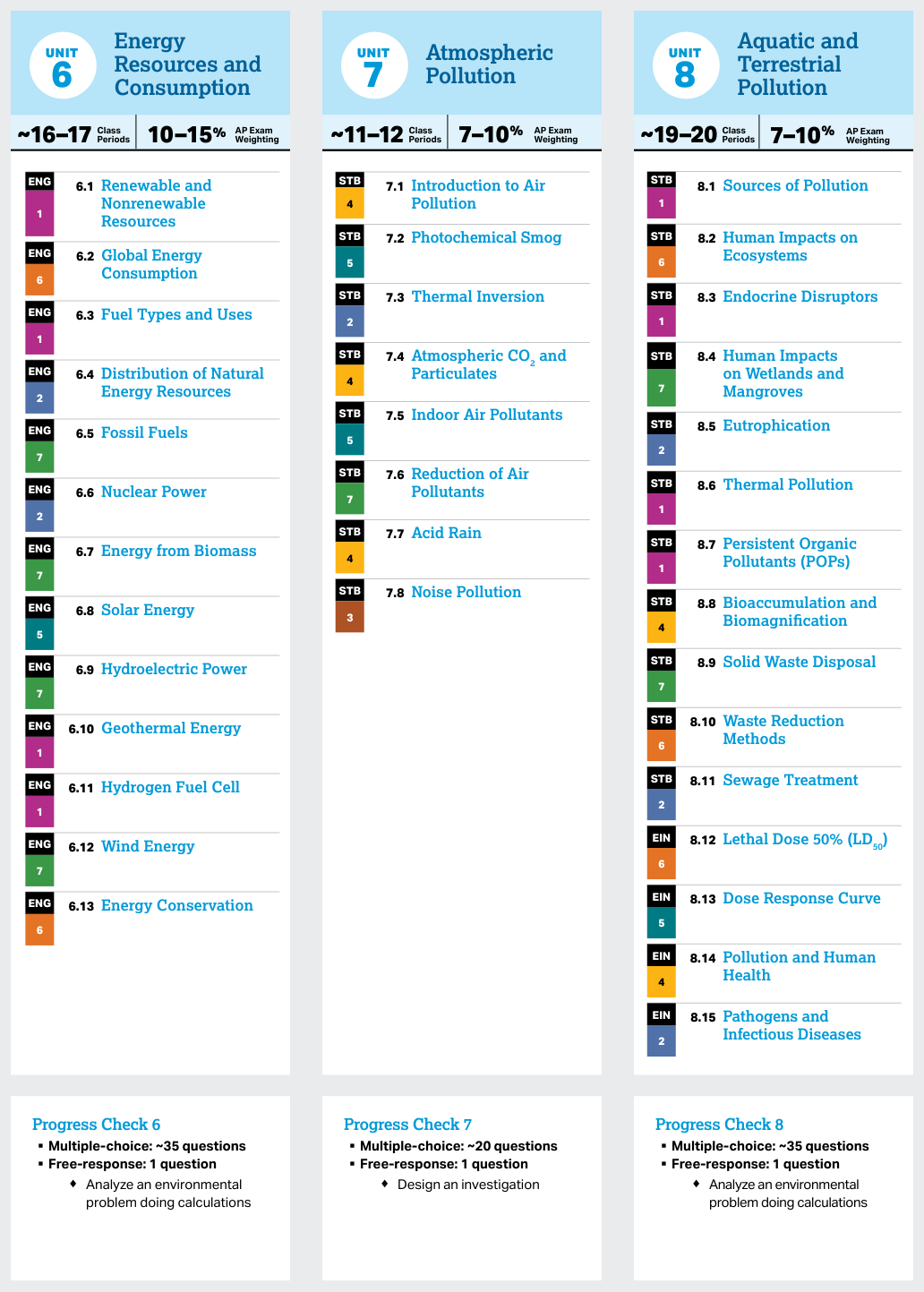
| ENG | Energy Transfer | Units 1, 4, and 6 |
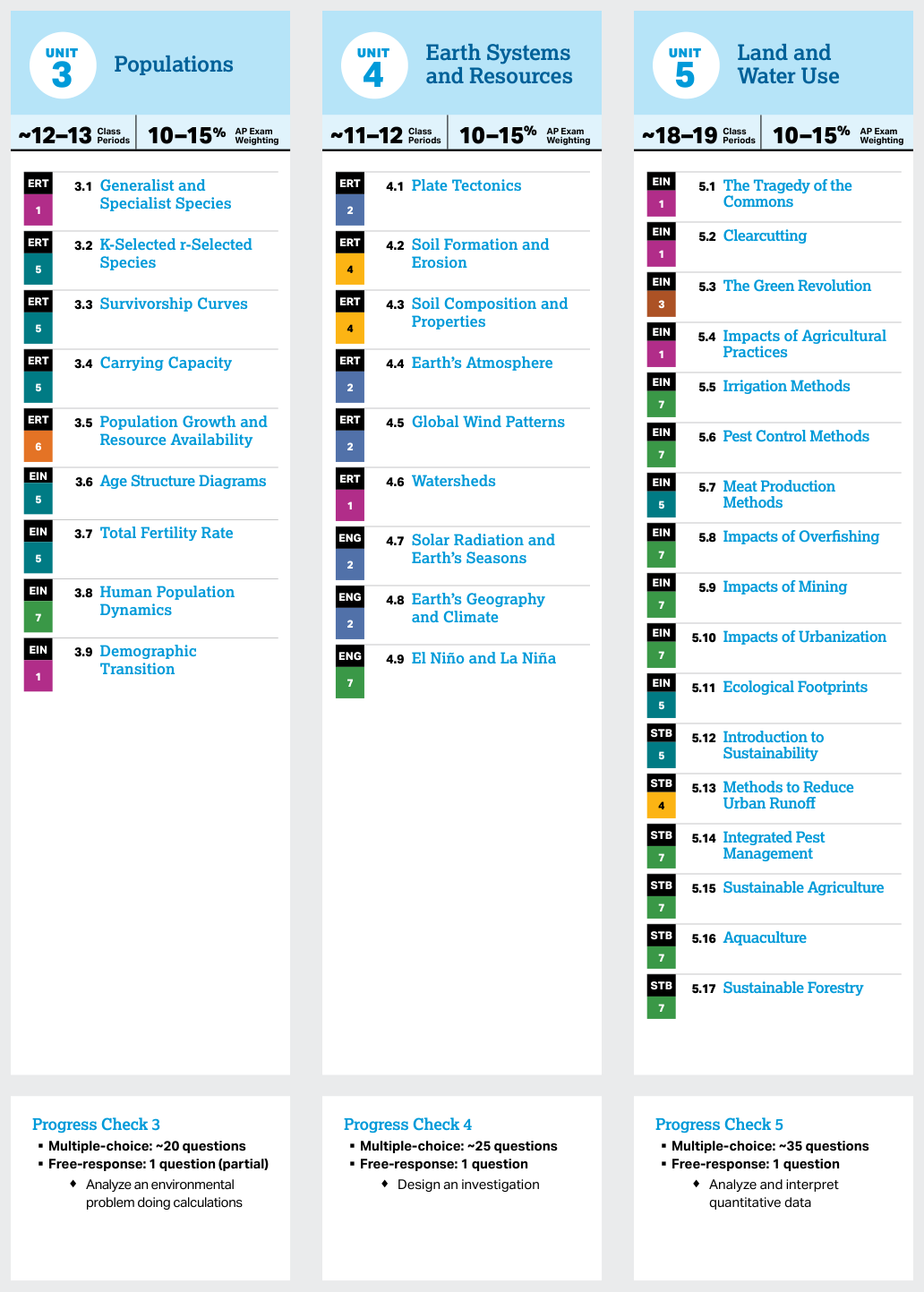
| ERT | Interactions Between Earth Systems | Units 1, 2, 3, and 4 |
| EIN | Interactions Between Different Species and the Environment | Units 3, 5, 8, and 9 |
| STB | Sustainability | Units 5, 7, 8, and 9 |
ERT, or Interactions Between Earth Systems, is especially visible early in the course. Ecosystems, biodiversity, populations, soils, atmosphere, and water are not separate subjects: they are interacting parts of Earth’s system. A change in one component can propagate through others—for example, altered precipitation can affect soil moisture, plant productivity, food webs, and human food production.
A central ENG principle is that energy is not created; it must come from somewhere. Solar radiation supplies most energy entering ecosystems, and energy is transferred through producers and consumers. At every transfer, some energy becomes less usable, often leaving the system as heat. Matter such as carbon, nitrogen, phosphorus, and water cycles through Earth systems, but energy flows in one direction.
Roadmap: which ideas and practices recur?
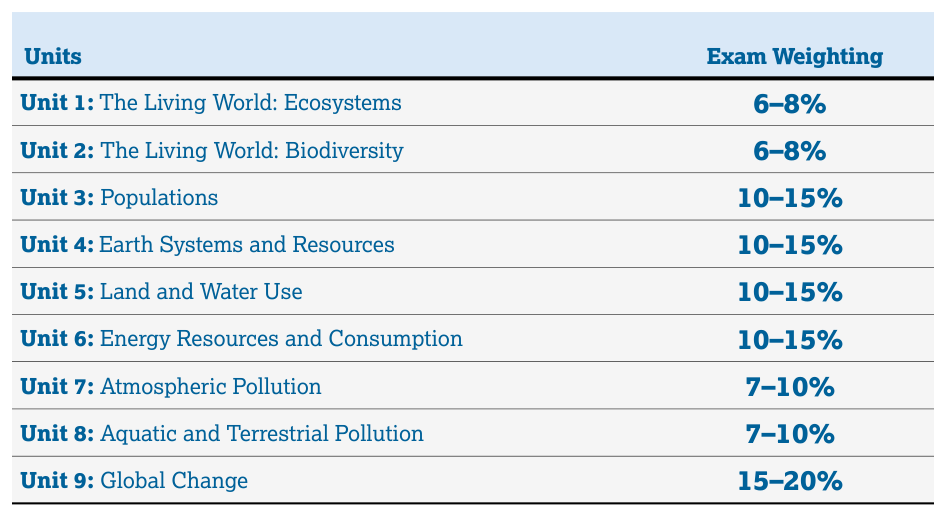
The Course at a Glance places ecosystems and biodiversity near the beginning because they establish relationships that later units reuse. Unit 1 leans strongly on ERT, ENG, Concept Explanation, and Visual Representations; Units 2–4 extend ERT into biodiversity, populations, soils, atmosphere, and climate. Units 5–9 increasingly emphasize EIN, STB, Data Analysis, Mathematical Routines, and Environmental Solutions.
The sequence shown in the Course at a Glance is an optional sequence, not a required order. Schools may organize instruction differently, provided the required content, Big Ideas, and science practices are addressed.
The seven Science Practices
The Big Ideas state what environmental understanding is being developed. The seven Science Practices state what students do with that understanding.
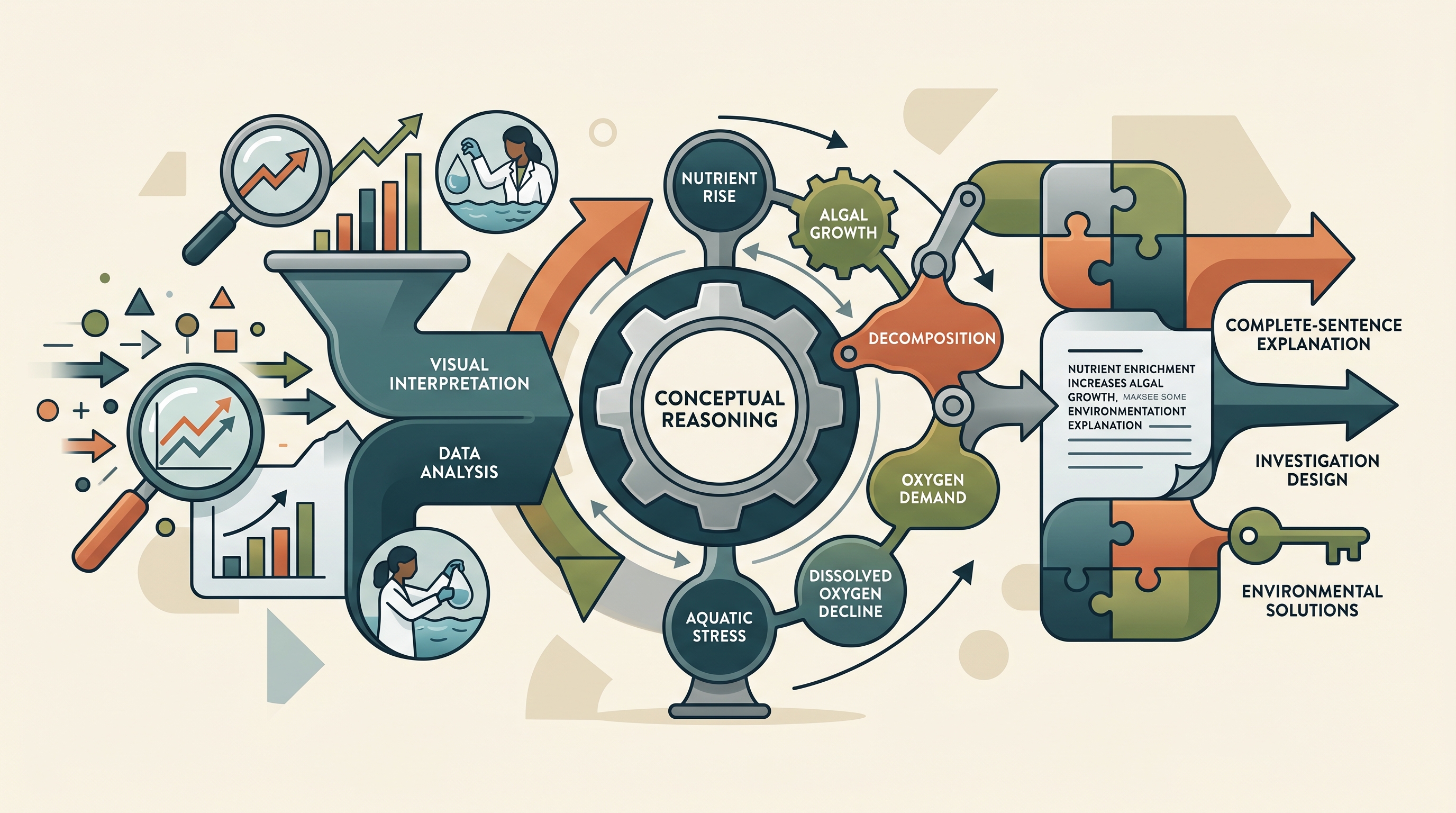
- Concept Explanation — Students explain environmental concepts, processes, or models in written formats. A strong explanation identifies a mechanism and connects cause to effect. For example, instead of merely stating that fertilizer causes algal blooms, a response explains that added nutrients increase algal growth, and decomposition of that biomass lowers dissolved oxygen.
- Visual Representations — Students describe or explain concepts and processes represented in diagrams, maps, graphs, models, and other visuals. They must read patterns and translate visual evidence into scientific language.
- Text Analysis — Students analyze written scientific or environmental information, including claims, evidence, assumptions, and implications.
- Scientific Experiments — Students plan or evaluate investigations. This includes identifying a testable question, independent and dependent variables, controls, repeated trials, and appropriate measurements.
- Data Analysis — Students interpret tables, graphs, and datasets; identify trends; compare groups; evaluate evidence; and use data to support a conclusion.
- Mathematical Routines — Students perform quantitative procedures such as percent change, rates, energy-transfer calculations, population calculations, and unit-based reasoning.
- Environmental Solutions — Students propose or evaluate solutions by connecting a strategy to an environmental problem, explaining its mechanism, and considering consequences or limitations.
How the practices work together
Environmental reasoning rarely uses only one practice. A typical investigation might begin with Text Analysis of a claim, use Scientific Experiments to design a test, apply Data Analysis to the results, use Mathematical Routines to calculate a rate or percentage, and finish with Concept Explanation and Environmental Solutions.
For example, suppose a wetland restoration project reports increased bird abundance. A scientifically careful response would ask: What was measured? Was there a comparison site? Did water quality change? Does the graph show correlation or a demonstrated cause? The ability to evaluate scientific accuracy, credibility, and validity prevents a visually impressive claim from being accepted without sufficient evidence.
Course-framework labels
The required-content labeling system moves from broad to specific:
$$ \text{Big Idea} \rightarrow \text{Enduring Understanding} \rightarrow \text{Learning Objective} \rightarrow \text{Essential Knowledge} $$
For instance, ERT may lead to an enduring understanding about ecosystems resulting from biotic and abiotic interactions. A learning objective then asks students to describe a distribution or process, while Essential Knowledge supplies the factual relationships needed to support that objective. Topic pages also pair content with a suggested practice, such as 1.A Explain environmental concepts and processes, 2.A, 2.B, or 6.C.
Assessment across the exam
The fully digital exam contains 80 multiple-choice questions in 90 minutes, worth 60% of the score, and three free-response questions in 70 minutes, worth 40%. Multiple-choice questions can combine any Big Idea with visual interpretation, text analysis, data, or calculations; free-response questions especially require complete-sentence explanations, investigation design, quantitative interpretation, calculations, and proposed environmental solutions.
Worked reasoning check: If a graph shows dissolved oxygen falling as nutrient concentration rises, do not write only “there is a negative relationship.” A creditworthy explanation identifies the mechanism: nutrient enrichment increases algal growth; decomposition increases biological oxygen demand; dissolved oxygen declines, potentially stressing aquatic organisms. That chain demonstrates Visual Representations, Data Analysis, and Concept Explanation together.
Key insight: Knowing an environmental fact is only the starting point. AP Environmental Science assesses whether you can use that fact to explain a mechanism, interpret evidence, evaluate an investigation, calculate a quantity, or defend a solution.
Retrieval check: Which Big Idea connects nutrient cycling, species interactions, and changes in water quality? Which Science Practice would you use to evaluate whether a graph supports a researcher’s claim?

Source Materials
- AP Environmental Science Course and Exam Description
- Review the Clarifications (.pdf)
- AP Environmental Science Course Overview
- AP Environmental Science Course at a Glance
- AP Environmental Science Course at a Glance Poster
- AP Environmental Science
- AP Environmental Science
- AP Environmental Science Sample Syllabus 1
- Figure — AP Environmental Science Course and Exam Description (p. 1)
- Figure — AP Environmental Science Course and Exam Description (p. 17)
- Figure — AP Environmental Science Course and Exam Description (p. 25)
- AP Environmental Science Course and Exam Description Course Framework V.1 | 19