From the free course AP Environmental Science on Lykke
6.3 Fuel Types and Uses · 6.4 Distribution of Natural Energy Resources
Key concepts: Energy resources and consumption · Fuel types and their uses · Coal formation and quality · Natural gas · Crude oil and tar sands · Fossil-fuel refining · Nuclear fission · Distribution and availability of natural energy resources · Environmental consequences of energy use
A fuel’s usefulness depends on more than how much energy it contains: its physical form, chemical composition, location, accessibility, and environmental cost determine whether people can realistically use it for heating, transportation, or electricity.
6.3 Fuel Types and Uses · 6.4 Distribution of Natural Energy Resources
A fuel’s usefulness depends on more than how much energy it contains: its physical form, chemical composition, location, accessibility, and environmental cost determine whether people can realistically use it for heating, transportation, or electricity.
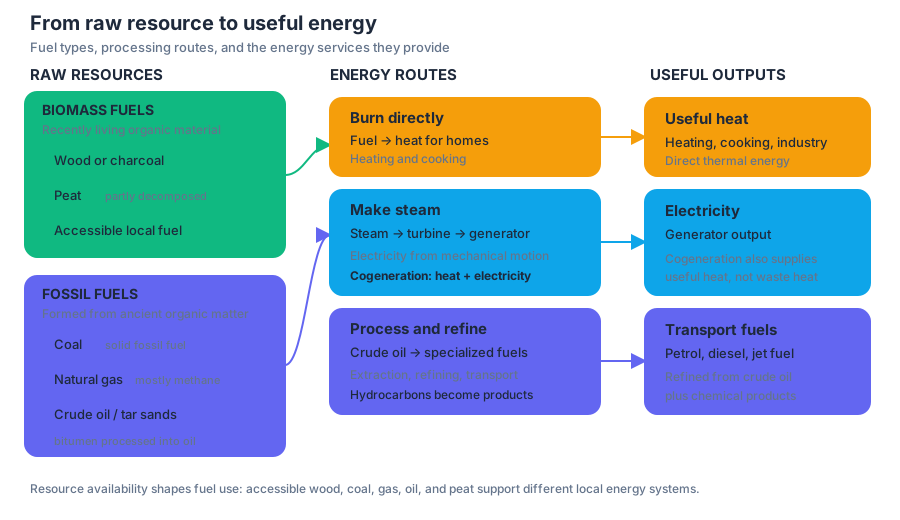
From raw resource to useful energy
Biomass fuels come from recently living organic material. Wood and charcoal are widely used where they are accessible, while peat—partially decomposed organic material—can also be burned. Fossil fuels formed from ancient organic matter and include coal, natural gas, and crude oil.
A fuel may be burned directly for heat, used to produce steam that turns a generator, or processed into a specialized fuel. Cogeneration is especially efficient because one fuel source produces both useful heat and electricity instead of releasing the heat as waste.
| Raw resource | Important characteristic | Typical use |
|---|---|---|
| Wood or charcoal | Accessible biomass fuel | Heating and cooking |
| Peat | Partially decomposed organic matter | Burned for fuel |
| Coal | Solid fossil fuel with variable carbon content | Electricity and industrial heat |
| Natural gas | Mostly methane; cleanest fossil fuel | Heating, electricity, and industry |
| Crude oil | Liquid mixture of hydrocarbons | Refined into transportation fuels and other products |
| Tar sands | Clay, sand, water, and bitumen | Source of crude oil after extraction and processing |
Coal quality: burial changes the fuel
Coal develops as buried organic material experiences increasing heat, pressure, and depth of burial. These conditions remove water and other volatile substances and generally increase the coal’s carbon concentration and energy content.
The major fuel coal types form an approximate progression:
$$ \text{lignite} \rightarrow \text{bituminous} \rightarrow \text{anthracite} $$
Lignite is relatively soft, has lower carbon content, and produces less energy per unit mass than higher-grade coal. Bituminous coal is more carbon-rich and widely used. Anthracite is harder and has the highest carbon content of these three types, so it generally burns more efficiently and with less smoke.
Misconception check — “All coal has the same quality.” Coal is not a single uniform fuel. A coal’s formation conditions influence its carbon content, energy yield, moisture content, and pollutant emissions. Higher quality does not mean zero environmental impact; extracting and burning coal still disturb land and release pollutants and carbon dioxide.
Natural gas, crude oil, and tar sands
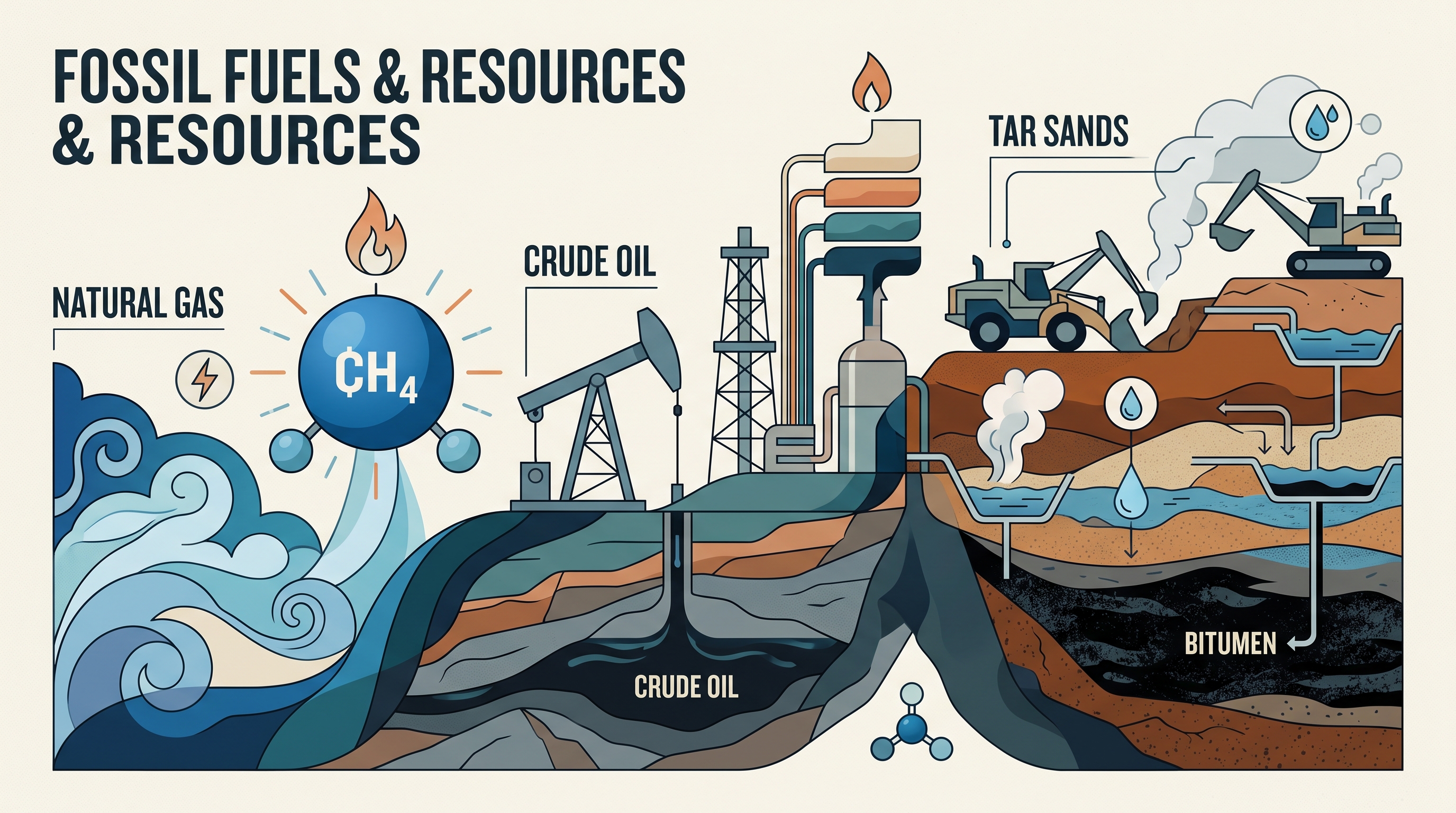
Natural gas is composed mostly of methane, $CH_4$, and is considered the cleanest fossil fuel because burning it usually produces less carbon dioxide and fewer conventional air pollutants per unit of energy than coal or oil. “Cleanest fossil fuel” does not mean “clean energy”: methane itself is a powerful greenhouse gas if it leaks before combustion.
Crude oil is a mixture of hydrocarbons that must be separated and processed. Tar sands, also called oil sands, contain clay, sand, water, and bitumen, a thick petroleum-containing substance. Recovering crude oil from tar sands requires extraction and processing, which can disturb land and demand substantial energy and water.
Refining matches fuels to jobs
Raw fossil fuels rarely go directly into every machine. Fossil-fuel refining separates and chemically modifies crude materials into fuels with properties suited to particular uses—for example, gasoline and diesel for motor vehicles, jet fuel for aircraft, and other petroleum products for industry.
A useful way to visualize refining is as a sorting-and-customizing process:
$$ \text{crude oil} \rightarrow \text{separation} \rightarrow \text{specialized fuels} \rightarrow \text{transportation, heating, or electricity} $$
Worked example: A town receives crude oil but has no refinery. It cannot simply substitute the crude oil directly into gasoline engines. The oil must first be refined into a fuel with the correct volatility and combustion properties. If the town instead receives natural gas through a pipeline, it may use methane directly for heating or electricity, but only if pipeline infrastructure and supply are available.
Location controls energy choices
Energy resources are unevenly distributed. Coal deposits, oil fields, natural-gas reserves, uranium ores, sunlight, moving water, and strong winds occur in different places and at different concentrations. Therefore, availability and distribution influence how and where resources are used: a resource that is abundant locally may be cheaper and more politically attractive than one that must be imported.
Energy demand rises as human use of energy increases. A growing population, expanding industry, transportation, heating, cooling, and electricity access can all raise demand. Distribution creates trade-offs: extraction may occur far from consumers, requiring pipelines, railways, ships, transmission lines, or fuel-processing facilities.
Nuclear energy also depends on resource distribution and specialized infrastructure. In a reactor, uranium-235 in fuel rods undergoes nuclear fission when struck by a neutron, splitting into smaller parts and releasing energy. The resource’s location matters, but so do reactor construction, fuel processing, safety systems, and waste management.
AP skill lens
This topic is commonly assessed through the official science practices Science Practice 1: Concept Application, when connecting fuel properties to uses; Science Practice 2: Visual Representations, when interpreting resource-distribution maps or process diagrams; Science Practice 5: Data Analysis, when comparing energy production and demand; Science Practice 6: Mathematical Routines, when calculating energy output or percentage change; and Science Practice 7: Environmental Solutions, when evaluating cogeneration, fuel switching, or infrastructure choices.
Retrieval check: Explain why anthracite generally has greater energy content than lignite, identify the main component of natural gas, and give one reason a region might use a locally available fuel even when another fuel has lower emissions.
Source Materials
- AP Environmental Science Course and Exam Description
- Review the Clarifications (.pdf)
- AP Environmental Science Course Overview
- AP Environmental Science Course at a Glance
- AP Environmental Science Course at a Glance Poster
- AP Environmental Science
- AP Environmental Science
- AP Environmental Science Sample Syllabus 1