From the free course AP Environmental Science on Lykke
4.9 El Niño and La Niña
Every few years, the tropical Pacific Ocean changes the way it stores and releases heat, rearranging rainfall, fisheries, storms, and drought risk across much of the planet.
4.9 El Niño and La Niña
Every few years, the tropical Pacific Ocean changes the way it stores and releases heat, rearranging rainfall, fisheries, storms, and drought risk across much of the planet. These linked ocean–atmosphere patterns are called El Niño and La Niña, together forming the El Niño–Southern Oscillation, or ENSO.
Learning objective ERT-1.I: Explain how El Niño and La Niña affect global climate.
Essential knowledge ERT-1.I.1: El Niño and La Niña result from changes in ocean circulation and atmospheric conditions in the tropical Pacific Ocean, producing global effects on temperature and precipitation.
The normal Pacific pattern
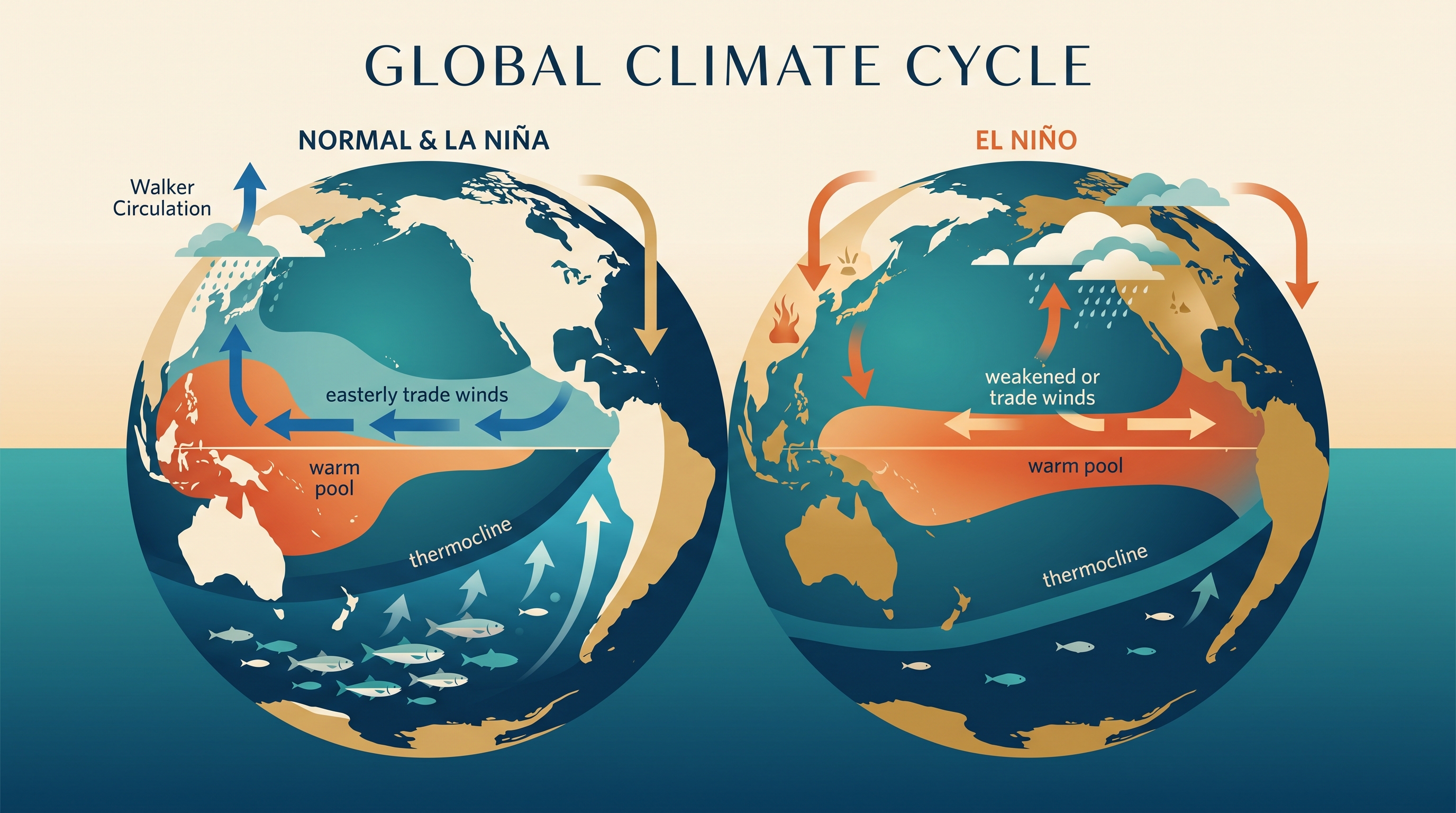
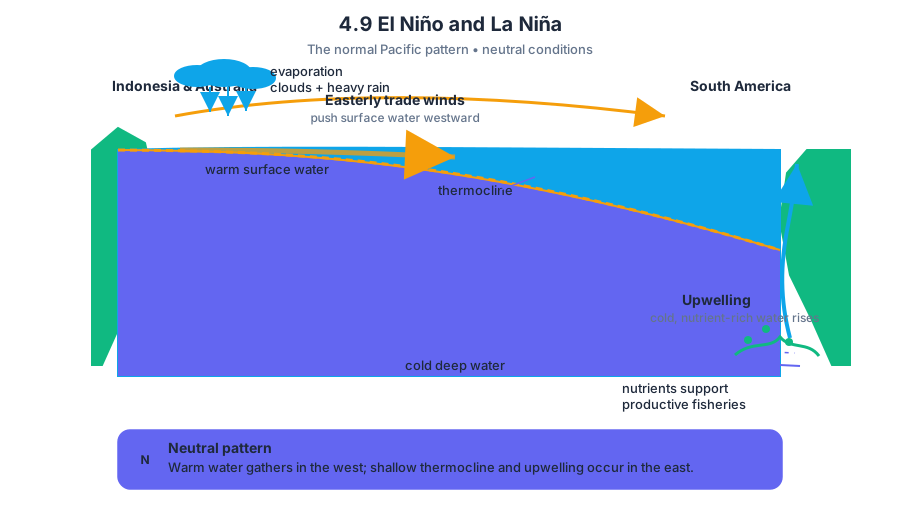
Under neutral, or typical, conditions, easterly trade winds push warm surface water westward from the coast of South America toward Indonesia and Australia. Warm water piles up in the western Pacific, where it promotes evaporation, cloud formation, and heavy rainfall.
At the same time, cold, nutrient-rich water rises near the western coast of South America. This process, called upwelling, supports highly productive marine food webs and major fisheries. The boundary between warm surface water and colder deep water—the thermocline—is relatively shallow in the eastern Pacific and deeper in the west.
El Niño: weakened winds, warmer eastern Pacific
During El Niño, the trade winds weaken or may temporarily reverse. Warm surface water moves eastward across the tropical Pacific, causing sea-surface temperatures to rise near the coasts of Peru and Ecuador.
Because the warm surface layer becomes deeper in the eastern Pacific, the thermocline sinks there. Upwelling is reduced, so fewer nutrients reach surface waters. Phytoplankton productivity declines, followed by declines in fish populations and the seabirds, marine mammals, and fishing communities that depend on them.
The displaced warm water also changes atmospheric convection—the rising of warm, moist air. Rainfall increases over parts of the eastern and central Pacific, while Indonesia and Australia may experience drought. El Niño can also shift atmospheric circulation far beyond the Pacific, changing the probability of floods, droughts, altered storm tracks, and unusually warm conditions in distant regions.
La Niña: stronger winds, cooler eastern Pacific
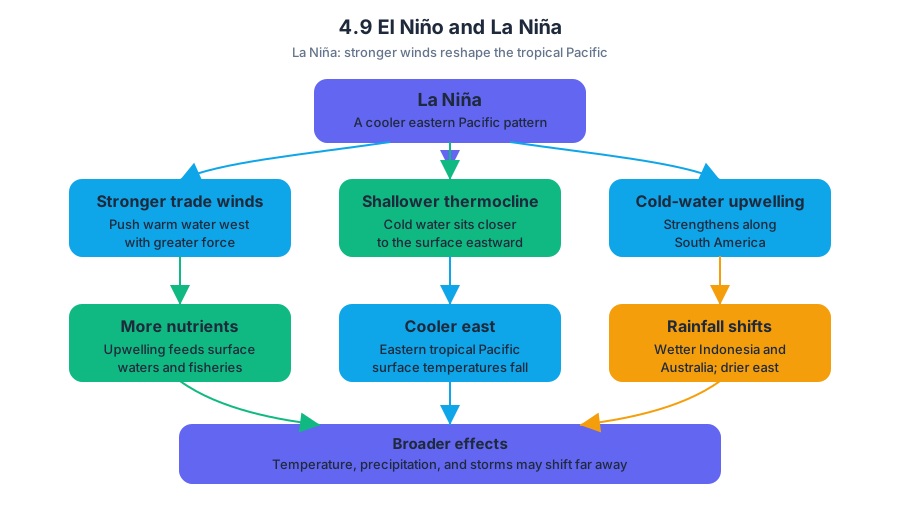
During La Niña, the trade winds become stronger than usual. They push even more warm water toward the western Pacific and strengthen cold-water upwelling along the South American coast.
The eastern tropical Pacific therefore becomes cooler, the thermocline remains shallower, and nutrient delivery to surface waters increases. Fisheries may benefit from this greater nutrient supply, although the ecological and economic result depends on the species involved and on the intensity and duration of the event.
La Niña commonly produces a broad pattern opposite to El Niño: wetter conditions in parts of Indonesia and Australia and drier conditions in portions of the eastern Pacific. Its remote effects can include shifts in temperature, precipitation, and storm activity in other regions.
One mechanism, many consequences
| Condition | Trade winds | Eastern-Pacific surface water | Upwelling near South America | Typical biological effect |
|---|---|---|---|---|
| Neutral | Typical strength | Relatively cool | Typical | Sustained nutrient supply |
| El Niño | Weakened | Warmer | Reduced | Lower marine productivity |
| La Niña | Strengthened | Cooler | Enhanced | Often higher marine productivity |
Worked example: Suppose a monitoring station records unusually warm surface water near Peru, declining nutrient concentrations, and a sharp drop in anchovy abundance. The strongest explanation is El Niño. The causal chain is:
$$ \text{weaker trade winds} \rightarrow \text{eastward movement of warm water} \rightarrow \text{deeper thermocline} \rightarrow \text{less upwelling} \rightarrow \text{fewer nutrients} \rightarrow \text{lower primary productivity} \rightarrow \text{reduced fish abundance} $$
The evidence does not prove that every regional weather event was caused by El Niño. ENSO changes probabilities and large-scale patterns; local geography, seasonal circulation, and other climate processes also influence actual weather.
Misconception check
Misconception: “El Niño means the entire planet becomes warmer, while La Niña means the entire planet becomes colder.” Neither event produces a uniform global temperature pattern. El Niño often raises the global average temperature temporarily because heat moves from the ocean into the atmosphere, but some locations can become cooler or wetter. La Niña can temporarily suppress the global average temperature while producing severe heat, drought, or flooding in particular regions.
AP science practices in this topic
- Science Practice 1: Concept Application — Use the trade-wind, thermocline, and upwelling mechanism to predict ecological consequences.
- Science Practice 2: Visual Representations — Interpret cross sections, circulation diagrams, and maps of sea-surface temperature.
- Science Practice 5: Data Analysis — Identify anomalies by comparing observed temperature, rainfall, or fish-abundance data with long-term averages.
- Science Practice 7: Environmental Solutions — Justify adaptive responses such as flexible fishery management, drought planning, or water-storage strategies.
Retrieval check: A graph shows cooler-than-average eastern-Pacific water, unusually strong easterly trade winds, and increased nutrient concentrations near South America. Identify the ENSO phase and explain the two-step mechanism linking the wind pattern to marine productivity.
Source Materials
- AP Environmental Science Course and Exam Description
- Review the Clarifications (.pdf)
- AP Environmental Science Course Overview
- AP Environmental Science Course at a Glance
- AP Environmental Science Course at a Glance Poster
- AP Environmental Science
- AP Environmental Science
- AP Environmental Science Sample Syllabus 1