From the free course AP Environmental Science on Lykke
7.1 Introduction to Air Pollution · 7.2 Photochemical Smog
Key concepts: Air pollution from fossil-fuel combustion · Pollutants released by coal combustion · Nitrogen oxides from fossil-fuel combustion · Photochemical smog formation · Role of heat and sunlight in smog formation · Volatile organic hydrocarbons · Primary and secondary air pollutants · Sulfur dioxide and air quality · Lead pollution and Clean Air Act regulation · Catalytic converters as pollution-control devices
A vehicle can release pollutants that were not present in its fuel as separate substances: combustion transforms fuel and oxygen into new gases, particles, and reactive chemicals.
7.1 Introduction to Air Pollution · 7.2 Photochemical Smog
A vehicle can release pollutants that were not present in its fuel as separate substances: combustion transforms fuel and oxygen into new gases, particles, and reactive chemicals. The central question is therefore not simply “What comes out of a smokestack or tailpipe?” but “Which pollutants are released directly, and which form later in the atmosphere?”
Enduring Understanding STB-2: Human activities have physical, chemical, and biological consequences for the atmosphere.
Learning Objective STB-2.A: Identify the sources and effects of air pollutants.
The pollutant mixture from fossil-fuel combustion
Air pollution is the release of substances into the atmosphere at concentrations that can harm organisms, ecosystems, materials, or air quality. Burning coal, gasoline, diesel, and other fossil fuels produces several pollutants at once because fuels contain carbon, hydrogen, sulfur, and impurities, while combustion occurs under conditions that may be incomplete or chemically complex.
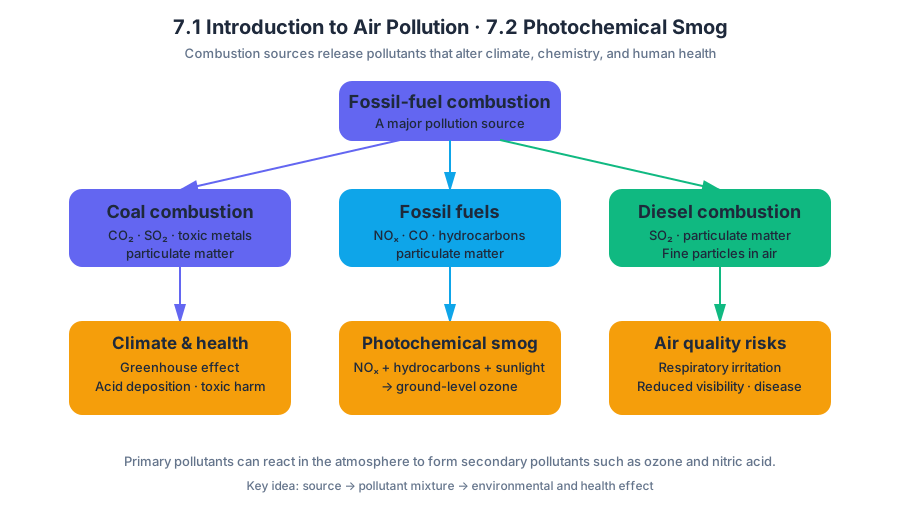
| Fuel-combustion source | Important pollutants | Major atmospheric consequence |
|---|---|---|
| Coal combustion | Carbon dioxide, sulfur dioxide, toxic metals, and particulate matter | Climate effects, degraded air quality, and health risks |
| Fossil-fuel combustion generally | Nitrogen oxides, carbon monoxide, hydrocarbons, and particulate matter | Ozone production, photochemical smog, and other pollution |
| Diesel combustion | Sulfur dioxide and particulate matter | Reduced air quality and respiratory hazards |
STB-2.A.1 requires recognition that coal combustion releases carbon dioxide, sulfur dioxide, toxic metals, and particulates. Carbon dioxide is a greenhouse gas; sulfur dioxide can contribute to acid deposition; toxic metals can harm organisms even at low concentrations; and particulate matter consists of small solid particles or liquid droplets suspended in air.
STB-2.A.2 identifies additional pollutants from fossil-fuel combustion. Nitrogen oxides, written collectively as $NO_x$, are released when combustion produces high temperatures that allow atmospheric nitrogen and oxygen to react. In the atmosphere, $NO_x$ contributes to ozone production, photochemical smog, and the formation of nitric acid, which can contribute to acid rain. Incomplete combustion can also produce carbon monoxide, while unburned or partially reacted fuel produces hydrocarbons.
Primary versus secondary pollutants
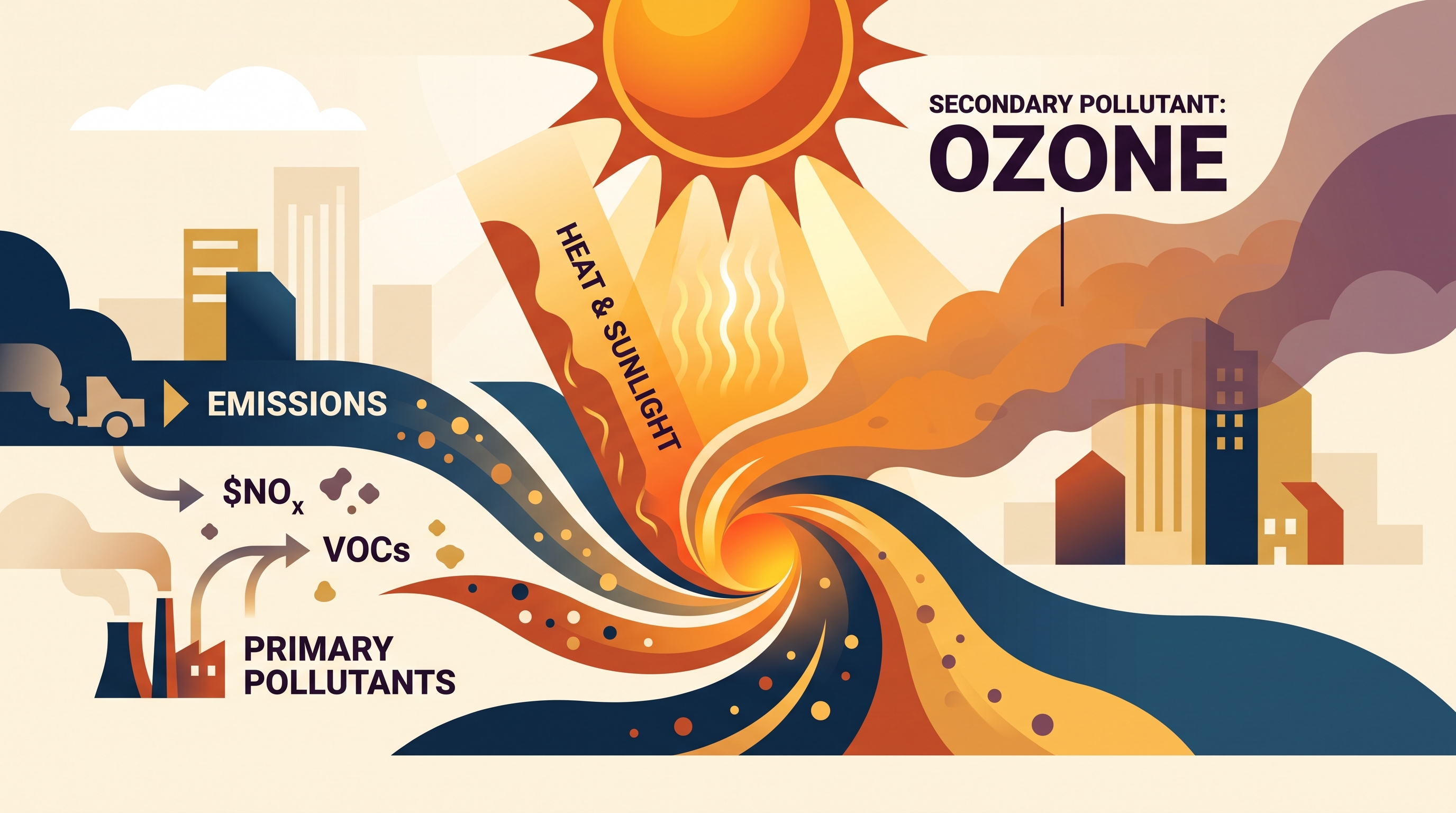
A primary pollutant enters the atmosphere directly from a source, such as sulfur dioxide emitted by a coal-fired power plant or carbon monoxide emitted by an engine. A secondary pollutant forms in the atmosphere when primary pollutants react with one another or with sunlight, heat, and atmospheric oxygen.
STB-2.A.5 requires this distinction. For example, $NO_x$ may be emitted directly, but ozone near Earth’s surface is generally a secondary pollutant because it forms through atmospheric reactions. The word secondary describes how a pollutant forms—not whether it is less dangerous.
How photochemical smog forms
Photochemical smog is a mixture of secondary air pollutants produced when nitrogen oxides and volatile organic hydrocarbons react in the presence of heat and sunlight. Volatile organic hydrocarbons are carbon-containing compounds that readily evaporate into the air; they can come from fuel vapors, vehicle exhaust, and industrial solvents.
The formation sequence is:
- Fossil-fuel combustion releases $NO_x$ and hydrocarbons.
- Sunlight supplies energy for atmospheric chemical reactions.
- Heat accelerates those reactions.
- The reacting mixture produces ozone and other secondary pollutants.
- The resulting brownish, irritating haze reduces air quality, especially in areas with many vehicles and strong sunlight.
Worked example: Imagine a sunny, hot afternoon in a city with heavy traffic. Tailpipes release $NO_x$, carbon monoxide, hydrocarbons, and particulate matter. Because heat and sunlight are abundant, the $NO_x$ and volatile organic hydrocarbons react in the atmosphere, producing ozone and a variety of other pollutants. The smog therefore does not merely equal the visible exhaust; it is a chemically altered mixture that develops after emission.
Misconception check: Ozone is not always “good” or always “bad.” Stratospheric ozone protects Earth from ultraviolet radiation, while ozone in the lower atmosphere is a harmful component of photochemical smog.
Pollution control and regulation
STB-2.A.3 emphasizes that sulfur dioxide released during fossil-fuel burning—particularly from diesel fuels—can affect air quality. Regulation can reduce emissions at the source. Under the Clean Air Act, the Environmental Protection Agency regulated lead, especially lead in fuels; these policies dramatically decreased the amount of lead in the atmosphere.
A catalytic converter is an air-pollution-control device installed in internal-combustion engine exhaust systems. It converts carbon monoxide, nitrogen oxides, and hydrocarbons into less harmful molecules, including carbon dioxide, nitrogen, oxygen, and water.
AP science practices in this topic
Air-pollution scenarios can assess Science Practice 1: Concept Explanation, when you identify a pollutant’s source and atmospheric effect; Science Practice 2: Visual Representations, when you interpret a reaction pathway or emissions diagram; Science Practice 3: Questions and Methods, when you predict how sunlight, heat, or fuel type would affect an investigation; Science Practice 4: Representing and Describing Data, when you describe pollutant trends; Science Practice 5: Statistical Tests and Data Analysis, when you evaluate whether measured differences support a claim; Science Practice 6: Mathematical Routines, when you calculate emissions or percent change; and Science Practice 7: Environmental Solutions, when you justify catalytic converters, fuel regulation, or another pollution-control strategy.
Retrieval check
A city records high $NO_x$ and hydrocarbon emissions on a hot, sunny day. Which pollutant is most likely to form secondarily, and why? Answer: Ozone, because $NO_x$ and volatile organic hydrocarbons react in the presence of heat and sunlight. Identify one primary pollutant in the same scenario: $NO_x$, carbon monoxide, hydrocarbons, sulfur dioxide, or particulate matter emitted directly from combustion.
Source Materials
- AP Environmental Science Course and Exam Description
- Review the Clarifications (.pdf)
- AP Environmental Science Course Overview
- AP Environmental Science Course at a Glance
- AP Environmental Science Course at a Glance Poster
- AP Environmental Science
- AP Environmental Science
- AP Environmental Science Sample Syllabus 1
- AP/College Environmental Science-Khan Academy
- AP Environmental Science Exam-College Board
- AP Environmental Science Units-Save my Exams
- AP Environmental Science-Bozeman Science