From the free course AP Environmental Science on Lykke
8.15 Pathogens and Infectious Diseases
Key concepts: Human pathogens · Infectious diseases · Pathogen cycling through the environment · Environmental transmission pathways · Direct and indirect health impacts of pollutants · Sanitary waste disposal and drinking-water quality · Disease emergence in new areas · Respiratory and direct-contact transmission · Vector-borne transmission · Plague
A human pathogen is a disease-causing organism or infectious agent that can move among hosts, survive in environmental reservoirs, and exploit opportunities created by climate, pollution, or inadequate sanitation.
8.15 Pathogens and Infectious Diseases
A human pathogen is a disease-causing organism or infectious agent that can move among hosts, survive in environmental reservoirs, and exploit opportunities created by climate, pollution, or inadequate sanitation. An infectious disease results when that pathogen enters a host, reproduces or disrupts normal function, and spreads through a transmission pathway.
Enduring Understanding EIN-3: Pollutants can have both direct and indirect impacts on the health of organisms, including humans.
Learning Objective EIN-3.D: Explain human pathogens and their cycling through the environment.
How pathogens cycle through the environment
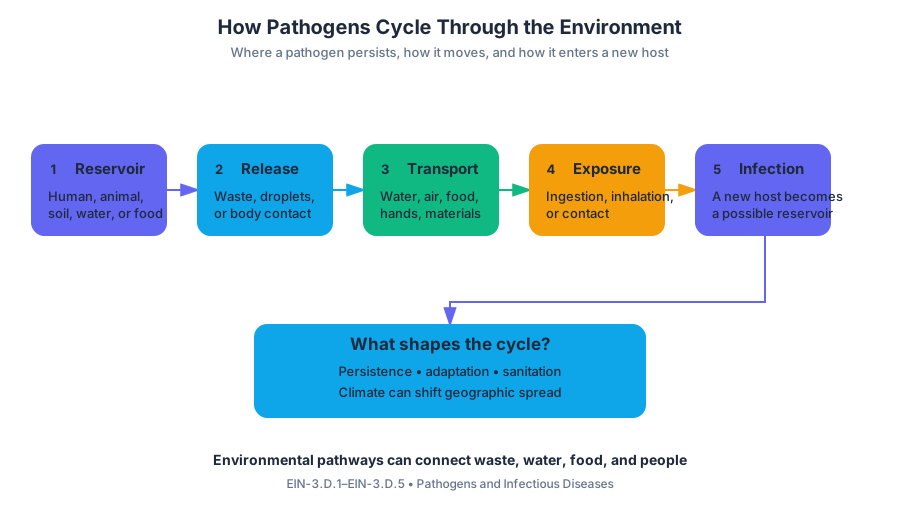
Pathogens do not exist only inside visibly sick people. They may cycle among humans, other organisms, soil, water, air, food, and contaminated materials. A pathogen’s environmental cycle therefore includes three linked questions: where it persists, how it moves, and how it enters a new host.
A useful model is:
reservoir → release → environmental transport → exposure → infection → new reservoir
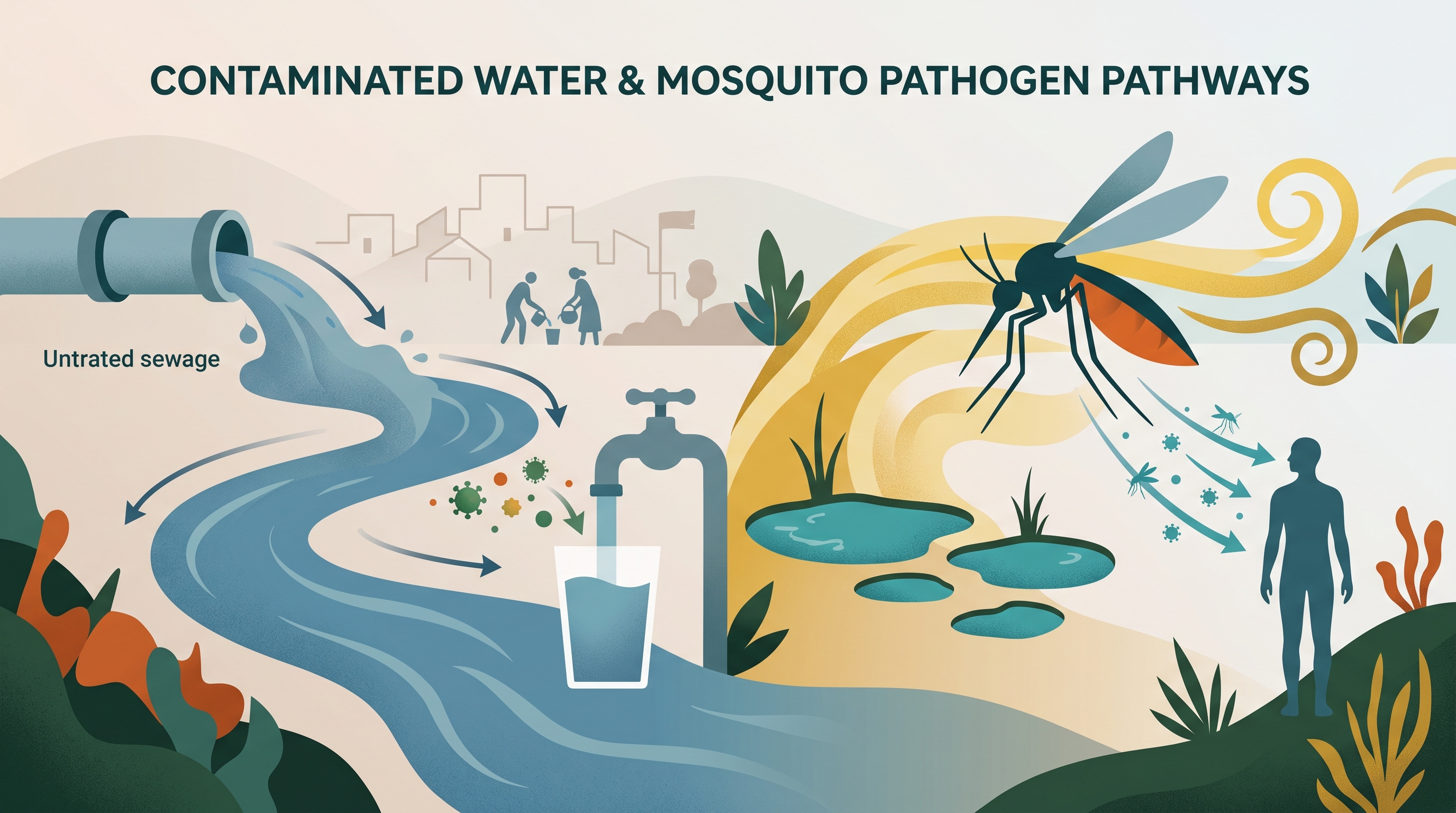
For example, human waste can introduce pathogens into surface water. If that water contaminates drinking supplies, food, or hands, another person may ingest the pathogen. The pathogen has therefore moved through an environmental pathway rather than passing only through direct person-to-person contact.
EIN-3.D.1–EIN-3.D.5 organize the required explanation of pathogen cycling, including pathogen persistence, adaptation, climate-related geographic spread, sanitation conditions, and the specific example of plague. Pathogens can occur even in places that appear sanitary, and some evolve in ways that allow them to exploit new hosts or transmission opportunities.
Environmental transmission pathways
Different pathogens use different routes. Respiratory transmission occurs when infectious particles move through the air or respiratory droplets; direct-contact transmission occurs through physical contact. Vector-borne transmission uses another organism—often an insect—to carry the pathogen from one host to another. Zoonotic transmission involves movement from an infected nonhuman animal to humans.
| Disease | Pathogen type | Main environmental or contact pathway |
|---|---|---|
| Tuberculosis | Bacterial | Respiratory or direct contact |
| SARS | Viral | Respiratory or direct contact |
| Malaria | Parasitic | Bites from infected mosquitoes |
| West Nile virus | Viral | Bites from infected mosquitoes |
| Zika | Viral | Bites from infected mosquitoes |
| Plague | Bacterial | Vector bites or contact with contaminated fluids and tissues |
The distinction between pathogen type and transmission pathway matters. Bacterial, viral, and parasitic describe what causes the disease; respiratory, direct-contact, mosquito-borne, or tissue-contact descriptions explain how it spreads. A virus is not automatically airborne, and a bacterium is not automatically waterborne.
Climate and geographic expansion
Diseases may spread into areas where they were not previously known to occur. As equatorial-type climate zones spread northward, warmer conditions may allow pathogens or their vectors—such as mosquitoes—to survive in subtropical or temperate areas. Climate does not create every disease by itself, but it can change whether a suitable host, vector, temperature range, and habitat exist in a particular location.
Worked example: Suppose a mosquito species cannot complete its life cycle in a cool region. If average temperatures rise, the mosquito may survive there for a longer season. If an infected person or animal introduces a pathogen, the mosquito can acquire it and transmit it to additional hosts. The disease’s geographic range has expanded because climate conditions altered the transmission pathway.
Misconception check — “A disease cannot occur in a new region unless the pathogen evolves there.”
A pathogen may already exist elsewhere. A change in temperature, precipitation, host distribution, or vector habitat can allow it to spread into a region where it was previously absent or uncommon.
Pollution, sanitation, and infectious disease
Pollutants can harm organisms directly, through immediate exposure or physiological damage, and indirectly, by changing environmental conditions that increase disease transmission. For instance, pollution may damage an organism’s health or weaken its defenses, while contaminated water and poorly managed waste may create reservoirs through which pathogens reach new hosts.
Poverty-stricken, low-income areas may lack sanitary waste disposal and have contaminated drinking-water supplies. These conditions create havens and opportunities for infectious disease because human waste, pathogens, and drinking water can come into contact. Improving sewage treatment, protecting water sources, and safely disposing of waste interrupt the pathogen cycle before infection occurs.
Plague illustrates several pathways at once. It is a bacterial disease carried by organisms infected with plague bacteria. Humans may acquire it through the bite of an infected organism or through contact with contaminated fluids or tissues. The same disease can therefore involve a vector pathway and a direct environmental-contact pathway.
AP skill: interpreting visual representations
Suggested Skill 2.B — Visual Representations: Explain relationships between different characteristics of environmental concepts, processes, or models represented visually: In theoretical contexts; In applied contexts. On a map, flowchart, or disease-cycle diagram, do more than identify labels: explain the relationship between them. For example, connect warmer conditions to expanded mosquito habitat, expanded habitat to increased vector contact, and increased contact to greater disease-transmission opportunity.
A strong visual explanation names both the mechanism and the direction of change: “Higher temperature permits mosquitoes to occupy a larger area, increasing the number of potential host-vector interactions.” That is stronger than simply writing “climate change increases malaria.”
Retrieval check
A town’s untreated sewage enters a river used for drinking water, while warmer temperatures extend the local mosquito season. Identify one pollutant-related indirect health impact and one mosquito-borne disease from the table. Then state how each pathway could be interrupted.
Answer: Untreated sewage indirectly increases infectious-disease risk by contaminating drinking water and enabling pathogen transmission; sanitary waste disposal and safe drinking-water treatment interrupt that route. Malaria, West Nile virus, or Zika could increase when mosquito habitat and season length expand; reducing standing-water habitat and limiting mosquito-human contact interrupts that vector pathway.
Source Materials
- AP Environmental Science Course and Exam Description
- Review the Clarifications (.pdf)
- AP Environmental Science Course Overview
- AP Environmental Science Course at a Glance
- AP Environmental Science Course at a Glance Poster
- AP Environmental Science
- AP Environmental Science
- AP Environmental Science Sample Syllabus 1