From the free course AP Environmental Science on Lykke
7.5 Indoor Air Pollutants · 7.6 Reduction of Air Pollutants
Key concepts: Indoor air pollution · Carbon monoxide as an asphyxiant · Particulate indoor air pollutants · Volatile organic compounds (VOCs) · Formaldehyde as an indoor air pollutant · Radon gas and radioactive decay · Health effects of indoor air pollutants · Sources and pathways of indoor pollutants · Reduction of air pollutants · Data analysis of air-pollution patterns and trends
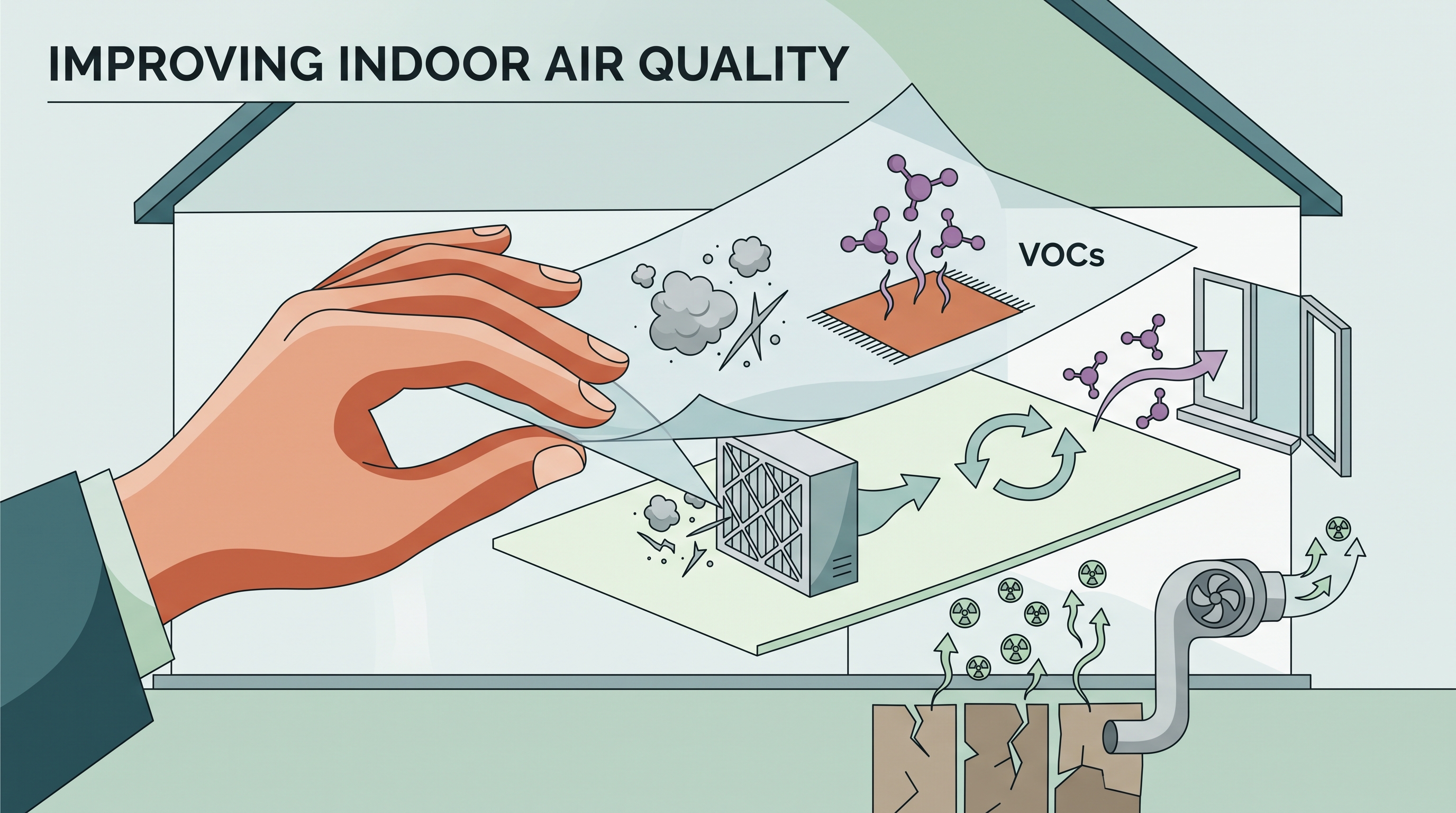
Indoor air pollution can build inside a home even when outdoor air appears clean. The key question is not merely what pollutant is present, but also where it comes from, how it affects people, and which intervention removes or reduces the exposure.
7.5 Indoor Air Pollutants · 7.6 Reduction of Air Pollutants
Indoor air pollution can build inside a home even when outdoor air appears clean. The key question is not merely what pollutant is present, but also where it comes from, how it affects people, and which intervention removes or reduces the exposure.
STB-2: Human activities have physical, chemical, and biological consequences for the atmosphere.
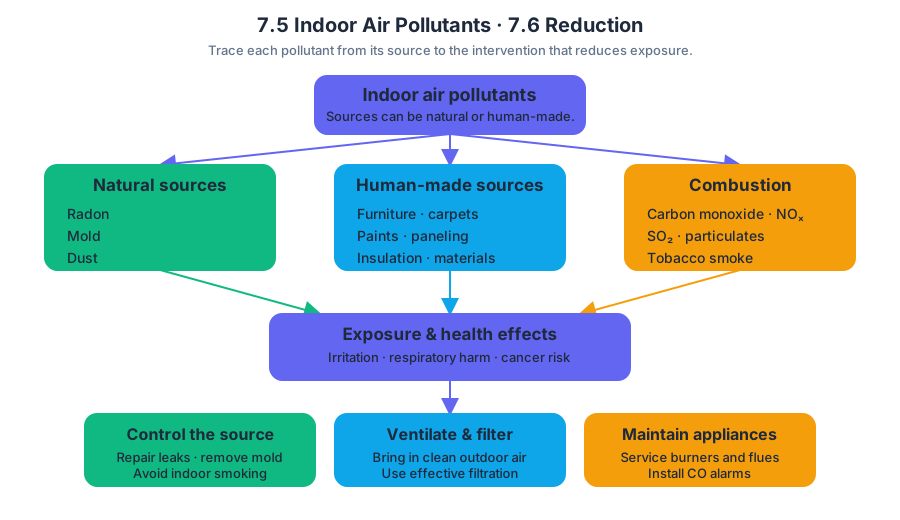
Under STB-2.E, the required learning objective is to identify indoor air pollutants. These pollutants come from three broad source categories:
- Natural sources: radon, mold, and dust
- Human-made sources: insulation, furniture, paneling, carpets, upholstery, building materials, and paints
- Combustion: carbon monoxide, nitrogen oxides, sulfur dioxide, particulates, and tobacco smoke
A source-to-health-effect map
The same building may contain pollutants from several categories at once. For example, a basement may receive naturally occurring radon from soil, while a poorly vented heater adds carbon monoxide and a new carpet releases volatile organic compounds.
| Pollutant or group | Typical indoor source | Classification or concern |
|---|---|---|
| Carbon monoxide | Incomplete combustion; tobacco smoke | Asphyxiant |
| Asbestos, dust, smoke | Insulation, damaged materials, combustion | Particulates |
| Volatile organic compounds (VOCs) | Furniture, paneling, carpets | Chemical indoor pollutants |
| Formaldehyde | Building materials, furniture, upholstery, carpeting | Chemical indoor pollutant |
| Radon | Uranium decay in rocks and soils | Radioactive natural pollutant |
| Lead | Paints | Toxic human-made pollutant |
Carbon monoxide: an asphyxiant
STB-2.E.1 identifies carbon monoxide as an indoor air pollutant classified as an asphyxiant. An asphyxiant is a substance that interferes with the body’s ability to obtain or use oxygen. Carbon monoxide is especially dangerous because it can accumulate indoors without producing a strong warning odor.
Worked example: A gasoline-powered generator operates inside a closed garage during a power outage. Combustion produces carbon monoxide, and the closed space prevents rapid dilution. The correct environmental-health chain is:
$$ \text{incomplete combustion} \rightarrow \text{CO accumulation} \rightarrow \text{interference with oxygen transport} \rightarrow \text{asphyxiation risk} $$
The solution is not simply to “wear a mask”; it is to eliminate the indoor source and provide safe ventilation by operating combustion equipment outdoors.
Misconception check: Carbon monoxide is not the same as carbon dioxide. Carbon monoxide is a toxic asphyxiant; carbon dioxide is a normal product of respiration and combustion that becomes hazardous at sufficiently high concentrations.
Particulates, VOCs, and formaldehyde
Under STB-2.E.2, indoor particulates are tiny solid or liquid particles suspended in air. Required examples include asbestos, dust, and smoke. Their small size allows them to remain airborne and enter the respiratory system; asbestos is particularly concerning because fibers can persist in lung tissue.
Volatile organic compounds (VOCs) are carbon-containing chemicals that readily evaporate into indoor air. Under STB-2.E.5, VOCs can originate from furniture, paneling, and carpets. Formaldehyde is another human-made indoor pollutant that can come from building materials, furniture, upholstery, and carpeting.
A useful distinction is that particulates are particles, whereas VOCs and formaldehyde are gases released from materials. Dust control and filtration address suspended particles; source substitution, ventilation, and low-emission materials address chemical vapors.
Radon: a natural pollutant with a serious consequence
STB-2.E.4 lists radon as a common natural-source indoor pollutant. STB-2.F.1 specifies that radon-222 is produced by the radioactive decay of uranium found in some rocks and soils. Radon can move upward through soil and enter homes through basements, cracks in walls or foundations, and groundwater entering through a well.
Under STB-2.F.2, exposure to radon gas can cause radon-induced lung cancer, identified in the required content as the second leading cause of lung cancer in America. The pathway is:
$$ \text{uranium in rock or soil} \rightarrow \text{radioactive decay} \rightarrow \text{radon gas} \rightarrow \text{indoor infiltration} \rightarrow \text{inhalation risk} $$
Radon reduction therefore depends on testing buildings, sealing entry pathways, improving ventilation beneath or within foundations, and using systems that vent radon safely outdoors.
Reducing indoor air pollution
Topic 7.6 Reduction of Air Pollutants applies a general prevention sequence:
- Control the source: remove tobacco smoke, repair combustion equipment, avoid indoor generator use, and select low-emission materials.
- Capture or filter pollutants: use appropriate particle filtration for dust and smoke.
- Increase safe ventilation: dilute and remove indoor contaminants without introducing polluted outdoor air.
- Monitor exposure: use carbon-monoxide alarms and radon testing.
- Maintain the intervention: replace filters, repair leaks, and retest after mitigation.
For STB-2.E.6 Data Analysis, interpret pollutant measurements by looking for patterns and trends rather than relying on a single reading. For example, if radon levels are consistently higher in a basement than on an upper floor, the pattern supports soil or foundation entry as a likely exposure pathway.
For 7.D, Use data and evidence to support a potential solution, connect the proposed action to measured evidence: “Because carbon monoxide rises whenever the heater operates, repairing or replacing the heater is a stronger solution than merely opening a window occasionally.”
Retrieval check
A house contains a dusty, deteriorating insulation material, a new carpet, and elevated basement radon. Identify one particulate, one VOC-related source, and one natural pollutant; then name one reduction method for each. The expected reasoning is: deteriorating insulation may release particulates, the carpet may release VOCs, radon comes from uranium decay in soil or rock, and the responses should match the pollutant—filtration or removal for particles, source control and ventilation for VOCs, and testing plus radon mitigation for radon.
Source Materials
- AP Environmental Science Course and Exam Description
- Review the Clarifications (.pdf)
- AP Environmental Science Course Overview
- AP Environmental Science Course at a Glance
- AP Environmental Science Course at a Glance Poster
- AP Environmental Science
- AP Environmental Science
- AP Environmental Science Sample Syllabus 1