From the free course AP Environmental Science on Lykke
9.1 Stratospheric Ozone Depletion · 9.2 Reducing Ozone Depletion
Key concepts: Stratospheric ozone depletion · Anthropogenic causes of ozone depletion · Chlorofluorocarbons (CFCs) · Natural factors contributing to ozone depletion · Melting ice crystals in the atmosphere · Antarctic spring ozone depletion · Ultraviolet (UV) radiation · Human health effects of increased UV exposure · Skin cancer · Cataracts
A thin layer of ozone high above Earth acts like a planetary sunscreen: when it becomes thinner, more ultraviolet radiation reaches the surface, increasing risks such as skin cancer and cataracts.
9.1 Stratospheric Ozone Depletion · 9.2 Reducing Ozone Depletion
A thin layer of ozone high above Earth acts like a planetary sunscreen: when it becomes thinner, more ultraviolet radiation reaches the surface, increasing risks such as skin cancer and cataracts. The central question is therefore not whether ozone is “good” or “bad,” but where it is located: ozone in the stratosphere protects life, while ozone near the ground is an air pollutant.
Enduring Understanding STB-4: Local and regional human activities can have impacts at the global level.
The protective role of stratospheric ozone
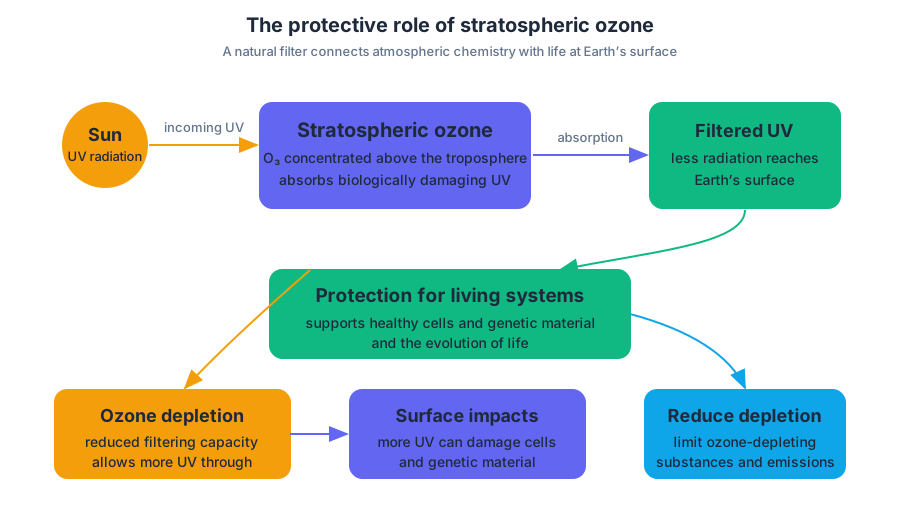
Stratospheric ozone is ozone, $O_3$, concentrated in the stratosphere, a layer of the atmosphere above the troposphere. It absorbs much of the Sun’s biologically damaging ultraviolet, or UV, radiation before that radiation reaches Earth’s surface.
The ozone layer is therefore important to both the evolution of life on Earth and the continued health and survival of organisms. Reduced ozone means reduced filtering: the surface receives more UV radiation, which can damage cells and genetic material.
How ozone depletion occurs
Ozone depletion is a reduction in the amount or concentration of stratospheric ozone. The CED identifies both human-caused and natural contributors.
Anthropogenic causes: CFCs
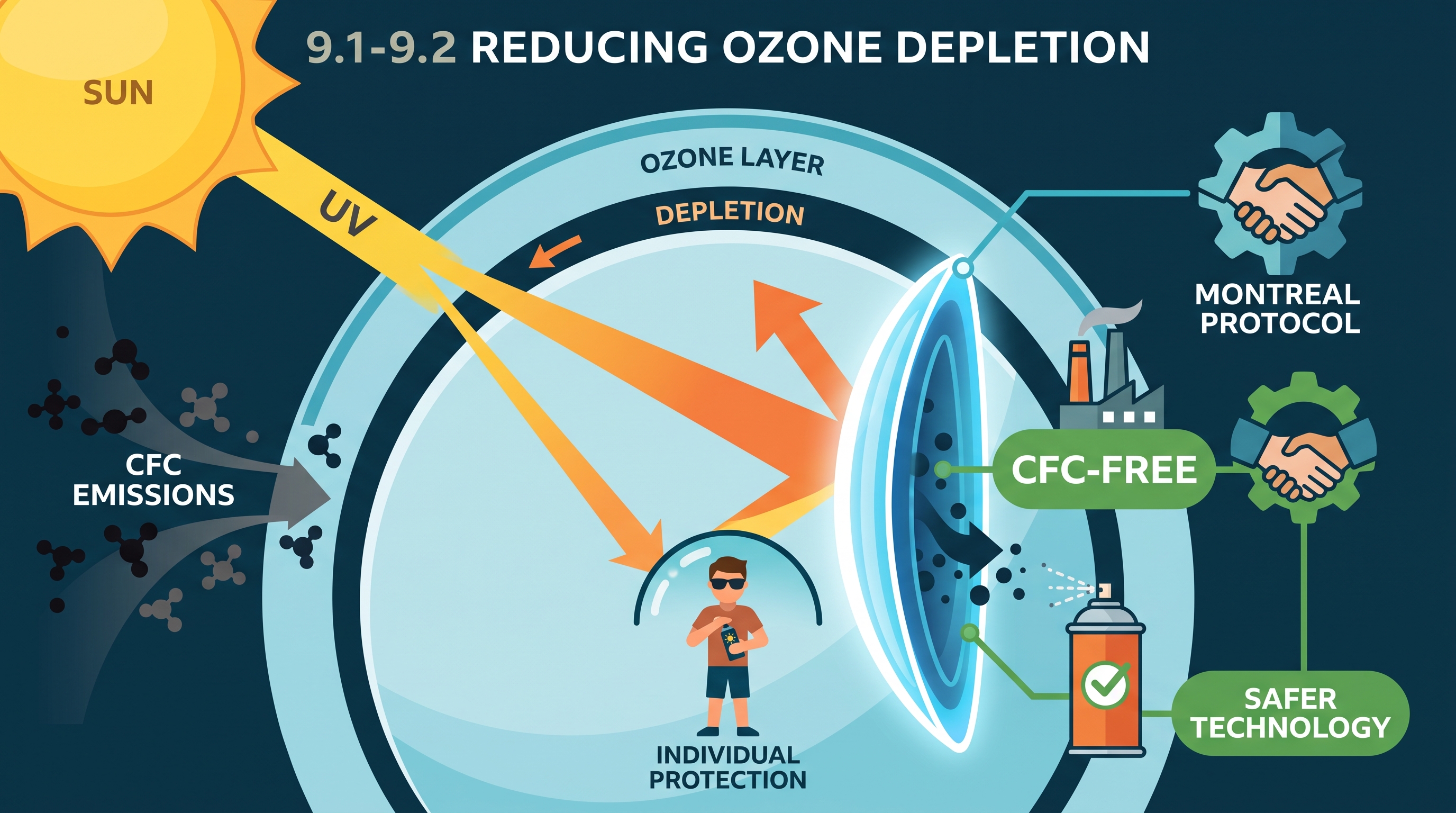
Chlorofluorocarbons, or CFCs, are human-made chemicals historically used in products such as refrigeration systems and aerosol propellants. After CFC molecules rise into the stratosphere, ultraviolet radiation can break them apart and release chlorine. Chlorine can participate in chemical reactions that destroy ozone molecules, allowing more UV radiation to pass through.
A useful cause-and-effect chain is:
$$ \text{CFC release} \rightarrow \text{stratospheric transport} \rightarrow \text{UV breakdown} \rightarrow \text{ozone destruction} \rightarrow \text{increased surface UV} $$
Misconception check — “CFCs immediately destroy ozone at ground level.” CFCs are relatively stable near Earth’s surface; their major ozone-depleting effect occurs after they reach the stratosphere and are altered by ultraviolet radiation. Also, ozone depletion is distinct from the greenhouse effect: both involve atmospheric chemistry, but they describe different mechanisms and environmental consequences.
Natural factors: Antarctic spring
Natural processes can also contribute to ozone depletion. At the beginning of the Antarctic spring, ice crystals in the atmosphere melt. These crystals and the chemical conditions surrounding them can support reactions that remove stratospheric ozone.
The Antarctic pattern is especially important because the seasonal return of sunlight interacts with cold atmospheric conditions and accumulated reactive chemicals. The result can be a pronounced springtime reduction in ozone over Antarctica.
From atmospheric change to human health
The environmental consequence is a direct radiation pathway:
$$ \downarrow \text{stratospheric ozone} \rightarrow \uparrow \text{UV radiation at Earth’s surface} $$
Greater UV exposure can increase the risk of skin cancer in humans. It can also contribute to cataracts, a clouding of the eye’s lens that interferes with vision.
| Atmospheric change | Surface consequence | Human-health concern |
|---|---|---|
| Less stratospheric ozone | More UV radiation reaches Earth | Skin cancer and cataracts |
9.2 Reducing ozone depletion
Reducing ozone depletion requires preventing ozone-depleting substances from entering the atmosphere and replacing them with safer alternatives. Because CFCs can circulate through the atmosphere and affect ozone far from their original release, effective action must extend beyond one city or country.
A major policy example is the Montreal Protocol, an international agreement designed to reduce and phase out substances that damage stratospheric ozone. Its importance illustrates the STB-4 idea: a local industrial activity can create a global atmospheric problem, while coordinated international regulation can address it.
Evidence-based solution reasoning
When evaluating a proposed action, connect the policy to the mechanism:
- Reduce production or release of CFCs.
- Limit the amount of chlorine-containing material reaching the stratosphere.
- Reduce chemical destruction of ozone.
- Increase protection from UV radiation.
- Lower risks of skin cancer and cataracts.
This reasoning supports Science Practice 1.A, “Describe environmental concepts and processes,” and the topic skill pairing STB-4.A, especially STB-4.A.3: a decrease in stratospheric ozone increases the UV rays reaching Earth’s surface, and exposure can lead to skin cancer and cataracts. A strong environmental-solutions response should name the action, explain its mechanism, and identify the resulting benefit rather than merely calling a policy “helpful.”
Worked example
A country proposes replacing CFC-based refrigeration equipment with systems that do not release ozone-depleting chemicals.
Reasoning: The replacement reduces anthropogenic emissions at the source. With fewer CFCs transported into the stratosphere, less chlorine is released by UV radiation, so less ozone is destroyed. A thicker or recovering ozone layer absorbs more UV radiation, reducing the exposure pathway associated with skin cancer and cataracts.
Retrieval check
A student says, “Because ozone depletion increases UV radiation, the best solution is to tell people to wear sunglasses.” What is incomplete about this answer? It addresses individual protection, but it does not reduce the cause. A stronger solution targets CFC emissions through safer technology and international controls such as the Montreal Protocol.
Source Materials
- AP Environmental Science Course and Exam Description
- Review the Clarifications (.pdf)
- AP Environmental Science Course Overview
- AP Environmental Science Course at a Glance
- AP Environmental Science Course at a Glance Poster
- AP Environmental Science
- AP Environmental Science
- AP Environmental Science Sample Syllabus 1
- AP/College Environmental Science-Khan Academy
- AP Environmental Science Exam-College Board
- AP Environmental Science Units-Save my Exams
- AP Environmental Science-Bozeman Science