From the free course AP Environmental Science on Lykke
8.1 Sources of Pollution · 8.2 Human Impacts on Ecosystems
Key concepts: Sources of pollution · Primary and secondary air pollutants · Physical, chemical, and biological consequences of human activities · Point sources of pollution · Human impacts on aquatic ecosystems · Economic impacts of oil pollution · Mercury contamination and methylmercury · Anthropogenic eutrophication · Environmental evidence and data analysis · Environmental problem-solving
A pollutant is a substance or form of energy introduced into the environment at a rate that can harm organisms, ecosystems, or human systems. Its effects depend not only on toxicity, but also on where it enters, how it moves, and how organisms respond.
8.1 Sources of Pollution · 8.2 Human Impacts on Ecosystems
A pollutant is a substance or form of energy introduced into the environment at a rate that can harm organisms, ecosystems, or human systems. Its effects depend not only on toxicity, but also on where it enters, how it moves, and how organisms respond.
Sources and types of pollution
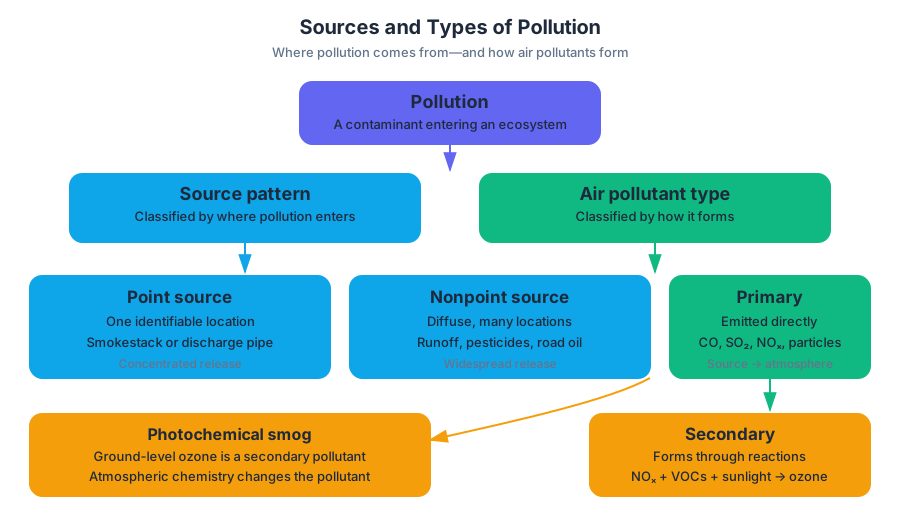
A point source releases pollution from a single, identifiable location, such as a smokestack or a waste-discharge pipe. A nonpoint source is diffuse: pesticide sprayed across many fields or urban runoff carrying oil, metals, and nutrients from roads may enter an ecosystem from many locations at once.
Air pollutants are classified by how they enter the atmosphere. A primary pollutant is emitted directly from a source; examples include carbon monoxide from incomplete combustion, sulfur dioxide from burning sulfur-containing fuels, nitrogen oxides from engines, and particulate matter from combustion or disturbed surfaces. A secondary pollutant forms in the atmosphere when primary pollutants react with one another or with sunlight. Ground-level ozone, a major component of photochemical smog, is produced through reactions involving nitrogen oxides and volatile organic compounds.
| Classification | Formation | Example |
|---|---|---|
| Primary pollutant | Released directly | Sulfur dioxide from a coal-burning facility |
| Secondary pollutant | Formed by atmospheric reactions | Ground-level ozone produced from nitrogen oxides and volatile organic compounds |
Misconception check — “secondary” means less harmful. It does not. A pollutant’s classification describes its formation, not its danger. A directly emitted pollutant can be harmful, and a secondary pollutant such as ground-level ozone can damage respiratory tissue and vegetation.
Physical, chemical, and biological consequences
Human activities, including resource use, have physical, chemical, and biological consequences for ecosystems (STB-3.A.2). Physical consequences alter habitat structure or environmental conditions: roads fragment habitat, mining removes soil, and dams change water flow. Chemical consequences change the composition of air, water, or soil: combustion adds pollutants to the atmosphere, while fertilizer runoff adds nitrogen and phosphorus to water. Biological consequences alter organisms and communities: pollution can reduce reproduction, shift species abundance, or cause death.
Organisms have a range of tolerance for pollutants. Within an optimum range, an organism can maintain homeostasis; outside that range, it may experience physiological stress, limited growth, reduced reproduction, or death (STB-3.B.1). Thus, a pollutant does not need to kill every organism immediately to damage an ecosystem: reducing reproduction or removing a sensitive species can change the entire community.
Aquatic pollution and cascading effects
Consider fertilizer carried by stormwater into a lake. The pollutant is nitrate, a nitrogen compound that acts as a nutrient. Excess nitrate stimulates algal growth; when algae die, decomposer bacteria break down the organic matter and consume dissolved oxygen. Oxygen depletion can then cause fish and other aerobic organisms to die.
This sequence is an anthropogenic form of eutrophication:
$$ \text{fertilizer runoff} \rightarrow \text{increased nitrate} \rightarrow \text{algal growth} \rightarrow \text{decomposition} \rightarrow \text{oxygen depletion} \rightarrow \text{fish death} $$
Misconception check — “the algae are the pollutant.” In this example, nitrate is the pollutant, algal growth is the biological response, and oxygen depletion and fish death are ecological consequences. Do not apply the primary/secondary air-pollutant classification to algae in a lake.
Another aquatic pathway involves mercury. Bacteria can convert elemental mercury into methylmercury, a highly toxic form that can enter aquatic food webs. Because methylmercury can accumulate in organisms and become increasingly concentrated at higher trophic levels, predators and people who consume contaminated fish may face greater exposure.
Economic consequences of pollution
Oil pollution illustrates how ecological damage becomes an economic problem. Oil washing onto a beach can harm organisms directly, contaminate habitat, and reduce the quality of the shoreline for recreation. Fishing industries may lose income when fish populations decline or catches become unsafe, while tourism industries may lose visitors because beaches are visually polluted or closed.
A useful environmental analysis connects the chain rather than naming only the first effect:
$$ \text{oil spill} \rightarrow \text{organism and habitat damage} \rightarrow \text{reduced fishing} \rightarrow \text{lost tourism revenue} $$
Evidence, graphs, and calculations
AP analysis often asks you to use evidence to support a solution. If a graph shows lower particulate concentrations after installation of emissions controls, a strong conclusion identifies the trend and connects it to the intervention: particulate concentration decreased after the control technology was installed, supporting the technology as a pollution-reduction strategy. Avoid claiming that the intervention caused the change unless the design or comparison supports causation.
For a numerical comparison, calculate percent change with:
$$ \text{percent change}=\frac{\text{final value}-\text{initial value}}{\text{initial value}}\times 100 $$
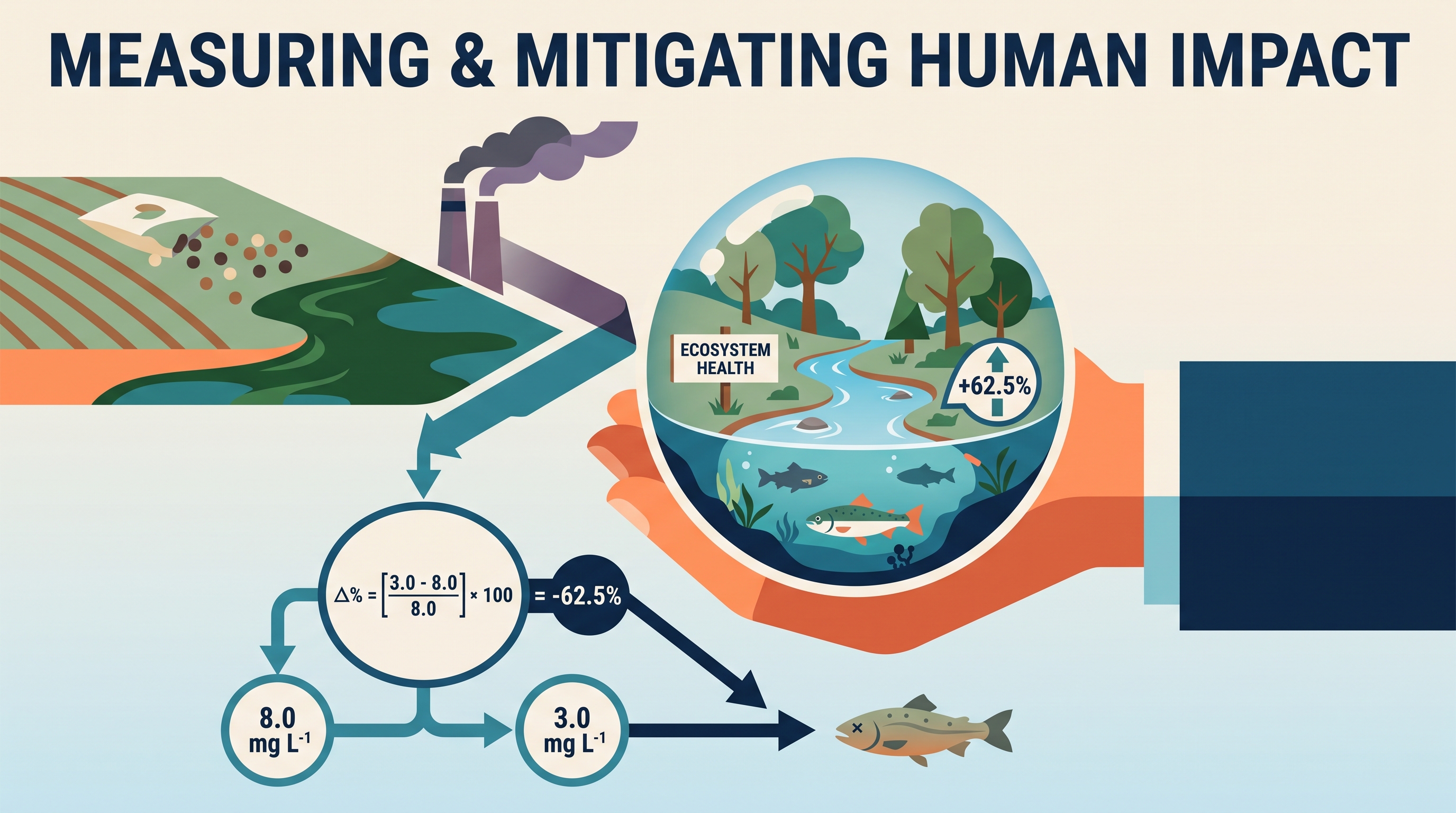
For example, if dissolved oxygen falls from $8.0\ \text{mg L}^{-1}$ to $3.0\ \text{mg L}^{-1}$:
$$ \frac{3.0-8.0}{8.0}\times100=-62.5% $$
The negative sign shows a decrease of $62.5%$.
These tasks develop STB-3.A Concept Explanation, STB-2.A.5 Scientific Experiments, and STB-3.B.4 Mathematical Routines: explain environmental mechanisms, evaluate evidence and experimental changes, compare trends, and show mathematical work using appropriate units.
Retrieval check: A stream receives fertilizer runoff. Identify the pollutant, the biological response, and two ecological consequences. Then classify this air-pollution example: sulfur dioxide released directly from a smokestack is primary or secondary? Answer: nitrate is the pollutant; algal growth is the biological response; oxygen depletion and fish death are ecological consequences; directly emitted sulfur dioxide is a primary pollutant.





Source Materials
- AP Environmental Science Course and Exam Description
- Review the Clarifications (.pdf)
- AP Environmental Science Course Overview
- AP Environmental Science Course at a Glance
- AP Environmental Science Course at a Glance Poster
- AP Environmental Science
- AP Environmental Science
- AP Environmental Science Sample Syllabus 1
- 1 point
- 1 point
- 1 point
- 1 point