From the free course AP Environmental Science on Lykke
8.7 Persistent Organic Pollutants (POPs) · 8.8 Bioaccumulation and Biomagnification
Key concepts: Persistent organic pollutants (POPs) · Synthetic carbon-based molecules · Environmental persistence · Fat solubility · Toxicity to organisms · Bioaccumulation · Selective absorption into organisms’ fatty tissues · Biomagnification · Trophic levels · DDT and PCBs as examples of POPs
Persistent organic pollutants (POPs) are synthetic, carbon-based molecules that resist environmental breakdown and can become increasingly concentrated in organisms and food webs. Two important examples are DDT and PCBs.
8.7 Persistent Organic Pollutants (POPs) · 8.8 Bioaccumulation and Biomagnification
Persistent organic pollutants (POPs) are synthetic, carbon-based molecules that resist environmental breakdown and can become increasingly concentrated in organisms and food webs. Two important examples are DDT and PCBs.
Investigative question: How can a small concentration of a pollutant in water eventually harm organisms at the top of a food web?
Why POPs persist
The word persistent means that a substance does not easily decompose or chemically break down in the environment. Because POPs are synthetic carbon-based molecules, natural processes such as microbial decomposition do not remove them quickly. A pollutant released in one location may therefore remain available for transport and biological uptake long after its original use.
STB-3.H.1: Persistent organic pollutants (POPs) do not easily break down in the environment because they are synthetic, carbon-based molecules, such as DDT and PCBs.
POPs may travel long distances through wind and water before being redeposited. This means that contamination can appear far from the place where a chemical was manufactured, applied, or released. Persistence and transport together give POPs a broad geographic reach.
A useful mental model is a slow-moving environmental conveyor belt:
$$ \text{release} \rightarrow \text{transport by wind or water} \rightarrow \text{redeposition} \rightarrow \text{uptake by organisms} $$
Why fat solubility causes toxicity
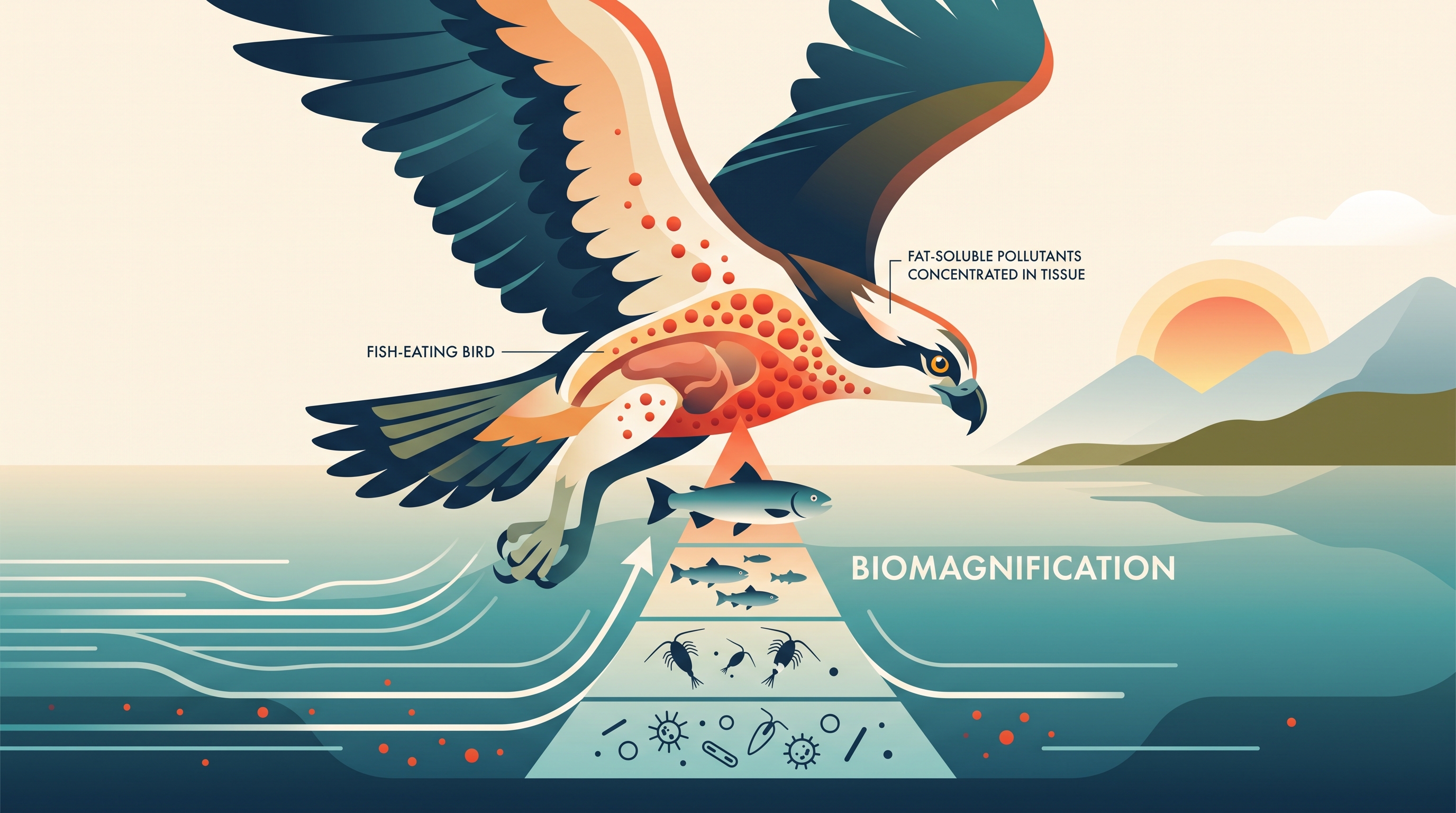
Many POPs are fat-soluble, meaning they dissolve more readily in lipids than in water. Once an organism absorbs a fat-soluble POP, the pollutant can be stored in fatty tissues instead of being rapidly excreted in urine or other water-based wastes.
STB-3.H.2: Persistent organic pollutants (POPs) can be toxic to organisms because they are soluble in fat, which allows them to accumulate in organisms’ fatty tissues.
Toxicity depends on exposure and biological effects, not simply on whether a chemical is present. A POP stored in tissue may interfere with reproduction, development, or normal body functions. At the ecosystem level, those effects can reduce reproductive success, alter predator–prey relationships, and change population sizes.
Key distinction: Persistence describes how long a pollutant remains in the environment; fat solubility helps explain why it remains in organisms.
Bioaccumulation versus biomagnification
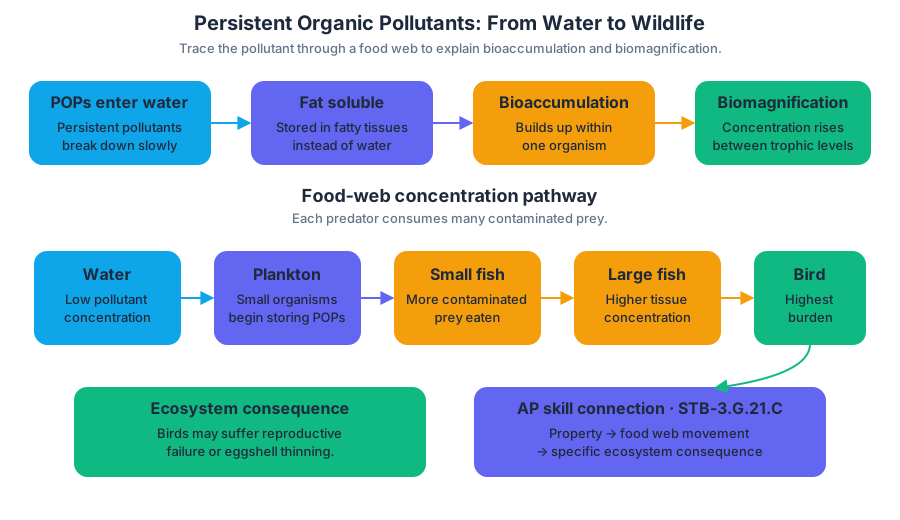
Bioaccumulation is the selective absorption and buildup of a pollutant within one organism’s tissues over time. It occurs when uptake from food, water, or sediment is faster than the organism can eliminate the pollutant.
Biomagnification is the increase in pollutant concentration at progressively higher trophic levels. A predator may consume many contaminated prey organisms, acquiring the pollutant stored in each one. Consequently, organisms at higher trophic levels can contain greater concentrations than organisms lower in the same food web.
The two processes operate together:
$$ \text{water or sediment} \rightarrow \text{plankton} \rightarrow \text{small fish} \rightarrow \text{large fish} \rightarrow \text{fish-eating bird} $$
$$ \text{bioaccumulation within individuals} + \text{consumption across trophic levels} \rightarrow \text{biomagnification} $$
Worked example: a contaminated wetland food web
Imagine that a wetland receives a small input of a PCB. The PCB does not easily break down, so it remains in sediment and water. Plankton absorb some of it, and a small fish accumulates more by eating many plankton over its lifetime.
A larger fish then eats numerous small fish. Finally, a wading bird eats several larger fish. The bird may receive the greatest total pollutant exposure because it consumes many contaminated organisms and stores the fat-soluble PCB in its own fatty tissues.
The reasoning chain is:
| Level | Environmental process | Expected consequence |
|---|---|---|
| Sediment and water | Persistent PCB remains available | Long-term contamination |
| Plankton | Absorption from the environment | Pollutant enters the food web |
| Small fish | Uptake from food exceeds elimination | Bioaccumulation |
| Large fish | Consumes many contaminated prey | Higher tissue concentration |
| Wading bird | Feeds at a high trophic level | Biomagnification and possible toxicity |
An AP-style explanation should connect mechanism to consequence: Because the PCB is persistent and fat-soluble, it remains in the ecosystem and accumulates in fatty tissues. Predators consume many contaminated prey, so PCB concentration increases at higher trophic levels, potentially reducing reproductive success or causing other biological effects in top predators.
Misconception check
Misconception: “Biomagnification means an organism simply gets larger.” Biomagnification refers to pollutant concentration increasing across trophic levels, not to body size. Bioaccumulation occurs within an individual organism; biomagnification compares concentrations among organisms at different trophic levels.
Misconception: “A low concentration in water is harmless.” A low environmental concentration can still matter when a persistent, fat-soluble pollutant is repeatedly absorbed and passed through a food web. Concentration, exposure duration, tissue storage, and trophic position all affect biological consequences.
AP skill connection
This topic is assessed through STB-3.G.21.C: Explain environmental biological consequences for ecosystems. To apply this skill, do more than name bioaccumulation: identify the pollutant’s property, trace its movement through the food web, and state a specific ecosystem consequence.
Retrieval check: A pollutant is found at a low concentration in water but at a much higher concentration in fish-eating birds. Which process explains the increase among trophic levels, and which pollutant property makes storage in the birds’ tissues possible?
Answer: Biomagnification explains the increase across trophic levels; fat solubility allows storage in fatty tissues.
Source Materials
- AP Environmental Science Course and Exam Description
- Review the Clarifications (.pdf)
- AP Environmental Science Course Overview
- AP Environmental Science Course at a Glance
- AP Environmental Science Course at a Glance Poster
- AP Environmental Science
- AP Environmental Science
- AP Environmental Science Sample Syllabus 1
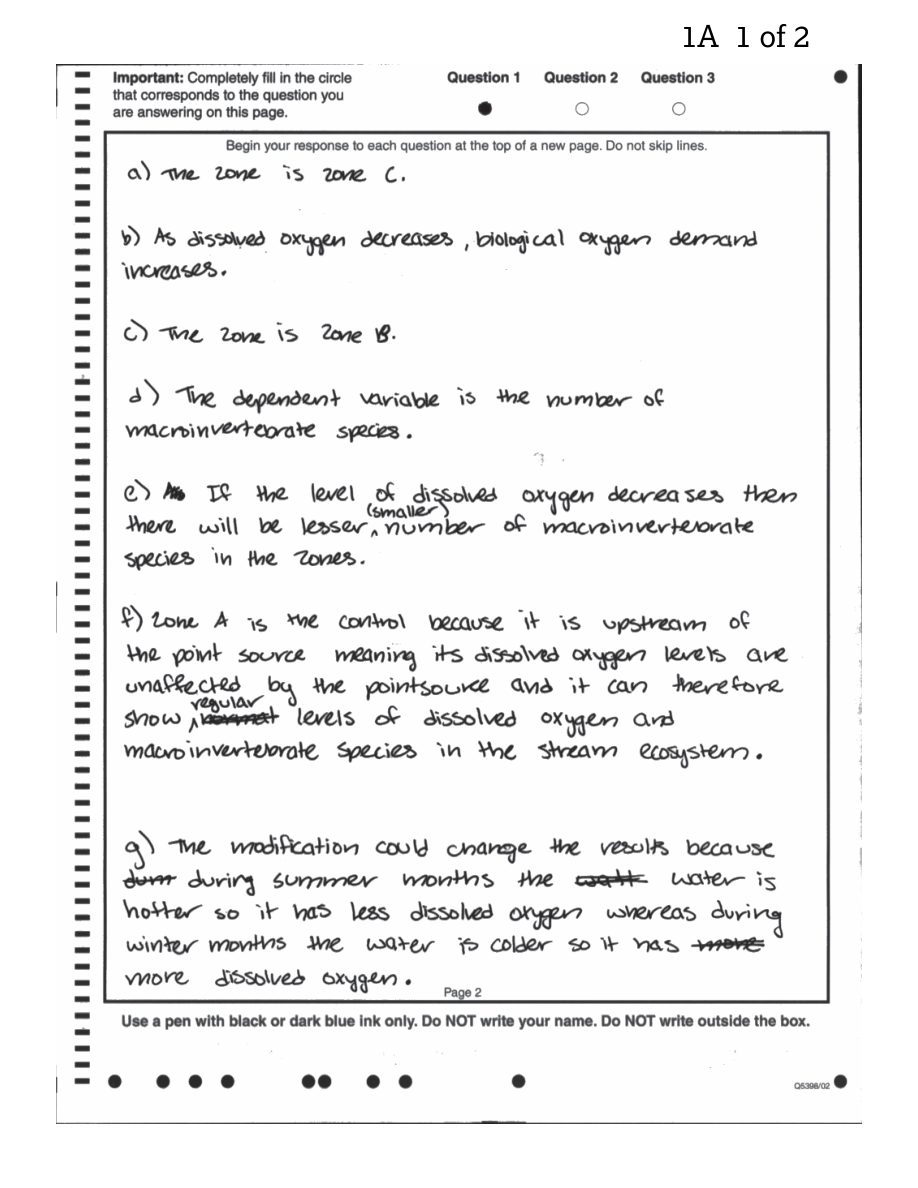
- Figure — Sample Responses Question 1 - Set 1 (p. 5)
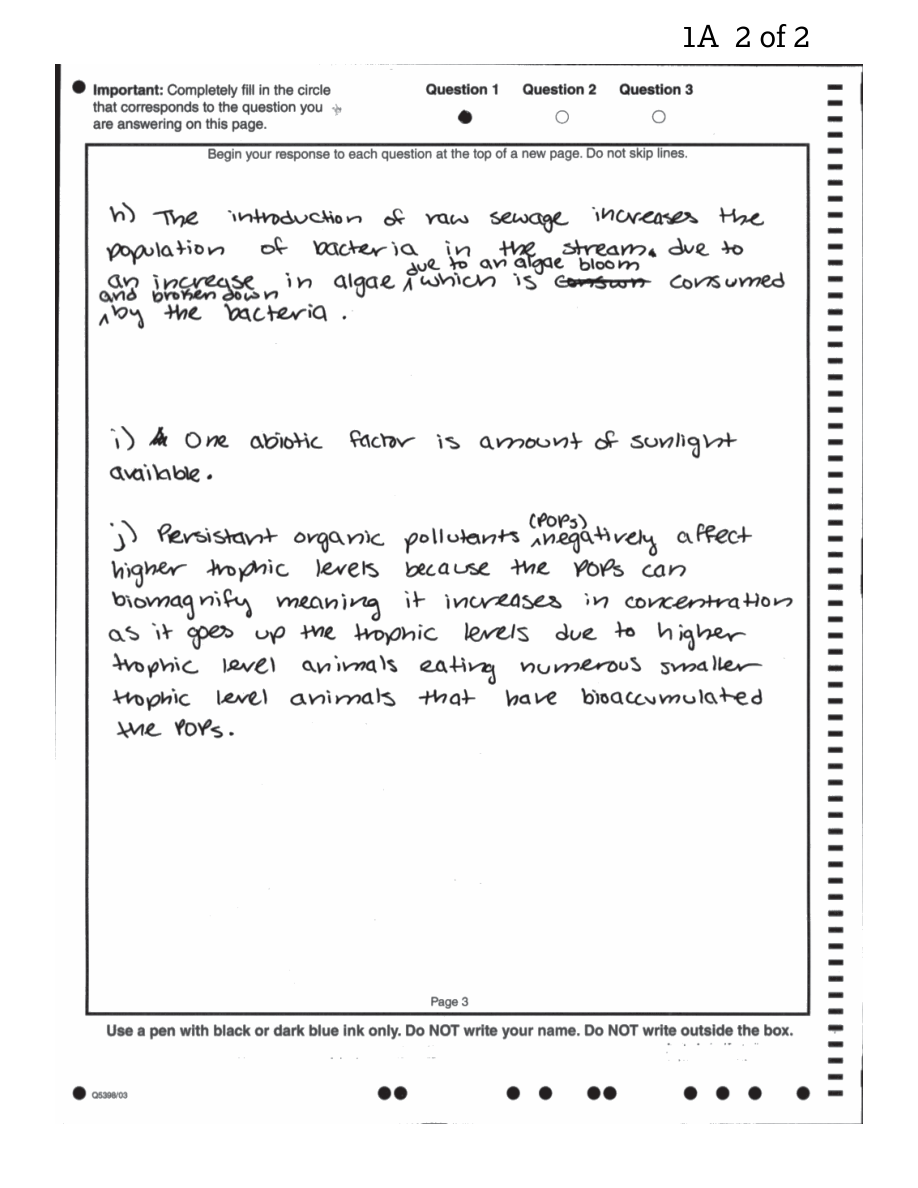
- Figure — Sample Responses Question 1 - Set 1 (p. 6)
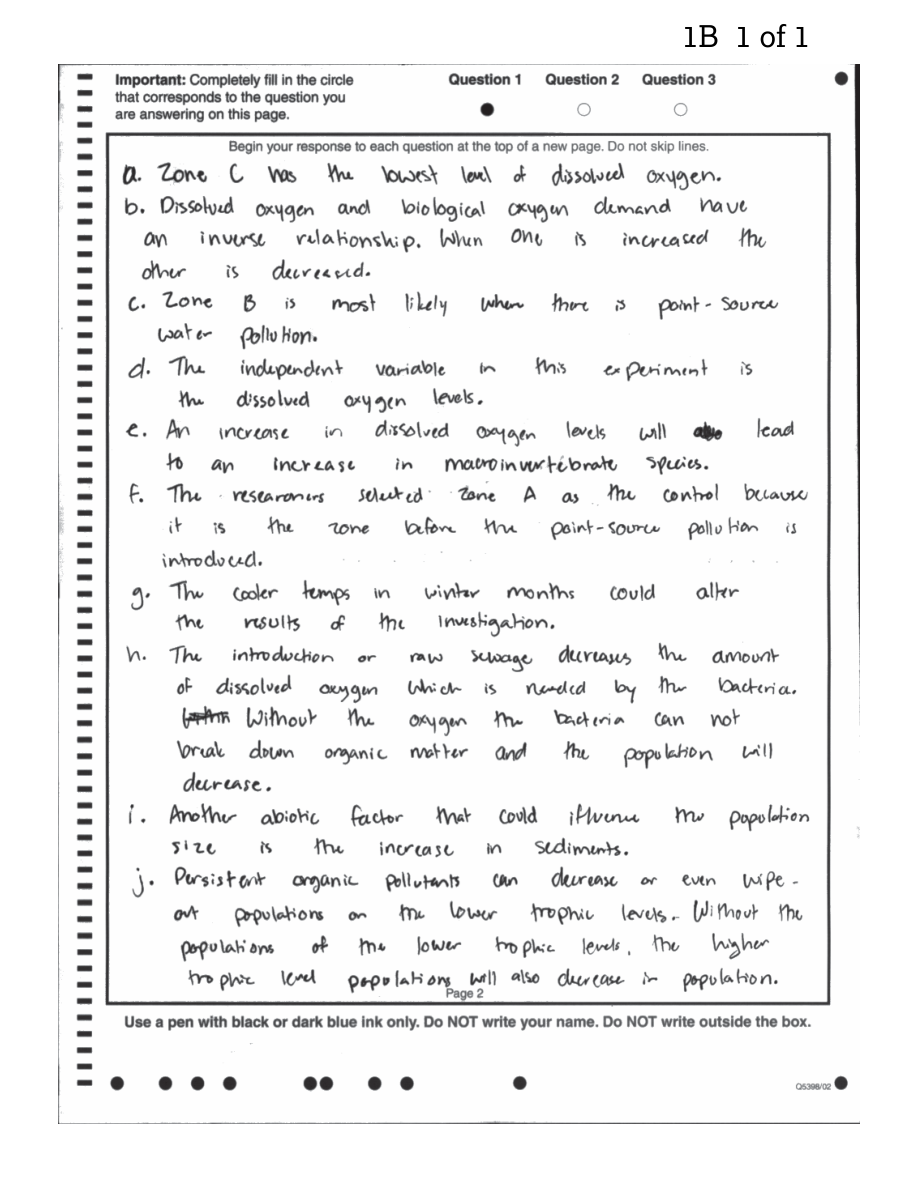
- Figure — Sample Responses Question 1 - Set 1 (p. 7)
- Figure — Sample Responses Question 1 - Set 1 (p. 8)