From the free course AP Environmental Science on Lykke
1.3 Aquatic Biomes · 1.4 The Carbon Cycle
Key concepts: Freshwater biomes · Marine biomes · Algae and aquatic primary productivity · Carbon reservoirs · Carbon cycle · Photosynthesis · Cellular respiration · Fossil fuel combustion · Carbon dioxide in the atmosphere · Aquatic photosynthesis in low-light environments
Water is not one ecosystem: a fast, oxygen-rich stream, a nutrient-loaded estuary, and a dark deep-ocean zone impose very different conditions on life. At the same time, these aquatic systems participate in the global carbon cycle, the movement of carbon among living organisms, the atmosphere, oceans, soils, and…
1.3 Aquatic Biomes · 1.4 The Carbon Cycle
Water is not one ecosystem: a fast, oxygen-rich stream, a nutrient-loaded estuary, and a dark deep-ocean zone impose very different conditions on life. At the same time, these aquatic systems participate in the global carbon cycle, the movement of carbon among living organisms, the atmosphere, oceans, soils, and geological stores.
1.3 Aquatic Biomes
The enduring understanding for this topic is ERT-1: Ecosystems are the result of biotic and abiotic interactions. The learning objective ERT-1.C: Describe the global distribution and principal environmental aspects of aquatic biomes requires more than naming ecosystems: it requires connecting their organisms and resources to abiotic conditions.
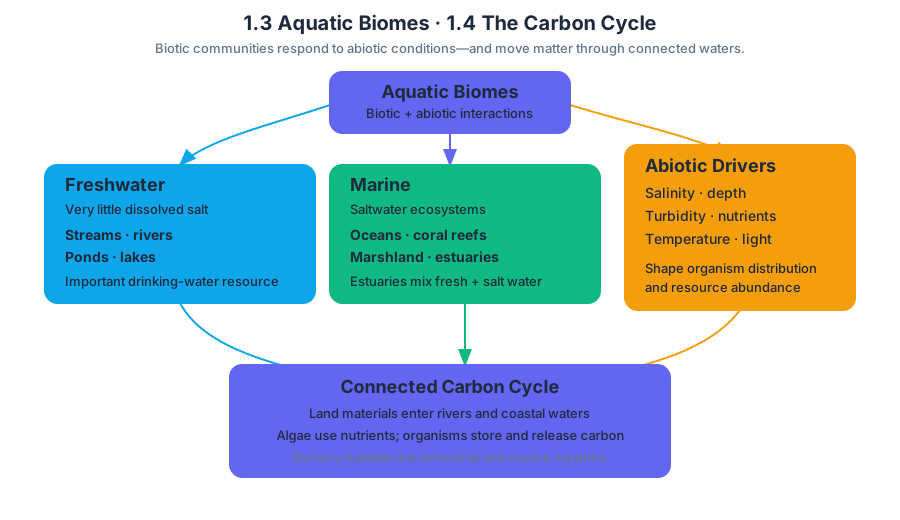
Freshwater biomes contain very little dissolved salt compared with marine systems. They include streams, rivers, ponds, and lakes, and they are a vital resource for drinking water.
Marine biomes include oceans, coral reefs, marshland, and estuaries. An estuary is a place where freshwater and seawater mix, producing changing salinity and often highly productive habitat. Marshland and estuarine environments also provide nursery habitat for many organisms and connect land-based materials to coastal waters.
The distribution of marine organisms and resources, including different types of fish, depends on a combination of salinity, depth, turbidity, nutrient availability, and temperature. These factors interact: nutrient-rich water may support abundant algae, but high turbidity can reduce the light available for photosynthesis.
Marine algae are especially important because they supply a large portion of Earth’s oxygen and take in carbon dioxide from the atmosphere. Aquatic photosynthesizers may live where visible light is limited, so they have adaptations that allow them to perform photosynthesis, the process of using light energy to convert carbon dioxide and water into stored chemical energy.
$$6CO_2 + 6H_2O \xrightarrow{\text{light energy}} C_6H_{12}O_6 + 6O_2$$
Misconception check — “Only forests produce important oxygen.” Forests are major terrestrial producers, but marine algae and other aquatic photosynthesizers supply a large portion of Earth’s oxygen. “Aquatic” does not mean ecologically minor.
Worked aquatic-biome example
A coastal estuary receives nutrient-rich freshwater after rainfall. The nutrients stimulate algal growth, but muddy runoff increases turbidity. The correct prediction is not simply “more nutrients means more productivity.” Initially, nutrients may increase algal production; if turbidity blocks light, however, photosynthesis can become light-limited. The outcome depends on the interaction between nutrient availability and turbidity.
This is an application of Science Practice 1: Concept Explanation, especially 1.B: Explain environmental concepts and processes. A strong explanation names the abiotic factor, identifies its effect on a biological process, and links that process to an ecosystem outcome.
1.4 The Carbon Cycle
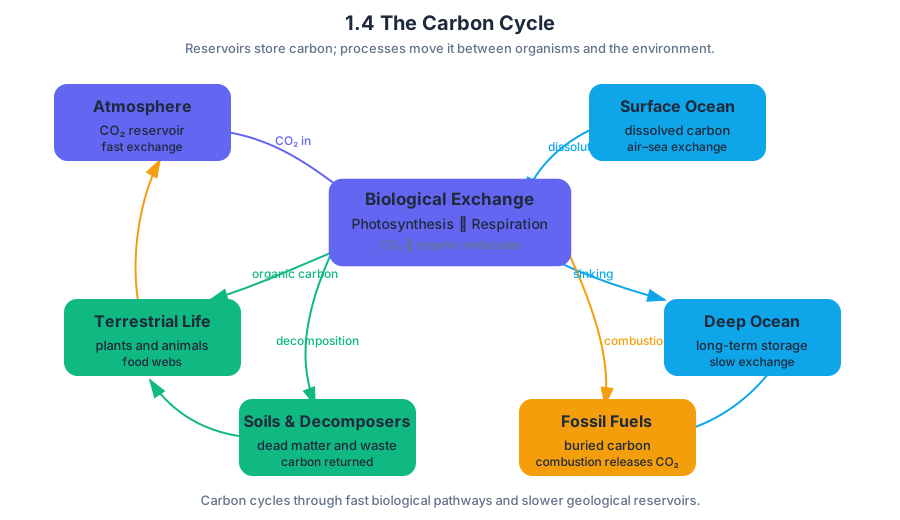
The learning objective for ERT-1.D: Explain how carbon cycles between organisms and the environment is built on the movement of carbon through reservoirs. A carbon reservoir is a place where carbon is stored for a period of time; reservoirs can exchange carbon at very different rates.
Important reservoirs include the atmosphere, surface ocean, deep ocean, marine organisms, fossil fuels, and terrestrial animals. Carbon also moves through plants, soils, decomposers, and other living organisms as ecosystems exchange matter with the surrounding environment.
The central biological exchange is between photosynthesis and cellular respiration:
- Photosynthesis removes $CO_2$ from the atmosphere or water and stores carbon in organic molecules.
- Cellular respiration breaks down organic molecules and returns carbon to the atmosphere or water as $CO_2$.
- Decomposition transfers carbon from dead organisms and waste into soils, sediments, water, and the atmosphere.
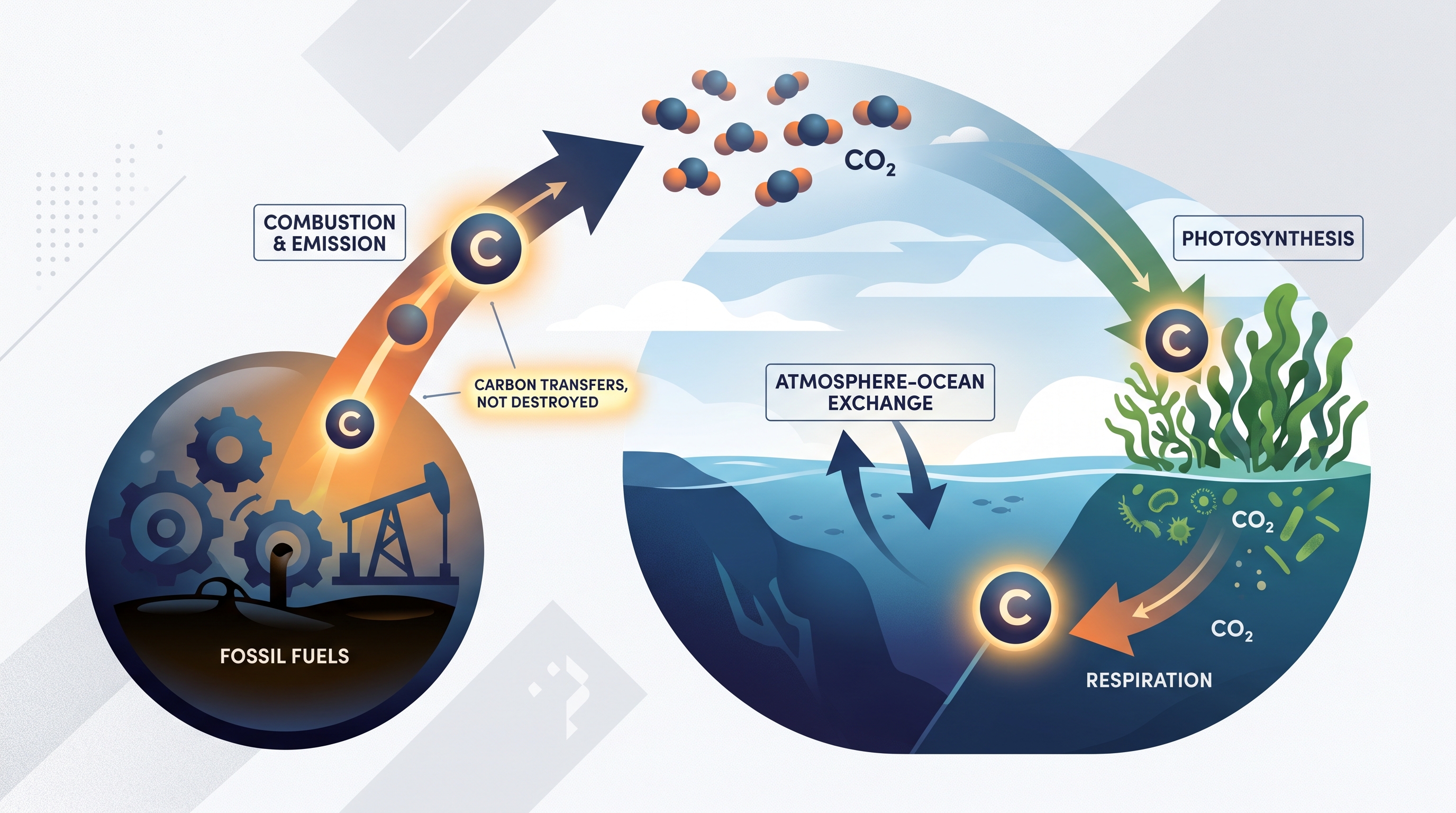
- Combustion releases stored carbon, especially from fossil fuels, as atmospheric $CO_2$.
Landfills can also increase atmospheric carbon dioxide. Organic waste decomposes, producing gases; when landfill gas is released or burned, carbon can ultimately enter the atmosphere as $CO_2$. The key reasoning move is to follow the carbon atom rather than memorize a single pathway.
Worked carbon-reservoir example
A power plant burns fossil fuel. Begin at the fossil-fuel reservoir and draw an arrow to the atmosphere:
$$\text{fossil fuels} \xrightarrow{\text{combustion}} \text{atmospheric } CO_2$$
The atmosphere can then exchange carbon with the surface ocean, while algae can remove dissolved carbon dioxide through photosynthesis and store it in marine biomass. If those organisms respire or decompose, some of that carbon returns to the water or atmosphere.
Misconception check — “Carbon is destroyed when fuel burns.” Combustion changes carbon-containing molecules into new substances; it does not destroy the carbon. The carbon moves from a long-term fossil-fuel reservoir into atmospheric carbon dioxide.
For an exam explanation, use Science Practice 2: Visual Representations when drawing or interpreting reservoir arrows, and Science Practice 5: Data Analysis when identifying a carbon-storage trend in a graph. A complete response states both the direction of movement and the process causing it.
Retrieval check: If marine algae remove carbon dioxide through photosynthesis and later undergo cellular respiration, which reservoir receives carbon next, and why? The expected reasoning is that respiration transfers carbon from marine organisms back to the surrounding water or atmosphere as $CO_2$.
Source Materials
- AP Environmental Science Course and Exam Description
- Review the Clarifications (.pdf)
- AP Environmental Science Course Overview
- AP Environmental Science Course at a Glance
- AP Environmental Science Course at a Glance Poster
- AP Environmental Science
- AP Environmental Science
- AP Environmental Science Sample Syllabus 1
- Students move to different nitrogen reservoirs by taking part in a simulation that relies on coin tosses and take note of what reservoirs they move to and the reasons that they move to them.
- (g) Explain why there are fewer bobcats present on the farmland now compared to several decades ago.