From the free course AP Environmental Science on Lykke
5.11 Ecological Footprints · 5.12 Introduction to Sustainability
Key concepts: Ecological footprints · Human use of natural resources · Natural-system alteration · Resource demands and waste production · Individual and societal environmental impacts · Land and water use · Climate impacts · Introduction to sustainability · Impacts of urbanization
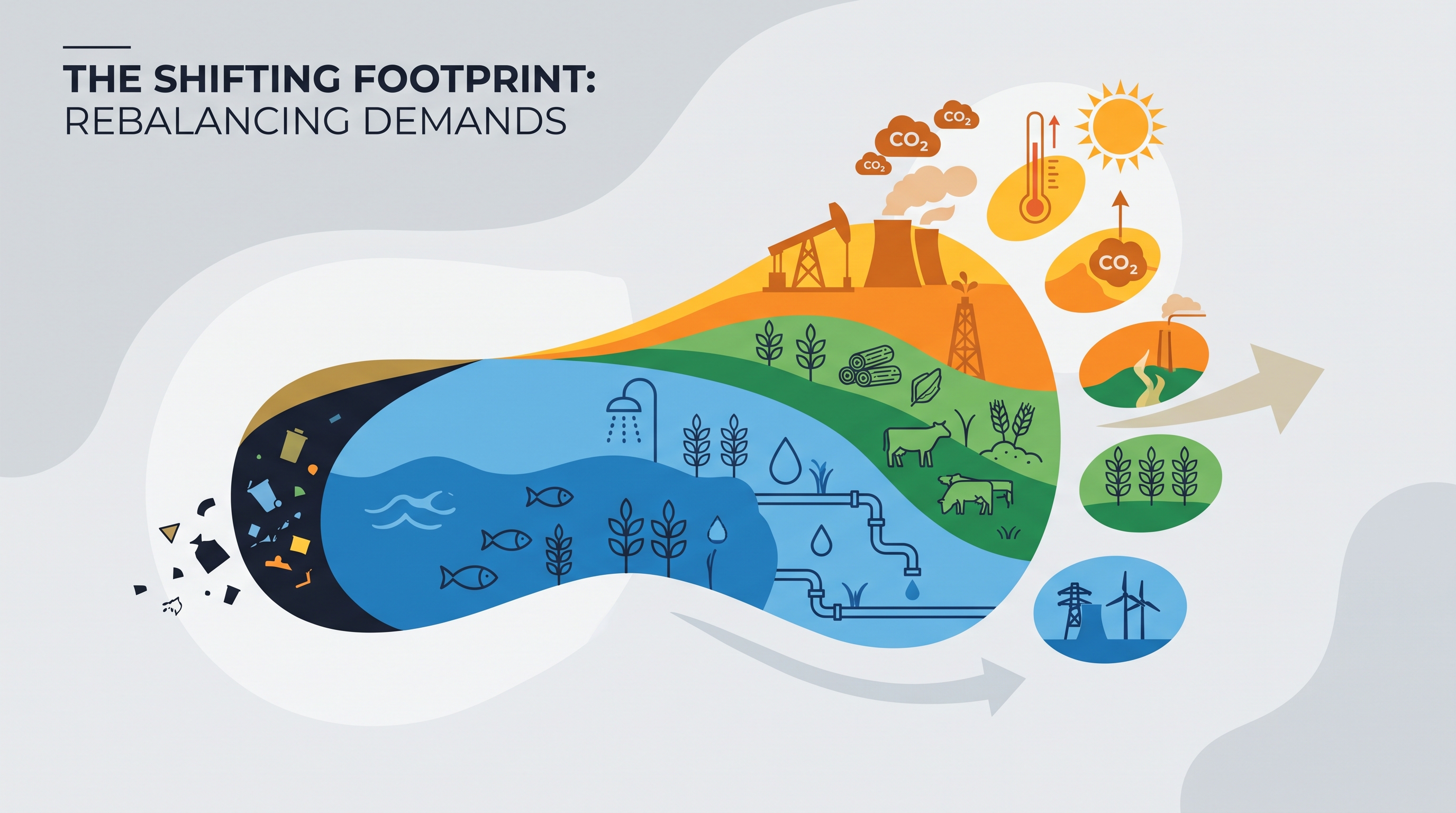
Every meal, building, trip, and manufactured object depends on natural resources—and using those resources alters natural systems. An ecological footprint estimates the resource demands and waste production associated with an individual or society, including demands on land and water.
5.11 Ecological Footprints · 5.12 Introduction to Sustainability
Every meal, building, trip, and manufactured object depends on natural resources—and using those resources alters natural systems. An ecological footprint estimates the resource demands and waste production associated with an individual or society, including demands on land and water.
From resource use to environmental impact
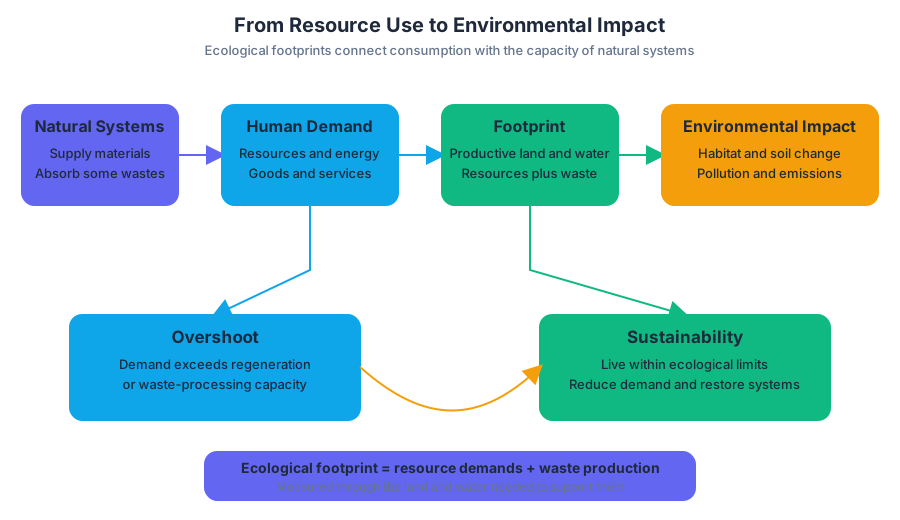
Natural systems supply materials and absorb some wastes. When human demand exceeds the ability of those systems to regenerate resources or process wastes, the system is altered. The alteration may involve habitat conversion, reduced water availability, soil degradation, atmospheric pollution, or increased greenhouse-gas emissions.
An ecological footprint therefore does not simply count how much someone buys. It connects consumption to the productive land and water needed to provide resources and to handle associated waste. A society with high material and energy use generally places greater demands on natural systems than a society with lower per-person consumption, although total population also affects the overall impact.
Ecological footprint: A measure of the resource demands and waste production associated with an individual or a society, including the land and water use required to support those demands.
The footprint idea is especially useful because environmental impacts are often hidden. A city may occupy a relatively small physical area while depending on distant agricultural land, water supplies, forests, mines, and energy systems. Its ecological footprint can therefore be much larger than the area visible on a map.
Worked example: comparing two households
Suppose Household A frequently purchases resource-intensive foods, drives long distances, uses substantial electricity, and discards most household waste. Household B uses less electricity, travels fewer miles, purchases fewer resource-intensive goods, and produces less waste. Household A will tend to have a larger ecological footprint because its lifestyle requires greater resource extraction, more supporting land and water use, and greater waste processing.
The reasoning chain is:
- Human activity: Household A consumes more goods, transportation fuel, and electricity.
- Resource demand: More energy, raw materials, land, and water are required to support that consumption.
- Waste production: More discarded materials and emissions are generated.
- Natural-system alteration: Extraction, production, disposal, and emissions place greater pressure on ecosystems.
- Environmental consequence: The household contributes more to cumulative impacts, including climate-related impacts when energy use releases greenhouse gases.
This comparison does not mean that one household alone determines environmental conditions. Individual choices accumulate across communities and societies, while infrastructure, income, technology, and access to alternatives influence the choices people can make.
Land, water, and climate connections
Land and water use are central to ecological footprints. Food production requires productive land and freshwater; housing and transportation occupy or transform land; manufacturing requires water and raw materials; and waste disposal requires space and management. These demands can compete with the needs of other species and with the ability of ecosystems to maintain their functions.
Energy use adds another pathway. When fossil fuels are burned to provide electricity, transportation, or industrial heat, greenhouse gases are released. Thus, an ecological footprint is connected to climate-related environmental impacts through the resource and energy demands that accompany human consumption.
Named misconception — “A small city has a small footprint.” Physical area and ecological footprint are different measurements. A densely built city may cover little land but depend on extensive external land and water systems for food, energy, materials, and waste management.
5.12 Sustainability
Sustainability means humans living on Earth and using resources without depleting those resources for future generations. The definition adds a time dimension: a practice is not sustainable merely because it meets present needs if it undermines the ability of future people to meet theirs.
CED Essential Knowledge STB-1.A.1: Sustainability refers to humans living on Earth and their use of resources without depletion of the resources for future generations.
Sustainability requires examining both benefits and limits: how much land and water a practice uses, how much waste it produces, whether natural systems can recover, and whether environmental burdens and benefits are distributed fairly. It is therefore broader than “using less.” A durable solution must meet human needs while maintaining the natural systems that provide resources and absorb wastes.
Urbanization illustrates why this balance matters. Concentrating people and infrastructure can increase demand for energy, materials, land, and water, but planning decisions determine how large those demands become and how much waste is generated. The relevant sustainability question is not whether urbanization exists, but whether human settlements operate within environmental limits over time.
Misconception check: Sustainability does not mean eliminating all human resource use. Humans must use resources; sustainability means using them without depleting the systems and supplies needed by future generations.
Retrieval check
A community reduces household waste but expands water-intensive consumption and electricity use from fossil fuels. Has its ecological footprint necessarily decreased? Explain using resource demands, waste production, land and water use, and the connection between energy use and climate-related environmental impacts.
Source Materials
- AP Environmental Science Course and Exam Description
- Review the Clarifications (.pdf)
- AP Environmental Science Course Overview
- AP Environmental Science Course at a Glance
- AP Environmental Science Course at a Glance Poster
- AP Environmental Science
- AP Environmental Science
- AP Environmental Science Sample Syllabus 1