From the free course AP Environmental Science on Lykke
6.7 Energy from Biomass · 6.8 Solar Energy
Key concepts: Biomass energy · Environmental consequences of overharvesting trees for fuel · Ethanol as a biomass-based gasoline fuel · Carbon emissions from burning biomass fuels · Solar energy · Photovoltaic systems · Active solar energy systems · Availability of sunlight as a limitation · Environmental benefits and impacts of solar energy · Energy use producing positive and negative consequences
A forest can become a fuel tank—but if people remove trees faster than the ecosystem replaces them, the “renewable” fuel source can produce lasting damage.
6.7 Energy from Biomass · 6.8 Solar Energy
A forest can become a fuel tank—but if people remove trees faster than the ecosystem replaces them, the “renewable” fuel source can produce lasting damage. Biomass and solar energy both originate from the Sun, yet they transform solar energy in very different ways and carry different environmental trade-offs.
6.7 Energy from Biomass
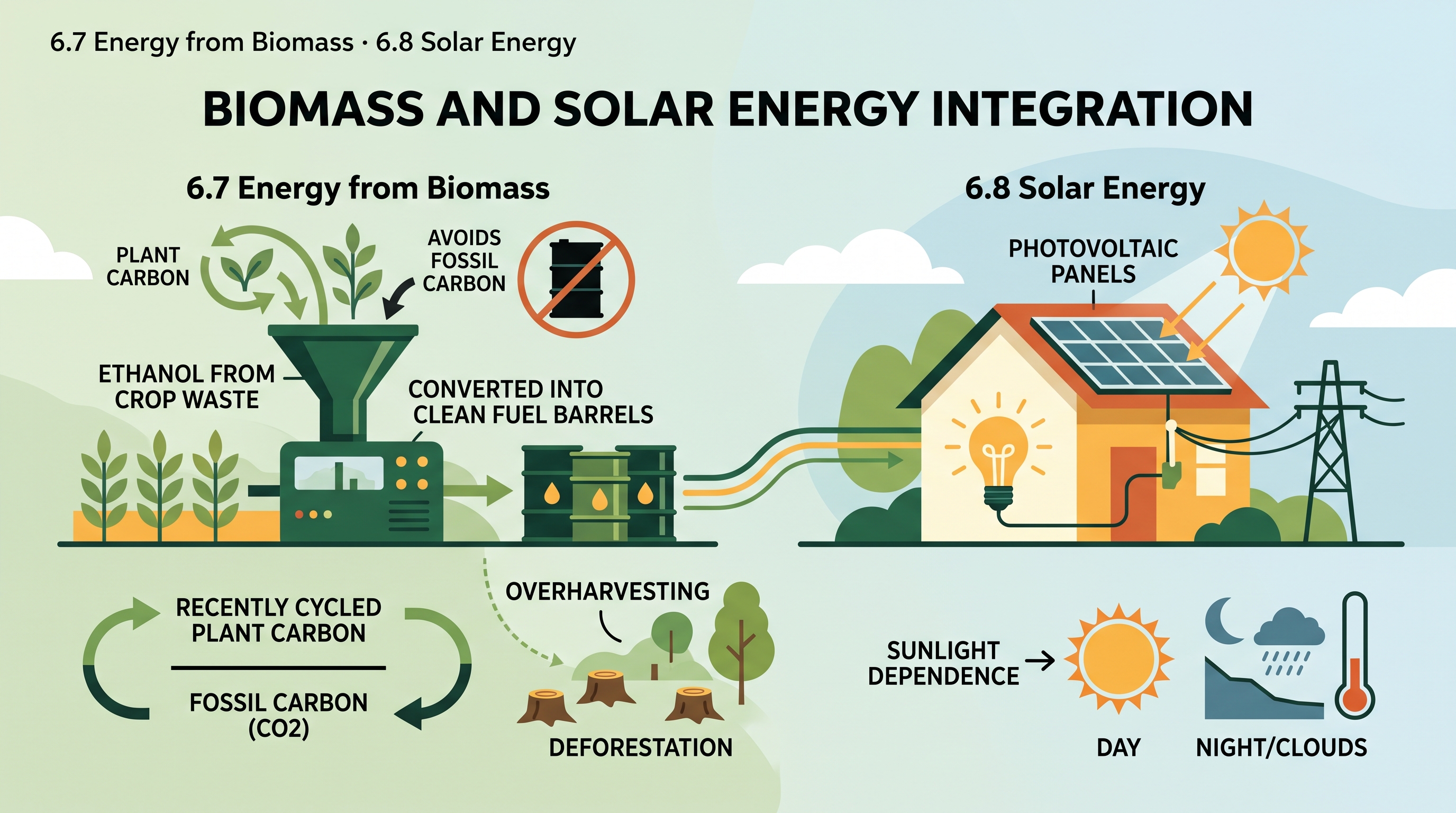
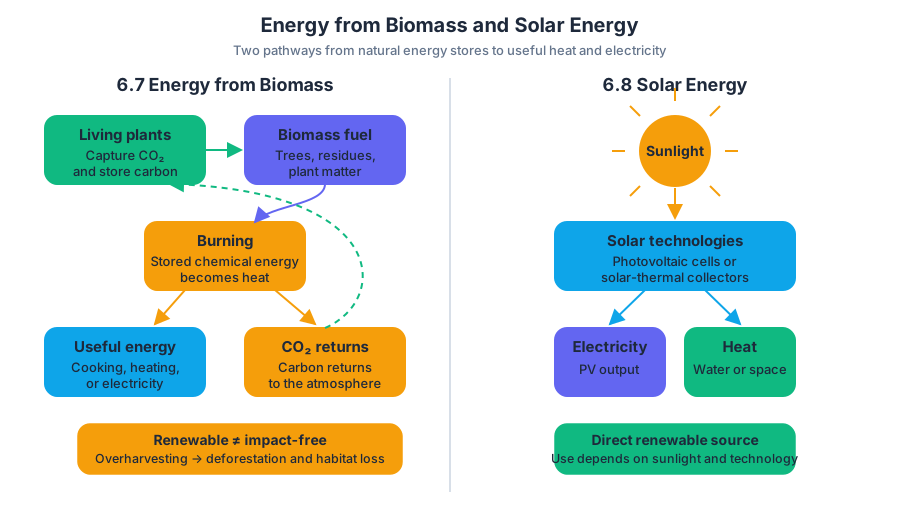
Biomass energy is energy obtained from recently living biological material, such as trees, crop residues, or other plant matter. Burning biomass releases stored chemical energy as heat, which can be used directly for cooking and heating or converted into electricity.
ENG-3.I.1 — Burning of biomass produces heat for energy.
The central advantage of biomass is that plants capture atmospheric carbon dioxide during photosynthesis and store carbon in their tissues. When biomass is burned, carbon returns to the atmosphere as carbon dioxide. If new plants replace the harvested material, some of that carbon may later be removed from the atmosphere again.
That carbon cycle does not make every biomass system environmentally harmless. Overharvesting trees for fuel can cause deforestation, which is the conversion or removal of forest cover, and habitat loss, which reduces the space and resources available to organisms. Soil erosion, reduced biodiversity, disrupted water cycling, and declining carbon storage can persist long after the fuel has been burned.
Misconception check: “Biomass is renewable, so using it has no environmental cost.”
Correction: Biomass is renewable only when its biological source is replenished at a rate comparable to its removal. A forest harvested faster than it regrows is being depleted.
Biomass can also become a liquid transportation fuel. Ethanol is an alcohol fuel produced from plant material, commonly from crops containing sugars or starches. It can be blended with gasoline or used as a gasoline substitute.
Burning ethanol releases carbon dioxide, but that carbon was recently removed from the atmosphere by the plants used to make the ethanol. Therefore, combustion of ethanol does not introduce additional carbon into the atmosphere in the same way that burning fossil fuels does, because fossil fuels release carbon that has remained stored underground for very long periods.
The comparison must include the entire production system. Growing, harvesting, processing, and transporting biomass require energy. Ethanol can therefore have a low energy return on energy investment, meaning the energy obtained from the fuel is not much greater than the energy required to produce it. Land used for fuel crops may also compete with food production or natural habitat.
Worked example: comparing two biomass choices
A community can either collect fallen branches from a managed forest or cut mature trees for fuel. The first option removes material that is already available while preserving most living vegetation. The second may produce more fuel immediately, but repeated harvesting reduces forest structure, wildlife habitat, and future carbon storage.
A strong environmental analysis would therefore identify both sides: biomass combustion supplies heat and can recycle recently captured carbon, but unsustainable harvesting can cause deforestation and habitat loss. The better choice depends on harvest rate, regrowth, land use, and the energy required to process the fuel.
6.8 Solar Energy
Solar energy uses radiation from the Sun as an energy source. Solar technologies generally have low environmental impacts during operation because they do not require combustion and therefore do not directly produce air pollutants or combustion-related carbon dioxide while generating electricity or heat.
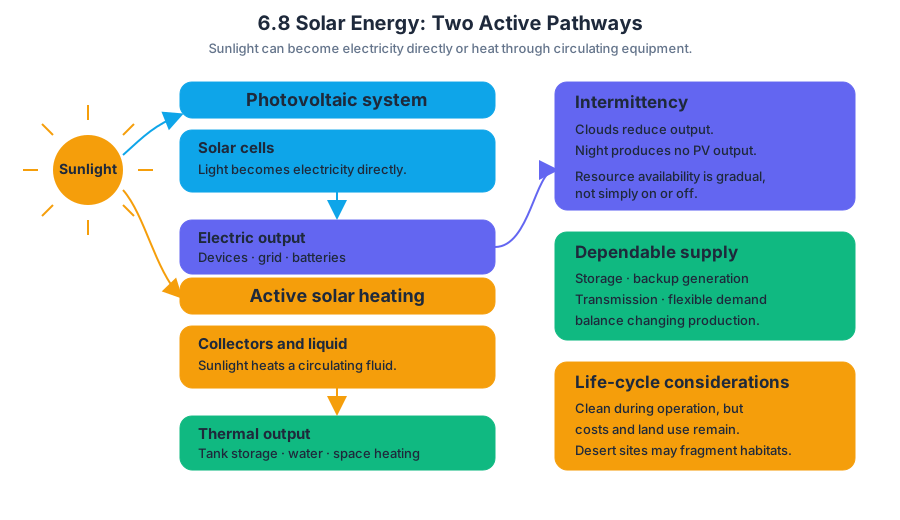
ENG-3.J.1 — Photovoltaic solar cells capture light energy from the sun and transform it directly into electrical energy. Their use is limited by the availability of sunlight.
A photovoltaic system uses solar cells to produce electricity directly from incoming light. The electricity can power devices immediately, enter an electrical grid, or charge batteries for later use.
The key limitation is intermittency: photovoltaic output decreases during cloud cover and falls to zero at night. Solar systems therefore often require energy storage, backup generation, transmission connections, or changes in electricity demand to provide dependable power at all times.
ENG-3.J.2 — Active solar energy systems use solar energy to heat a liquid through mechanical and electric equipment to collect and store the energy captured from the sun.
An active solar energy system uses equipment such as pumps, pipes, collectors, and storage tanks. Sunlight heats a liquid, and mechanical or electrical components circulate that liquid so its thermal energy can be stored or used for water and space heating.
Solar energy is generally clean during operation, but it is not impact-free across its entire life cycle. Solar systems can have high initial costs, and large installations require land. In desert environments, extensive solar facilities may disrupt habitats, fragment wildlife movement, or disturb fragile soils and biological communities.
Misconception check: “Solar panels work only when they produce electricity.”
Correction: A panel can still receive sunlight but produce less electricity when sunlight is weak, the panel is shaded, or its angle is unfavorable. Solar availability is a resource constraint, not simply an on-or-off switch.
Retrieval check
A town replaces gasoline with ethanol and installs photovoltaic panels. Identify one reason ethanol can avoid adding fossil carbon to the atmosphere, one environmental consequence of overharvesting trees for biomass, and one limitation of photovoltaic energy. A complete response should connect ethanol to recently cycled plant carbon, overharvesting to deforestation or habitat loss, and photovoltaic output to sunlight availability.
Source Materials
- AP Environmental Science Course and Exam Description
- Review the Clarifications (.pdf)
- AP Environmental Science Course Overview
- AP Environmental Science Course at a Glance
- AP Environmental Science Course at a Glance Poster
- AP Environmental Science
- AP Environmental Science
- AP Environmental Science Sample Syllabus 1