From the free course AP Environmental Science on Lykke
8.5 Eutrophication · 8.6 Thermal Pollution
Key concepts: Deforestation · Clear-cutting · Water temperature · Shade from trees · Sunlight reaching water · Sedimentation
A forest can influence the temperature and oxygen content of a stream even when the trees never touch the water. Removing the forest changes the stream’s physical conditions first; those changes can then affect dissolved oxygen, algae, and aquatic organisms.
8.5 Eutrophication · 8.6 Thermal Pollution
A forest can influence the temperature and oxygen content of a stream even when the trees never touch the water. Removing the forest changes the stream’s physical conditions first; those changes can then affect dissolved oxygen, algae, and aquatic organisms.
Deforestation and clear-cutting
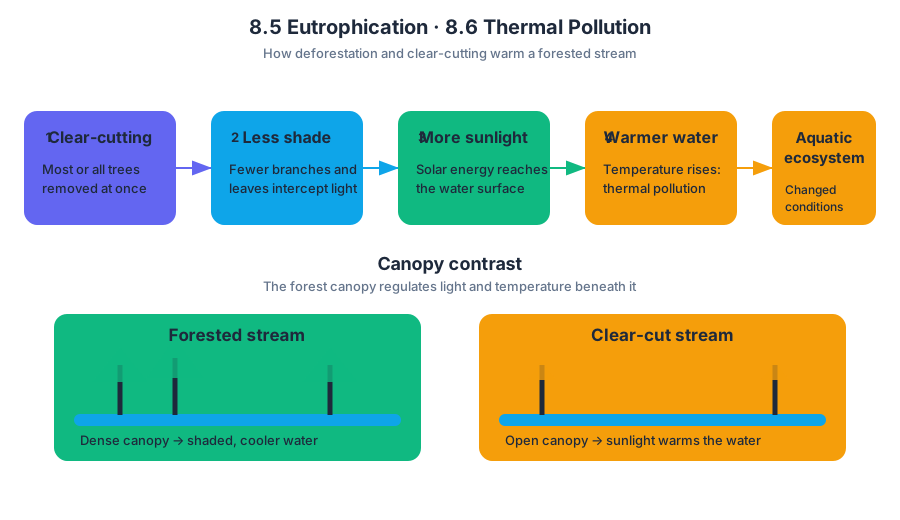
Deforestation is the removal or conversion of forest cover. Clear-cutting is one form of deforestation in which most or all trees in an area are removed at once. Because a forest canopy regulates the conditions beneath it, clear-cutting can alter both terrestrial and aquatic ecosystems.
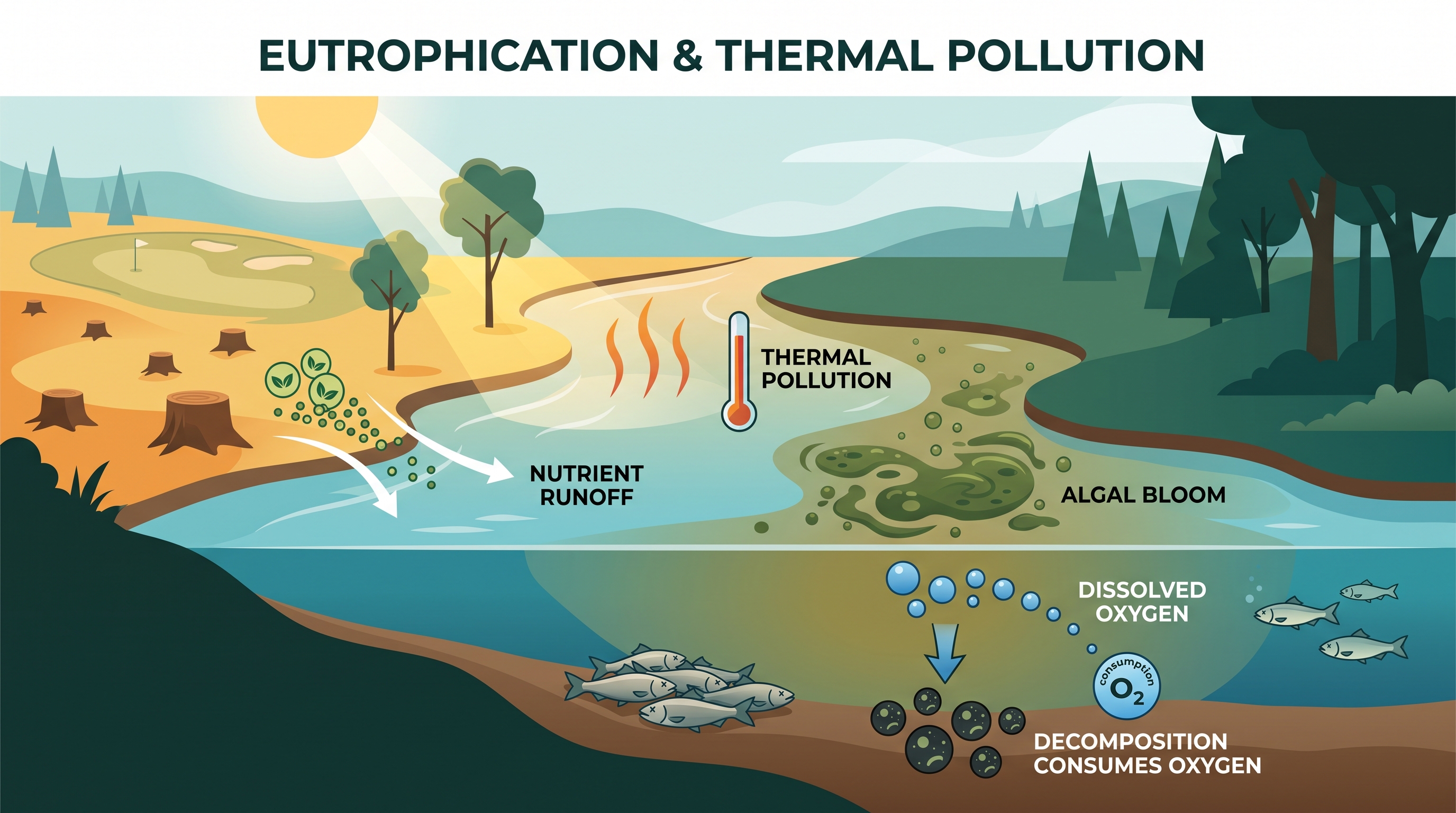
Along a forested stream, tree branches and leaves provide shade, blocking part of the incoming solar radiation. After clear-cutting, fewer trees remain to intercept sunlight, so more sunlight reaches the water’s surface. Increased solar energy can raise the water temperature; this is a form of thermal pollution, meaning a human-caused change in the temperature of a natural water body.
$$ \text{clear-cutting} \rightarrow \text{less shade} \rightarrow \text{more sunlight at water surface} \rightarrow \text{higher water temperature} $$
A second pathway: sedimentation
Clear-cutting can also leave soil exposed. Without tree roots and ground vegetation to hold soil in place, rainfall may cause more erosion, carrying sediment into the stream. Sedimentation is the accumulation or transport of soil particles into an aquatic system. Suspended or deposited sediment can absorb solar energy and contribute to warming, while also increasing turbidity and covering stream-bottom habitat.
The two explanations are related but distinct. A strong explanation may identify either the loss of shade and increased sunlight or the addition of sediment from erosion; the strongest response recognizes that both mechanisms can operate simultaneously.
| Change after clear-cutting | Immediate mechanism | Possible aquatic effect |
|---|---|---|
| Trees removed | Less canopy shade | More sunlight reaches water |
| Exposed soil | Greater erosion during rainfall | More sediment enters stream |
| More solar absorption | Water gains thermal energy | Water temperature rises |
| More suspended particles | Reduced water clarity | Turbidity and habitat quality may change |
Thermal pollution and dissolved oxygen
Warmer water generally holds less dissolved oxygen than cooler water. Therefore, a temperature increase caused by clear-cutting can place additional stress on aquatic organisms, especially species that require cool, oxygen-rich water. Temperature is an abiotic factor, but it can produce biological consequences throughout the ecosystem.
Misconception check: clear-cutting does not necessarily cool a stream simply because vegetation has been removed. The relevant question is the energy balance at the water surface: removing shade usually allows more sunlight to enter, and sediment may absorb additional heat. The expected explanation is therefore a temperature increase, not merely “the habitat was disturbed.”
Eutrophication from nutrient runoff
A golf course constructed in forest B could alter a different water-quality indicator through fertilizer runoff. Fertilizers commonly add nitrogen and phosphorus compounds, including nitrates and phosphates, to the surrounding environment. Rain can transport these nutrients into nearby water.
$$ \text{fertilizer runoff} \rightarrow \text{more nitrates and phosphates} \rightarrow \text{algal growth} \rightarrow \text{decomposition} \rightarrow \text{lower dissolved oxygen} $$
Eutrophication is the enrichment of water with nutrients that promotes excessive algal or plant growth. When the resulting algae die, decomposer organisms break down the organic matter and use oxygen during cellular respiration. If oxygen consumption exceeds oxygen replenishment, dissolved oxygen falls, potentially creating stressful or hypoxic conditions for aquatic organisms.
Not every change at the golf course must increase pollution. Maintained grass can reduce erosion compared with barren, clear-cut land, so sedimentation or turbidity might decrease relative to the clear-cut area. The direction of change depends on which land surface is being compared and which pollutant pathway dominates.
Applying the investigation design
If forest A remains intact while forest B is clear-cut, forest A functions as a control. Researchers can compare temperature, turbidity, sedimentation, or dissolved oxygen between the intact and altered areas. The comparison helps isolate the effect of forest removal rather than treating a single measurement as proof of causation.
AP science practices in context
This topic most directly uses Science Practice 1: Concept Application when connecting clear-cutting to shade, sunlight, sedimentation, temperature, and dissolved oxygen; Science Practice 2: Visual Representations when interpreting a forest-stream diagram or causal model; Science Practice 4: Scientific Experiments when identifying the control forest and measured variables; Science Practice 5: Data Analysis when comparing water-quality measurements; and Science Practice 7: Environmental Solutions when evaluating strategies such as preserving streamside trees. Science Practice 3: Text Analysis can support evidence-based explanations, while Science Practice 6: Mathematical Routines may be used to calculate changes in temperature, turbidity, or dissolved oxygen.
Retrieval check
A stream beside a clear-cut area becomes warmer, and nitrate concentration rises near a fertilized golf course. Give one mechanism for the temperature increase and one mechanism for a possible dissolved-oxygen decrease.
Answer: Fewer trees provide less shade, allowing more sunlight to reach and warm the water. Fertilizer runoff adds nutrients, stimulating algal growth; decomposition of dead algae consumes dissolved oxygen.
Source Materials
- AP Environmental Science Course and Exam Description
- Review the Clarifications (.pdf)
- AP Environmental Science Course Overview
- AP Environmental Science Course at a Glance
- AP Environmental Science Course at a Glance Poster
- AP Environmental Science
- AP Environmental Science
- AP Environmental Science Sample Syllabus 1