From the free course AP Environmental Science on Lykke
6.9 Hydroelectric Power · 6.10 Geothermal Energy
Key concepts: Hydroelectric power generation · Dams and reservoirs · River turbines · Tidal energy · Environmental effects of hydroelectricity · Geothermal energy generation · Geothermal energy accessibility and cost · Hydrogen sulfide release · Thermal energy from Earth · Turbines and electricity generation
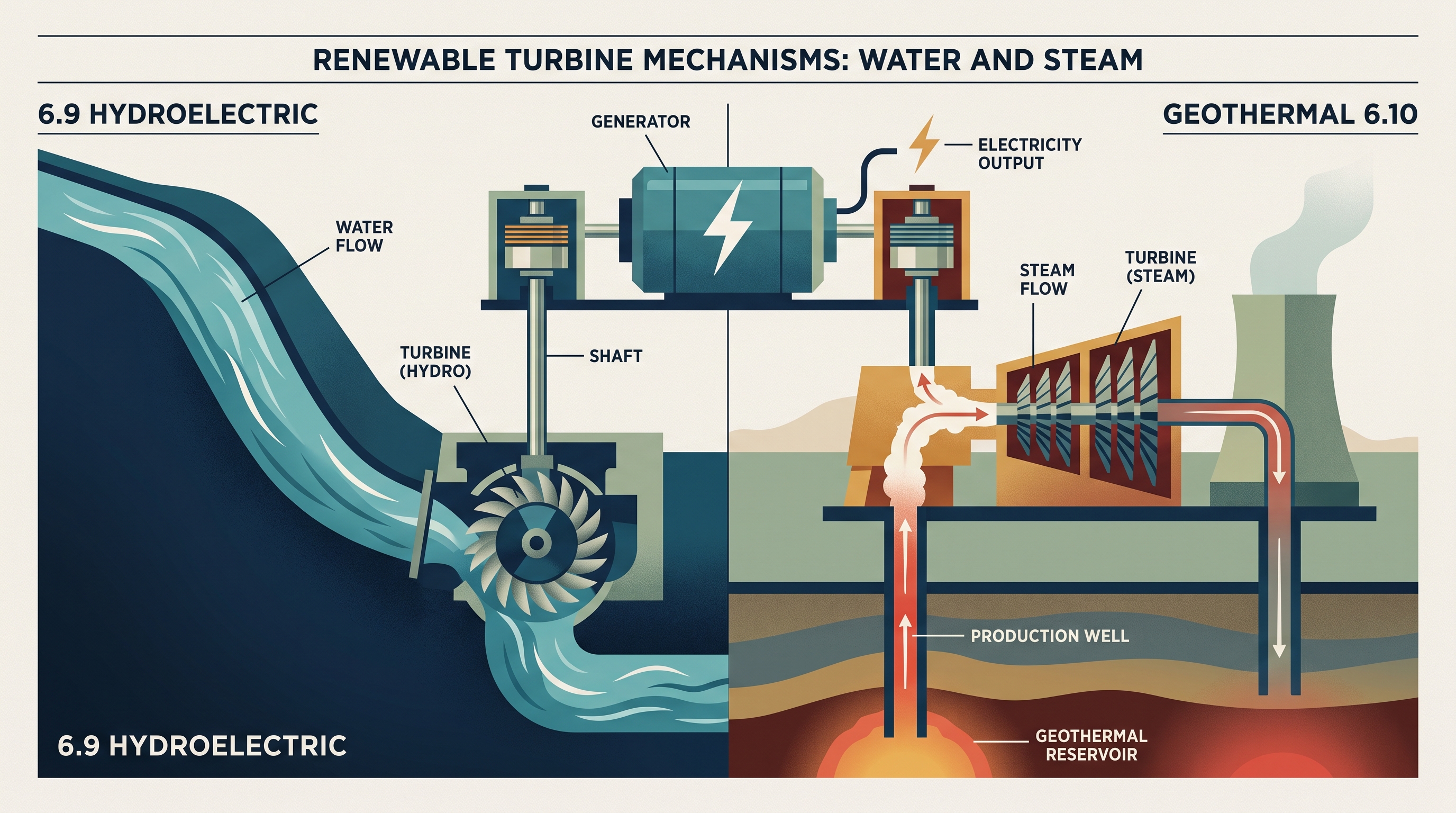
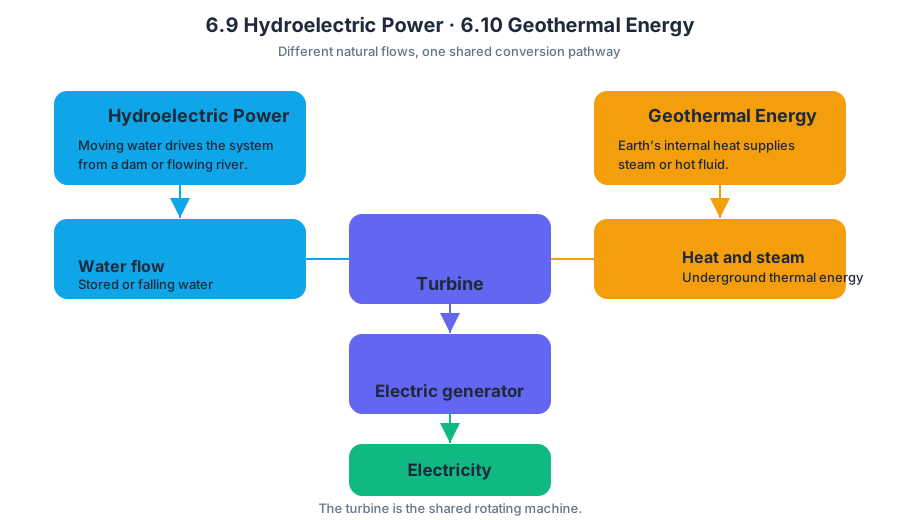
Both hydroelectric and geothermal systems generate electricity by turning a turbine—a rotating machine connected to an electric generator—but they draw energy from different natural flows: hydroelectricity uses moving water, while geothermal energy uses heat stored inside Earth.
6.9 Hydroelectric Power · 6.10 Geothermal Energy
Both hydroelectric and geothermal systems generate electricity by turning a turbine—a rotating machine connected to an electric generator—but they draw energy from different natural flows: hydroelectricity uses moving water, while geothermal energy uses heat stored inside Earth.
Hydroelectric power: turning water movement into electricity
Hydroelectric power is electricity generated when moving or falling water spins a turbine. The turbine transfers mechanical energy to a generator, which converts that motion into electrical energy.
Under ENG-3.L, “Describe the use of hydroelectricity in power generation,” the required mechanisms are identified in ENG-3.L.1 and ENG-3.L.2:
- Dams and reservoirs: A dam built across a river blocks or regulates the river’s flow. Water collects behind it in a reservoir, and water released through an outlet moves rapidly through turbines.
- River turbines: Turbines can be placed directly in smaller rivers. Flowing water turns the turbine without requiring a large reservoir.
- Tidal energy: Tidal flows can also turn turbines. Here, the moving water comes from the regular rise, fall, and movement of ocean tides rather than from river discharge.
Worked example — a reservoir system: A dam stores water high above a downstream turbine. When operators release water, gravity causes it to flow downhill through the turbine. The turbine rotates, the generator produces electricity, and the water continues downstream. The key energy conversion is approximately:
$$ \text{gravitational potential energy} \rightarrow \text{kinetic energy of water} \rightarrow \text{mechanical energy of turbine} \rightarrow \text{electrical energy} $$
A small “run-of-river” installation follows the same central principle but uses the river’s existing current. It may reduce the need for a large reservoir, although the amount of electricity produced depends strongly on the river’s flow rate.
Environmental trade-offs
Under ENG-3.M, “Describe the effects of the use of hydroelectricity in power generation on the environment,” ENG-3.M.1 requires a balanced description. Hydroelectric power generation does not produce air pollution or waste during electricity generation, but construction can be expensive and dams can cause the loss of or change in habitats.
The environmental effects occur mainly because a dam changes the river system:
| Benefit | Environmental or economic cost |
|---|---|
| Electricity generation does not directly produce air pollution or waste | Construction of dams and power plants can be expensive |
| Reservoirs can regulate water flow | Flooding upstream areas can eliminate or alter terrestrial and aquatic habitats |
| Flowing water provides a renewable energy source | Altered river flow can change downstream habitats and ecological conditions |
Misconception check — “Hydroelectric power has no environmental impact.” The correct claim is narrower: hydroelectric electricity generation does not generate air pollution or waste in the way many fuel-burning systems do. The dam itself can substantially alter habitats, so “no air pollution” does not mean “no environmental effects.”
Geothermal energy: using Earth’s internal heat
Geothermal energy is energy obtained from heat stored in Earth’s interior. Much of this internal heat results from radioactive decay, and it can be used to heat underground water until the water becomes steam.
The generation pathway in ENG-3.N, “Describe the use of geothermal energy in power generation,” is specified by ENG-3.N.1:
$$ \text{Earth’s internal heat} \rightarrow \text{heated underground water} \rightarrow \text{steam} \rightarrow \text{turbine rotation} \rightarrow \text{electricity} $$
A geothermal facility brings steam—or hot water that is converted into steam—to the surface. The steam drives an electric generator. Unlike hydroelectricity, the immediate energy source is not water’s motion caused by gravity; it is thermal energy from Earth.
Limits and environmental effects
Under ENG-3.O, “Describe the effects of the use of geothermal energy in power generation on the environment,” ENG-3.O.1 emphasizes two important limitations: accessing geothermal energy can be prohibitively expensive, and geothermal resources are not easily accessible in many parts of the world.
Geothermal energy therefore has a geographic and economic constraint. A region may contain substantial underground heat, yet drilling deeply enough to reach usable hot water or steam may cost too much for electricity production to be practical.
Geothermal facilities can also release hydrogen sulfide, a gas associated with a rotten-egg odor and environmental and health concerns at elevated concentrations. Thus, geothermal energy is not automatically impact-free simply because it does not rely on combustion.
Misconception check — “Geothermal energy is available everywhere.” Earth is hot inside, but usable geothermal energy is not equally accessible in every location. The relevant question is whether heat can be reached and transferred to water economically, not merely whether Earth’s interior contains heat.
AP skill connection and retrieval check
This topic most directly develops Science Practice 1: Concept Explanation, especially Skill 1.A: Describe environmental concepts and processes. A strong response names the energy source, explains how that source turns a turbine, and identifies a specific environmental or economic consequence rather than offering a vague claim such as “it is sustainable.”
Retrieval check: A proposed power site has a fast-flowing river but no suitable underground steam reservoir. Which energy technology is directly supported by the site, and what turbine process would generate electricity? Then name one environmental effect that could result if a dam and reservoir were constructed.
Source Materials
- AP Environmental Science Course and Exam Description
- Review the Clarifications (.pdf)
- AP Environmental Science Course Overview
- AP Environmental Science Course at a Glance
- AP Environmental Science Course at a Glance Poster
- AP Environmental Science
- AP Environmental Science
- AP Environmental Science Sample Syllabus 1