From the free course AP Environmental Science on Lykke
AP Practice 3
A nitrate-rich runoff pulse can transform a clear stream into an oxygen-starved system because nutrient enrichment increases algal production, and decomposition of that algal biomass consumes dissolved oxygen.
AP Practice 3
A nitrate-rich runoff pulse can transform a clear stream into an oxygen-starved system because nutrient enrichment increases algal production, and decomposition of that algal biomass consumes dissolved oxygen.
This practice set targets quantitative data interpretation, a free-response task that combines Science Practice 5: Data Analysis, Science Practice 6: Mathematical Routines, Science Practice 1: Concept Application, and Science Practice 7: Environmental Solutions. The scenario is original and unofficial.
Exam conditions
Allow approximately 23 minutes for this question when practicing as part of a $70$-minute, three-question free-response section. Use a calculator when helpful, but show the setup, substitution, and units for every calculation.
The strongest responses do not merely report that two variables changed together. They identify the pattern, calculate accurately, connect the pattern to an environmental mechanism, and propose a solution whose mechanism matches the pollutant.
Scenario and data
A reservoir receives drainage from an agricultural watershed. Researchers sampled the reservoir during three periods: before heavy rainfall, shortly after rainfall, and several days later. The measured variables were nitrate concentration, algal biomass, and dissolved oxygen concentration.
| Sampling period | Nitrate concentration ($\text{mg/L}$) | Algal biomass ($\text{mg/L}$) | Dissolved oxygen ($\text{mg/L}$) |
|---|---|---|---|
| Before rainfall | $2.0$ | $12$ | $8.4$ |
| Two days after rainfall | $10.0$ | $40$ | $3.1$ |
| Seven days after rainfall | $7.0$ | $55$ | $1.8$ |
The reservoir’s fish require at least $5.0\ \text{mg/L}$ of dissolved oxygen for normal activity. Oxygen concentrations below this value create stressful conditions; still lower concentrations can produce hypoxia, meaning abnormally low dissolved oxygen, or anoxia, meaning nearly absent dissolved oxygen.
Practice prompt
(a) Identify the period with the greatest nitrate concentration and state the relationship between nitrate concentration and dissolved oxygen concentration across the three sampling periods.
(b) Calculate the percent increase in nitrate concentration from before rainfall to two days after rainfall. Show your work.
(c) Describe the sequence of ecological processes that most plausibly explains the decrease in dissolved oxygen after nitrate concentration increased.
(d) Propose one treatment improvement at the agricultural site that would reduce the risk of oxygen depletion in the reservoir. Explain the mechanism by which the improvement reduces nitrate delivery or downstream oxygen consumption.
Worked reasoning
Part (a): Interpret the data
The greatest nitrate concentration occurred two days after rainfall, at $10.0\ \text{mg/L}$. Across the three sampling periods, nitrate concentration and dissolved oxygen show an inverse relationship: as nitrate concentration increased from $2.0$ to $10.0\ \text{mg/L}$, dissolved oxygen decreased from $8.4$ to $3.1\ \text{mg/L}$; as nitrate later declined to $7.0\ \text{mg/L}$, dissolved oxygen declined further to $1.8\ \text{mg/L}$.
The final sentence matters because it prevents an over-simple answer. Dissolved oxygen did not immediately recover when nitrate decreased. The algal biomass continued increasing from $40$ to $55\ \text{mg/L}$, so oxygen consumption could continue even after the nitrate peak had passed.
Scoring target: one point for identifying the correct sampling period and one point for describing the inverse pattern with data support. A response that says only “the variables are related” is weaker because it does not specify the direction of the relationship.
Part (b): Calculate percent increase
Use the percent-change equation:
$$ \text{Percent increase}
\frac{\text{new value} - \text{original value}}{\text{original value}} \times 100 $$
Substitute the nitrate values:
$$ \text{Percent increase}
\frac{10.0\ \text{mg/L} - 2.0\ \text{mg/L}} {2.0\ \text{mg/L}} \times 100
\frac{8.0}{2.0}\times 100
400% $$
The nitrate concentration increased by $400%$. It became five times its original value, but “five times as large” is not the same as a $500%$ increase: the original $100%$ is included in the final amount, so the increase is $400%$.
Scoring target: one point for the correct setup and one point for the correct answer with appropriate units or percent notation. Units cancel during the ratio, so the final result is reported as a percentage rather than $\text{mg/L}$.
Part (c): Explain the mechanism
The complete causal chain is:
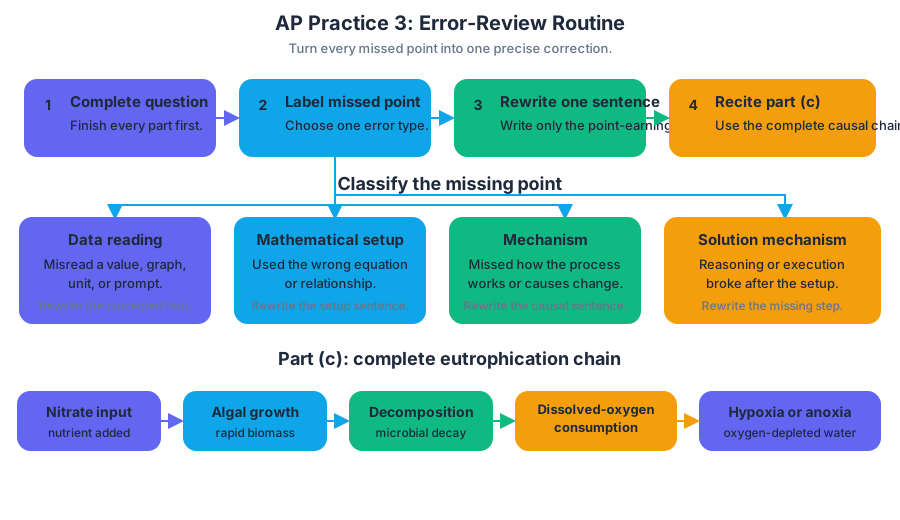
$$ \text{nitrate input} \rightarrow \text{algal growth} \rightarrow \text{decomposition} \rightarrow \text{dissolved-oxygen consumption} \rightarrow \text{hypoxia or anoxia} $$
Rainfall can wash nitrate fertilizer from agricultural land into the reservoir. Because nitrogen is a limiting nutrient in some aquatic systems, the additional nitrate stimulates algal growth. When algae die, decomposers break down the organic matter; their cellular respiration consumes dissolved oxygen, causing the oxygen concentration to fall. Fish and other aerobic organisms are then stressed or displaced as hypoxia develops.
Scoring target: earn credit by connecting nitrate to algal growth and connecting decomposition to oxygen consumption. Simply stating that “nitrate uses oxygen” is incomplete: nitrate directly acts as a nutrient, while decomposer respiration is the major step that consumes oxygen in this eutrophication pathway.
Part (d): Propose an effective solution
One effective improvement is to establish or widen a vegetated riparian buffer between crop fields and drainage channels. Dense vegetation slows surface runoff, increases infiltration, and takes up dissolved nitrate before the water reaches the reservoir. Lower nitrate delivery reduces excessive algal growth; less algal biomass later decomposes, so decomposers consume less dissolved oxygen.
A different valid improvement would be to apply fertilizer according to soil-test results and avoid fertilizing immediately before predicted rainfall. This reduces excess nitrate available for runoff at the moment when stormwater would otherwise transport it rapidly into the reservoir.
Scoring target: one point for naming a plausible treatment improvement and one point for explaining its mechanism. “Use less fertilizer” earns stronger credit when the response explains how the change reduces nitrate runoff and the later oxygen demand.
Misconception check
Misconception: “More nitrate directly suffocates fish.” Nitrate enrichment can initiate eutrophication, but the oxygen crisis is produced mainly through the linked process of algal growth, algal death, and decomposer respiration. Also, nitrate concentration and dissolved oxygen are correlated in these observations, but the causal explanation comes from the ecological mechanism, not from the graph alone.
Error-review routine
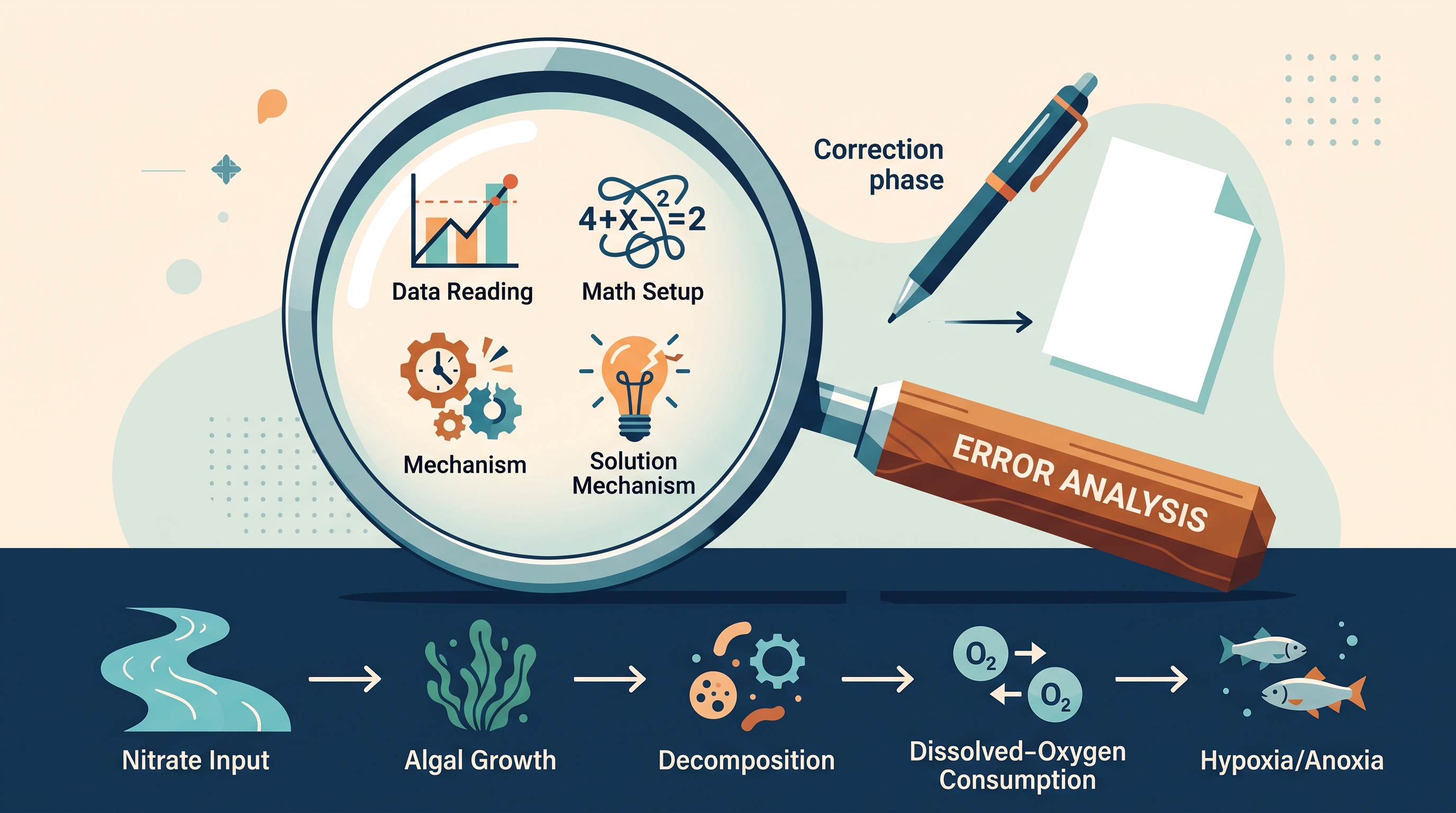
After completing the question, label each missed point as one of four error types: data reading, mathematical setup, mechanism, or solution mechanism. Then rewrite only the sentence that would have earned the missing point. For part (c), recite the complete chain: nitrate input → algal growth → decomposition → dissolved-oxygen consumption → hypoxia or anoxia.
Source Materials
- AP Environmental Science Course and Exam Description
- Review the Clarifications (.pdf)
- AP Environmental Science Course Overview
- AP Environmental Science Course at a Glance
- AP Environmental Science Course at a Glance Poster
- AP Environmental Science
- AP Environmental Science
- AP Environmental Science Sample Syllabus 1
- AP/College Environmental Science-Khan Academy
- AP Environmental Science Exam-College Board
- AP Environmental Science Units-Save my Exams
- AP Environmental Science-Bozeman Science