From the free course AP Environmental Science on Lykke
2.3 Ecological Tolerance · 2.4 Natural Disruptions to Ecosystems
Key concepts: Ecological tolerance · Temperature, salinity, flow rate, and sunlight as environmental conditions · Individual and species tolerance ranges · Natural disruptions to ecosystems · Short-term and long-term ecosystem impacts · Environmental consequences of natural disruptions · Major environmental change and upheaval over geological time · Ecosystem structure and diversity changing over time · Analyzing and interpreting tables, charts, and graphs
A trout cannot survive in every stream: temperature, salinity, flow rate, and sunlight each impose limits on where it can live, grow, and reproduce. Ecological tolerance is the range of environmental conditions an organism can endure before injury or death results.
2.3 Ecological Tolerance · 2.4 Natural Disruptions to Ecosystems
A trout cannot survive in every stream: temperature, salinity, flow rate, and sunlight each impose limits on where it can live, grow, and reproduce. Ecological tolerance is the range of environmental conditions an organism can endure before injury or death results.
ERT-2.F.1: Ecological tolerance refers to the range of conditions, such as temperature, salinity, flow rate, and sunlight, that an organism can endure before injury or death results.
Ecological tolerance: a survival window
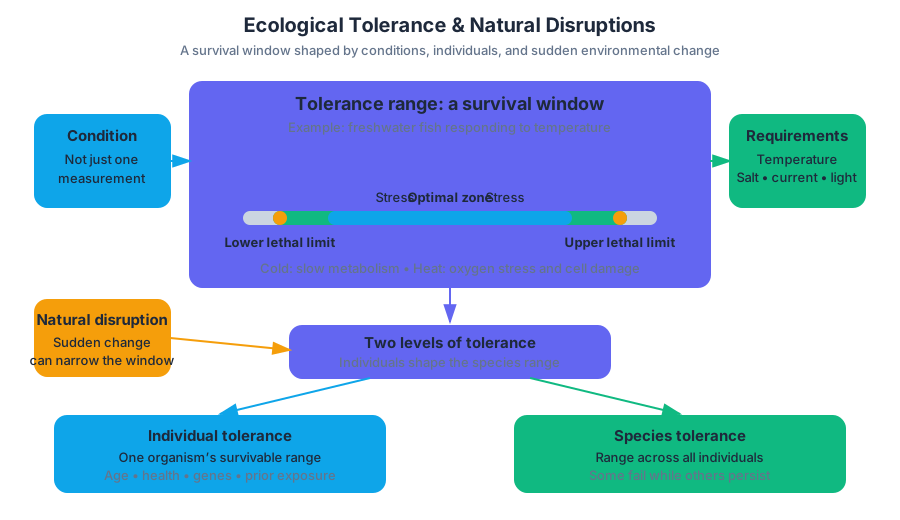
Imagine sliding a temperature control from cold to hot while observing a freshwater fish. At very low temperatures, metabolism slows; within a middle range, the fish functions best; at very high temperatures, oxygen stress and cellular damage increase. The full interval between the lower and upper lethal limits is the fish’s tolerance range.
A tolerance range applies at two levels:
- Individual tolerance: the conditions one organism can withstand. Two fish of the same species may differ because of age, health, genetics, or previous exposure.
- Species tolerance: the broader range represented across all individuals in a species. A species may persist even when some individuals cannot tolerate a particular condition.
The condition is not always a single measurement. A stream organism may be limited by water temperature, dissolved salt concentration, current speed, or the amount of sunlight reaching its habitat. A condition can also affect another requirement: warmer water, for example, generally holds less dissolved oxygen, creating additional stress for aquatic organisms.
ERT-2.F.2: Ecological tolerance can apply to individuals and to species.
Worked example: reading a tolerance pattern
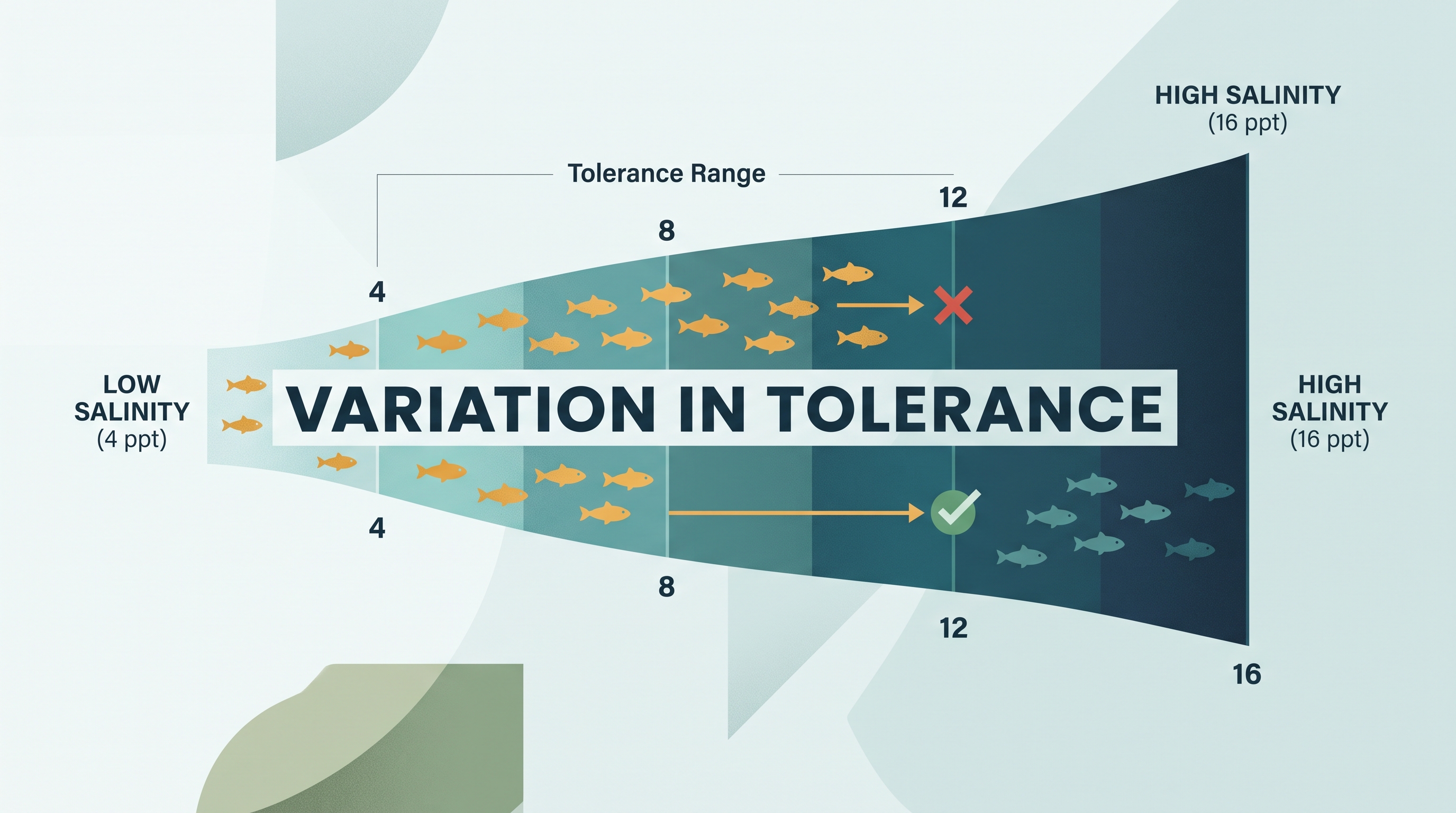
Suppose a freshwater snail population is observed at different salinities. The observations below are invented for practice but illustrate the reasoning required when interpreting environmental data.
| Salinity | Average snails observed per square meter |
|---|---|
| $0$ parts per thousand | $42$ |
| $4$ parts per thousand | $48$ |
| $8$ parts per thousand | $31$ |
| $12$ parts per thousand | $7$ |
| $16$ parts per thousand | $0$ |
The population performs best near $4$ parts per thousand, but the species tolerates at least some salinity through $12$ parts per thousand. The data suggest a declining abundance as salinity rises, not an immediate death threshold at the optimum. A strong interpretation distinguishes best performance from maximum survival.
Misconception check: “One species has one fixed tolerance”
A species does not have a single unchanging tolerance value. The range can vary among individuals and populations, and an organism may tolerate a condition briefly without being able to reproduce there. Therefore, presence alone does not prove that conditions are ideal; abundance, health, and reproductive success provide stronger evidence.
2.4 Natural Disruptions to Ecosystems
A wildfire, flood, volcanic eruption, drought, hurricane, or sudden disease outbreak can reorganize an ecosystem in a matter of days. Other changes, such as shifting climate or changing glacial ice, operate over decades, centuries, or geological time.
ERT-2.G: Explain how natural disruptions, both short- and long-term, impact an ecosystem.
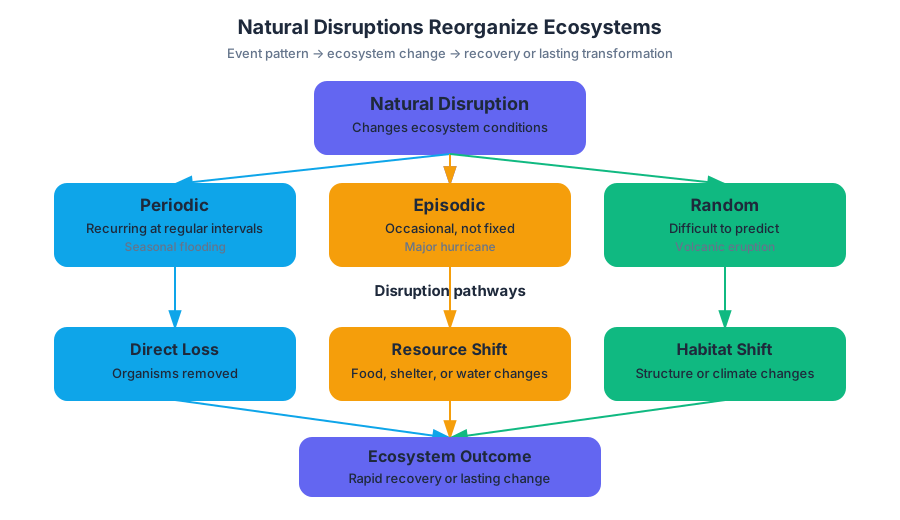
Natural disruptions are events or processes that alter ecosystem conditions, populations, habitat, or resource availability without being caused primarily by human activity. They may be:
- Periodic: recurring at fairly regular intervals, such as seasonal flooding.
- Episodic: occurring occasionally but not on a fixed schedule, such as a major hurricane.
- Random: difficult to predict in timing, such as a particular volcanic eruption.
A disruption may remove organisms directly, change food or shelter, alter water quality, or shift the physical structure of habitat. Its consequences may be short-lived if organisms quickly return, or long-lasting if habitat is destroyed, climate conditions change, or local populations disappear.
Natural change across geological time
Earth’s climate has changed repeatedly over geological time for many reasons. Sea level has also varied substantially as the amount of glacial ice changed: when more water was stored as land-based ice, less remained in the oceans. Major environmental upheaval commonly produces large-scale habitat changes, forcing organisms to move, adapt, or decline.
Wildlife migration can therefore be a response to both short-term and long-term disruption. A herd may move temporarily after a drought, while a species may shift its range over many generations as temperature or water availability changes. Natural disruptions can have environmental consequences as great as, or greater than, those of many human-made disruptions for a particular occurrence.
Data interpretation: connecting disruption to ecosystem response
Consider a grassland survey after a natural fire:
| Year after fire | Plant species richness | Bare ground |
|---|---|---|
| $0$ | $6$ species | $78%$ |
| $2$ | $14$ species | $39%$ |
| $5$ | $19$ species | $18%$ |
| $10$ | $16$ species | $22%$ |
The pattern shows that species richness increased from $6$ to $19$ species during the first five years, while bare ground decreased. By year $10$, richness had declined slightly, so the correct conclusion is not “fire always increases biodiversity.” Instead, the data support a more precise claim: this fire was followed by an initial increase in plant diversity, followed by a modest decline as ecosystem structure changed.
Misconception check: “Natural means harmless”
Natural does not mean insignificant or beneficial in every circumstance. A natural flood can replenish sediment and water wetlands, but it can also remove nests and reduce local populations. The effect depends on the event’s intensity, timing, duration, frequency, and the ecosystem’s existing conditions.
AP science practices in action
This topic most directly develops 3.A, Text Analysis: Identify the author’s claim, when evaluating a scientific explanation about tolerance or disruption, and 5.A, Data Analysis: Describe patterns or trends in data, when interpreting tables, charts, or graphs. A complete data response names the direction of change, identifies exceptions or turning points, and links the pattern to an ecological mechanism rather than merely repeating numbers.
Retrieval check
A population disappears after salinity rises from $4$ to $16$ parts per thousand, while a nearby population persists at $12$ parts per thousand. What should you conclude? The strongest answer is that individuals and populations differ in tolerance, and that the species’ tolerance range may extend farther than the first population’s range.
Source Materials
- AP Environmental Science Course and Exam Description
- Review the Clarifications (.pdf)
- AP Environmental Science Course Overview
- AP Environmental Science Course at a Glance
- AP Environmental Science Course at a Glance Poster
- AP Environmental Science
- AP Environmental Science
- AP Environmental Science Sample Syllabus 1
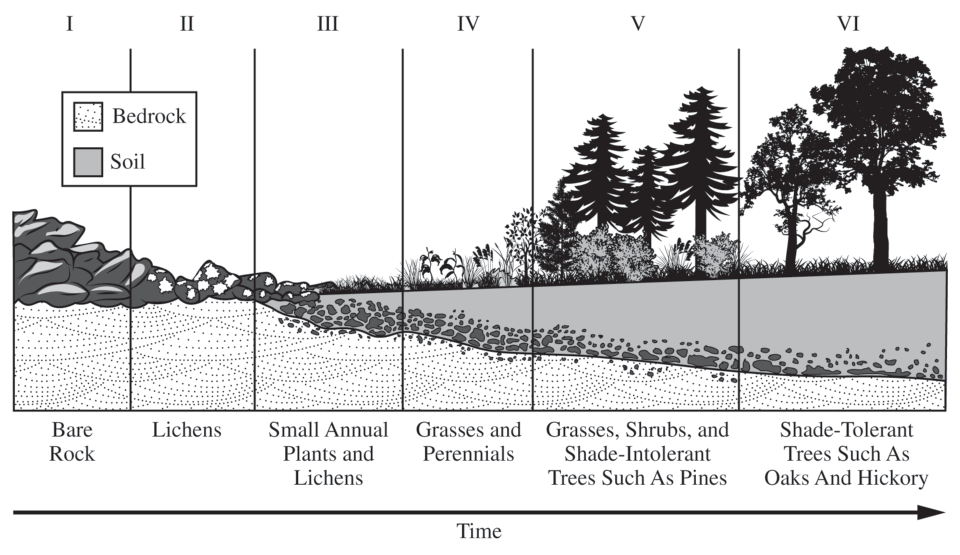
- (a) Identify the ecological change over time illustrated in the diagram.