From the free course AP Environmental Science on Lykke
6.11 Hydrogen Fuel Cell · 6.12 Wind Energy
Key concepts: Hydrogen fuel cells · Hydrogen and oxygen reaction · Renewable fuel sources · Hydrogen fuel cells in power generation · Environmental impacts of hydrogen fuel cells · Hydrogen fuel-cell automobiles · Energy-intensive hydrogen production · Economic cost of hydrogen vehicles · Safety risks of hydrogen fuel cells · Wind energy
A hydrogen fuel cell generates electricity by combining hydrogen gas with oxygen from the air; a wind turbine generates electricity by capturing the kinetic energy of moving air.
6.11 Hydrogen Fuel Cell · 6.12 Wind Energy
A hydrogen fuel cell generates electricity by combining hydrogen gas with oxygen from the air; a wind turbine generates electricity by capturing the kinetic energy of moving air. Both can replace some nonrenewable fuel use, but neither is environmentally consequence-free: the key question is where the input energy comes from and what impacts occur during construction and operation.
6.11 Hydrogen Fuel Cell
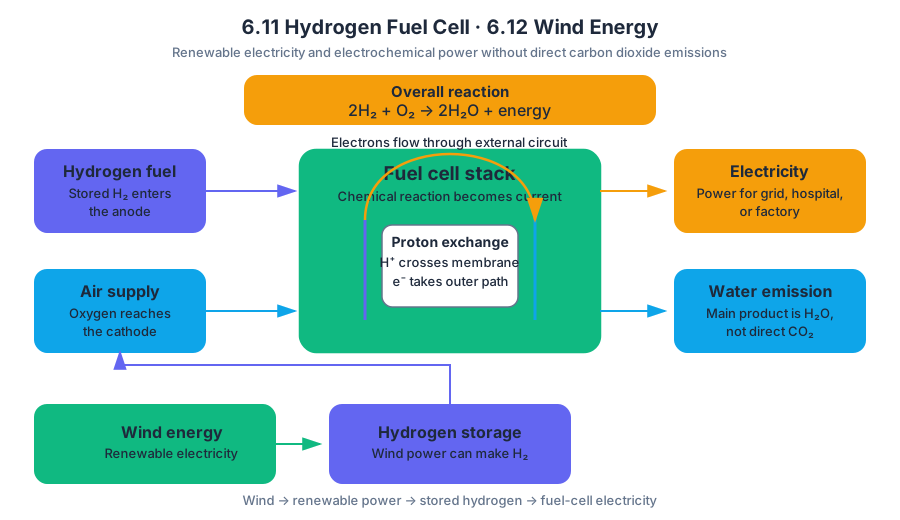
A hydrogen fuel cell is an electrochemical device that uses hydrogen as a fuel and oxygen as the reactant. Instead of burning hydrogen in a flame, the cell separates the chemical reaction into steps that produce an electric current. The overall reaction can be represented as:
$$ 2H_2 + O_2 \rightarrow 2H_2O + \text{energy} $$
In practical terms, hydrogen enters one side of the cell and oxygen enters from the air. Hydrogen is split into positively charged hydrogen ions and electrons; the electrons travel through an external circuit, producing electricity, while the ions and oxygen combine to form water. The main product, or emission, from the fuel cell is water rather than carbon dioxide.
This makes hydrogen fuel cells an alternative to nonrenewable fuel sources. A fuel-cell power station, for example, could receive stored hydrogen, combine it with air, and supply electricity to a hospital, factory, or local electrical grid. It can generate power without the direct carbon dioxide emissions produced by burning coal, oil, or natural gas.
Environmental trade-offs
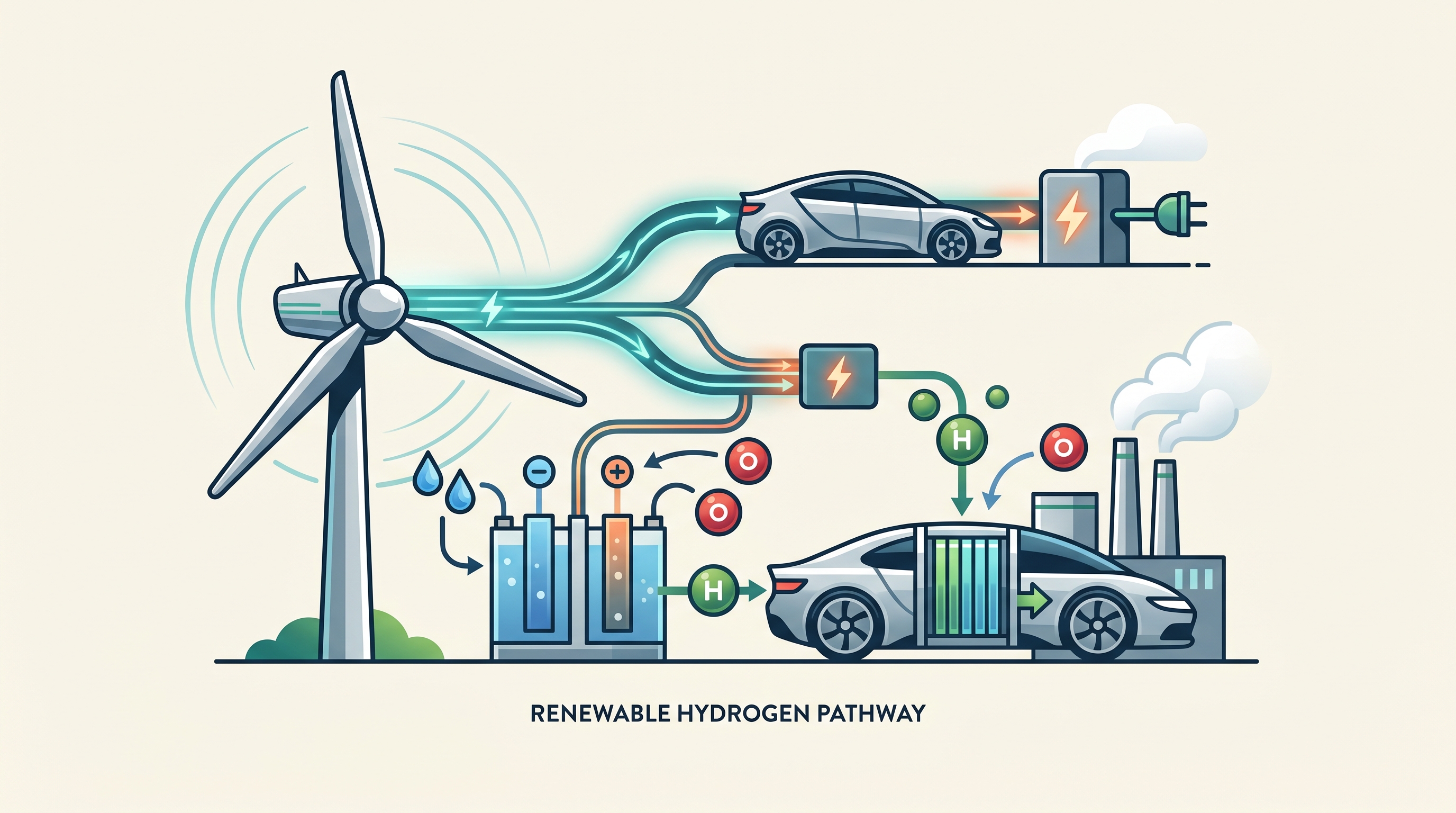
The environmental advantage depends strongly on how the hydrogen is produced. If electricity from a renewable source is used to separate water into hydrogen and oxygen, the hydrogen can be produced with no carbon dioxide emissions from the production process. During operation, the fuel cell also produces no carbon dioxide, so its direct environmental impact is relatively low.
However, hydrogen is an energy carrier, not usually a primary energy source. Energy must first be used to create, compress, transport, and store the hydrogen. If that energy comes from fossil fuels, carbon dioxide may be released before the hydrogen ever reaches the fuel cell. Even when the hydrogen is produced from water, the process may require substantial energy—possibly more energy than the fuel cell ultimately generates for a vehicle.
Hydrogen technology also has economic and safety limitations. Hydrogen fuel-cell automobiles are currently expensive to manufacture, and hydrogen is highly flammable; a vehicle involved in an accident may present an explosion risk.
Misconception check: “A hydrogen fuel-cell vehicle has the same disadvantage as a battery-powered vehicle because charging stations may be unavailable or the battery may fail.”
The relevant disadvantages here are the high manufacturing cost, energy-intensive hydrogen production, and possible explosion risk. Limited charging stations and battery problems describe battery-electric vehicles, not the key CED disadvantage of hydrogen fuel cells.
6.12 Wind Energy
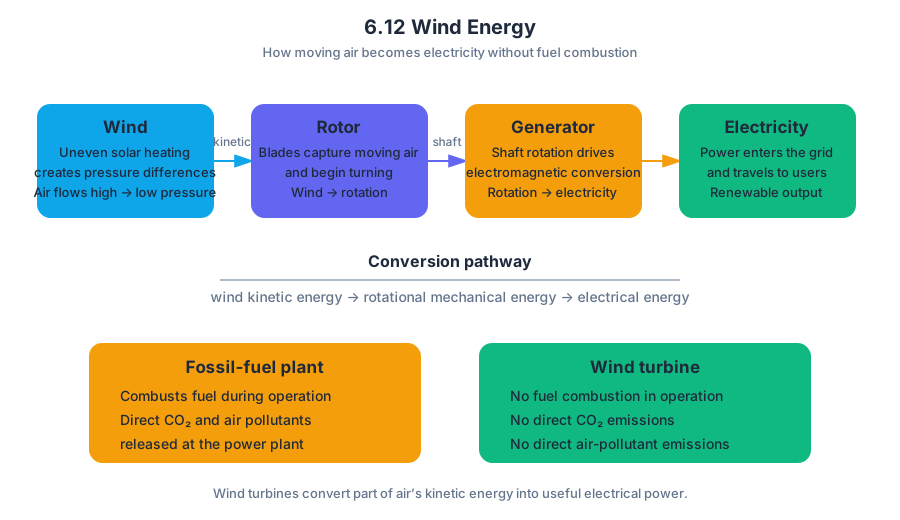
Wind energy uses moving air as a renewable energy source. Uneven solar heating creates differences in air temperature and pressure; air moves from areas of higher pressure toward areas of lower pressure. A wind turbine captures part of that moving air’s kinetic energy.
The conversion pathway is:
$$ \text{wind kinetic energy} \rightarrow \text{rotational mechanical energy} \rightarrow \text{electrical energy} $$
As wind pushes the turbine blades, the rotor turns a shaft connected to a generator. The generator converts mechanical rotation into electricity, which can then be transmitted to users. Unlike a fossil-fuel power plant, a wind turbine does not combust fuel during operation, so it produces no direct carbon dioxide or air-pollutant emissions.
Benefits and limitations
Wind power is renewable because atmospheric motion is continually regenerated by solar heating. It also uses little water during operation and can reduce dependence on nonrenewable fuel sources. A wind farm can therefore lower operational greenhouse-gas emissions when it displaces electricity generated by fossil fuels.
Wind is intermittent: turbines produce electricity only when wind speeds fall within their operating range. Electricity demand, however, continues even during calm conditions, so wind power may require energy storage, transmission connections, or complementary generating sources. Turbine construction also requires materials and land, and installations may create visual and noise impacts or harm birds and bats if poorly located.
The important comparison is not “renewable equals impact-free.” A wind farm generally has low impacts during electricity generation, while its larger concerns involve intermittency, infrastructure, habitat disturbance, and wildlife collisions. A hydrogen fuel cell similarly has clean direct emissions, but its total environmental benefit depends on the energy used to produce the hydrogen.
Worked application
A rural hospital needs reliable electricity. A wind farm could supply low-emission electricity when wind conditions are favorable. Excess renewable electricity could produce hydrogen from water; the hydrogen could then be stored and fed into a fuel cell when wind output is low. This pairing addresses wind’s intermittency, but it adds energy losses and costs during hydrogen production, compression, storage, and reconversion to electricity.
Retrieval check
A hydrogen fuel cell receives hydrogen produced using electricity from coal-fired power plants. Does the vehicle have zero carbon dioxide emissions overall? No. The fuel cell produces no carbon dioxide at the vehicle, but upstream coal combustion released carbon dioxide while producing the hydrogen. Explain one advantage and one limitation of wind energy: a strong response identifies renewable, low-direct-emission electricity as an advantage and intermittency or wildlife and land impacts as a limitation.
AP alignment
ENG-3.P — Describe the use of hydrogen fuel cells in power generation. Connect the hydrogen–oxygen reaction to electricity production and water as the product. ENG-3.Q — Describe the effects of the use of hydrogen fuel cells in power generation on the environment. Explain both the low direct carbon dioxide emissions and the energy and cost required to produce hydrogen. The suggested science practice is 1.C: Concept Explanation, especially when applying these processes to a power station or vehicle.
Source Materials
- AP Environmental Science Course and Exam Description
- Review the Clarifications (.pdf)
- AP Environmental Science Course Overview
- AP Environmental Science Course at a Glance
- AP Environmental Science Course at a Glance Poster
- AP Environmental Science
- AP Environmental Science
- AP Environmental Science Sample Syllabus 1