From the free course AP Environmental Science on Lykke
8.11 Sewage Treatment · 8.12 Lethal Dose 50% (LD50)
Key concepts: Sewage treatment · Disinfection of treated sewage · Chlorine, ozone, and ultraviolet (UV) light as disinfectants · Lethal Dose 50% (LD50) · Interpreting an LD50 curve · Calculating LD50 · Dose-response relationships · Using experimental data to estimate LD50
Sewage treatment uses physical, biological, and chemical steps to reduce pollutants and pathogens before wastewater returns to the environment. The final safety question is simple but consequential: How can treated sewage be disinfected, and how can the toxicity of a chemical be measured quantitatively?
8.11 Sewage Treatment · 8.12 Lethal Dose 50% (LD50)
Sewage treatment uses physical, biological, and chemical steps to reduce pollutants and pathogens before wastewater returns to the environment. The final safety question is simple but consequential: How can treated sewage be disinfected, and how can the toxicity of a chemical be measured quantitatively?
Sewage treatment and disinfection
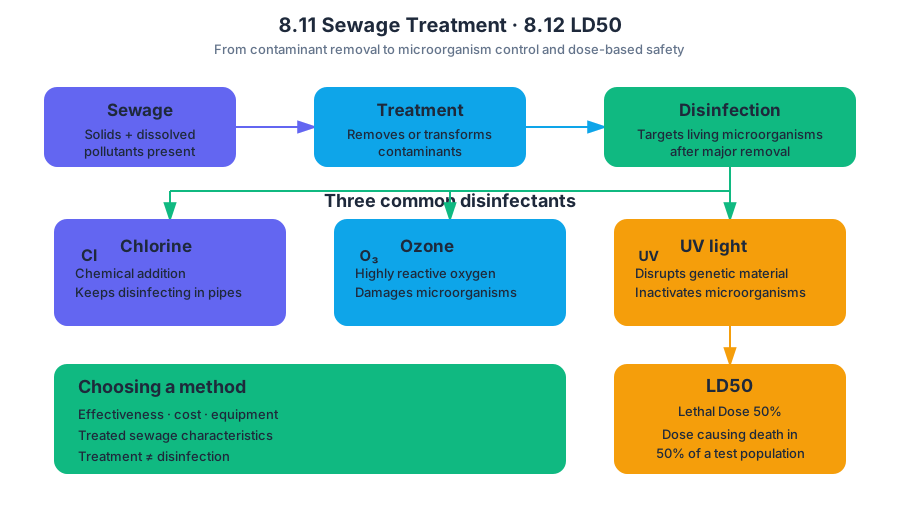
After solids and many dissolved pollutants have been removed, sewage treatment may use one or more disinfectants, substances that kill bacteria and other disease-causing microorganisms. Common disinfectants named for Topic 8.11 are chlorine, ozone, and ultraviolet (UV) light.
These disinfectants work through different mechanisms. Chlorine is added as a chemical and is widely used because it can continue disinfecting water while it moves through pipes. Ozone is a highly reactive form of oxygen that damages microorganisms, while UV light inactivates microorganisms by disrupting their genetic material. The treatment choice depends on effectiveness, cost, equipment, and the characteristics of the treated sewage.
A useful distinction is that treatment and disinfection are not identical. Treatment removes or transforms contaminants; disinfection specifically targets living microorganisms. A water sample can appear clear yet still contain bacteria, so visual clarity alone does not demonstrate that sewage is safe for release.
Suggested skill connection — Science Practice 3: Scientific Experiments, Skill 3.A: Describe characteristics of a scientific investigation. A sewage-treatment investigation could compare equal volumes of treated sewage exposed to chlorine, ozone, or UV light. The independent variable is the disinfectant treatment, the dependent variable is the number of surviving bacteria, and untreated or non-disinfected sewage provides a comparison condition.
Worked example: comparing disinfectants
Suppose three equal wastewater samples begin with similar bacterial concentrations. After treatment, the chlorine sample contains a much smaller bacterial population, the ozone sample contains a similarly small population, and the UV sample also shows substantial bacterial reduction. The valid conclusion is that each treatment reduced bacterial abundance under the tested conditions; the data do not automatically prove that one disinfectant is best in every sewage-treatment plant.
Misconception check — “Disinfection removes all pollution.” Disinfection is aimed at microorganisms, especially bacteria. It does not mean that every nutrient, dissolved chemical, heavy metal, or solid has been removed; those pollutants require other treatment processes.
What LD50 measures
Lethal Dose 50% (LD50) is the dose of a chemical that kills $50%$ of an exposed population. The population may consist of laboratory organisms, plants, animals, or humans. LD50 is therefore a population-level statistic, not a prediction that one individual will die at exactly that dose.
$LD_{50}$ is the chemical dose associated with $50%$ mortality in the tested population.
The dose must be reported in the quantity appropriate to the problem. If the data describe milligrams of chemical per kilogram of body mass, the result should be reported as $\mathrm{mg,kg^{-1}}$. If the question asks for the total amount administered, a result in milligrams may be required instead. A number without its unit—or with the wrong type of quantity—can misrepresent the result.
Interpreting an LD50 curve
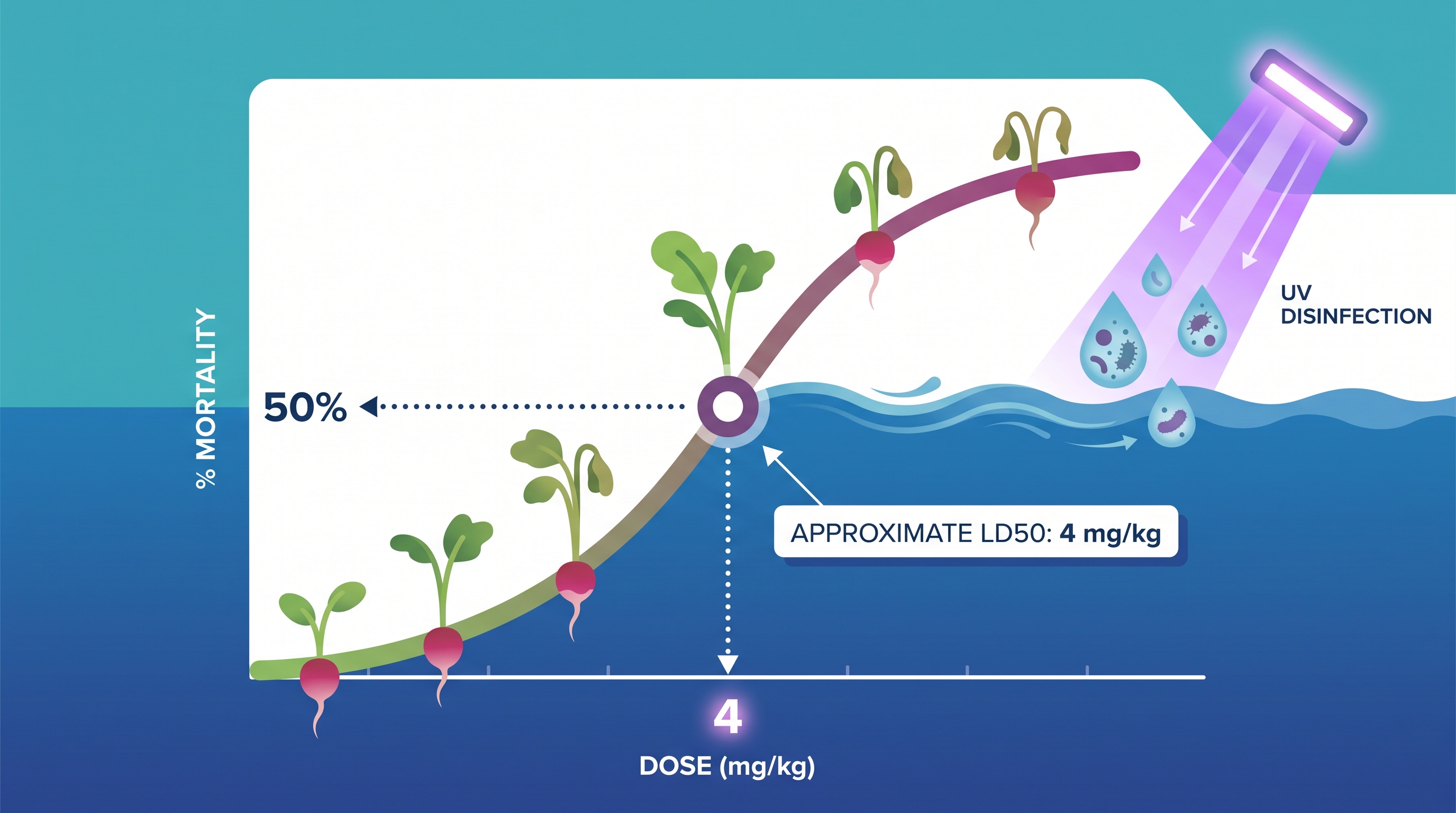
An LD50 curve is created by plotting chemical dose on the horizontal axis and the percentage of organisms that die on the vertical axis. As dose increases, mortality commonly increases. The LD50 is estimated at the dose corresponding to $50%$ mortality.
Imagine a classroom investigation using radish seeds. Students expose groups of seeds to several drug doses, then record the percentage that dies at each dose. The dose-response points are graphed, and a smooth or best-fit curve is used to estimate where the curve crosses $50%$ mortality.
For example, suppose the experimental results are:
| Dose | Mortality |
|---|---|
| $2\ \mathrm{mg,kg^{-1}}$ | $30%$ |
| $4\ \mathrm{mg,kg^{-1}}$ | $70%$ |
The $50%$ mortality point lies between the two measured doses. A simple linear interpolation gives
$$ LD_{50}=2+\left(\frac{50-30}{70-30}\right)(4-2) $$
Thus,
$$ LD_{50}=2+\left(\frac{20}{40}\right)(2)=3\ \mathrm{mg,kg^{-1}} $$
This is an estimate based on the experimental pattern, not a directly observed dose unless a tested group actually had exactly $50%$ mortality.
Misconception check — “A lower LD50 means a safer chemical.” The opposite is generally true: a lower LD50 means that a smaller dose produces $50%$ mortality in the tested population, indicating greater acute toxicity. However, LD50 alone does not describe every aspect of environmental risk, such as persistence, bioaccumulation, exposure frequency, or long-term effects.
Retrieval check
A sewage facility disinfects wastewater with UV light, while a radish-seed experiment finds $40%$ mortality at $3\ \mathrm{mg,kg^{-1}}$ and $60%$ mortality at $5\ \mathrm{mg,kg^{-1}}$. Name the purpose of UV disinfection, identify the approximate LD50, and state the unit that should be used if the problem reports dose per kilogram of organism.
The answers are: UV light is used to kill or inactivate bacteria; the estimated $LD_{50}$ is approximately $4\ \mathrm{mg,kg^{-1}}$; and the result should retain the dose-per-mass unit $\mathrm{mg,kg^{-1}}$. These applications exercise Science Practice 6: Mathematical Routines, Skill 6.B: Apply appropriate mathematical relationships to solve a problem, with work shown (e.g., dimensional analysis).
Source Materials
- AP Environmental Science Course and Exam Description
- Review the Clarifications (.pdf)
- AP Environmental Science Course Overview
- AP Environmental Science Course at a Glance
- AP Environmental Science Course at a Glance Poster
- AP Environmental Science
- AP Environmental Science
- AP Environmental Science Sample Syllabus 1