From the free course AP Environmental Science on Lykke
5.13 Methods to Reduce Urban Runoff · 5.14 Integrated Pest Management
Key concepts: Methods to reduce urban runoff · Permeable pavement · Planting trees · Increased use of public transportation · Integrated pest management (IPM) · Combining methods to control pest species · Minimizing disruption to human health and the environment · Advantages and drawbacks of IPM
Urban runoff increases when rain falls on hard, impervious surfaces and cannot soak into the ground. Two powerful environmental solutions address this problem from different directions: redesigning human infrastructure to manage water, and combining pest-control methods to reduce harm to people and ecosystems.
5.13 Methods to Reduce Urban Runoff · 5.14 Integrated Pest Management
Urban runoff increases when rain falls on hard, impervious surfaces and cannot soak into the ground. Two powerful environmental solutions address this problem from different directions: redesigning human infrastructure to manage water, and combining pest-control methods to reduce harm to people and ecosystems.
5.13 Methods to Reduce Urban Runoff
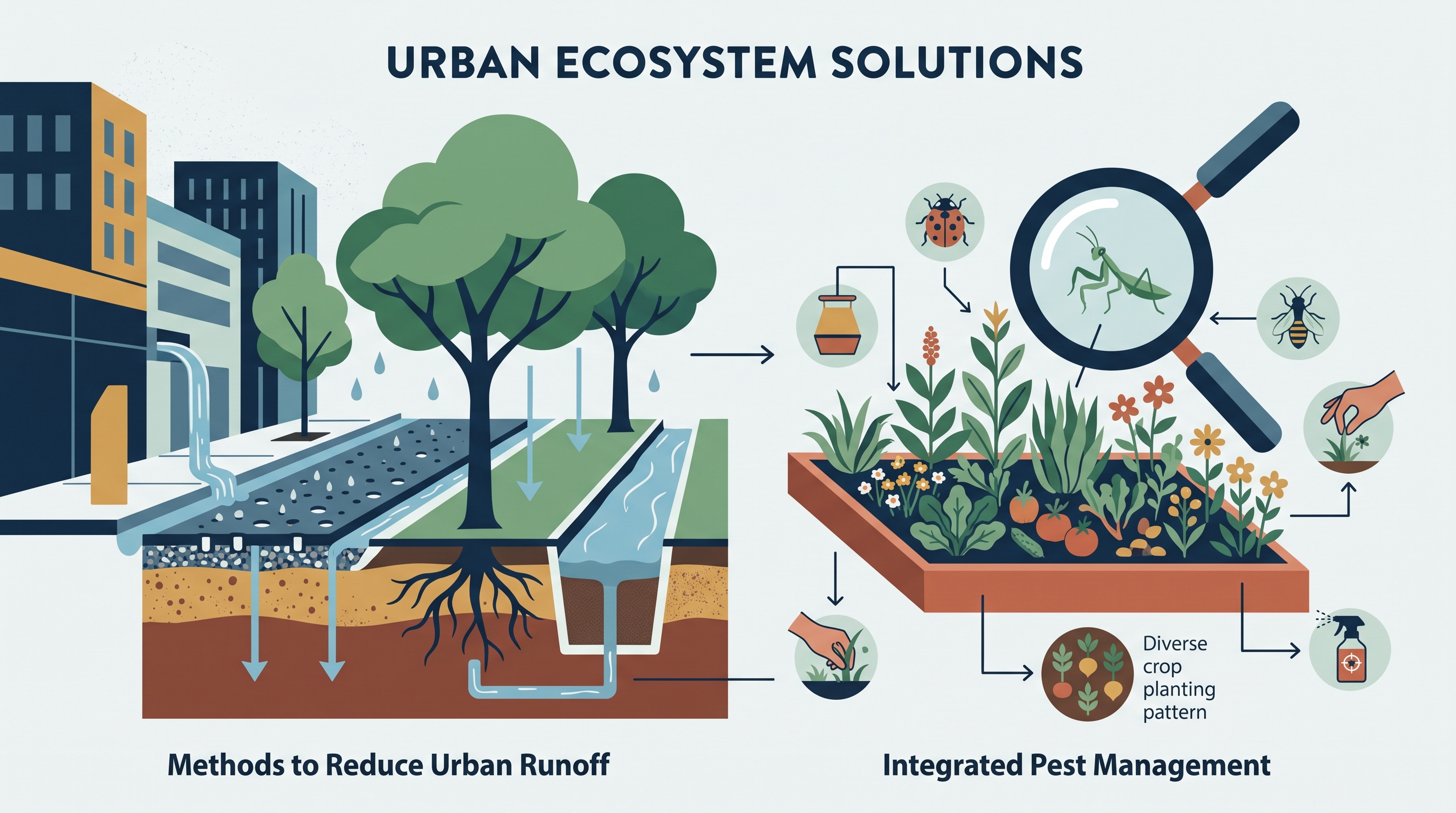
Urban runoff is water from rain or melting snow that flows across streets, roofs, parking lots, and other surfaces instead of infiltrating into soil. Traditional pavement accelerates this flow because water cannot pass through it easily. The result can include heavier stormwater flows, erosion, transport of pollutants, and greater pressure on drainage systems.
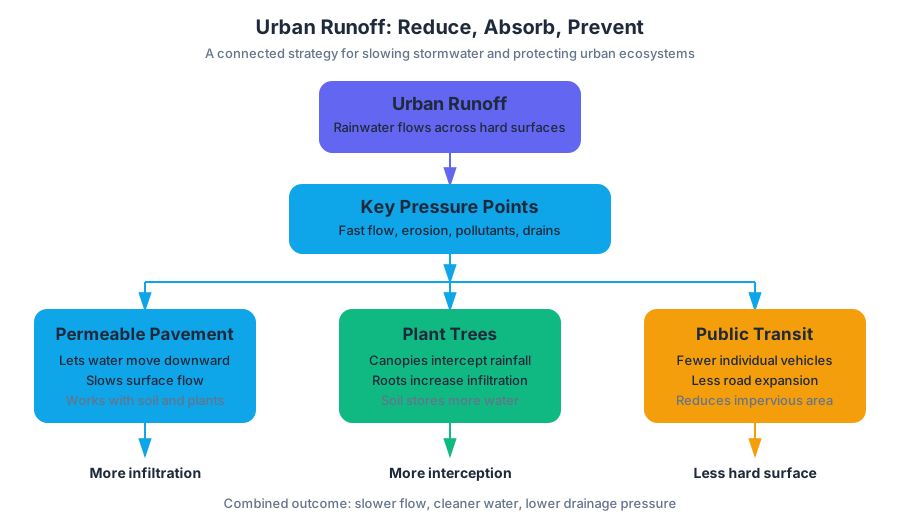
Replacing traditional pavement with permeable pavement can help mitigate urban runoff by allowing more water to pass through the surface and enter the ground.
Permeable pavement does not make rainfall disappear. Instead, it changes the pathway: rather than sending most precipitation immediately into a storm drain, the surface allows some water to move downward. This can reduce the volume and speed of surface flow, especially when permeable areas are combined with soil and vegetation that can absorb water.
Planting trees is another method for reducing urban runoff. Tree canopies intercept rainfall before it reaches the ground, while roots and surrounding soil help increase infiltration. Trees therefore affect both the amount of water reaching pavement and the movement of water through the soil.
A broader urban strategy is increasing the use of public transportation. Public transportation can reduce the number of individual vehicles and the amount of land devoted to roads and parking. Because roads and parking areas are impervious surfaces, reducing the need to expand them can reduce runoff and related environmental impacts. A related planning idea is building up, not out: compact development can limit the spread of pavement across previously undeveloped land.
Worked example: redesigning a neighborhood
Suppose a neighborhood floods after intense storms. Planners replace a conventional parking area with permeable pavement, plant trees along the streets, and improve bus service so fewer residents need separate cars. The strongest explanation is not that one action “solves flooding”; rather, each action changes a different part of the runoff system:
- Permeable pavement increases the opportunity for infiltration.
- Trees intercept rainfall and help water enter soil.
- Public transportation can reduce pressure to construct additional roads and parking areas.
- Compact development limits the conversion of open land into impervious surface.
Under AP Skill 7.D: Environmental Solutions, the evidence must support a potential solution. A strong response would identify a measurable outcome—such as reduced runoff volume or lower peak flow after storms—then compare data from before and after the intervention, or compare treated and untreated areas. The solution is supported when the observed evidence matches the proposed mechanism.
Misconception check: “Planting trees prevents all urban flooding.”
Correction: Trees can reduce runoff, but their effect depends on rainfall intensity, soil conditions, tree coverage, and the amount of impervious surface remaining.
5.14 Integrated Pest Management
Integrated pest management (IPM) is a combination of methods used to effectively control pest species while minimizing disruption to human health and the environment. Instead of depending on one control method—especially repeated conventional pesticide use—IPM combines approaches and selects them according to the pest problem and available evidence.
The central trade-off is practical: IPM can have advantages compared with conventional pest control because it is designed to reduce unwanted environmental and health effects, but it can also be complex and expensive. Effective implementation may require monitoring, identifying the pest accurately, evaluating multiple control options, and coordinating several methods rather than applying one immediate treatment.
Worked example: a crop pest outbreak
A vegetable farm discovers that a pest species is damaging leaves. A conventional response might apply a pesticide immediately. An IPM response first gathers evidence about the pest and the extent of damage, then combines suitable control methods—for example, physical removal, biological control, habitat changes, or carefully limited chemical treatment when needed.
The reasoning is important: IPM does not mean “never use pesticides.” It means that pest control is treated as a decision problem in which several methods are combined to control the pest effectively while minimizing disruption to human health and the environment.
Misconception check: “IPM is simply organic pest control.”
Correction: IPM is a strategy for combining methods and reducing harm; it is not defined by whether every method is organic or chemical-free.
The CED identifier STB-1.D.1 connects this topic to the use of integrated pest management. When evaluating an IPM proposal, explain both sides of the solution: identify the environmental or health advantage, and acknowledge that monitoring and coordination can make IPM more complex and expensive than a single conventional treatment.
Retrieval check
A city proposes permeable pavement, street trees, expanded bus service, and an IPM program for municipal gardens. Identify one mechanism by which each runoff strategy reduces environmental impact, then explain why IPM is described as a combination of methods rather than a single treatment. Finally, name one type of evidence that could be used under AP Skill 7.D: Environmental Solutions to evaluate whether the runoff plan worked.
Source Materials
- AP Environmental Science Course and Exam Description
- Review the Clarifications (.pdf)
- AP Environmental Science Course Overview
- AP Environmental Science Course at a Glance
- AP Environmental Science Course at a Glance Poster
- AP Environmental Science
- AP Environmental Science
- AP Environmental Science Sample Syllabus 1