From the free course AP Environmental Science on Lykke
5.5 Irrigation Methods · 5.6 Pest Control Methods
Key concepts: Irrigation-method evaluation · Pest-control methods · Physical pest control through trapping · Genetically modified pest-resistant crops · Advantages, disadvantages, and unintended consequences of solutions · Nutrient cycling through decomposition · Community resilience and biodiversity · Ecological succession after disturbance · Population and community changes after introduction of a new species · Nutrient and sediment runoff comparisons between crop plots
How can a farm increase crop production without simply transferring its problems into the soil, water, or surrounding ecosystem? Irrigation and pest control are environmental solutions because they address immediate agricultural limits—but every solution can create new effects elsewhere.
5.5 Irrigation Methods · 5.6 Pest Control Methods
How can a farm increase crop production without simply transferring its problems into the soil, water, or surrounding ecosystem? Irrigation and pest control are environmental solutions because they address immediate agricultural limits—but every solution can create new effects elsewhere.
Irrigation: delivering water, moving consequences
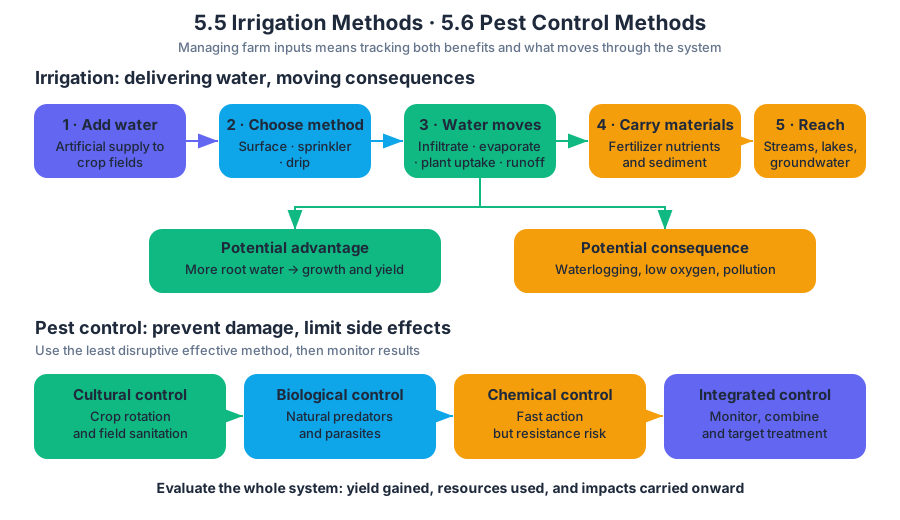
Irrigation is the artificial application of water to crops. It can stabilize yields during dry periods, support food production in regions with seasonal rainfall, and make otherwise dry land productive. However, irrigation changes the movement of water and dissolved substances through an agricultural system.
The most important evaluation question is not simply “Does irrigation add water?” but “Where does the water go next?” Water may infiltrate into soil, evaporate, be taken up by plants, or run off the plot. As it moves, it can carry dissolved fertilizer nutrients and eroded sediment into neighboring plots, streams, lakes, or groundwater.
A useful comparison is:
| Irrigation outcome | Potential advantage | Potential disadvantage or unintended consequence |
|---|---|---|
| More water reaches crop roots | Increased plant growth and yield | Excess water can cause waterlogging and reduce oxygen around roots |
| Water moves through soil | Can supply plants and transport nutrients | May carry nitrate into groundwater or surface water |
| Runoff leaves a field | Can remove excess water | Can transport sediment and nutrients into waterways |
| Repeated application in dry regions | Makes farming possible | Evaporation can concentrate salts, causing soil salinization |
Worked example — comparing two plots. Suppose Plot A receives more irrigation than Plot B, while fertilizer amount, crop type, and soil are held constant. If Plot A produces greater runoff, that runoff may carry more dissolved nutrients and sediment into a nearby plot. The strongest conclusion is not that irrigation is always harmful; it is that excess irrigation can increase nutrient movement and erosion when water leaves the soil faster than the soil and plants can retain it.
To analyze such an investigation, identify the independent variable—the factor deliberately changed, such as irrigation amount—and the dependent variable, such as runoff volume, nitrate concentration, sediment mass, or crop yield. A control plot receives the standard condition; a constant, such as fertilizer quantity, is not the control group.
Pest-control methods: removing pests without creating a larger problem
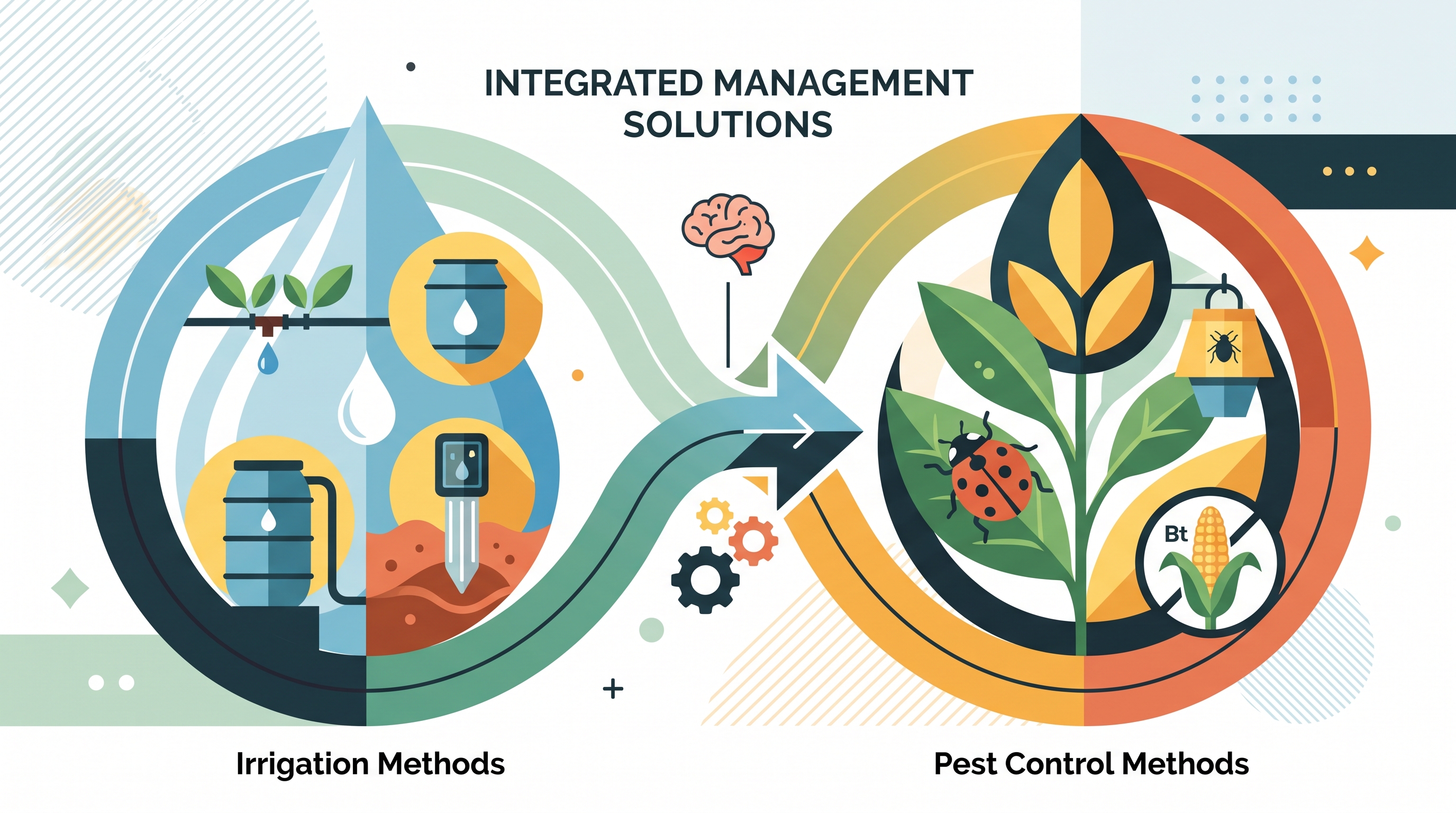
Pest-control methods include physical removal, biological controls, chemical pesticides, and genetically engineered crops. A sound environmental evaluation compares effectiveness with effects on non-target organisms, soil and water quality, human health, resistance evolution, and biodiversity.
Physical pest control through trapping removes insects without applying a chemical across the entire field. Traps may attract, capture, or physically block a target insect. This approach can reduce pesticide exposure and protect some beneficial organisms, but it may require frequent labor, work only for particular pests, and fail when insect populations are large or widely dispersed.
Some crops are genetically modified so that they are naturally resistant to particular pests. Such crops may reduce the need for broad-spectrum pesticide applications, lowering pesticide runoff and exposure. Possible disadvantages include evolution of resistant pest populations, effects on non-target organisms, reduced genetic diversity if one crop variety dominates, and ecological effects that depend on the specific engineered trait and local environment.
Worked comparison — unmodified and genetically modified plots. Imagine unmodified plants and pest-resistant genetically modified plants grown in separate plots. If the modified plot has fewer insects and requires less pesticide, it may show lower pesticide-related runoff. But soil temperature, nutrient runoff, and sediment runoff must still be measured rather than assumed. A difference in soil temperature could affect decomposition, microbial activity, and water loss; a difference in nutrient or sediment runoff could reflect changes in plant cover, root structure, irrigation, or fertilizer movement—not automatically the genetic modification itself.
Disturbance, decomposition, and ecological recovery
When crops are buried after harvest, decomposers break down the organic material. The nutrients formerly contained in plant tissues return to the soil, renewing soil materials and contributing to nutrient cycling. This process can improve soil fertility, although decomposition does not mean that nutrients can never leach away; heavy irrigation or rainfall may still move them beyond the root zone.
Communities also respond to disturbances such as burning, floods, or the introduction of a new species. A community with greater plant diversity may recover more quickly after flooding because different plants perform different roles: some hold soil with roots, some slow water, some tolerate saturation, and others recolonize exposed ground. More species can therefore provide ecological “backup,” increasing resilience.
Introducing a new beetle species can alter competition, predation, disease transmission, and crop damage. The new beetle may spread rapidly if it lacks local predators or finds abundant food; existing beetles may decline if the newcomer uses the same resources. Planting additional preferred host plants could divert beetles from valuable crops, but it might also increase the beetle population—an example of why proposed solutions require evidence and careful consequence analysis.
AP skills in action
This topic emphasizes 7.C Describe disadvantages, advantages, or unintended consequences for potential solutions: evaluate irrigation, traps, or pest-resistant crops across multiple environmental effects. It also uses 7.E Make a claim that proposes a solution to an environmental problem in an applied context: propose a realistic pest-control method and connect it to the specific mechanism reducing spread or damage.
Data-based investigations additionally draw on 5.E Explain what the data implies or illustrates and 4 Scientific Experiments. A complete claim states the direction of change, cites the measured evidence, and explains the ecological mechanism.
Misconception check: Genetically modified pest-resistant crops are not automatically environmentally harmless, and irrigation is not automatically destructive. The correct evaluation depends on the trait, method, dose, location, controls, and measured outcomes.
Retrieval check: A field receives extra irrigation and shows higher nitrate and sediment runoff. Name the changed variable, identify one likely transport mechanism, and propose one pest- or water-management solution whose advantage and unintended consequence you could test.
Source Materials
- AP Environmental Science Course and Exam Description
- Review the Clarifications (.pdf)
- AP Environmental Science Course Overview
- AP Environmental Science Course at a Glance
- AP Environmental Science Course at a Glance Poster
- AP Environmental Science
- AP Environmental Science
- AP Environmental Science Sample Syllabus 1