From the free course AP Environmental Science on Lykke
3.1 Generalist and Specialist Species · 3.2 K-Selected and r-Selected Species
Key concepts: Generalist species · Specialist species · Habitat stability and species advantage · Changing habitats and species advantage · Invasive species · Generalist or r-selected characteristics of invasive species · K-selected species · r-selected species · Biodiversity and ecosystem recovery · Habitat loss and species loss
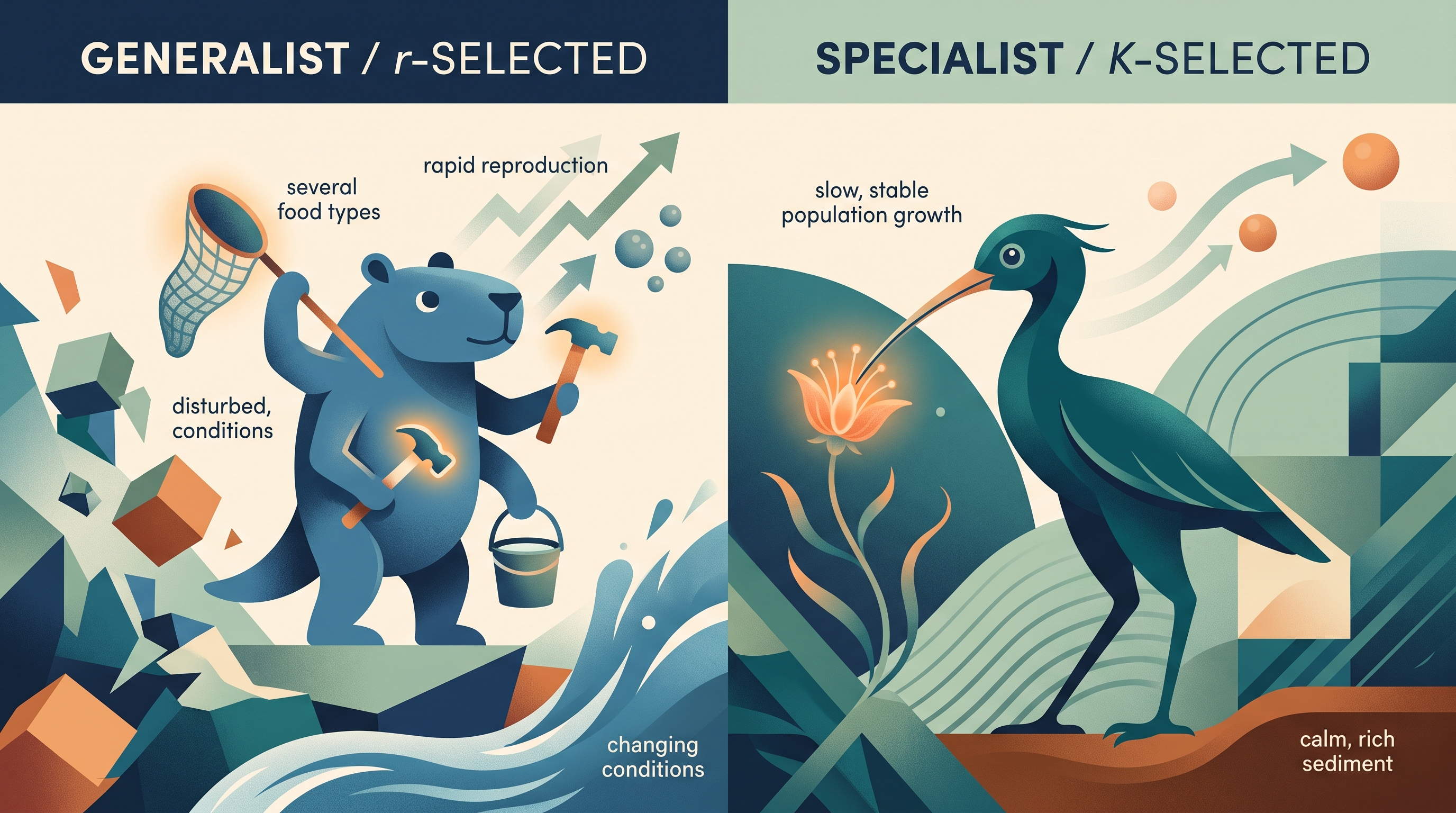
A habitat that changes slowly rewards precision; a habitat that changes often rewards flexibility. These two pressures help explain why some organisms are specialist species, adapted to a narrow range of conditions, while others are generalist species, able to use many resources and tolerate varied conditions.
3.1 Generalist and Specialist Species · 3.2 K-Selected and r-Selected Species
A habitat that changes slowly rewards precision; a habitat that changes often rewards flexibility. These two pressures help explain why some organisms are specialist species, adapted to a narrow range of conditions, while others are generalist species, able to use many resources and tolerate varied conditions.
Generalist and Specialist Species
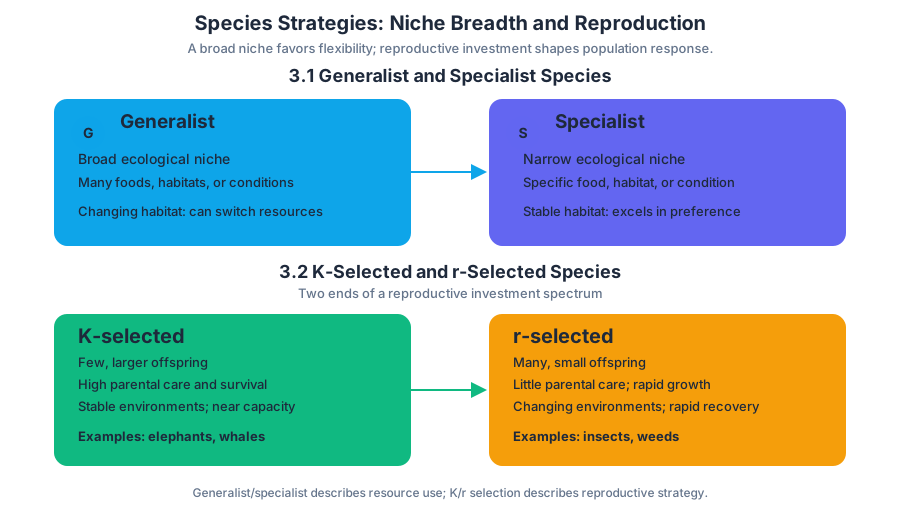
A specialist species has a narrow ecological niche—the specific range of resources, conditions, and relationships it needs to survive. A generalist species has a broader niche and can often eat different foods, occupy several habitats, or tolerate a wider range of environmental conditions.
| Species strategy | Resource use | Advantage in a stable habitat | Advantage in a changing habitat |
|---|---|---|---|
| Specialist | Narrow food source, habitat, or environmental requirement | Performs very well when its preferred conditions remain constant | Vulnerable if its resource or conditions disappear |
| Generalist | Many foods, habitats, or tolerable conditions | May face stronger competition from specialists using the same preferred resource | More likely to persist because it can switch resources or locations |
Worked example: Imagine a forest containing one tree species whose seeds are eaten by a bird with a highly specialized beak. If that tree species remains abundant for decades, the specialist bird may be extremely successful. If drought kills the trees, however, the bird cannot easily replace its food source. A generalist bird that eats seeds, insects, and fruit may be less efficient at using any one resource, but it has more ways to survive the drought.
This is the central relationship in Topic 3.1, aligned with ERT-3 and the learning objective to identify differences between generalist and specialist species. Specialist species tend to be advantaged in habitats that remain constant, while generalist species tend to be advantaged in habitats that are changing.
Habitat loss and changing advantage
Habitat destruction often removes specialists first because fragmentation or degradation eliminates the precise conditions they require. Generalists may persist longer by using disturbed areas, substitute foods, or smaller habitat patches, but continued habitat loss can eventually reduce generalist populations as well. Species requiring large territories are especially vulnerable because even apparently suitable fragments may be too small to support them.
The ecological consequence is not simply that “some animals disappear.” Losing specialists can remove particular pollination, predation, seed-dispersal, or feeding relationships; losing generalists later reduces the remaining flexibility of the community. Habitat change therefore alters both species composition and ecosystem function.
Misconception check: “Generalists are better-adapted than specialists.”
Correction: Neither strategy is universally superior. A specialist may outcompete a generalist when a preferred resource is abundant and stable. Generalists gain an advantage mainly when conditions vary or preferred resources become unreliable.
K-Selected and r-Selected Species
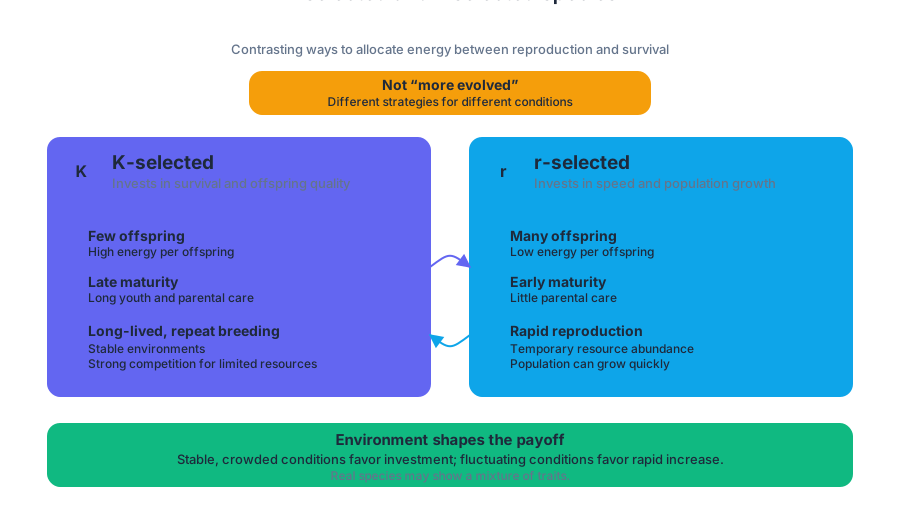
K-selected species and r-selected species represent contrasting reproductive strategies. The comparison is about how organisms allocate energy to reproduction and survival—not about whether one species is “more evolved” than another.
A K-selected species tends to be large, produce few offspring during each reproductive event, invest substantial energy in each offspring, mature after an extended period of youth and parental care, live relatively long lives, and reproduce more than once. Its population commonly experiences strong competition because resources in its relatively stable environment are limited.
An r-selected species generally emphasizes rapid reproduction and population increase. It tends to produce many offspring with relatively little investment in each individual, allowing the population to grow quickly when resources are temporarily abundant or when disturbed conditions create open opportunities.
| Reproductive strategy | Typical environmental context | Main population advantage | Common vulnerability |
|---|---|---|---|
| K-selected | Relatively stable conditions with intense competition | Efficient investment in a small number of offspring | Slow recovery when adult individuals or breeding habitat are lost |
| r-selected | Variable or disturbed conditions | Rapid increase in population size | Many offspring may fail to survive when resources become limited |
Worked contextual example: After a field is disturbed, fast-reproducing weeds may colonize exposed soil before slower-growing organisms arrive. Their high reproductive output allows a rapid increase in population size. A large mammal that produces one offspring after years of development cannot respond as quickly; even if adults survive, the population may recover slowly because replacement occurs over a longer time.
Invasive species
An invasive species is a nonnative species that spreads in a new environment and causes ecological, economic, or human-health harm. Invasive species may display generalist or r-selected characteristics: they often tolerate many conditions, use multiple resources, reproduce rapidly, and colonize disturbed habitats.
These traits do not mean that every invasive species is both generalist and r-selected, nor that every generalist or r-selected species is invasive. The important reasoning chain is: broad tolerance or rapid reproduction can help a nonnative population establish; escape from its original predators, parasites, or competitors can then allow it to expand and displace native species.
Misconception check: “Nonnative means invasive.”
Correction: Nonnative describes origin; invasive describes harmful spread. A species can be nonnative without becoming invasive.
AP skill and retrieval check
This topic is assessed through Science Practice 1: Concept Explanation, specifically 1.A — Explain environmental concepts and processes. A strong response names the strategy, connects it to habitat conditions, and explains the population consequence rather than merely labeling an organism.
Retrieval check: A wetland dries periodically, contains several food types, and is frequently disturbed. Which organisms should generally gain an advantage: specialists or generalists; K-selected or r-selected species? Explain using two linked reasons.
Answer: Generalists should generally be favored because they can use multiple resources and tolerate changing conditions. r-selected species may also gain an advantage because rapid reproduction can exploit temporary opportunities created by disturbance.
Source Materials
- AP Environmental Science Course and Exam Description
- Review the Clarifications (.pdf)
- AP Environmental Science Course Overview
- AP Environmental Science Course at a Glance
- AP Environmental Science Course at a Glance Poster
- AP Environmental Science
- AP Environmental Science
- AP Environmental Science Sample Syllabus 1
- AP/College Environmental Science-Khan Academy
- AP Environmental Science Exam-College Board
- AP Environmental Science Units-Save my Exams
- AP Environmental Science-Bozeman Science